In July 2026, the US House folded the UAP Disclosure Act into the National Defense Authorization Act, complete with an eminent domain provision for recovered materials. Congressional hearings on unidentified anomalous phenomena have become routine. The question of whether we are alone has moved from the fringe into the legislative calendar.
Which makes a much older question newly urgent for a lot of people, and it is the one this article is about: are there aliens in the Bible, and if something else is out there, what does that do to Scripture?
The answer most often given — that Scripture is full of extraterrestrial visitors, misfiled as angels — gets the texts badly wrong. But so does the opposite answer, that the Bible knows nothing of other intelligences.
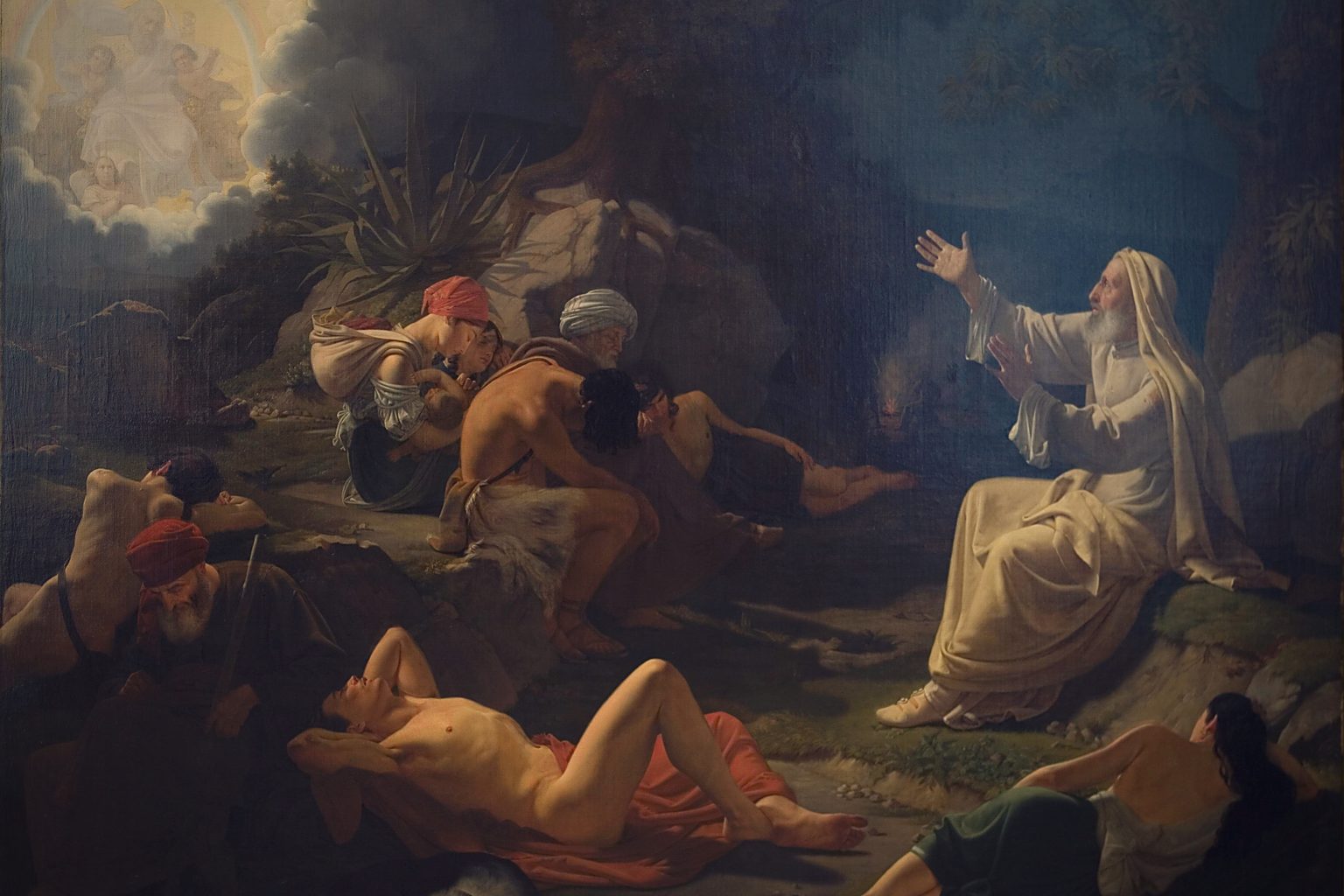
The Bible is saturated with non-human intelligent beings. That is not in dispute by anyone who has read it. The real question is narrower and more interesting: is “extraterrestrial” the right category for them?
Does the Bible Mention Aliens?
Not in the modern sense. Scripture contains no reference to beings from other planets, no other inhabited world, and no visitors from elsewhere in the physical universe.
What it contains instead is an extensive population of non-human intelligences — angels, cherubim, seraphim, ophanim, “sons of God,” principalities and powers — described as created beings operating in a domain adjacent to ours, with assignments, ranks and restricted access.
The ancient-astronaut reading takes those beings and reclassifies them as aliens. The reclassification is the whole argument, and it is worth examining rather than assuming.
The Passages That Get Cited
Here is the standard list, assessed individually.
Ezekiel’s Wheel (Ezekiel 1)
The strongest case by a wide margin, and genuinely strange. A deported priest by a canal in Babylon describes something coming out of the north: four living creatures, and beside them wheels “like a wheel in the middle of a wheel,” rims full of eyes, moving in four directions without turning.
That last property is mechanically specific. It describes omnidirectional motion — a real engineering problem whose modern solutions were patented in the 1970s.
It is also where the technological reading is weakest on its own terms, because Ezekiel identifies the creatures himself in chapter 10: “I knew that they were the cherubim.” And the whole assembly sits beneath a throne. The full analysis is here — what stands out is not the machinery but the grammar, a trained priest saying the appearance of the likeness of because he has no vocabulary for what he saw.
The Nephilim and the Sons of God (Genesis 6)
“The sons of God saw the daughters of men that they were fair; and they took them wives.”
Read as alien interbreeding, this is the foundation of most modern ancient-astronaut theology. The Hebrew phrase bene ha-Elohim means angelic beings everywhere else it appears — Job 1:6, Job 38:7 — and Job 38:7 places them at the founding of the earth, before humanity existed.
That is the problem for the alien reading. These beings are described as pre-existing the planet, not as arriving from another one. The detail is here.
Elijah’s Chariot (2 Kings 2:11)
A chariot of fire and horses of fire, and Elijah goes up by a whirlwind into heaven. Witnessed by Elisha.
It is a departure, not an arrival, and the text presents it as a divine act rather than a retrieval. Enoch’s disappearance has the same structure with even less description — “God took him.”
The Pillar of Cloud and Fire (Exodus 13:21)
A column that goes before the camp by day as cloud and by night as fire, guiding the route. Read technologically, a beacon. Read in context, the visible presence of God, the same phenomenon that fills the tabernacle in Exodus 40:35 so densely that the priests cannot enter.
The New Jerusalem (Revelation 21)
A city descending from heaven with published dimensions — roughly 2,200 km (1,367 miles) on each edge, with the height equal to the base. It is the passage that most invites the “mothership” reading, and the measurements are genuinely startling. Examined in full here.
Zechariah’s Flying Scroll (Zechariah 5:1-2)
A flying object with stated dimensions — twenty cubits by ten. Rarely cited, and the most literal “unidentified flying object” in Scripture. The text immediately interprets it as the curse going out over the land, which is unusually explicit for an apocalyptic vision.
“Other Sheep I Have” (John 10:16)
“And other sheep I have, which are not of this fold.” Frequently quoted as evidence of other worlds.
The context rules it out. John 10 is addressed to a Jewish audience, and the next clause — “them also I must bring, and they shall hear my voice; and there shall be one fold” — is about the inclusion of Gentiles, which is one of the central themes of the New Testament. This is the weakest item on the list, and its popularity is a good measure of how these arguments are assembled.
Why the Texts Resist the Alien Reading
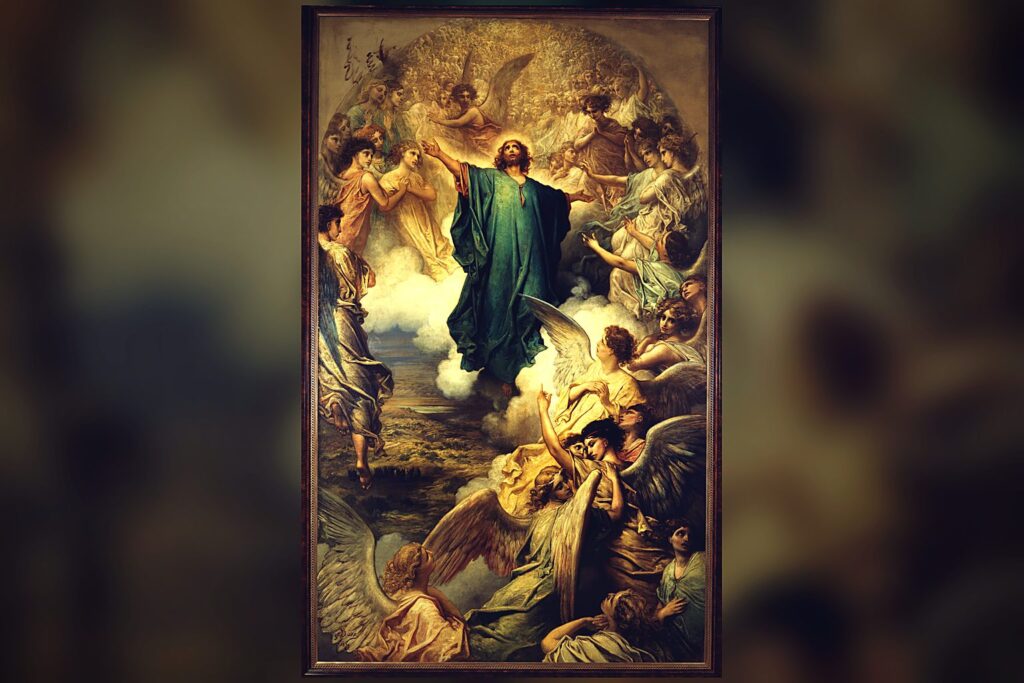
Set aside individual passages and look at what the beings in Scripture actually do. Four features recur, and none fits an extraterrestrial species.
They worship. Every angelic being in Scripture is depicted in an attitude of service or worship. The seraphim of Isaiah 6 cover their faces. When John attempts to worship an angel in Revelation 19:10, it refuses: “See thou do it not: I am thy fellowservant.” A visiting civilisation has no obvious reason to behave this way.
They are created, not evolved. Colossians 1:16 states that all things were created “whether they be thrones, or dominions, or principalities, or powers.” The text explicitly includes the non-human intelligences in the category of created beings with a stated origin.
They existed before the earth. Job 38:7 has them present and celebrating when the foundations were laid. That places them outside the sequence a biological species from another planet would occupy.
They occupy a different kind of place. Angels in Scripture are localised — they travel, arrive, and can be delayed in transit. In Daniel 10:13 a messenger explains he was held up twenty-one days. But the domain they move through is described as a jurisdiction with access rights rather than as space. Jude 1:6 speaks of angels who “left their own habitation” — an assigned station, not a homeworld.
The pattern is consistent enough to be decisive: the Bible describes other intelligences, but it consistently locates them in a different order of creation rather than a different address in this one.
Where the Ancient Astronaut Reading Comes From
It is worth being clear that this interpretation is modern, not ancient.
Erich von Däniken’s Chariots of the Gods? appeared in 1968. Zecharia Sitchin’s The 12th Planet followed in 1976 — and the linguistic case against Sitchin is comprehensive, since the Sumerian texts he relied on do not say what he reported.
Before the twentieth century, nobody read Ezekiel as a spacecraft, because the category did not exist. The reading is not a recovery of lost knowledge. It is the present projecting its own vocabulary backwards — the same way Descartes read the pineal gland through the hydraulics of his era, and Victorians read the brain through the telegraph.
That does not make it worthless. Reading old texts through new frameworks sometimes reveals real things, and Ezekiel’s wheels are a genuine case where a modern engineering concept illuminates a description that had no coherent reading before. But the framework has to be held loosely, because it is the thing most likely to be wrong in fifty years.
What Theologians Actually Say About Life Elsewhere
Here is where the popular framing is most misleading. The assumption is that religious institutions are threatened by the possibility of extraterrestrial life and resist it.
They mostly do not, and the Catholic Church has been unusually direct.
The Vatican Observatory is a functioning astronomical research institution with facilities in Italy and Arizona. Its former director, the Jesuit astronomer José Gabriel Funes, put the position plainly: “Just as there is a multiplicity of creatures on earth, there can be other beings, even intelligent, created by God. And this is not in contrast with faith, because we cannot place limits on the creative freedom of God.” Funes has since led a project bringing together scientists, theologians and philosophers to examine the implications.
The current director, Brother Guy Consolmagno, co-wrote a book titled Would You Baptize an Extraterrestrial? Asked directly whether he would, his answer was: “Only if she asked.” The point is a serious one — baptism is a sacrament that must be freely requested, not administered to a specimen.
The underlying theological argument is straightforward. Genesis describes the creation of this world and the beings in it. It does not claim to be an inventory of everything God has made, and never says the earth is the only inhabited place. Scripture repeatedly indicates that creation exceeds human knowledge of it.
C.S. Lewis worked through the question in essays and in his Space Trilogy, and identified the genuinely difficult part: not whether other beings could exist, but whether they would be fallen, and if not, whether the Incarnation applies to them. Lewis’s view was that unfallen beings would need no redemption — which, he noted, would make humanity the anomaly rather than the centre.
That is the theologically interesting question, and it is nothing like the one usually asked.
The Question Underneath
Strip away both the ancient-astronaut reading and the assumption that faith requires an empty universe, and what remains is a single real point of contact.
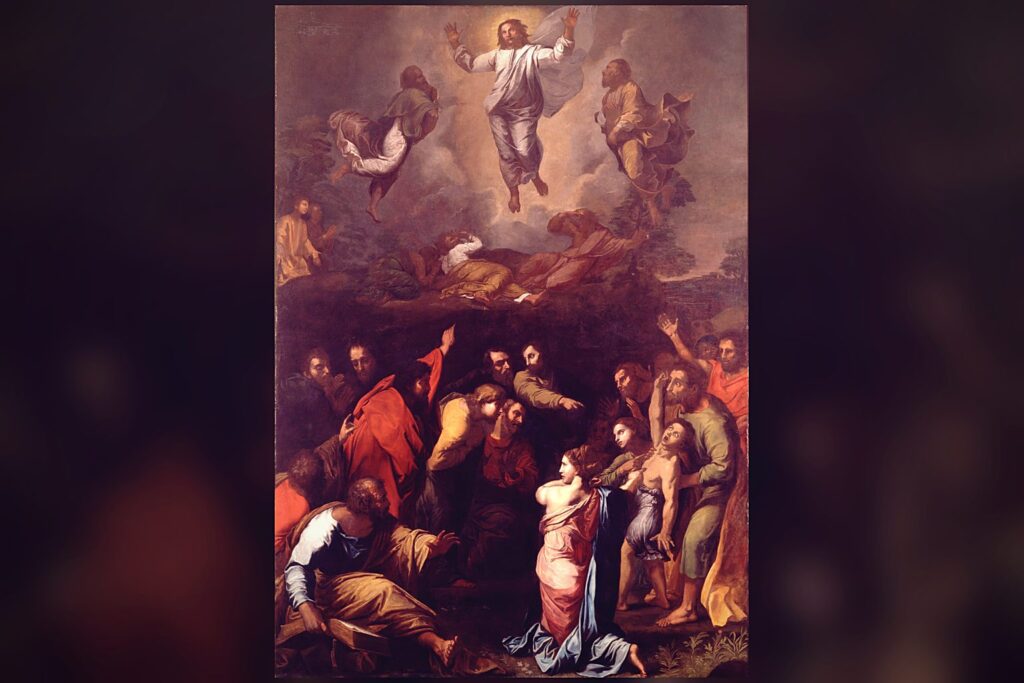
The Bible’s claim is not that humanity is alone. It is that humanity is made in the image of God (Genesis 1:27) and that this world was the site of a specific intervention. Neither claim requires the universe to be empty; both are claims about significance rather than about demographics.
And Scripture already contains the harder version of the problem. It describes beings vastly more powerful than us, older than the planet, with capabilities we cannot match — and then spends most of its length insisting that the decisive events happen among the weaker party. A third of those beings rebelled and the response was not to elevate the survivors but to work through a family, a nation, and eventually one person.
If that framework can absorb cherubim and seraphim, the discovery of microbial life on Europa is not the difficulty it is usually presented as.
Frequently Asked Questions
Does the Bible mention aliens?
Not in the modern sense. Scripture contains no reference to other inhabited planets or to visitors from elsewhere in the physical universe. It describes extensive non-human intelligences — angels, cherubim, seraphim, ophanim — as created beings in a different order of creation.
Is Ezekiel’s wheel a UFO?
That interpretation was popularised by Erich von Däniken in 1968 and developed by NASA engineer Josef Blumrich in 1974. It is not accepted by biblical scholars. Ezekiel himself identifies the creatures as cherubim in Ezekiel 10:20, and the whole assembly sits beneath a throne.
Were the Nephilim aliens?
The phrase “sons of God,” bene ha-Elohim, means angelic beings everywhere else it appears in the Hebrew Bible. Job 38:7 places these beings at the founding of the earth, before humanity, which is difficult to reconcile with arrival from another planet.
Does “other sheep I have” mean other worlds?
No. John 10:16 is addressed to a Jewish audience, and the following clause about bringing them into one fold refers to the inclusion of Gentiles, a central New Testament theme.
What does the Catholic Church say about extraterrestrial life?
It does not regard it as a conflict with faith. Vatican Observatory director José Gabriel Funes said other intelligent beings created by God would not contradict belief, since limits cannot be placed on God’s creative freedom. Current director Guy Consolmagno co-wrote Would You Baptize an Extraterrestrial?
Would aliens need salvation?
C.S. Lewis addressed this directly and concluded that unfallen beings would require no redemption, since redemption answers a fall. On that reading, humanity’s situation would be the exception rather than the norm.
Does the Bible say Earth is the only inhabited world?
No. Scripture describes the creation of this world and never claims to catalogue everything God has made or to state that the earth is uniquely inhabited.
When did people start reading the Bible as describing aliens?
In the twentieth century. Erich von Däniken’s Chariots of the Gods? appeared in 1968 and Zecharia Sitchin’s The 12th Planet in 1976. No pre-modern reader interpreted these passages as spacecraft, because the category did not exist.
Two Readings, One Assumption
The ancient-astronaut reading and the “faith needs an empty universe” reading make the same mistake from opposite directions. Both assume that non-human intelligence is a problem the Bible has to solve.
It is not. It is the Bible’s starting assumption. The text opens with a God who has a court, populates its middle with beings who deliver messages and guard boundaries and occasionally rebel, and ends with a city descending out of the sky.
What it never does is treat those beings as another biological species from another planet, and reading them that way flattens something stranger into something more familiar. The cherubim are not astronauts. They are described as an entirely different order of created thing — which is a far harder idea than aliens, and considerably older.
If something is eventually confirmed to be flying over the Pacific, the theological adjustment required is smaller than most people assume. The difficult claim in Genesis was never that we are alone.
It was that we matter.
Continue Reading
- Biblical Prophecies That Came True — and the Test That Sorts Them — Four questions decide whether a prophecy can be checked at all. Tyre, Cyrus, the temple and one that failed outright…
- Ezekiel’s Wheel: The Vision a Priest Had No Words For — A wheel in the middle of a wheel, rims full of eyes, moving in four directions without turning. What Ezekiel 1 actually…
- The Book of Enoch Giants: The Lost Book That Names Them — They were enormous and they ate people — that is the part everyone knows. The part nobody knows is that a second book…