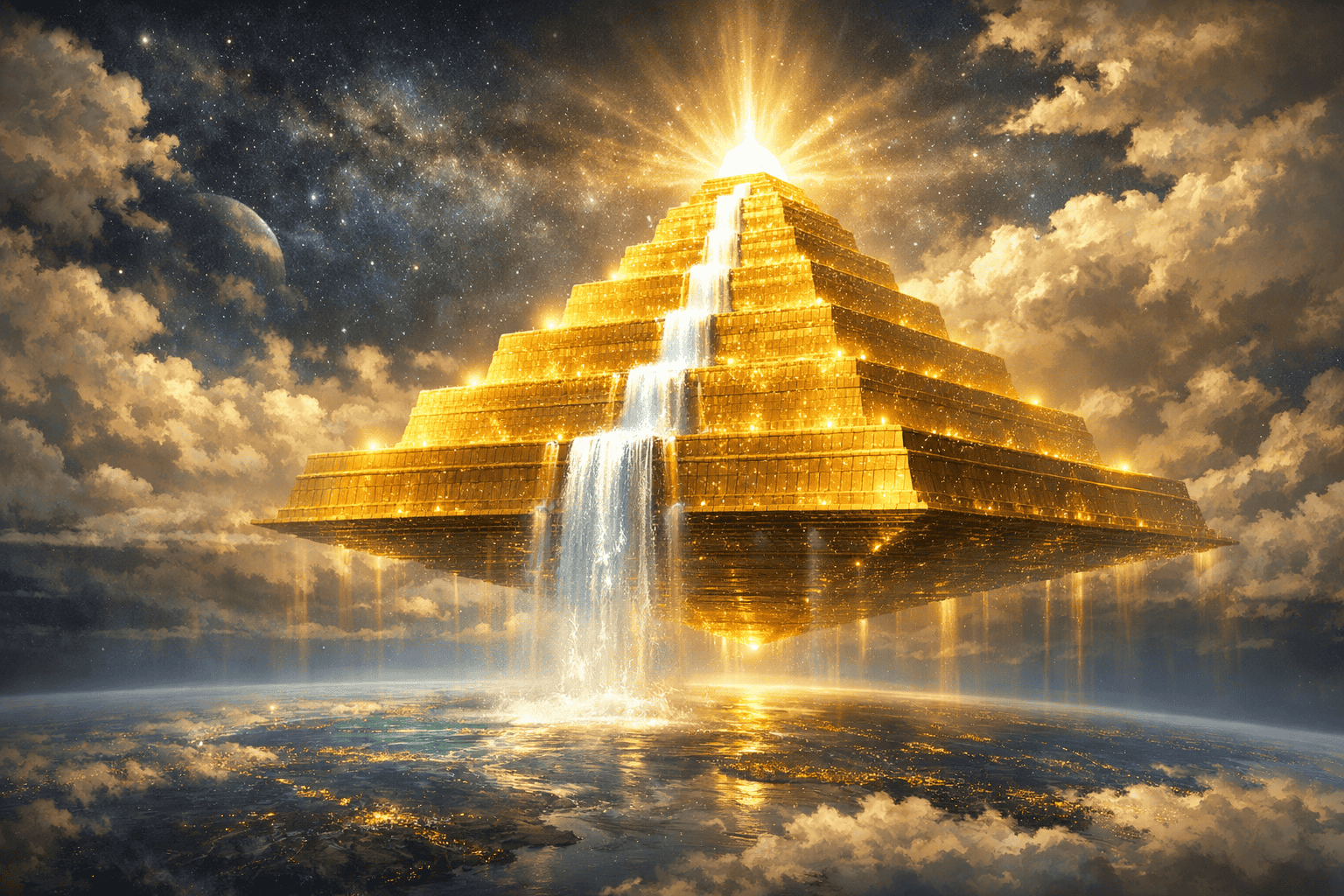
The Descent of the Holy City
For thousands of years, the Book of Revelation has stood as the ultimate conclusion to the biblical narrative. In its final chapters, the Apostle John describes an event that challenges everything we have been taught about eternity.
“And I John saw the holy city, new Jerusalem, coming down from God out of heaven, prepared as a bride adorned for her husband.” (Revelation 21:2)
Most of the commentary tradition reads this city as a spiritual metaphor — a vision of heaven in the vocabulary of a walled city, because that was the vocabulary an ancient reader had for safety and permanence. It is a serious reading, and the apocalyptic genre is full of numbers that are meant symbolically.
The other reading takes the measurements at face value. On that view John is not writing an abstract poem but reporting what he was shown, in the only terms available to him, and what he reports has dimensions, materials and internal systems. This article follows that second reading as far as the text allows, which is the interesting thing to do with it — not because the first reading has been ruled out.
Read that way, the text describes something closer to a habitat than a heaven: exact measurements, a materials list, a water source and a light source. To a modern reader it lands somewhere near a “divine mothership” — which is a modern phrase for an idea the text states in its own, and the resemblance is worth examining rather than either dismissing or overselling.
The Blueprint of Eternity
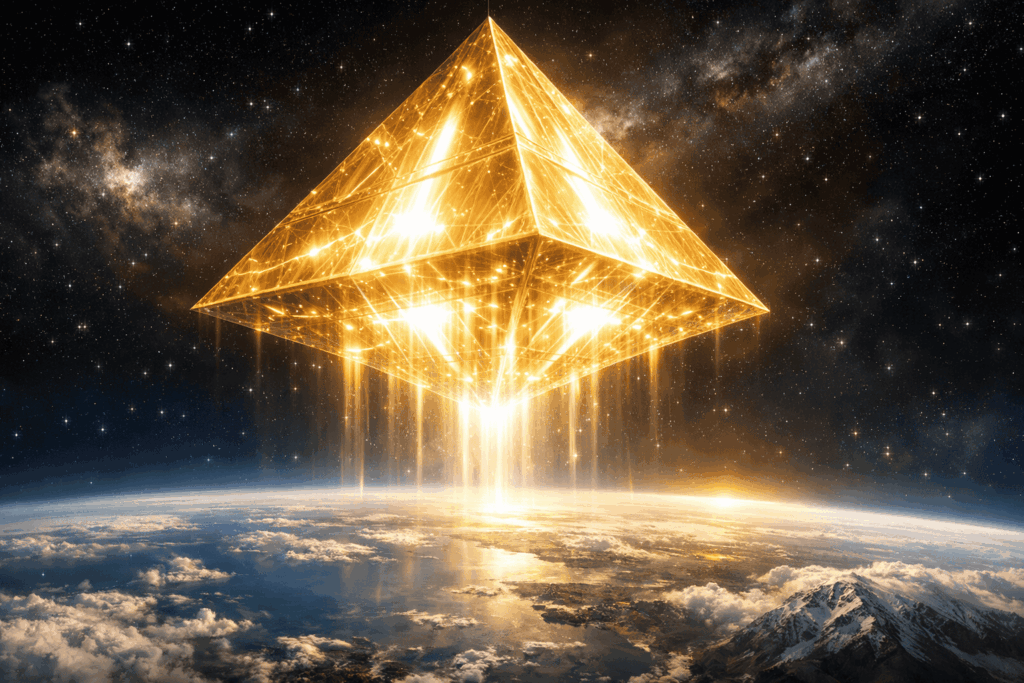
If the New Jerusalem were merely a poem, the angel would not have needed a measuring rod. But the Bible provides exact, terrifyingly massive dimensions. Revelation 21:16 states:
“And the city lieth foursquare, and the length is as large as the breadth: and he measured the city with the reed, twelve thousand furlongs. The length and the breadth and the height of it are equal.”
Twelve thousand furlongs (stadia) is roughly 2,200 to 2,400 kilometres (1,400 to 1,500 miles) on each side. If the base of this city rested over Europe, it would stretch from London to Athens. But the most staggering dimension is its height. It rises 1,500 miles straight up into the heavens.
An object of this mass cannot simply rest on the Earth’s crust without crushing the tectonic plates. This reveals that the Creator’s architecture possesses absolute mastery over the laws of physics. Such a colossal structure would require advanced gravitational control, allowing this heavenly habitat to hover majestically in the atmosphere, dominating the sky with the glory of God.
The Prepared Mansions: Inside the Heavenly Habitat
If this megastructure is 1,500 miles high, what is inside it? The Bible tells us that it is not empty space; it is a highly engineered, fully prepared habitat for the redeemed.
Before Jesus ascended, He gave His disciples a highly specific architectural promise in John 14:2-3:
“In my Father’s house are many mansions: if it were not so, I would have told you. I go to prepare a place for you. And if I go and prepare a place for you, I will come again, and receive you unto myself; that where I am, there ye may be also.”
The word translated as “mansions” (in Greek: monai) literally means dwelling places, rooms, or abodes. Jesus did not say we would be floating on clouds; He said He was going to prepare a place—a physical, constructed habitat.
In a vessel that is 1,500 miles wide and 1,500 miles high, there is more than enough volume to house billions of people in unimaginable luxury and perfect design. The New Jerusalem is the ultimate fulfillment of this promise. It is the “Father’s house” equipped with individual dwelling places for every citizen of the Kingdom.
The Geometry of God: A Cubic Station or a Golden Pyramid?
Because the length, width, and height are exactly equal, theologians have long debated its shape. There are two primary architectural theories for this divine vessel:
The Holy Cube Many assume it is a giant Cube, mirroring the Holy of Holies in the earthly Temple. As a colossal cubic vessel, it would maximize internal volume for its inhabitants, acting as the ultimate, self-contained celestial habitat designed to transport and house the redeemed.
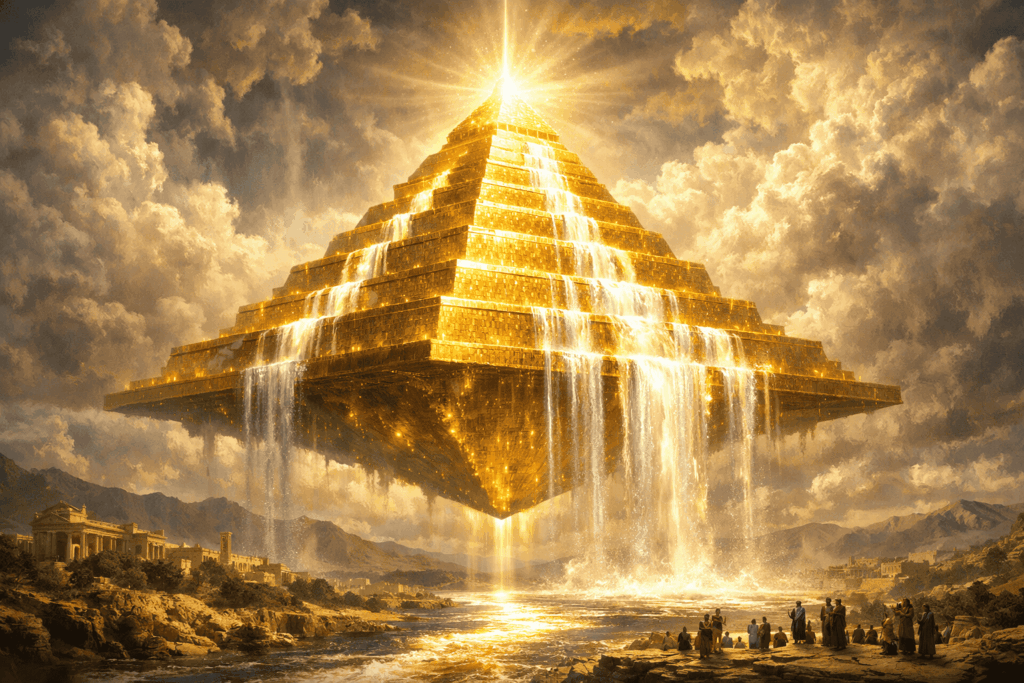
The Stepped Pyramid (The Mountain of God) A pyramid with a square base also shares equal length, width, and height if measured to its apex. Many biblical scholars argue this is the true shape of the descending city. God has always met with His people on sacred mountains (Mount Sinai, Mount Zion). In Revelation 21:10, the angel specifically takes John to a “great and high mountain” to see the city. Furthermore, a pyramid allows the Throne of God to sit at the very top—the ultimate, glowing Capstone—where the River of Life can cascade down the golden terraces.
The 12 Foundations: A Cosmic Energy Grid
One of the most breathtaking details of the New Jerusalem is its foundation. It does not sit on dirt or common rock. The base of the mothership is an intricate, multi-layered grid of precious gemstones.
Revelation 21:19-20 provides the exact geological and structural report:
“And the foundations of the wall of the city were garnished with all manner of precious stones. The first foundation was jasper; the second, sapphire; the third, a chalcedony; the fourth, an emerald; The fifth, sardonyx; the sixth, sardius; the seventh, chrysolite; the eighth, beryl; the ninth, a topaz; the tenth, a chrysoprasus; the eleventh, a jacinth; the twelfth, an amethyst.”
Inscribed on these twelve foundations are the names of the twelve apostles (Revelation 21:14). But there is a profound physical reality here. In modern optics, these specific stones are recognized as anisotropic crystals. When pure light passes through them, it does not distort; it refracts into a brilliant, perfectly organized spectrum. Because the city has no need of the sun—fueled entirely by the glory of God (Revelation 21:23)—these twelve massive foundations act as a colossal optical prism. They take the blinding, pure light of the Creator and project it outward in an eternal display of breathtaking colors.
Divine Shielding and Cosmic Portals
Encasing the lowest level of the city is a massive outer wall, 144 cubits — about 65 metres (213 feet) — high, made entirely of Jasper (Revelation 21:17). For a vessel traversing the heavens, this crystalline barrier serves as the ultimate perimeter of holiness and structural shielding against any cosmic elements.
Set into this massive wall are twelve gates. The Bible is highly specific about their construction:
“And the twelve gates were twelve pearls; every several gate was of one pearl…” (Revelation 21:21)
These are colossal, monolithic entryways forged from single, iridescent pearls, each guarded by an angel. These gates are never shut (Revelation 21:25). They stand eternally open, serving as grand access ports or divine airlocks where the righteous nations of the Earth bring their honor and glory directly into the Heavenly City.
Advanced Biosphere: The River and the Tree of Life
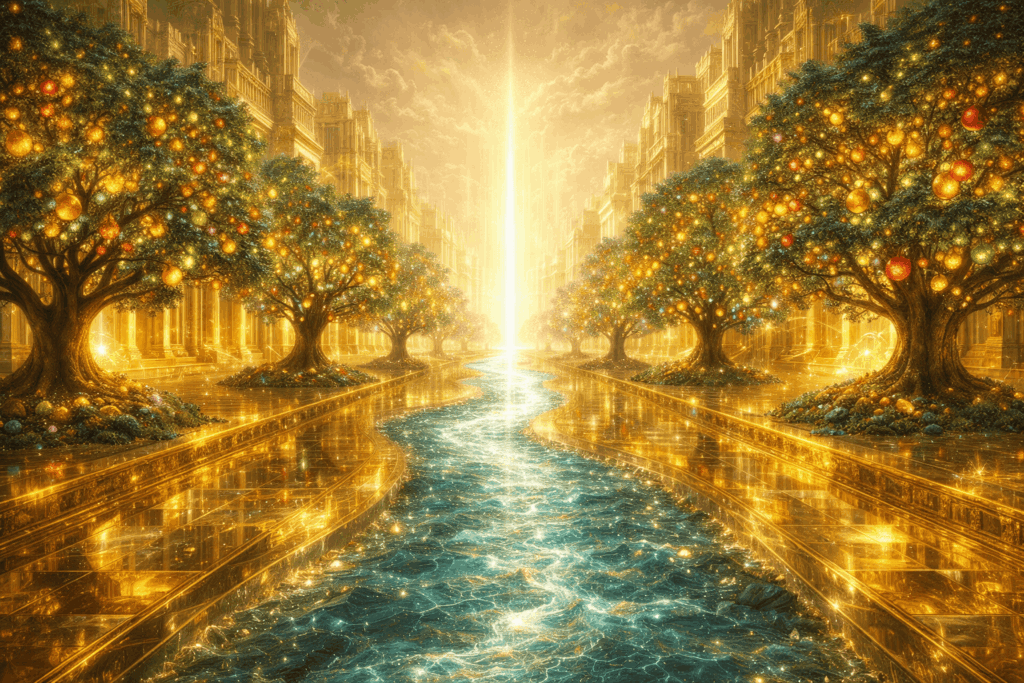
Inside the city, we find an environment perfectly engineered to sustain eternal physical life. Revelation 22:1-2 describes a “pure river of water of life” and the “Tree of Life, which bare twelve manner of fruits.”
In the context of a massive heavenly vessel, this is the ultimate, divine biosphere. It is a self-sustaining ecosystem that provides eternal biological renewal. The leaves of the tree are for the “healing of the nations,” ensuring that there will be no more pain, crying, or death. The Creator Himself is the internal light, generating a literal, physical radiance that illuminates a structure spanning billions of cubic miles.
The Tabernacle of God
The New Jerusalem is an architectural marvel that defies human comprehension. Whether it is a towering cube or a glorious, terraced golden pyramid, it is the ultimate Divine Mothership. Its purpose is not conquest, but absolute restoration.
As the voice from the throne declares:
“Behold, the tabernacle of God is with men, and he will dwell with them, and they shall be his people…” (Revelation 21:3)
The descent of the New Jerusalem is the final act of the biblical narrative. God does not abandon His creation; He redeems it. The Heavenly City is the ultimate proof that the physical universe will be crowned with a Megastructure of perfect peace, eternal light, and the very presence of the Creator.
How Big Is the New Jerusalem, Exactly?
The measurement in Revelation 21:16 is given in stadia, and converting it is worth doing carefully because the scale is the whole point.
Twelve thousand furlongs (stadia) is approximately 2,200 kilometres, or about 1,380 miles, on each edge. Since the length, breadth and height are stated to be equal, that gives:
| Dimension | Figure |
|---|---|
| Each edge | ~2,200 km (~1,380 miles) |
| Base footprint | ~4.8 million km squared |
| Total volume (as a cube) | ~10.6 billion cubic km |
| Wall height | 144 cubits (~65 m / 213 ft) |
For scale, the base alone would cover roughly half the continental United States, or stretch from London to beyond Athens. The height reaches far past the orbit of the International Space Station and well into what we would call space.
The wall figure is the detail that stops people. 144 cubits is only about 65 metres (213 feet) — tall for an ancient rampart, and utterly trivial against a structure rising 2,200 kilometres (1,380 miles). A wall that height on a city that size is not a defensive perimeter. It cannot be. It is a boundary marker, which fits a city whose gates are “not shut at all by day” (Revelation 21:25), in a state where there is nothing left to defend against.
Cube or Pyramid: Why the Shape Is Debated
Equal length, breadth and height permit two solutions, and both have serious advocates.
The cube matches the Holy of Holies, which was itself a perfect cube — twenty cubits each way in Solomon’s temple (1 Kings 6:20). Revelation 21:22 says the city has no temple, “for the Lord God Almighty and the Lamb are the temple of it.” On this reading, the city does not contain a Holy of Holies. The city is one.
The pyramid also satisfies equal measurements to the apex, and it accounts for details the cube handles awkwardly: the angel takes John to “a great and high mountain” to view it (21:10), the throne sits at a summit, and the river of life flows “out of the throne” (22:1) — which requires a height for it to descend from.
The cube has the stronger scriptural argument. The pyramid has the stronger architectural one. The text does not settle it.
The Materials List
Revelation is uncharacteristically specific about what the city is made of, and the specification is consistent in one respect: everything is transparent or luminous.
- The city itself: pure gold, “like unto clear glass” (21:18)
- The wall: jasper
- The street: pure gold, “as it were transparent glass” (21:21)
- Twelve foundations: jasper, sapphire, chalcedony, emerald, sardonyx, sardius, chrysolite, beryl, topaz, chrysoprasus, jacinth, amethyst (21:19-20)
- Twelve gates: each a single pearl (21:21)
Gold that is transparent is not gold as we handle it. But the repeated insistence — gold like clear glass, street like transparent glass — is describing an optical property, not a metallurgical one. In a city with no sun and no moon, “for the glory of God did lighten it” (21:23), a structure built entirely of transmissive material is not decorative. It is the mechanism by which the light source reaches every part of the interior.
The same specification-mindedness appears wherever the biblical record describes something built: the Ark of the Covenant as a materials stack with handling rules, Noah’s Ark as a hull ratio, the tabernacle as a set of tolerances.
What the City Closes
The final chapter completes an arc that opened in Genesis 3.
In Eden, humanity is expelled and the way to the tree of life is blocked by cherubim and a turning flaming sword. In Revelation 22:2, the tree of life stands in the middle of the street of the city, bearing twelve kinds of fruit, with leaves “for the healing of the nations.” Revelation 22:14 states that the redeemed “have right to the tree of life.”
The same tree. The barrier gone. The access restored, in a city where the gates are never shut.
Frequently Asked Questions
How big is the New Jerusalem?
Revelation 21:16 gives twelve thousand furlongs on each side, roughly 2,200 km or 1,380 miles, with length, breadth and height equal. The base alone would cover about half the continental United States, and the height extends far into space.
Is the New Jerusalem a cube or a pyramid?
The text states only that length, breadth and height are equal, which both shapes satisfy. The cube matches the Holy of Holies, itself a perfect cube. The pyramid better explains the “great and high mountain” viewpoint and the river flowing from the throne.
What is the New Jerusalem made of?
Pure gold described as being like clear glass, a wall of jasper, twelve foundations of named gemstones, and twelve gates each made from a single pearl. The consistent feature is that the materials are transparent or luminous.
Why does the New Jerusalem have no temple?
Revelation 21:22 explains that the Lord God Almighty and the Lamb are its temple. On the cubic reading, the city does not contain a Holy of Holies because the city itself is one.
Why are the walls only 144 cubits?
At about 65 metres (213 feet), the wall is negligible against a structure 2,200 km (1,380 miles) high, so it cannot be defensive. It functions as a boundary marker, consistent with gates that are never shut because there is nothing left to defend against.
Does the New Jerusalem come down to earth?
Revelation 21:2 describes it coming down from God out of heaven, and 21:3 declares that the tabernacle of God is now with men. The text presents it as descending to a new earth rather than remaining in a separate heaven.
What is the river of life?
Revelation 22:1 describes a pure river of water of life, clear as crystal, proceeding out of the throne of God and of the Lamb, with the tree of life on either side of it.
Continue Reading
- The Third Temple: What Is Actually Ready, and What Is Not — The vessels are finished, the garments are woven and the plans exist. What does not exist is a valid set of ashes, an…
- The End of the World According to Revelation — Seals take a quarter, trumpets a third, bowls take everything. The fractions are the tell. Revelation is not a…
- The Mark of the Beast: What Revelation 13 Actually Specifies — There are two marks in Revelation, in the same place, doing the same job. Why 666 may be 616, what gematria points to…