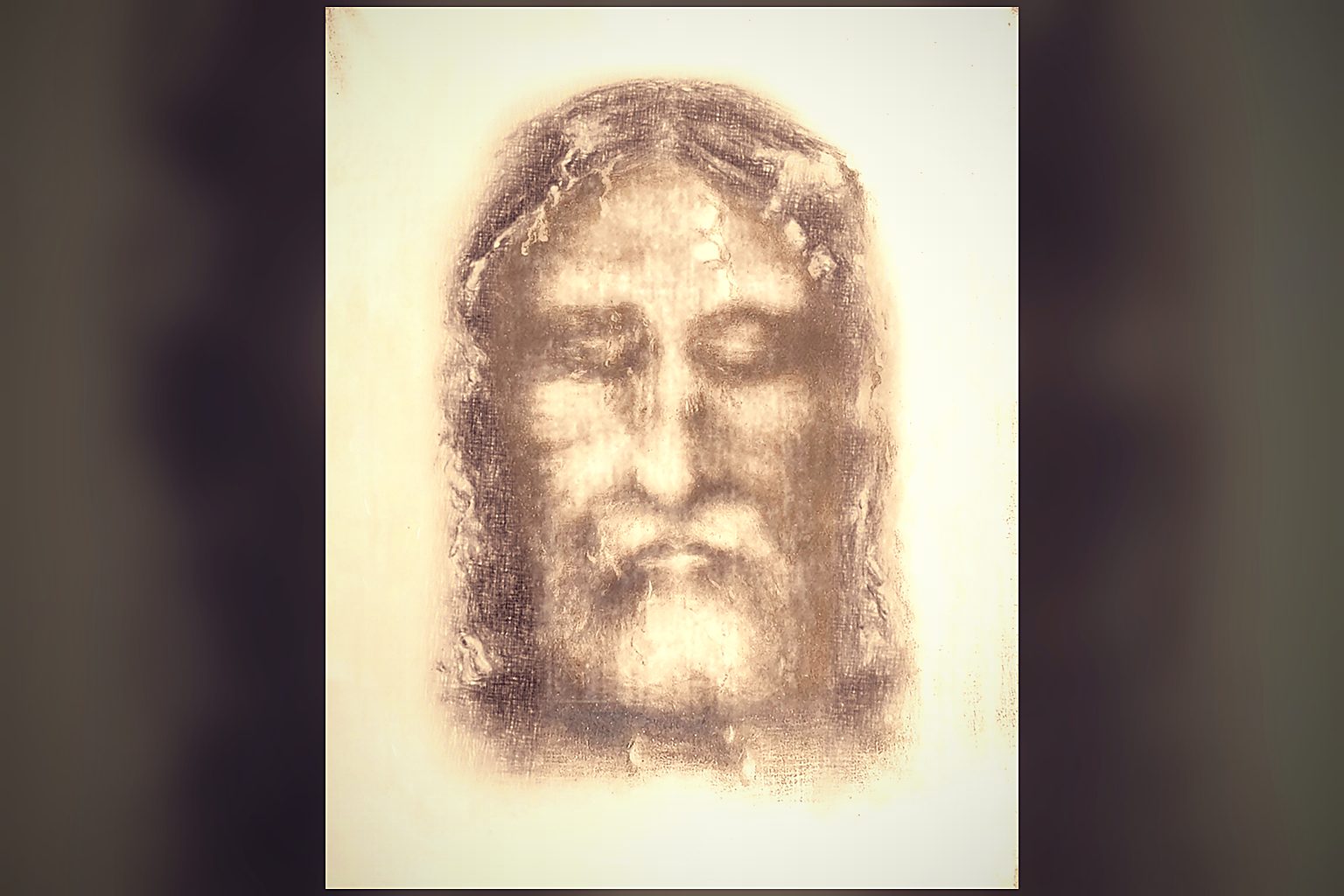
On the evening of 28 May 1898, a lawyer and amateur photographer named Secondo Pia was permitted to photograph a linen cloth kept in Turin Cathedral. The faint brownish stains on it had been venerated for centuries as the burial cloth of Jesus of Nazareth, but up close they read as little more than blotches. Whether the Shroud of Turin is real had been argued for as long, and on nothing better than those blotches. Nobody would read Shroud of Turin DNA off anything for another century.
He developed the glass plates that night. And on the negative — where light and dark are reversed — a face appeared.
Not a blotch. A photographically coherent human face, with correct anatomical shading, as though the cloth itself were a negative and the photographic process had turned it back into a positive.
Pia later said he nearly dropped the plate.
Whatever else the Shroud of Turin is, that moment is the reason the argument has not ended in 127 years — because it revealed a property of the image that nobody had put there on purpose, and that nobody has fully explained since.
What Is the Shroud of Turin?
The Shroud of Turin is a linen cloth measuring roughly 4.4 by 1.1 metres (3 ft 7 in), bearing the faint front-and-back image of a man who appears to have been scourged, crowned with thorns, and crucified. It has been kept in Turin since 1578, and its documented history begins in Lirey, France, around 1354.
It is the most intensively studied artefact in the world. It is also, after five decades of laboratory work, still unresolved.
The 1988 Carbon Dating
In 1988, three laboratories — Oxford, Zurich and Arizona — independently radiocarbon-dated samples cut from one corner of the Shroud.
The result was consistent across all three: AD 1260-1390, with 95% confidence. Published in Nature as Damon et al., “Radiocarbon dating of the Shroud of Turin”, it appeared to settle the matter. The cloth was medieval, and its first documented appearance around 1354 sat squarely inside the range.
For most of the scientific community, that was the end of it.
Why the Dating Is Contested
The objections are not all special pleading, and three of them are substantive.
The sample came from one corner. All three labs were given material from a single site at the edge of the cloth — an area handled for centuries during public displays, and adjacent to a region affected by the 1532 fire and subsequent repairs. Standard practice would take multiple samples from different locations. That was not done, on the reasonable grounds of not wanting to cut up the object further.
The invisible reweaving claim. Chemist Raymond Rogers, who had worked on the 1978 STURP examination and who publicly expected to confirm the medieval date, analysed reserved threads and reported in Thermochimica Acta (2005) that the radiocarbon sample contained cotton and a gum-and-dye coating not present elsewhere in the cloth. His conclusion was that the tested area was a later repair. Critics argue his sample provenance was not adequately established, and the claim remains disputed.
The 2019 raw data release. After a legal request, the raw measurement data from the 1988 test was published and re-analysed. Some statisticians reported significant heterogeneity between and within lab sub-samples, suggesting the material was not uniform and that a single date range may not be appropriate. Others maintain the variation is within normal bounds.
The 2026 Study on the Contamination Claim
This is the most important recent development, and it cuts against the objections above.
Rachel Freer-Waters and A.J.T. Jull published an analysis in npj Heritage Science of two fragments physically retained from the Arizona portion of the 1988 sample — actual material from the dated corner, compared against the control textiles distributed to the laboratories.
Their finding: the fragments are consistent with the main body of the Shroud, and show no evidence of contamination — no reweaving, no foreign cotton, no gum-and-dye coating of the kind Rogers reported.
That is a direct test of the central objection to the 1988 result, conducted on the disputed material itself, and it supports the medieval date.
It does not close every question. It addresses the Arizona sample, and the heterogeneity in the raw statistics is a separate issue. But anyone citing the reweaving hypothesis now has to engage with a study that looked at the actual threads and did not find it.
And the Newer Dating Claim
In 2022, Liberato De Caro at Italy’s Institute of Crystallography published in the journal Heritage a dating attempt using Wide-Angle X-ray Scattering (WAXS) — measuring the natural structural degradation of flax cellulose over time rather than carbon decay.
The reported result was that the Shroud sample was compatible with linen from the Siege of Masada (AD 55-74), implying roughly 2,000 years of age. The method is non-destructive, which is a genuine advantage.
It should be treated with caution. WAXS dating of textiles is not an established, widely validated technique; results depend heavily on assumptions about the storage temperature and humidity a sample has experienced over its life, and the Shroud’s history includes a fire. It has not been independently replicated. The study circulated widely in 2024 as though it had overturned the 1988 result. It has not.
So the honest position on date: the 1988 result is the only measurement by a well-validated method, its main contamination objection has now been tested directly and not supported, and no replacement dating has been established. On the evidence as it stands in 2026, the medieval date is the stronger position.
The Problem Nobody Has Solved
Here is why the Shroud remains interesting regardless of its age, and it is not the date. It is the image.
The properties are unusual and well documented by the 1978 STURP investigation, a team of around thirty scientists given direct access:
There is no pigment. No paint, no dye, no ink, no stain. The image is not a substance applied to the cloth. It is a discolouration of the fibres themselves.
It is superficial to an extraordinary degree. The colouration exists only in the outermost layer of the fibres, to a depth of roughly 200 nanometres — a fraction of the width of a single fibre. It does not penetrate the thread.
There are no brush strokes and no directionality. Nothing indicates an application process.
It does not fluoresce, while the scorch marks from the 1532 fire on the same cloth do. So the image was not produced by heat in the way those scorches were.
It encodes distance. This is the strangest property. The intensity of the image varies with how far the cloth would have been from the body it covered — closer means darker. That is why a 1976 VP-8 Image Analyzer rendering, which maps brightness to elevation, produced a coherent three-dimensional relief rather than the distorted output a photograph or painting gives.
The bloodstains came first. Chemical analysis indicates the blood is on the fibres underneath the image area, and that there is no image beneath the bloodstains. A forger would have to paint the body first and then the blood, not the reverse.
Is It Actually Blood?
STURP identified the stains as containing haemoglobin and gave a positive test for serum albumin. Bilirubin levels reported are elevated, which is consistent with severe trauma. Some researchers, notably microscopist Walter McCrone, argued the red material was iron oxide pigment in a binder — a dispute that has never been fully resolved between the teams.
What the Shroud of Turin DNA Actually Shows
DNA has been recovered twice — in 2015, and again in 2026, when a Padova team led by Gianni Barcaccia ran PCR-free metagenomic sequencing on dust vacuumed from the cloth during the official 1978 examination.
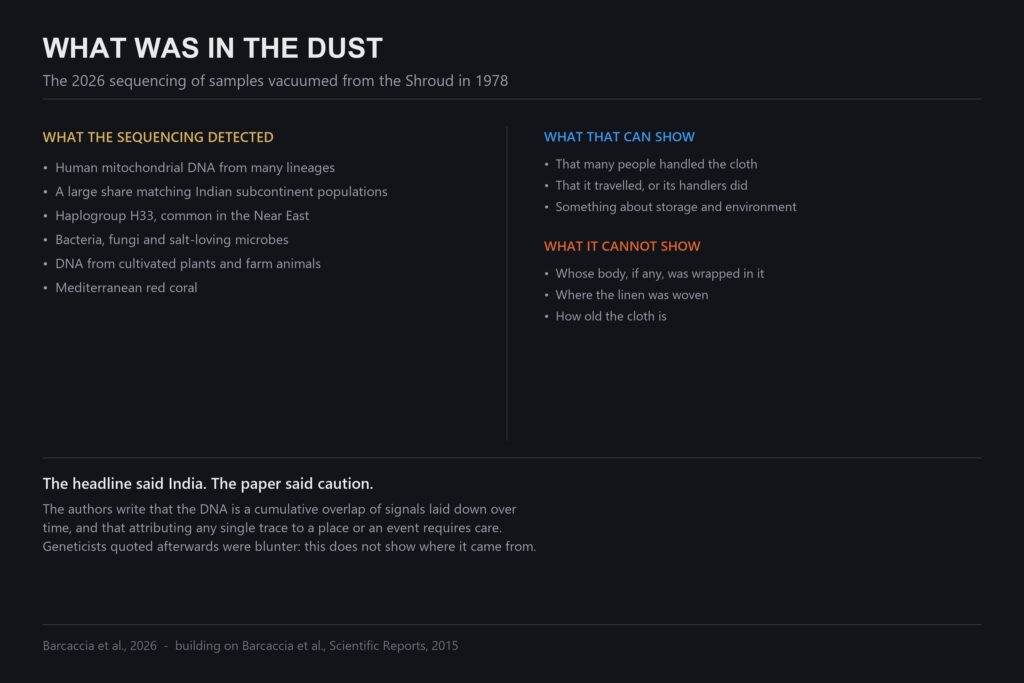
What came back was an inventory of everything that has ever touched the linen: human mitochondrial DNA from many lineages, bacteria, fungi, plants, animals, Mediterranean red coral. The finding that travelled was that a large share of the human sequences match populations of the Indian subcontinent, and within days that had become a claim that the Shroud came from the Indus Valley.
The paper does not say that. Its authors describe the DNA as a cumulative overlap of signals deposited over time, and warn against pinning any single trace to a place or an event; geneticists asked afterwards were blunter. The reason is obvious once stated. This is a surface that has been unrolled, handled, kissed, displayed, patched by nuns and carried across Europe for six and a half centuries. It accumulates a passenger list, not a birth certificate.
Blood Type AB, and Where That Came From
A second claim circulates with even more confidence: that the blood on the Shroud is type AB.
The source is real. Italian researchers including Baima Bollone reported AB from the stains, and in the 1990s Leoncio Garza-Valdés at Texas reported both AB typing and DNA amplification, later arguing for a bacterial coating on the fibres that he said had skewed the carbon dating.
It has not been accepted, and the reasons are technical rather than dismissive. Ancient degraded bloodstains are notoriously unreliable for ABO typing — the antigens break down, and aged samples have a documented tendency to type as AB whether or not they were. Garza-Valdés’s amplification work has never been independently replicated, and early PCR on heavily handled material is exactly the situation in which modern contamination produces convincing results.
So: reported, repeatedly, by serious people. Never confirmed under conditions that would settle it.
What DNA Could Never Settle
Here is the part that gets left out of every article on this subject, and it is the one that actually closes the question.
Suppose everything went perfectly. Suppose a complete, uncontaminated human genome were recovered from the Shroud tomorrow, with no ambiguity about which individual it belonged to.
It still could not tell you whose it was.
Identification by DNA is comparative. A sample is matched against a reference — a living relative, a known burial, a database. That is how remains get named. For the man in the Shroud there is no reference sample and there is no candidate for one, because the central claim of the tradition itself is that the tomb was found empty.
That is not a gap waiting on better technology. It is structural. A named identification would require material from a person whose defining claim is that he left no material behind.
So the honest statement about Shroud of Turin DNA is this: it can tell you a great deal about the object’s history, and nothing whatever about the identity it is famous for.
The Question That Genetics Does Reach
There is one biological question about Jesus that genetics can state precisely, and it is not about the cloth.
The birth narratives in Matthew and Luke describe a conception without a human father. Stated in modern terms, that is a claim about where half a genome came from — and specifically about a Y chromosome, which in ordinary human reproduction can only arrive from a father. The mechanics of that problem, and what the various proposed readings do and do not solve, are a separate matter with a literature of their own.
It is worth noting only because of the contrast. The virgin birth is a genetic claim that can at least be formulated as one. The Shroud is not: it is an artefact question wearing genetic clothes, and the DNA in it belongs to the crowd rather than to the man.
Is This the Face of Jesus?
Strip away the laboratory reports and one claim is underneath all of them: that this is the burial cloth of Jesus of Nazareth, and that the face on it is his.
That is what has been argued since the cloth surfaced at Lirey, it is why it is in a cathedral rather than a textile museum, and it is the only reason anyone has spent five decades running laboratory tests on a piece of linen.
Here is what can honestly be said about it.
The image is of a man who was crucified in the Roman manner, and the details match the gospel accounts unusually closely: scourge wounds across the back consistent with a Roman flagrum, puncture wounds around the whole scalp rather than a circlet, a wound in the side delivered after death, and — against every artistic convention of medieval Europe — nails through the wrists rather than the palms. Crucified men were common in the Roman world. Crucified men who were also crowned with thorns and speared instead of having their legs broken were not.
And none of that names him. Everything above is consistent with the gospel account of Jesus’ death. It is also consistent with any other man who died the same way, and the Romans crucified thousands. The image can establish a manner of death. It cannot establish an identity, and neither can the DNA.
What that leaves is a cloth whose contents fit the description in the gospels at every point anyone has checked, and no mechanism by which it could ever be signed.
The Face and the Icons
There is one line of argument that does bear on identity, and it is about art history rather than forensics.
Look at the standard Byzantine image of Christ — the Pantocrator type, the long centre-parted hair, the divided beard, the long nose and large open eyes. That face is remarkably stable across centuries, and it does not look like ordinary portraiture; it looks like copying.
In the 1930s Paul Vignon catalogued a set of oddities shared between the Shroud face and Byzantine images: a topless square on the forehead, a V at the bridge of the nose, a transverse line across the throat, two loose strands of hair, an asymmetry between the cheeks. He listed about twenty; Ian Wilson later narrowed it to fifteen he considered solid. Several of them make no artistic sense at all — a topless square is not a thing a painter invents — and they recur in image after image from roughly the fifth century onwards.
The case that matters: the Sinai Pantocrator is sixth century, and Christ’s portrait appears on the coinage of Justinian II from the 690s, which is about as securely dated as ancient evidence gets. If Byzantine artists were copying these features from the Shroud, the Shroud existed six or seven centuries before the radiocarbon window of 1260–1390.
The case against it is that the markings are doing less work than they appear to. A topless square, or the vertical strokes that suggest one, is an ordinary way of rendering a forehead. Pattern-matching between a faint image and a stylised icon is exactly the sort of comparison that finds what it is looking for, and the list has been revised downward once already, by a supporter. And the causal arrow can run the other way: a fourteenth- century artist who wanted to produce a convincing image of Christ would copy the face everyone already recognised, which is the Pantocrator.
The argument has not been settled, and it is one of the few in this subject that could be, by someone doing the comparison systematically rather than by eye.
What the Gospels Actually Say About the Cloths
Since the claim is scriptural, the scriptural description deserves checking, and it is not as tidy as the Shroud’s defenders usually present it.
Matthew, Mark and Luke each say Joseph of Arimathea wrapped the body in a linen cloth — singular, sindon. That fits a single large sheet.
John does not. John 19:40 says the body was bound in othonia, a plural, with spices, “as the manner of the Jews is to bury”. And John 20:6–7 has Peter seeing the othonia lying, and the cloth that had been about his head — the soudarion — folded up in a place by itself, separate from the rest.
A separate face cloth is a problem for a single full-length shroud bearing a facial image, and it has been recognised as one for a long time. The usual replies are that othonia is a general plural covering wrappings and bindings, and that the soudarion was a chin band rather than a face covering. Those readings are possible. They are also clearly readings, adopted because of the object, and an honest treatment says so.
It is worth adding that the tradition has a candidate for the soudarion too: the Sudarium of Oviedo, a bloodstained cloth with no image, documented in Spain far earlier than the Shroud appears in France. Whether the stains on the two correspond is disputed and has been argued in both directions.
Could a Medieval Artist Have Made It?
This is the decisive test, and it cuts both ways.
Reproduction attempts have partially succeeded. Chemist Luigi Garlaschelli produced a Shroud-like image in 2009 using a bas-relief rubbing technique with acidic pigment, followed by artificial ageing. Joe Nickell has demonstrated similar results. These reproductions capture the general appearance and the negative quality.
They do not capture everything. The published reproductions have not simultaneously matched the 200-nanometre superficiality, the absence of any substance on the fibres, and the distance-encoded intensity. Critics of the reproductions note that they use pigment, which the Shroud does not contain.
Defenders of authenticity then propose mechanisms — a radiation burst, corona discharge, or a chemical reaction with burial ointments — and these have their own problem: none has been demonstrated to produce the observed image on linen under testable conditions, and some of them require a phenomenon not otherwise known to physics.
That is where the matter genuinely sits. The image has not been fully reproduced, and it has not been explained. Both statements are true, and partisans tend to quote only one.
What Is Actually Known About the Man
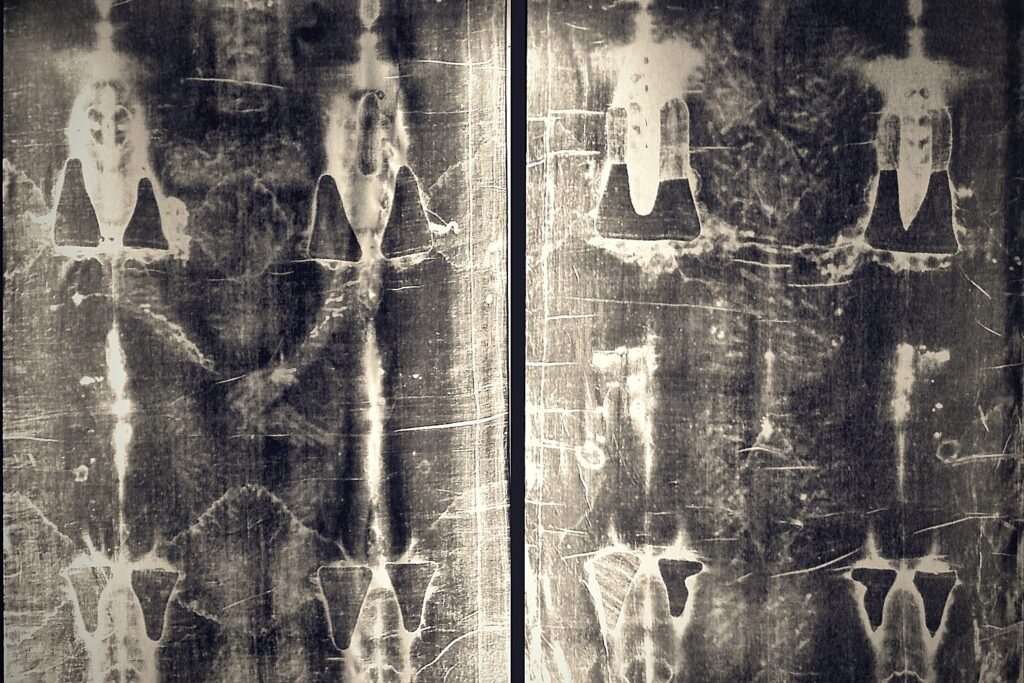
Independent of authenticity, the image records a consistent forensic picture:
- A man roughly 1.75 m (5 ft 9 in) tall, well built, aged perhaps 30-45
- Approximately 100-120 scourge marks across the back, shoulders and legs, in a pattern matching the Roman flagrum with dumbbell-shaped tips
- Puncture wounds around the scalp, consistent with a cap of thorns rather than a circlet
- A wound in the wrist, not the palm — anatomically necessary to bear body weight, and contrary to almost all medieval artistic convention, which shows palm wounds
- A large wound in the side, with separated blood and a clear fluid
- No broken legs — unusual, since crucifixion victims typically had their legs broken to hasten death
- Swelling on one cheek, and a shoulder abrasion consistent with carrying a heavy beam
The wrist wound is the detail that most troubles the forgery case. A 14th-century artist working to convince contemporaries would have painted the hands, because that is what every crucifix in every church showed.
Why This Case Matters Beyond Itself
The Shroud is an unusually clean example of something this site keeps encountering: a claim where both sides are overstating their evidence.
The sceptical position — carbon dating settled it in 1988 — ignores that the sample was taken from one handled corner, that a chemist who expected to confirm the result reported contamination, and that the image mechanism remains unexplained by any reproduction.
The authenticity position — the 2022 study proves it is 2,000 years old — rests on an unvalidated, unreplicated technique, and quietly drops the fact that the only well-established dating method gave a medieval answer.
The same pattern runs through the retracted Sodom airburst paper, still cited years after withdrawal; the Paluxy footprints, retracted by their own promoters; and the Dogon Sirius claim, which dissolved when somebody repeated the fieldwork.
The difference here is that after five decades, with more scrutiny than any comparable object has received, the Shroud has not resolved in either direction. That is rare, and it is the reason to keep paying attention to it.
Frequently Asked Questions
Is the Shroud of Turin real, or was it debunked?
The dating evidence points medieval. Radiocarbon in 1988 gave AD 1260-1390, and a 2026 study in npj Heritage Science analysed fragments physically retained from that very sample, found them consistent with the main cloth and saw no sign of contamination — which undercuts the main objection to the result. The image mechanism is a separate matter and has never been fully reproduced or explained, which is why the question is not treated as closed.
Is the face on the Shroud of Turin the face of Jesus?
That is the claim, and it is why the cloth has been studied at all. What the image can establish is a manner of death: scourging, a cap of thorn punctures rather than a circlet, a post-mortem chest wound, and nails through the wrists rather than the palms. All of that matches the gospel account of Jesus’ death closely. None of it identifies an individual, and no test proposed so far could.
Why does the Shroud face look like Byzantine icons of Christ?
Paul Vignon catalogued about twenty peculiarities shared between the Shroud face and Byzantine images, and Ian Wilson narrowed the list to fifteen. Supporters argue that artists from the sixth century onward were copying the Shroud, which would place it centuries before the radiocarbon window. Critics reply that several markings are ordinary painting conventions, and that a medieval artist would naturally copy the face everyone already recognised.
Does the Shroud of Turin have DNA?
Yes, and a great deal of it. A 2026 metagenomic study of dust vacuumed from the cloth in 1978 recovered human mitochondrial DNA from multiple lineages, bacteria, fungi, plant and animal DNA and Mediterranean red coral. It reflects centuries of handling rather than identifying any individual.
Does the Shroud of Turin DNA prove it came from India?
No, and the study’s authors say so. A substantial share of the human sequences match populations of the Indian subcontinent, but the paper describes the DNA as a cumulative overlap of traces deposited over time and warns against attributing any single one to a place or event. Geneticists commenting afterwards were firmer: the analysis cannot establish the cloth’s origin.
Is there blood on the Shroud of Turin, and what type?
STURP identified haemoglobin and gave a positive test for serum albumin, with elevated bilirubin consistent with severe trauma; the microscopist Walter McCrone disputed this and argued the red material was iron oxide pigment, and the two teams never resolved it. Type AB has been reported several times, including by Baima Bollone and by Leoncio Garza-Valdés, but degraded ancient bloodstains are unreliable for ABO typing and tend to read as AB regardless, so nobody has confirmed it under conditions that would settle it.
Could DNA identify the man in the Shroud?
Not even in principle. DNA identification is comparative and needs a reference sample from the person or a relative. No such reference exists, and the tradition’s own central claim — an empty tomb — means none is expected to.
How was the image on the Shroud made?
Unknown. There is no pigment, no brush strokes and no directionality. The colouration is confined to roughly the outermost 200 nanometres of the fibres, and its intensity varies with the cloth-to-body distance, which is why it renders as a coherent 3D relief. Luigi Garlaschelli produced a Shroud-like image in 2009 with a bas-relief rubbing, pigment and artificial ageing, but no reproduction has matched the nanometre-scale superficiality, the absence of any added substance and the distance-encoded intensity at the same time.
How old is the Shroud of Turin?
The only well-validated measurement, the 1988 radiocarbon test, gave AD 1260-1390, and a 2026 study of retained fragments from that sample supports its integrity. A 2022 WAXS study suggested roughly 2,000 years, but that technique is not established for textiles and has not been independently replicated.
Conclusion: A Negative Nobody Ordered
The date now leans medieval more firmly than it did a few years ago. Set it aside, and one fact still remains stubborn.
For more than five hundred years, from Lirey in 1354 to Turin in 1898, everyone who venerated this cloth was looking at the wrong version of the image. The faint stains were all anyone could see, and they were not especially impressive — which is partly why a 14th-century bishop denounced the object as a painted fake almost as soon as it appeared.
Then photography was invented, and a lawyer with a camera discovered that the cloth had been carrying a photographic negative for centuries that nobody could perceive.
If a medieval forger produced it, he encoded an image that could only be properly seen with a technology that would not exist for another five hundred years, in a medium he could not have tested, at a level of detail nobody could verify — and then got the wrist wound right against every artistic convention of his own era.
That is not proof of anything. It is just a very odd thing for a forger to have done.
Continue Reading
- Human Chromosome 2: The Fusion, and the 1,280 Who Carried It — You have 46 chromosomes. Every other great ape has 48. What sits at 2q13, the case against reading it as a fusion, and…
- Junk DNA: An Archive Nobody Curated — An onion has five times more DNA than you do. That single fact is the hardest question in genomics, and it is the one…
- What Did Jesus Say to Satan? Three Answers, One Book — Nobody else was there, so the account can only have come from him. The three offers in order, what forty days without…