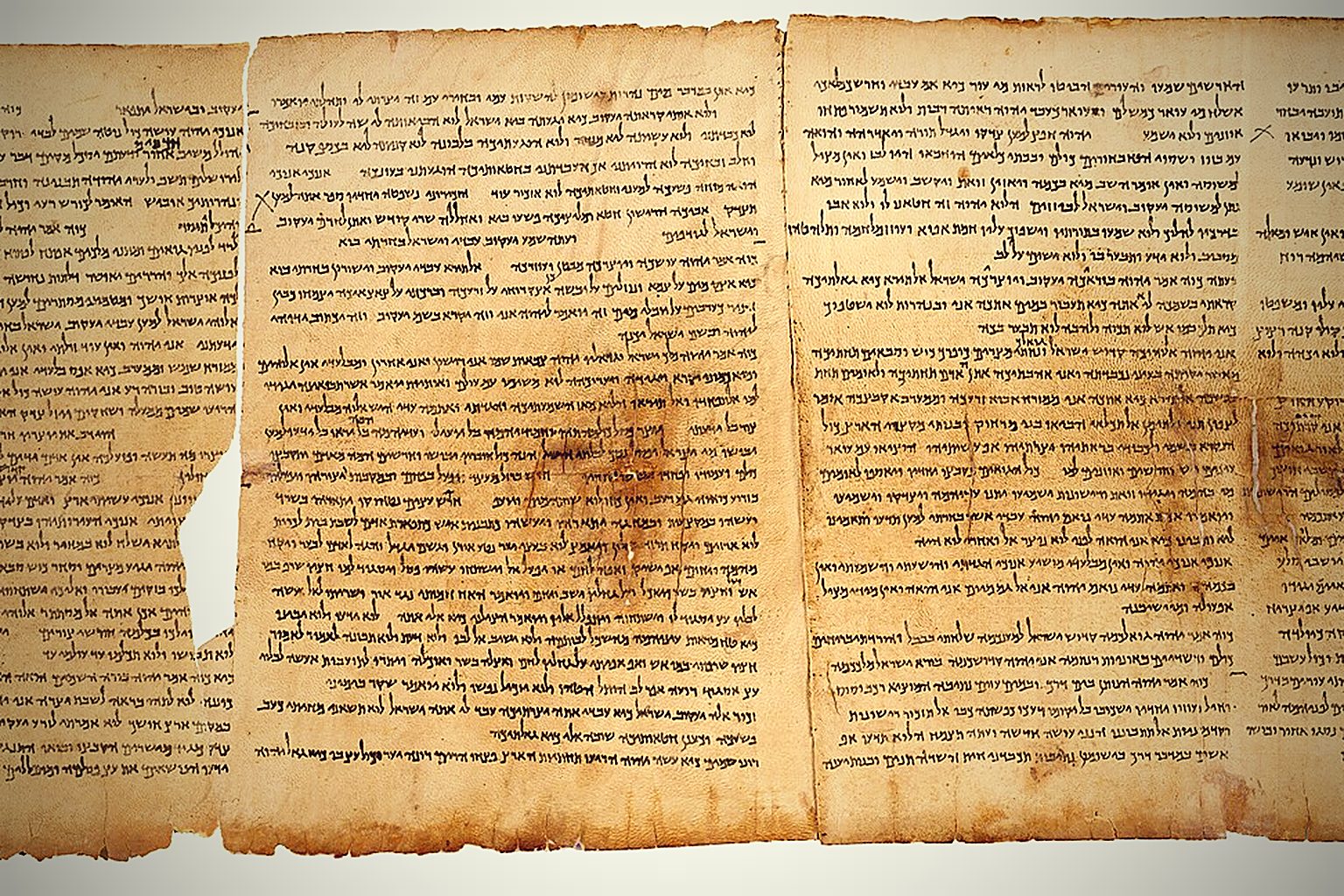
Every list of biblical prophecies that came true has the same shape. Twenty entries, each one a verse on the left and a historical event on the right, and an arrow between them doing all the work. The lists never say how the arrow was drawn.
There is a way to draw it that can be checked. It is four questions long, it is not new, and it is the same standard a court applies to an alibi or a journal applies to a preregistered study. Applied honestly it does something the lists never do: it rules things out.
So here is the test, and then here are five claims run through it — four famous ones and one that failed so completely that a hundred thousand people sold their farms over it. The failed one scores full marks. That is not a flaw in the test. That is the reason to trust it.
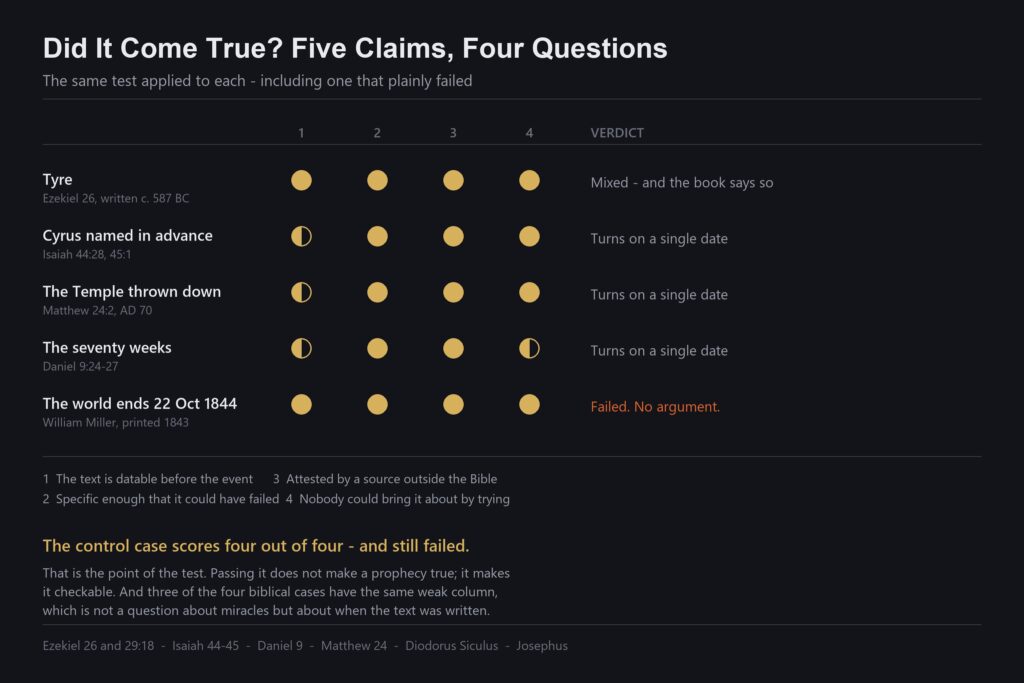
The Four Questions
A prediction is worth something only if it could have been wrong, and only if you can show it was made first. Everything else is commentary.
1. Is the text datable before the event? Not “traditionally dated” — datable, by manuscripts, by quotation in another dated work, by translation into another language, by something outside the claim itself. This is the question that decides almost everything, and it is the one the lists skip.
2. Is it specific enough that it could have failed? “A great king shall arise” cannot fail. “Cyrus” can. “There will be wars” cannot fail. “Not one stone shall be left upon another” can. A prophecy immune to failure is also immune to confirmation.
3. Is the event attested outside the Bible? A text reporting its own fulfilment is one source, not two. Diodorus Siculus, Arrian, Josephus, the Babylonian Chronicles and the excavation report are the witnesses that count here, because none of them has a stake in the prophecy.
4. Could anyone have made it happen on purpose? A prediction that motivates the people who bring it about has not been confirmed by history; it has been acted out. This is the least discussed criterion and it does real damage to some popular entries.
Four questions, one verdict at the end. Notice that none of them is “do you believe in miracles”. That question comes later, and it comes to a much smaller set of claims once these four have done their work.
Tyre: The Prophecy That Records Its Own Shortfall
Ezekiel 26 is the strongest case on the list and the most interesting, because of something that almost never gets quoted.
The prophecy is dated in the text to the eleventh year — around 587 BC — and it is unusually concrete. Nebuchadnezzar king of Babylon is named as the agent (26:7). The city will be scraped to bare rock, a place for the spreading of nets (26:4–5). Its stones, its timber and its dust will be laid “in the midst of the water” (26:12). And it will be built no more (26:14).
On question 1 this scores full marks, and it does so even on the sceptical reckoning. Ezekiel is dated to the sixth century BC by conservative and critical scholars alike; there is no serious school that puts it after Alexander. On question 2 it is about as specific as ancient prophecy gets. On question 3 the sources are abundant and none of them is religious.

What actually happened, in order
Nebuchadnezzar besieged Tyre for thirteen years, from 586 to 573 BC. Tyre was then two cities: a mainland settlement and an island fortress half a mile offshore. He took the mainland. He could not take the island, because he had no fleet worth the name, and the siege ended in a negotiated surrender in which Tyre’s king was replaced by Baal II, ruling as a Babylonian vassal. The city was not scraped to bare rock. It was not thrown into the sea. It changed its tax arrangements.
Two hundred and forty-one years later, in 332 BC, Alexander arrived with the same problem and a different answer. He built a causeway out to the island — a mole across the half-mile channel, through water that shelved to about eighteen feet near the walls — and he built it out of the mainland city. Diodorus Siculus records that the rubble of old Tyre went into the sea to make the road. The siege took seven months. The island fell.
So the stones, the timber and the dust of Tyre were laid in the midst of the water, literally, by a man who had never read Ezekiel and did not care what it said. Question 4 is satisfied about as thoroughly as it can be.
And now the part the lists leave out
Ezekiel 26:7 says Nebuchadnezzar would do it. Nebuchadnezzar did not do it.
The Book of Ezekiel says so itself. Sixteen years later, in chapter 29, a second oracle arrives:
Son of man, Nebuchadrezzar king of Babylon caused his army to serve a great service against Tyrus: every head was made bald, and every shoulder was peeled: yet had he no wages, nor his army, for Tyrus, for the service that he had served against it. (Ezekiel 29:18)
Every head bald from the padding of the carrying baskets, every shoulder rubbed raw, thirteen years of it, and nothing to show. The text then transfers Egypt to him as payment instead.
This is remarkable and it is almost never mentioned. A book of prophecy has recorded, in its own pages, that one of its own predictions did not pay out as announced. That is not what a fabricated collection looks like. A forger writing after the fact writes down the hit and deletes the miss.
And Tyre exists. It is a Lebanese city of roughly two hundred thousand people, with a name that has survived Babylon, Macedon, Rome and the Crusades. “Built no more” is not a description of Tyre.
So what is the verdict? The mechanism landed with uncanny precision and the wrong man did it, two and a half centuries late, and the city is still there. Anyone who tells you Ezekiel 26 was fulfilled to the letter has not read chapter 29. Anyone who tells you it failed has not read Diodorus. The honest answer is the one the lists have no column for.
Cyrus, Named Before He Was Born
Isaiah calls Cyrus by name, twice, and appoints him to a job:
That saith of Cyrus, He is my shepherd, and shall perform all my pleasure: even saying to Jerusalem, Thou shalt be built; and to the temple, Thy foundation shall be laid. (Isaiah 44:28)
On the traditional dating, Isaiah wrote in the eighth century BC and Cyrus took Babylon in 539 BC — a gap of roughly a hundred and fifty years, with the man’s name in it. That is question 2 answered with a thoroughness nothing else on the list matches. A name is the most falsifiable thing a prophecy can contain.
Question 3 is answered too, though not quite in the way it is usually claimed.
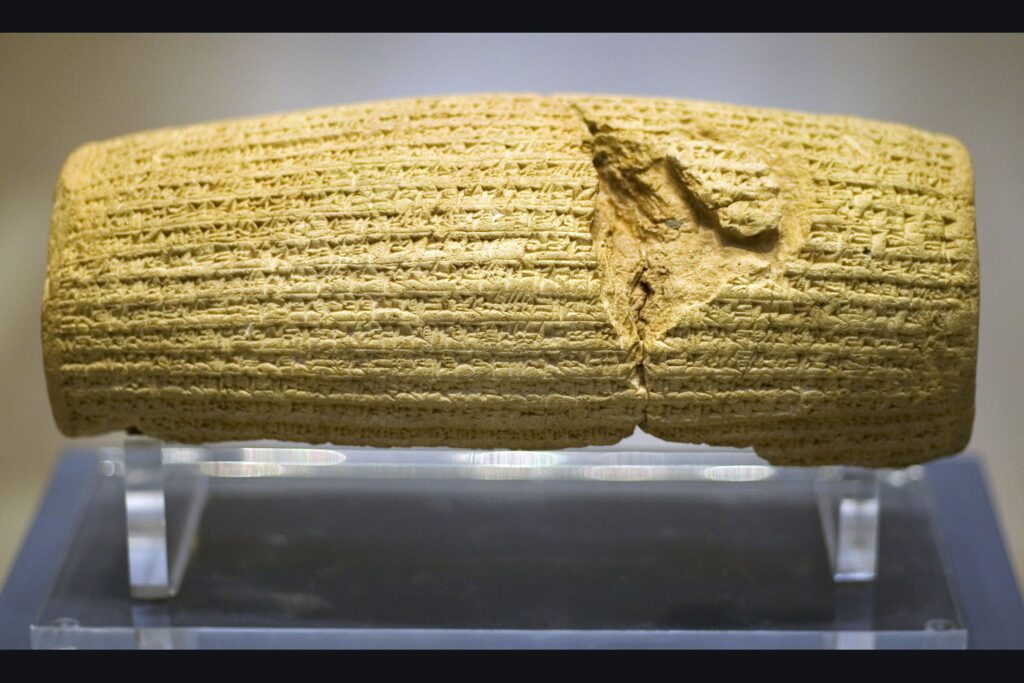
The Cyrus Cylinder, dug up at Babylon in 1879 and now in the British Museum, is a Babylonian document written for Babylonians. It records Cyrus restoring the temples Nabonidus had disrupted, returning divine statues to their cities, and sending deported populations home. It is the policy Ezra 1 describes, attested in cuneiform, from the Persian side, with no interest in the Hebrew scriptures whatsoever.
It also never mentions the Jews, and never mentions Jerusalem. The sections that survive concern territories east of the Tigris. What the Cylinder establishes is that Cyrus really did the kind of thing Ezra credits him with, as a matter of imperial policy — not that this particular decree is on record. That distinction matters, and half the internet loses it.
The whole case rests on one date
Everything turns on question 1, and question 1 is genuinely contested.
Since the late eighteenth century most critical scholars have held that Isaiah 40–66 was written by a later hand, during or after the exile, addressing an audience already in Babylon. The chapters speak to people in captivity as though they are standing there. On that reading, Cyrus is named because Cyrus had already appeared.
The usual reply is the Great Isaiah Scroll. Found in Cave 1 at Qumran, copied around 125 BC, it contains all sixty-six chapters in a single roll — and it is one of the most complete ancient manuscripts of anything that exists. It is frequently produced as though it closed the argument.
It does not, and it is worth being precise about why. The scroll proves the text was a unity by 125 BC. The claim under test needs it to be a unity before 539 BC. No manuscript on earth reaches that far back — for Isaiah or for anything else in the Hebrew Bible. The scroll is a genuine and spectacular witness to how stable the text has been, which is a real finding in its own right and one the Dead Sea Scrolls are rightly famous for. It is simply not a witness to authorship four centuries before it was copied.
So the Cyrus prophecy scores 3½ out of 4, and the half is the whole argument. There is no archaeological fact that settles it. There is a literary judgement about where a book divides, and reasonable people have landed on both sides of it for two hundred years.
The Temple Thrown Down
Jesus, leaving the temple, is shown its buildings:
See ye not all these things? verily I say unto you, There shall not be left here one stone upon another, that shall not be thrown down. (Matthew 24:2)
In AD 70 Titus took Jerusalem and burned the temple. Josephus, who was there on the Roman side, describes the site afterwards as so thoroughly levelled that a visitor would not believe it had been inhabited. The stones of the platform were levered off the walls and are still lying where they fell, on the pavement below the southwest corner, and anybody can go and look at them.
Question 2: specific, and specific in a way that could have failed. Sieges usually end with a sacked building, not a dismantled one. Question 3: attested by a Roman-employed Jewish historian with no motive to confirm a Christian prediction. Question 4: nobody engineered it; the besieged were trying very hard to prevent it.
And question 1 is, once again, the whole fight.
The mainstream critical position dates Mark to about AD 70 and Matthew and Luke to somewhere between AD 80 and 90 — after the event, which would make the passage a description wearing a prediction’s clothes. The technical term for that is vaticinium ex eventu, prophecy after the fact, and it is a perfectly respectable thing to suspect.
The arguments on the other side are not merely traditional loyalty. Acts ends with Paul alive under house arrest in Rome around AD 62 and simply stops — an odd place to end a book if its author knew about the executions of Paul and Peter and the destruction of the temple. Luke uses Mark, so Mark is earlier again. And the discourse itself contains instructions that read strangely after the fact: flee to the mountains, pray it is not in winter, pray it is not on the sabbath. A writer inventing a prophecy in AD 80 has no reason to tell his readers to run.
Against that, the critical side notes that the temple is described as levelled rather than burned, which is what happened rather than what a besieger normally intends.
Two sets of arguments, both real, neither decisive, and the same question underneath as the Cyrus case. This is not a coincidence, and it is the thing worth taking away from the whole exercise.
The Same Argument, Every Time
Run the four questions across the famous cases and a pattern falls out that no individual entry reveals.
| Claim | Datable first? | Could fail? | Outside witness? | Self-fulfilling? |
|---|---|---|---|---|
| Tyre, Ezekiel 26 | yes, uncontested | yes | Diodorus, Arrian | no |
| Cyrus, Isaiah 44–45 | contested | yes | Cyrus Cylinder | no |
| The temple, Matthew 24 | contested | yes | Josephus | no |
| Seventy weeks, Daniel 9 | contested | yes | Maccabean history | partly |
| 22 October 1844 | yes, printed | yes | newspapers | no |
Three of the four biblical cases fail in exactly one column, and it is the same column. The dispute over Isaiah, the dispute over Matthew and the dispute over Daniel are not three arguments. They are one argument, held three times, about whether a text may be dated earlier than the event it describes.
That has a consequence people on both sides tend not to enjoy. If you accept the late date for Daniel, consistency points you toward the late date for Isaiah, because the reasoning is the same reasoning. If you reject it in one place, you have to say what is different about the other — and “this one is in the New Testament” is not a difference in the evidence.
Daniel 9 is where this bites hardest, because the seventy weeks are arithmetic rather than imagery, and both readings of them — the messianic and the Maccabean — end up with a number that does not quite fit. That argument is long enough to need its own page, and it has one.
Notice also that Tyre is the only case with a clean first column, and Tyre is the one with the messy fourth. There is no entry that is clean everywhere. A list that presents twenty of them as uniformly confirmed is not reporting; it is selling.
The Control Group
A test that never fails anything is not a test. So here is a prediction that satisfies all four criteria and was wrong anyway.
William Miller, a New England farmer, worked through Daniel 8:14 and concluded that Christ would return between March 1843 and March 1844. It was printed. It was preached. When the window closed he recalculated and named 22 October 1844. By then something like a hundred thousand Americans were waiting, some of them having sold property they expected not to need.
Score it. Datable before the event: printed years in advance, beyond dispute. Specific enough to fail: a calendar date. Attested outside the Bible: covered in the press at the time. Self-fulfilling: impossible. Four out of four — a better score than any biblical case on the list.
It failed completely. The day is still called the Great Disappointment.
Harold Camping did it again in the modern era, first for 1994, then for 21 May 2011, then for 21 October 2011, with billboards. After the May date passed he announced that the rapture had occurred spiritually and invisibly, which is question 2 being retrospectively removed from a prophecy that had already answered it.
That last move is the one to watch for, because it is the commonest failure mode in this entire field. A claim is made in falsifiable terms, it fails, and it is then reinterpreted into terms that cannot fail. The reinterpretation is usually described as deeper. It is the opposite: a prediction that has had its testability surgically removed.
The Self-Fulfilment Problem
Question 4 is where the modern entries mostly come apart, and it is worth one honest example.
The most-cited prophecy of the last century is the return of Israel — Ezekiel 37’s valley of dry bones, or Isaiah 66:8’s nation born in a day, matched to 14 May 1948. The text is unquestionably ancient; question 1 is not in play at all.
But the people who made it happen were, in many cases, people who knew the text. Restorationist movements, in Britain and America and among the Zionist founders themselves, argued from those verses for a century beforehand and organised accordingly. That does not make the event less extraordinary and it does not make the reading wrong. It does mean the fourth question cannot be answered cleanly, and an argument that ignores the fourth question is not going to persuade anyone who is looking for it.
The same caution applies to the third temple, where the institutes preparing the vessels are explicitly working from prophecy, and to a great deal of what gets read out of Revelation. When the reader is also the actor, fulfilment and enactment become impossible to separate from the outside.
What the Test Leaves Standing
Nothing here proves or disproves anything about God, and the test was never going to. What it does is sort the pile.
It removes the vague entries, which is most of them. It removes the ones reinterpreted after failure. It flags the ones somebody could have brought about on purpose. And it isolates what is actually being argued in the remaining cases, which turns out to be one narrow and entirely worldly question: when was the text written?
That question is answerable in principle. It is answered by manuscripts, by linguistic dating, by quotation, by translation history — and in three of the four cases here, the evidence genuinely underdetermines it. Both sides have real arguments. Neither has a knockout. Anyone claiming otherwise, in either direction, is telling you about their confidence rather than about the evidence.
Which leaves Tyre, oddly, as the most interesting entry on the list: the one nobody disputes the date of, whose mechanism arrived with almost absurd precision, under the wrong king, two and a half centuries late, at a city that is still inhabited today — and whose own book wrote down the shortfall while it was still fresh.
That is a stranger thing than a clean hit. Clean hits are what forgeries look like. This is not what anyone was trying to write, and there are only two ways to explain a book that keeps a record of its own unpaid bill. It was not curated. Or it was not worried.
Prediction, in the end, is not the only way a text can tell you something. There is also the question of what it chose to keep — which is a different kind of evidence, and the same one that makes records kept in advance worth more than a memory recalled afterwards.
Frequently Asked Questions
What biblical prophecies came true?
The most defensible candidates are the fall of Tyre’s island fortress (Ezekiel 26, fulfilled in part by Alexander in 332 BC), the naming of Cyrus as the restorer of Jerusalem (Isaiah 44–45), the destruction of the second temple (Matthew 24, AD 70) and the seventy weeks of Daniel 9. Each one is genuinely disputed, and in three of the four the dispute is about the date the text was written rather than about the event.
How many prophecies in the Bible have been fulfilled?
No honest count exists. Figures between 300 and 2,500 circulate, but they depend entirely on how loosely a “fulfilment” is allowed to be matched to a verse. A strict standard — datable in advance, specific enough to fail, attested by a non-biblical source, not brought about deliberately — leaves a list short enough to read in an afternoon.
Was the prophecy about Tyre fulfilled?
Partly, and the text itself says so. Ezekiel 26 names Nebuchadnezzar as the one who would destroy the city; his thirteen-year siege (586–573 BC) ended in a negotiated surrender and Ezekiel 29:18 records that he received no payment for it. The literal throwing of Tyre’s stones into the sea happened in 332 BC, when Alexander built his causeway out of the ruins of the mainland city. Tyre is still inhabited today.
Did Isaiah really name Cyrus 150 years in advance?
That is what the traditional dating implies, and Isaiah 44:28 and 45:1 do name him. The critical position holds that Isaiah 40–66 was composed during or after the exile, which would place the naming after Cyrus appeared. The Great Isaiah Scroll from Qumran, copied around 125 BC, shows the book was a single unity by then — but no manuscript of anything reaches back before 539 BC, so the scroll cannot settle the question either way.
Does the Cyrus Cylinder prove the Bible?
It proves that Cyrus pursued a policy of repatriating deported peoples and restoring their temples, which is exactly the policy Ezra 1 describes. It does not mention the Jews, Jerusalem or the temple there — the surviving text concerns lands east of the Tigris. It is strong corroboration of the context and not a copy of the decree.
Why do failed prophecies matter to this question?
Because a test that cannot fail anything proves nothing. William Miller’s prediction of 22 October 1844 was printed in advance, specific to the day, widely reported and impossible to bring about deliberately — full marks on all four criteria — and it was simply wrong. Passing the test makes a claim checkable, not true.
What is vaticinium ex eventu?
Latin for “prophecy from the event”: a prediction written after the thing it predicts, presented as though it came first. It is the standard critical explanation for the most precise passages in Daniel, Isaiah 40–66 and the Olivet discourse, and the only way to answer it is with evidence about when the text was written.
Is the founding of Israel in 1948 a fulfilled prophecy?
The texts usually cited — Ezekiel 37 and Isaiah 66:8 — are unquestionably ancient, so there is no dating problem. The difficulty is the fourth criterion: many of the people who worked toward 1948 were arguing from those very passages, so the event cannot be cleanly separated from the effort to bring it about. That does not make the reading wrong; it makes it unprovable by this method.
Continue Reading
- The Seventy Weeks of Daniel: The Arithmetic, Laid Out — A prophecy with a start, a unit and a count. Three decrees it could run from, two lengths of year, and the awkward fact…
- The Third Temple: What Is Actually Ready, and What Is Not — The vessels are finished, the garments are woven and the plans exist. What does not exist is a valid set of ashes, an…
- Adam’s First Wife: The Lilith Story Has One Source — The first wife, the refusal, the exile – all of it enters the record in a single medieval book of proverbs that half…