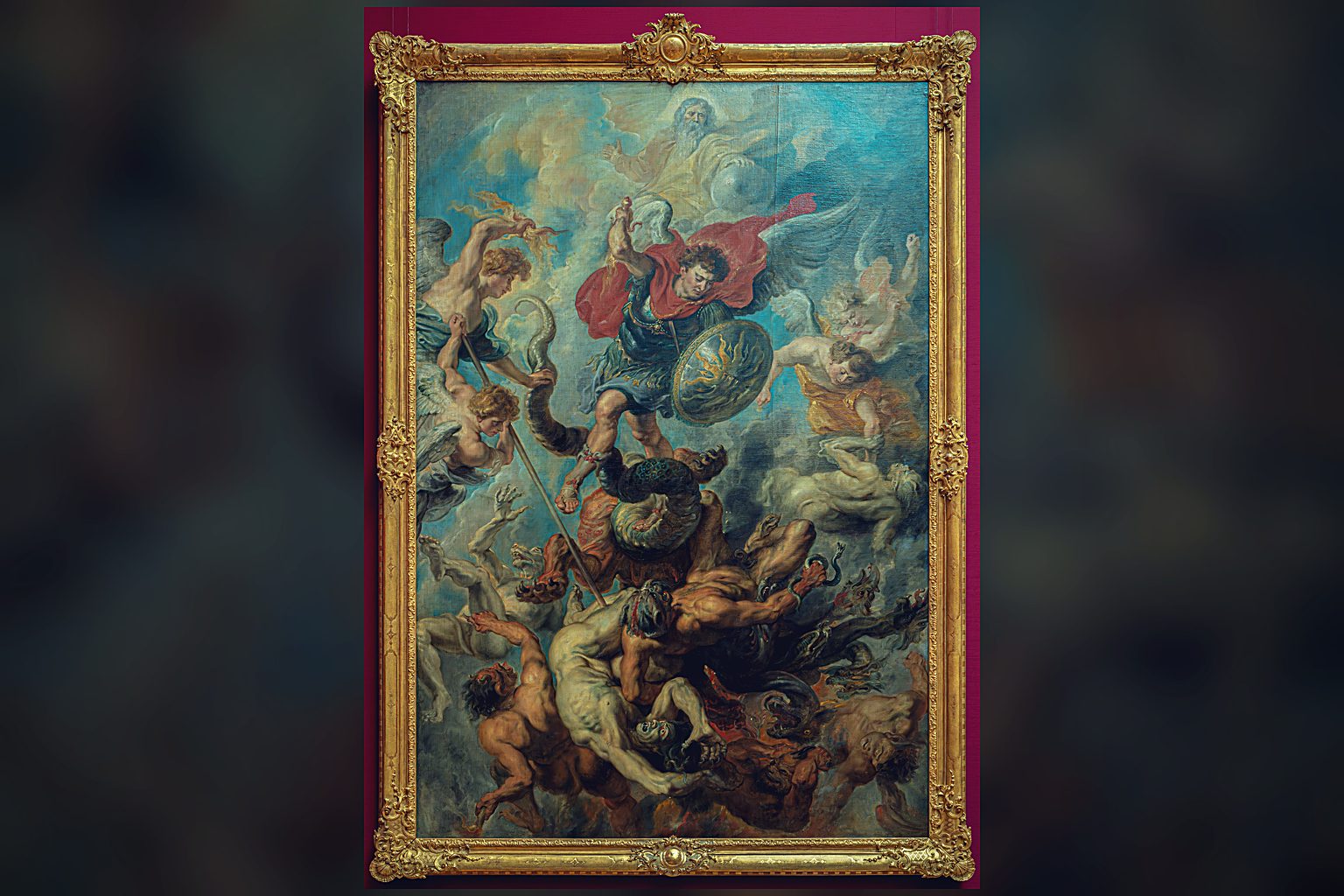
Four verses in Genesis 6, and the word Nephilim in the middle of them, have generated more argument than almost any other passage in the Hebrew Bible, and the reason is simple: they describe something happening that the rest of Scripture treats as impossible.
“That the sons of God saw the daughters of men that they were fair; and they took them wives of all which they chose… There were giants in the earth in those days; and also after that, when the sons of God came in unto the daughters of men, and they bare children to them, the same became mighty men which were of old, men of renown.” (Genesis 6:2, 4)
Then, five verses later, God announces He will erase every living thing on the planet.
The two statements sit next to each other, and the text offers no transition. Whatever the first one means, it is presented as sufficient cause for the second.
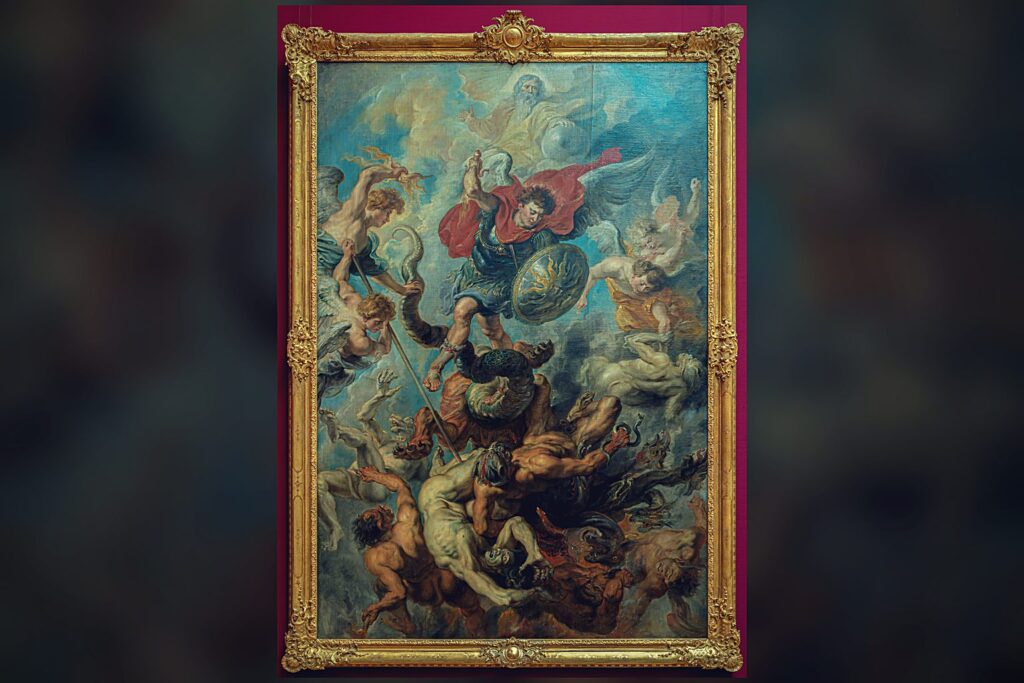
Who Were the Nephilim?
The Nephilim are the offspring described in Genesis 6:4, born after “the sons of God” took wives from “the daughters of men.” The text calls them gibborim — mighty men, men of renown — and the Septuagint translated Nephilim as gigantes, giants.
The Hebrew name comes from the root naphal, “to fall.” Whether that describes them as the fallen ones, those who fall upon others (attackers), or the ones who caused others to fall is disputed in the Hebrew itself.
The Central Question: Who Were the “Sons of God”?
Everything hinges on the phrase bene ha-Elohim. There are three readings, and they are not equally supported.
| View | Who the “sons of God” were | Strength | Weakness |
|---|---|---|---|
| Angelic | Fallen angels or Watchers | The phrase means angels everywhere else in the Hebrew Bible; oldest interpretation; 2 Peter and Jude appear to support it | Matthew 22:30 says angels in heaven do not marry |
| Sethite | Godly male line of Seth intermarrying with the line of Cain | Avoids the biological problem | The phrase never means “godly men” elsewhere; does not explain why the offspring were extraordinary |
| Royal | Ancient kings and rulers claiming divine descent | Fits Near Eastern royal ideology | Requires a meaning the phrase does not carry in Hebrew Scripture |
The decisive point is lexical. Bene ha-Elohim appears in Job 1:6, Job 2:1 and Job 38:7, and in every case it unambiguously means angelic beings. Job 38:7 has them present at the founding of the earth, before humanity existed.
The Sethite view was largely a later development, adopted in part because the angelic reading was theologically uncomfortable. It has one serious problem beyond the lexical one: if this were simply intermarriage between two human family lines, there is no reason the children would be anything remarkable. Ordinary marriages produce ordinary children. The text says these unions produced a distinct category of being.
The counter-argument deserves a fair hearing. Jesus says in Matthew 22:30 that angels in heaven neither marry nor are given in marriage. But note the qualifier — in heaven. Jude 1:6 describes angels who “kept not their first estate, but left their own habitation,” which is precisely a description of beings who departed from their assigned condition. The verse describes the normal state, not the limits of what a rebel could attempt.
Jude then continues, and the sequence is hard to ignore:
“Even as Sodom and Gomorrha, and the cities about them in like manner, giving themselves over to fornication, and going after strange flesh, are set forth for an example…” (Jude 1:7)
“In like manner.” Jude compares the sin of the angels to a sexual transgression, and uses the phrase “strange flesh” — literally other flesh, flesh of a different kind.
What the Book of Enoch Adds
Genesis gives four verses. 1 Enoch gives chapters.
The account names two hundred angels who descended on the summit of Mount Hermon, and records that they bound themselves by mutual oath — aware they were committing a crime, and making sure no individual could withdraw and inform on the rest. Their leader is Semjaza; a second figure, Azazel, is blamed for the worst of the resulting damage.
The story is told in more detail in Enoch’s own account, including the curriculum the Watchers transmitted: metallurgy and weapons, cosmetics, pharmacology, astrology.
And then Enoch describes what the offspring did, in a progression that reads like an ecological collapse:
“…who consumed all the acquisitions of men. And when men could no longer sustain them, the giants turned against them and devoured mankind.” (1 Enoch 7:3-5)
First the crops. Then the livestock. Then the population.
This is worth taking seriously as a description rather than as horror. Introduce a large-bodied apex organism into an ecosystem with no predator controlling it, and the sequence is predictable: it exhausts the available resource base and then moves down the list. Metabolic demand scales with mass, and a population of very large obligate consumers in a Bronze Age agricultural economy would strip it.
On the heights: some extra-biblical traditions give figures of 300 cubits. That is roughly 137 metres (449 ft) on the common cubit of about 45 cm (18 in), and nearer 157 m (515 ft) if the royal Egyptian cubit of 52.36 cm (21 in) is meant — either way, taller than most cathedrals.
Under present-day conditions a figure like that collides with the square-cube law: bone strength scales with cross-sectional area, mass with volume, so scaling a vertebrate up far enough makes it collapse under its own weight. The largest land animals in the fossil record are an order of magnitude short of it, and the tallest verified human, Robert Wadlow at 2.72 m (8 ft 11 in), had a skeleton that was already failing him.
Readers who take the figure literally make a fair reply: an argument from present-day conditions assumes present-day conditions, and what is in dispute is whether the world before the Flood was the present one. That is not a question that can be closed from a chair — though the mechanisms usually offered for it, a denser atmosphere and a much higher oxygen fraction, have problems of their own, which the 900-year lifespans piece goes through. The competing explanation is simpler and needs no change in physics: numbers grow in transmission. That is visible in Goliath’s height, where the oldest manuscripts give a figure three feet shorter than the one most Bibles print.
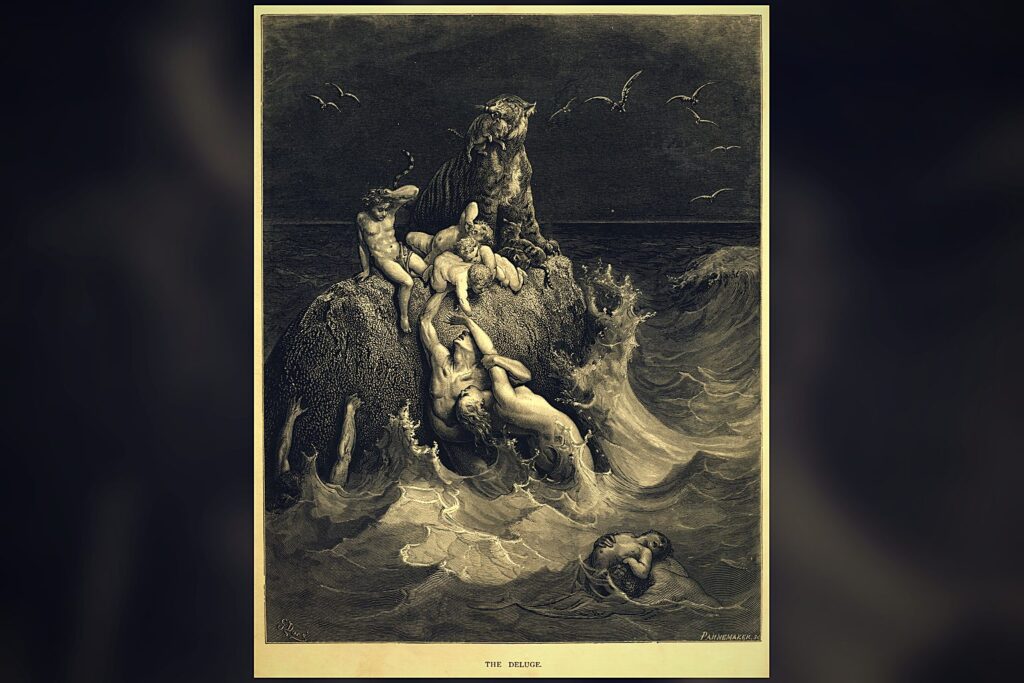
The Flood as a Containment Operation
This is where Genesis 6 stops reading like a moral fable and starts reading like an incident report.
The stated cause of the Flood is not that people were unkind. It is this:
“And God saw that the wickedness of man was great in the earth… And God looked upon the earth, and, behold, it was corrupt; for all flesh had corrupted his way upon the earth.” (Genesis 6:5, 12)
All flesh. Not all hearts. Not all minds. Flesh — a biological category. And the corruption is described as extending beyond humanity, since the judgement that follows includes the animals.
Then the description of Noah, which is the single most loaded sentence in the chapter:
“Noah was a just man and perfect in his generations.” (Genesis 6:9)
Two words matter.
Tamim, translated “perfect,” is the word used in Leviticus for a sacrificial animal that is without physical blemish — structurally sound, unmarked, fit for purpose. It is not primarily a moral word; it describes physical integrity.
“In his generations” — b’dorotav — refers to his lineage, his descent, his genealogical line. Not his behaviour. His ancestry.
Read together, Genesis 6:9 says Noah was unblemished in his line of descent. In a chapter whose entire problem is a corrupted biological inheritance, that phrasing is difficult to read as coincidence.
On this reading, the Flood is not punishment in the ordinary sense. It is containment — the removal of a corrupted population and the preservation of an uncompromised remnant, which is the same operational pattern visible at Sodom and in the tenth plague: a warning period, a marked exemption, and a sterilised zone.
The Problem of “And Also After That”
Genesis 6:4 contains four words that break the tidy version of this story:
“There were giants in the earth in those days; and also after that…”
Nephilim existed before the Flood — and afterwards. Yet the Flood was supposed to end that line.
And the Bible does record giants long after: Og of Bashan, the Anakim of Hebron, the Emim, the Zamzummim, and the sons of the giant at Gath. Numbers 13:33 has the spies reporting “there we saw the giants, the sons of Anak, which come of the giants: and we were in our own sight as grasshoppers.”
Three explanations are offered:
- A second incursion. The transgression was repeated after the Flood, on a smaller scale.
- Transmission through the Ark. One of the wives carried the recessive inheritance — which would make the later giants a resurfacing rather than a new event.
- Unrelated peoples. The later “giants” were simply unusually tall human populations who inherited the terminology.
None is decisive. The second is the most genetically coherent — a recessive trait can pass invisibly through a carrier and reappear generations later, which is exactly the mechanism at work in Jacob’s breeding of Laban’s flocks.
The Giant Skeletons
This is the part of the subject most people meet first, and it is worth going through slowly, because here the physical evidence and the text point in different directions.
Start with the photographs. No giant human skeleton has ever been verified. Every widely-shared photograph of an enormous excavated skeleton is a digital composite. The best-known series originated in a 2002 photo-manipulation contest and has been recycled with invented captions ever since. There is no suppressed Smithsonian vault.
The 19th-century newspaper reports are a more interesting case, because they were real reports — and they have real explanations:
- Mound burials were genuinely excavated across the American Midwest, and skeletons were recovered. Careless or enthusiastic measurement of a disarticulated skeleton laid out in soil routinely overstates height. Bones separate; gaps get counted.
- 19th-century journalism ran on sensation. Fabricated archaeology was a recognised genre. The Cardiff Giant of 1869 — a ten-foot “petrified man” — was an outright hoax that drew paying crowds for months.
- Misidentified animal remains account for a further share, particularly mastodon and mammoth bones, which were regularly interpreted as giant humans before comparative anatomy was well established.
Arguing that institutions stayed silent is not evidence in itself. The Smithsonian has published on this repeatedly, and the mound-builder collections are catalogued and accessible.
Readers who hold to the older interpretation do not usually dispute any of that, and their reply is worth hearing: the photographs were never the evidence. The text was. A forged picture does no more to disprove Genesis 6 than it does to prove it, and a claim made in a Bronze Age document does not become false because somebody made a bad composite about it in 2002.
So none of this settles what Genesis 6 means. What it settles is narrower: the archaeological claim does not carry the argument, and anyone resting the case on photographs has picked the weakest support available when the text itself is right there.
Why the Target Was Human Biology
If the angelic reading is correct, the strategic logic is worth stating, because it explains the choice of target.
Humanity is described in Genesis 1:27 as made in the image of God — the only thing in creation given that designation. Genesis 3:15 then specifies how the conflict ends: through “her seed”, a descendant of the woman who will crush the serpent’s head.
That prophecy creates a single point of vulnerability. The counter-move to a promise fulfilled through a bloodline is to corrupt the bloodline — not to defeat the seed, but to ensure there is no uncompromised line left for it to come through.
Read that way, Genesis 6 is not random depravity. It is an attack aimed precisely at the mechanism named in Genesis 3:15 — and the Flood is the response that preserves one unblemished line, from which, many generations later, that promised descendant would come.
The war that began with a third of the angels falling had moved to a new front, and the battlefield was the human genome.
Frequently Asked Questions
Who were the Nephilim?
The offspring described in Genesis 6:4, born after “the sons of God” took human wives. The text calls them mighty men of renown; the Septuagint translated the name as “giants.” The Hebrew derives from a root meaning “to fall.”
Were the sons of God fallen angels?
The phrase bene ha-Elohim means angelic beings everywhere else it appears in the Hebrew Bible, including Job 1:6 and Job 38:7. Jude 1:6-7 compares the sin of the angels who left their habitation to sexual transgression involving “strange flesh.” The main objection is Matthew 22:30, which says angels in heaven do not marry.
How tall were the Nephilim?
The Bible never gives one. Extra-biblical traditions preserve figures as large as 300 cubits — roughly 137 metres (449 ft) on the common cubit of about 45 cm (18 in), nearer 157 m (515 ft) on the royal Egyptian cubit of 52.36 cm (21 in). Under present-day conditions that runs into the square-cube law, since bone strength scales with cross-section while mass scales with volume; readers who take the figure literally reply that pre-Flood conditions are exactly what is in dispute. The giants the Bible does measure — Goliath, Og — are very much smaller, and they are the ones that can be checked.
Did the Nephilim survive the Flood?
Genesis 6:4 says giants were on the earth “in those days, and also after that,” and giants appear later in Numbers 13:33 and Deuteronomy 3:11. Explanations include a second incursion, transmission of a recessive trait through the Ark, or later use of the same terminology for unusually tall peoples.
What does “Noah was perfect in his generations” mean?
The Hebrew tamim is used in Leviticus for sacrificial animals without physical blemish, and “in his generations” refers to his line of descent. In a chapter concerned with corrupted flesh, many readers understand it as a statement about the integrity of Noah’s ancestry rather than his moral behaviour.
Are there giant skeletons in museums?
No verified giant human skeleton is held in any museum collection. The photographs that circulate are digital composites, most traceable to a 2002 photo-manipulation contest, and the 19th-century newspaper accounts are explained by imprecise measurement of mound burials, sensationalist journalism and misidentified mammoth and mastodon remains. Readers who hold to the older interpretation point out that the photographs were never the evidence — the text was, and Genesis 6 neither stands nor falls on a forged picture.
What is the Book of Enoch’s account of the Nephilim?
1 Enoch describes two hundred Watchers descending on Mount Hermon and binding themselves by oath, taking human wives and fathering the giants. It records the offspring consuming crops, then livestock, then turning on humanity, and lists forbidden knowledge the Watchers taught.
Why did God send the Flood?
Genesis 6:5 and 6:12 give the reason as pervasive wickedness and the corruption of “all flesh” upon the earth. The phrase is biological rather than purely moral, which is why many readers connect the Flood directly to the events described in Genesis 6:1-4.
Conclusion: Four Verses and a Deluge
Genesis 6:1-4 is the most compressed passage in the primeval history, and the compression is the point. Something is described in four verses, and five verses later the planet is scheduled for erasure.
You can read the sons of God as angels, as the line of Seth, or as kings. But whichever reading you take, the chapter’s own logic is consistent: something happened to flesh — not to attitudes — and the response was not correction but removal, with one line preserved on the explicit grounds that it was unblemished in its descent.
The giants never appear in Scripture as heroes. They are never righteous, never repentant, never redeemed. They appear, they consume, and they are destroyed. In a book that finds room for the redemption of murderers, adulterers and traitors, that absence is the most telling detail of all.
Continue Reading
- Who Was Enoch? The Man Who Never Died — Genesis 5 lists the patriarchs and every entry ends the same way: and he died. On the seventh entry the ledger simply…
- The Book of Enoch Giants: The Lost Book That Names Them — They were enormous and they ate people — that is the part everyone knows. The part nobody knows is that a second book…
- The War in Heaven: How the Rebellion of the Angels Changed Reality — A third of the angels rebelled and lost. But they were not destroyed – they were relocated. Inside the war in heaven…