
Do the Dead Sea Scrolls contradict the Bible? The question only has force once you know what came before them. Until 1947, the oldest complete Hebrew manuscript of the Old Testament was the Leningrad Codex, copied around AD 1008.
That is a problem you can state in one sentence. The book of Isaiah was written in roughly the 8th century BC. The oldest complete copy anyone could examine was from the 11th century AD. Between the original and the manuscript lay eighteen hundred years of hand-copying, by scribes nobody could check, with no way to know what had drifted.
Then a Bedouin shepherd threw a stone into a cave near the Dead Sea and heard pottery break.
The scrolls recovered from Qumran over the following decade pushed the manuscript record back by a thousand years — and made it possible, for the first time, to test how accurately the text had actually been transmitted.

What Are the Dead Sea Scrolls?
The Dead Sea Scrolls are a collection of roughly 900 to 1,000 manuscripts, surviving in around 25,000 fragments, recovered between 1947 and 1956 from eleven caves near Qumran on the north-western shore of the Dead Sea.
They date from approximately 250 BC to AD 68, when the site was destroyed during the First Jewish Revolt. Most are in Hebrew, with some in Aramaic and a few in Greek.
They divide into three groups:
| Type | Share | Content |
|---|---|---|
| Biblical | ~40% | Copies of Hebrew Bible books — every book except Esther |
| Sectarian | ~30% | The community’s own rules, hymns and commentaries |
| Other Jewish literature | ~30% | Apocryphal and pseudepigraphal works, including Enoch and Jubilees |
Do the Dead Sea Scrolls Contradict the Bible?
This is the most-asked question, and the answer has two halves that get quoted separately by people with opposite agendas.
The stability is genuinely remarkable
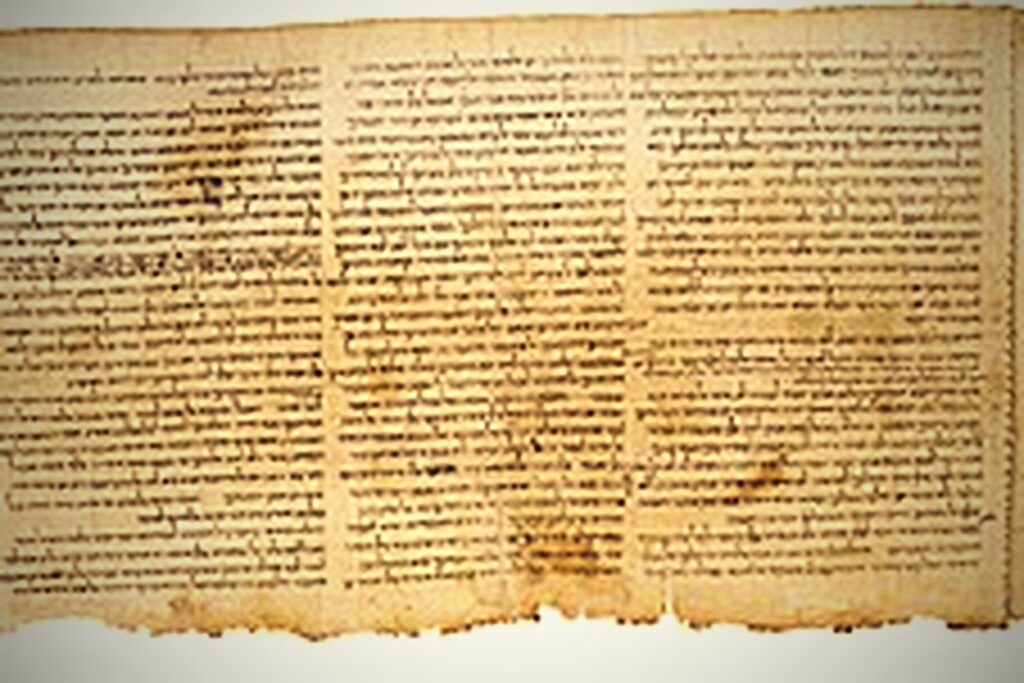
The Great Isaiah Scroll (1QIsaᵃ) is the showpiece: a complete copy of Isaiah, 7.3 metres (24 ft) long, dated to around 125 BC. Compared with the Masoretic text of a thousand years later, it is substantially identical.
The differences that exist are overwhelmingly trivial — spelling variations, the presence or absence of the conjunction “and,” word order in a handful of places. The commonly cited figure is that around 95% of the text is word-for-word identical, with most remaining variation being orthographic.
For a document copied by hand for a thousand years with no printing press, no photocopier and no checking against an original, that is an extraordinary result. It is the strongest evidence available that the transmission was careful.
And there are real variants
Anyone who stops at the previous paragraph is telling half the story.
The text was not uniform in antiquity. The scrolls show that multiple textual traditions existed side by side at Qumran. Some manuscripts align with the Masoretic tradition, some with the Hebrew source behind the Greek Septuagint, some with the Samaritan Pentateuch, and some with none of them. The single authoritative Hebrew text familiar today was not yet standard.
Some variants matter. The clearest example is one this site has examined in detail: 4QSamᵃ gives Goliath’s height as four cubits and a span — about 6 ft 9 in — where the Masoretic text reads six cubits and a span, about 9 ft 9 in. The Septuagint agrees with the scroll. The full case is here, and it is a real, three-foot difference in a familiar story.
Jeremiah exists in two editions. Qumran preserves Hebrew fragments of a shorter Jeremiah, roughly one-eighth briefer than the Masoretic version and with material in a different order — matching the Septuagint. Two genuine editions of a biblical book were circulating.
Psalm 145 gains a verse. The scroll 11QPsᵃ contains a line in the acrostic that the Masoretic text lacks, filling a gap where the alphabetical structure demands a letter.
So the honest answer: the scrolls confirm the text was transmitted with great care, and they also show the text was not perfectly uniform. Both statements are true. The scrolls did not overturn the Bible, and they did not leave it exactly as received either.
Do the Scrolls Mention Jesus?
No. This needs stating plainly because it circulates constantly in both directions.
The scrolls were deposited by AD 68 and the bulk of them were written before Jesus was born. No manuscript names him, and no New Testament text has been identified among them despite occasional claims — most notably about a Greek fragment from Cave 7, an identification almost universally rejected.
What the scrolls do provide is enormously valuable for understanding the period: the religious world Jesus and the earliest Christians lived in. They show a Judaism far more varied than the later sources suggested, containing:
- Intense messianic expectation, including texts anticipating more than one messianic figure
- Apocalyptic dualism — the War Scroll describes the Sons of Light against the Sons of Darkness
- Communal property, ritual washing and shared meals
- A Teacher of Righteousness, a founding figure persecuted by opponents
Some of that vocabulary is strikingly close to New Testament language, which has produced endless speculation about direct connections. The mainstream reading is more modest and probably right: both drew on a common Jewish religious environment.
What the Scrolls Say That the Bible Does Not
The non-biblical material is the part most people never hear about, and it is the most interesting.
1 Enoch is here, in Aramaic. Fragments of Enoch were found at Qumran, confirming that the text was circulating in Judea well before the New Testament — which matters, because Jude 1:14 quotes it directly. The full account of Enoch is here.
The Book of Giants. An Enochic work elaborating on the Nephilim, giving the giants names and describing their dreams of coming judgement.
The Copper Scroll. Unique — inscribed on metal rather than parchment, and it is a treasure list. It catalogues 64 locations holding quantities of gold and silver so large that most scholars doubt the inventory is literal. Nobody has found any of it, and nobody has resolved whether it is a real hoard, a symbolic text, or a record of temple assets hidden before the Roman destruction.
The Temple Scroll. The longest scroll at over eight metres, describing an idealised temple with specifications far exceeding anything built.
The Community Rule. The group’s own constitution — entry procedures, discipline, shared meals, and a rigid hierarchy.
Who Wrote Them?
The traditional identification is the Essenes, a Jewish sect described by Josephus, Philo and Pliny the Elder as living communally near the Dead Sea, practising ritual purity and holding property in common. The match between those descriptions and the Community Rule is close.
It is not unanimous. Alternative proposals hold that the scrolls were a library evacuated from Jerusalem before the Roman advance and hidden in the caves, which would explain the textual diversity better than a single sect’s own library does. Others propose a Sadducean origin based on legal positions in some texts.
The debate is unresolved, and the diversity of textual traditions in the collection is the strongest argument that it is not the product of one community’s copying.
Why This Is the Most Important Manuscript Find Ever Made
Here is the thing that makes Qumran different from every other claimed discovery in this field.
It was a test that could have failed.
Before 1947, the accuracy of the biblical text’s transmission was a matter of assertion. Believers asserted it had been preserved; sceptics asserted a thousand years of copying must have deformed it. Neither side could check, because there was nothing to check against.
The scrolls made the check possible. A thousand-year gap was suddenly available for inspection, and the result could have gone any way — wholesale rewriting, missing books, inserted material, drifting narratives.
What came back was: substantially the same text, with real but limited variation, and a more complicated picture of what “the text” meant in antiquity than either side had expected.
That is what a genuine finding looks like, and it is worth contrasting with the pattern that runs through most of this field — the Sodom paper that was retracted, the footprints withdrawn by their own promoters, the Dogon astronomy that could not be replicated, the Shroud dating that remains contested after fifty years.
The Dead Sea Scrolls are the case where somebody asked a hard question, the evidence arrived, and it gave a clear answer that was not what anybody’s simple version predicted.
Frequently Asked Questions
Do the Dead Sea Scrolls contradict the Bible?
Not substantially. The Great Isaiah Scroll from around 125 BC is largely identical to the Masoretic text a thousand years later, with most differences being spelling. But real variants exist, including Goliath’s height in 4QSamᵃ, a shorter edition of Jeremiah, and an additional verse in Psalm 145.
Do the Dead Sea Scrolls mention Jesus?
No. The scrolls were deposited by AD 68 and most predate Jesus’s birth. No manuscript names him, and claimed identifications of New Testament fragments among them are almost universally rejected.
Are the Dead Sea Scrolls in the Bible?
About 40% of the manuscripts are copies of Hebrew Bible books — every book except Esther. The remaining 60% consists of the community’s own writings and other Jewish literature, including 1 Enoch, Jubilees and the Book of Giants.
How old are the Dead Sea Scrolls?
They date from roughly 250 BC to AD 68. Before their discovery, the oldest complete Hebrew Old Testament manuscript was the Leningrad Codex from around AD 1008, so the scrolls pushed the record back by about a thousand years.
Who wrote the Dead Sea Scrolls?
Most commonly attributed to the Essenes, a Jewish sect described by Josephus, Philo and Pliny as living communally near the Dead Sea. Alternatives propose a library evacuated from Jerusalem before the Roman advance, which would better explain the textual diversity.
What is the Copper Scroll?
A unique scroll inscribed on metal rather than parchment, listing 64 locations said to hold large quantities of gold and silver. None of it has been found, and whether the inventory is literal, symbolic, or a record of hidden temple assets remains unresolved.
Do the Dead Sea Scrolls predate Jesus?
Most do. The collection spans roughly 250 BC to AD 68, so a large proportion was written before Jesus’s lifetime, and the rest during or shortly after it.
What do the Dead Sea Scrolls prove?
That the Hebrew biblical text was transmitted with great care over a thousand years, while also showing that multiple textual traditions coexisted in antiquity and that a single standardised Hebrew text had not yet been fixed.
Conclusion: The Gap That Got Filled
For eighteen centuries, the most important claim anyone made about the Hebrew Bible — that it had come down substantially unchanged — was unfalsifiable. There was no older copy to compare against. You could believe it or not, and no evidence could touch the question.
In 1947 that changed, because a shepherd looking for a lost goat threw a rock into a cave and heard something break.
The comparison that became possible was one nobody controlled. The Isaiah scroll had been sitting in a jar since before the Roman occupation of Judea, untouched by every subsequent argument about what the text should say.
It came out reading almost exactly like the version in a modern Bible — and also carrying enough real variation to show that antiquity was messier than the tidy story on either side.
That is the most valuable kind of discovery: one that answers the question that was actually asked, and complicates it at the same time.
Continue Reading
- The Book of Jubilees: Fifteen Copies and the Wrong Calendar — Qumran held more copies of Jubilees than of Kings. What the book says, the 364-day calendar it was willing to split a…
- The Book of Enoch Giants: The Lost Book That Names Them — They were enormous and they ate people — that is the part everyone knows. The part nobody knows is that a second book…
- Who Was Enoch? The Man Who Never Died — Genesis 5 lists the patriarchs and every entry ends the same way: and he died. On the seventh entry the ledger simply…