Ask whether there are dinosaurs in the Bible and you will get two confident answers. Here is a fact that does not fit neatly into either.
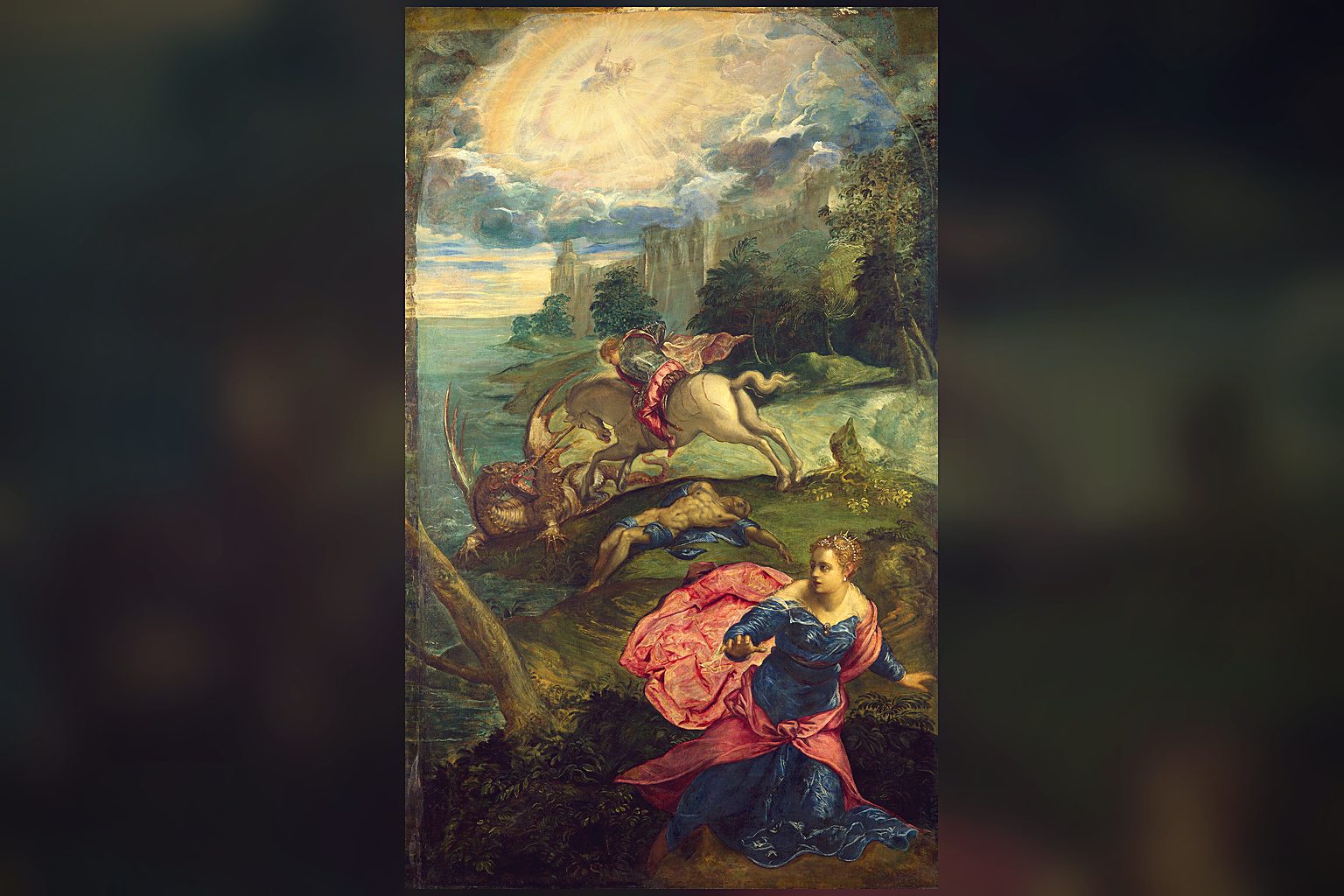
Almost every ancient culture on earth — with no contact, no shared language, and no common mythology — independently describes the same animal. Large. Reptilian. Long-tailed. Dangerous. The Chinese called it lóng. The Norse, ormr. The Greeks, drakon. The Welsh put one on their flag, where it still is.
Dragons are one of the most widely distributed motifs in human storytelling, and they appear in places whose inhabitants never met.
That is a genuine puzzle. It is not, on its own, evidence that anyone saw a dinosaur — and the honest version of this subject requires separating what the texts actually say from what has been claimed on their behalf.
Where the Word Comes From
The most common objection has a mundane answer.
Sir Richard Owen coined the word “dinosaur” — from Greek deinos sauros, “terrible lizard” — in 1841. The King James Bible was translated in 1611, two hundred and thirty years earlier. No English translator before Owen could have used a word that did not exist.
What the Hebrew text uses instead is tannin (תַּנִּין), a word appearing about 28 times and rendered variously as dragon, serpent, sea monster or whale depending on context. Genesis 1:21 uses it for the great creatures God made on the fifth day.
The category existed. The label changed.
Behemoth: The Strongest Case in the Text
The most substantial passage is in Job 40, and it repays careful reading.
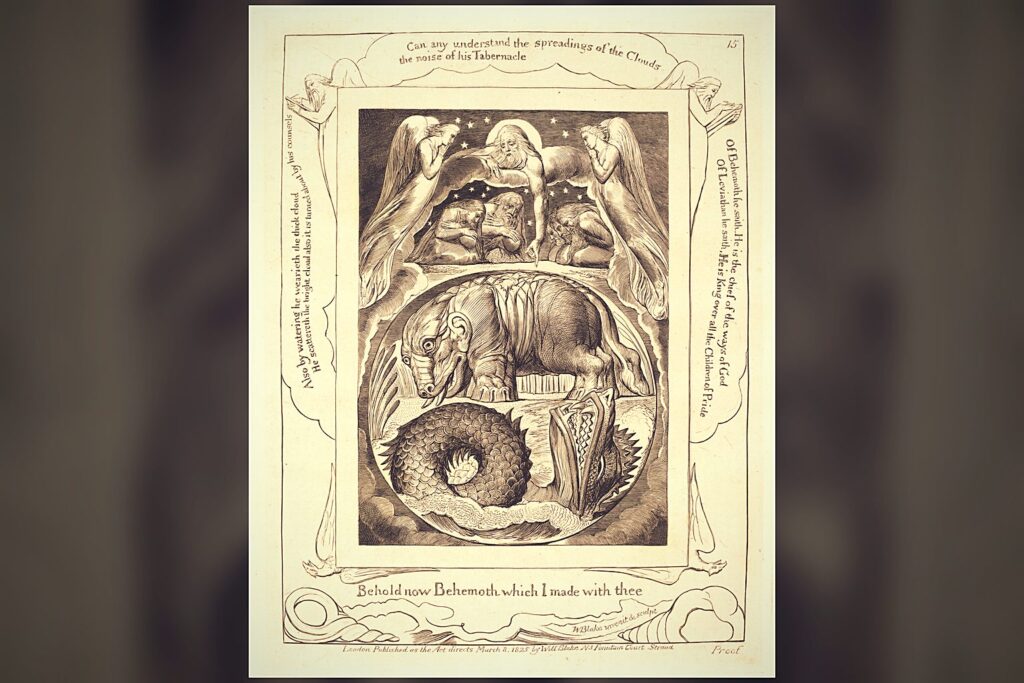
“Behold now behemoth, which I made with thee; he eateth grass as an ox. Lo now, his strength is in his loins, and his force is in the navel of his belly. He moveth his tail like a cedar: the sinews of his stones are wrapped together.” (Job 40:15-17)
Then:
“His bones are as strong pieces of brass; his bones are like bars of iron. He is the chief of the ways of God.” (Job 40:18-19)
Four details matter:
“Which I made with thee.” God presents Behemoth as a contemporary of Job, not a creature from a vanished age.
“He eateth grass as an ox.” A herbivore.
“He moveth his tail like a cedar.” This is the crux. A cedar of Lebanon is a massive tree with a thick, tapering trunk.
“The chief of the ways of God.” The largest or foremost of God’s works — an odd superlative for an ordinary animal.
The Footnote Problem
Most modern Bibles footnote Behemoth as a hippopotamus or elephant. Both have a real difficulty with verse 17.
A hippopotamus’s tail is a short flattened flap, roughly 35 cm (14 in). An elephant’s is a thin rope with a tuft. Neither invites comparison to a cedar, and the comparison is the one detail the text chooses to emphasise.
The usual defence is that zanab might mean something other than tail, or that the comparison is to the cedar’s swaying rather than its bulk. Both are possible. Neither is comfortable.
A sauropod — a diplodocid or similar — has exactly the tail the verse describes: enormous at the base, tapering along its length, muscular. It also eats plants, has bones that could fairly be compared to iron bars, and would unquestionably be “the chief of the ways of God” in size.
The honest position: Job 40 describes an animal whose most emphasised feature does not match the standard identifications, and does match a class of animal the writer is not supposed to have known about. That is a real observation. It is not proof, because a poetic text is not a field guide, and we cannot cross-examine the author.
Job 41 then describes Leviathan at even greater length — the sea counterpart, armoured, unkillable by human weapons.
The Paluxy River Tracks: A Correction
This needs to be addressed directly, because it is repeated constantly and the people who originally promoted it retracted it.
In the limestone bed of the Paluxy River near Glen Rose, Texas, there are genuine, abundant, well-preserved dinosaur tracks. Alongside them, elongated impressions were interpreted from the 1930s onward as human footprints — the “Taylor Trail” — and presented as proof that humans and dinosaurs walked the same mud.
Then, in the mid-1980s, the case collapsed, and it collapsed from the inside.
- As the surface weathered, colouration appeared within the elongated tracks revealing dinosaur toe impressions. The “human” prints were the full metatarsal impressions of a dinosaur walking with its foot flat to the ankle rather than on its toes.
- In 1986, John Morris of the Institute for Creation Research published a retraction — “The Paluxy River Mystery” — stating the tracks could no longer be used as evidence.
- Answers in Genesis lists the Paluxy man tracks among arguments creationists should not use.
- Some of the prints in circulation were also carved — locals sold fabricated “man tracks” to tourists during the Depression.
So the Paluxy evidence is withdrawn, by its own advocates, on the basis of physical observation. Anybody still citing it is citing something abandoned forty years ago.
This matters beyond Paluxy. A case built on retracted evidence is weaker than one built on the text — and the same lesson applies to the giant skeleton photographs and to the retracted Sodom airburst paper. Keeping a dead claim alive costs more credibility than the claim was ever worth.
So Why Do Dragons Appear Everywhere?
Strip away the discredited material and the distribution problem remains. Four explanations compete, and they are not mutually exclusive.
| Explanation | Mechanism | Strength | Weakness |
|---|---|---|---|
| Fossil interpretation | Ancient peoples found large bones and reconstructed the animal | Documented — Adrienne Mayor’s work shows Greek and Chinese fossil finds shaping monster traditions | Does not explain accounts describing behaviour and habitat |
| Convergent psychology | Humans have inherited threat responses to snakes, big cats and raptors; dragons combine all three | Explains why dragons recur without contact; fits primate predator-detection research | Does not explain the consistently reptilian and specific form |
| Living animals | Crocodiles, monitor lizards, large snakes, and rare sightings | Nile crocodiles reach 6 m (20 ft); Komodo dragons were unknown to science until 1910 | Does not account for the size and the flight motif |
| Genuine memory | Some accounts preserve encounters with animals now extinct | Would explain the specificity | No verified physical evidence |
The fossil explanation is the strongest single answer, and it is well documented. The classicist Adrienne Mayor demonstrated in detail how Greek griffin legends track the fossil beds of Protoceratops along Central Asian trade routes, and how Chinese “dragon bones” — sold in apothecaries for centuries — were dinosaur and mammal fossils.
That is a real mechanism, evidenced, and it explains a great deal without requiring anyone to have seen a living dinosaur.
What it explains less well is the subset of accounts that describe behaviour — feeding, nesting, movement, habitat — rather than form alone. Bones give you a shape. They do not tell you what the animal ate or where it lived.
The Corruption Question
There is a theological difficulty underneath all of this that is rarely stated plainly.
Genesis 1 has God creating the animals and pronouncing them good, and Genesis 1:30 assigns plants as food to every creature. Yet the fossil record contains animals equipped with serrated teeth, gripping claws and binocular predatory vision — anatomy that is not ambiguous.
Two responses are possible.
The first is that predation was part of the design from the beginning, and that “good” means fit for purpose rather than free of death.
The second reads Genesis 6:12 the way the Nephilim account does:
“…for all flesh had corrupted his way upon the earth.”
All flesh — a biological category extending past humanity. On this reading, what was made good was later damaged, and some of what we find in the fossil record reflects that damage rather than the original specification.
This is speculation and should be labelled as such. It is a reading of a phrase, not a finding. But it is at least a coherent response to a genuine tension in the text, which is more than the usual answers manage.
What Happened to Them?
If large reptiles did coexist with humans, their disappearance needs no exotic explanation. It has a name, and we are still doing it.
Large-bodied, slow-reproducing animals are the most vulnerable class in any extinction event. They need extensive territory, they breed slowly, and they cannot recover from sustained pressure. Humans have driven exactly this category to extinction repeatedly and recently — moa, aurochs, Steller’s sea cow, thylacine.
Add a climatic catastrophe of the kind the Flood narrative describes, followed by a colder, drier, lower-productivity world, and large ectotherms are precisely the animals that would not make it through.
And the stories would remain, because stories outlive species. The last real one is killed, and the account keeps being told until nobody can check it.
Frequently Asked Questions
Are dinosaurs mentioned in the Bible?
The word “dinosaur” was coined in 1841, long after the Bible was translated, so it could not appear. The Hebrew tannin, rendered dragon, serpent or sea monster, covers large reptilian creatures, and Job 40-41 describes Behemoth and Leviathan in physical detail.
Is Behemoth a dinosaur?
Job 40:17 says Behemoth “moveth his tail like a cedar,” which fits a sauropod’s tail and fits neither a hippopotamus’s short flap nor an elephant’s thin tail. The passage is poetry rather than zoology, so the identification cannot be settled, but the standard footnote identifications do struggle with that verse.
Did humans and dinosaurs live at the same time?
Mainstream science places non-avian dinosaur extinction around 66 million years ago, long before humans. No verified physical evidence of coexistence exists. The Paluxy River “man tracks,” long offered as proof, were retracted by the creationist organisations that promoted them.
Are the Paluxy River human footprints real?
No. Weathering revealed dinosaur toe impressions inside the elongated tracks, showing them to be metatarsal dinosaur prints. John Morris of the Institute for Creation Research published a retraction in 1986, and Answers in Genesis lists them among arguments not to use. Some circulating prints were also carved fakes.
Why do so many cultures have dragon legends?
The best-evidenced explanation is fossil interpretation — ancient peoples finding large bones and reconstructing the animal, documented by classicist Adrienne Mayor for Greek griffin and Chinese dragon traditions. Inherited predator-detection instincts and encounters with crocodiles and large lizards also contribute.
What is Leviathan in the Bible?
A sea creature described at length in Job 41, with impenetrable scales, terrifying strength and imagery of fire and smoke. It also appears in Psalm 74 and Isaiah 27, where God is said to break its heads.
What does the Hebrew word tannin mean?
A large reptilian creature — translated as dragon, serpent, sea monster or whale depending on context. It appears about 28 times, including Genesis 1:21 for the great creatures made on the fifth day.
Conclusion: The Text and the Evidence
Two things can be true at once, and the usual argument insists they cannot be.
The physical evidence does not support human-dinosaur coexistence. The Paluxy tracks are retracted. No verified artefact exists. The fossil interpretation hypothesis explains worldwide dragon traditions without requiring anyone to have seen a living one.
And Job 40 still describes an animal whose most emphasised feature is a tail like a cedar, presented as a contemporary of the man being addressed, and called the chief of the ways of God.
The second fact does not overturn the first. But it is a real feature of a very old text, and translating it into “hippopotamus” has never been a comfortable fit for anyone who reads the verse carefully.
What the ancient world actually recorded is not dinosaurs in the modern sense. It is something more modest and, in its way, more interesting: a consistent memory, spread across unconnected cultures, of very large reptiles that mattered — and a Hebrew text that describes two of them in more anatomical detail than it gives to any animal alive today.
Continue Reading
- The Leviathan Paradox: Why Did God Execute His Own Creation? — God praises Leviathan for thirty-four verses in Job 41 – then breaks its heads in Psalm 74. How many were there, why…
- King Solomon: What the Archaeology Actually Shows — No inscription names him. But radiocarbon put industrial copper smelting in the Arava in his century, and a 2021…
- Atlantis: One Source, and It Stops Mid-Sentence — Every Atlantis expedition in history traces back to two unfinished dialogues by one Athenian. What Plato actually…