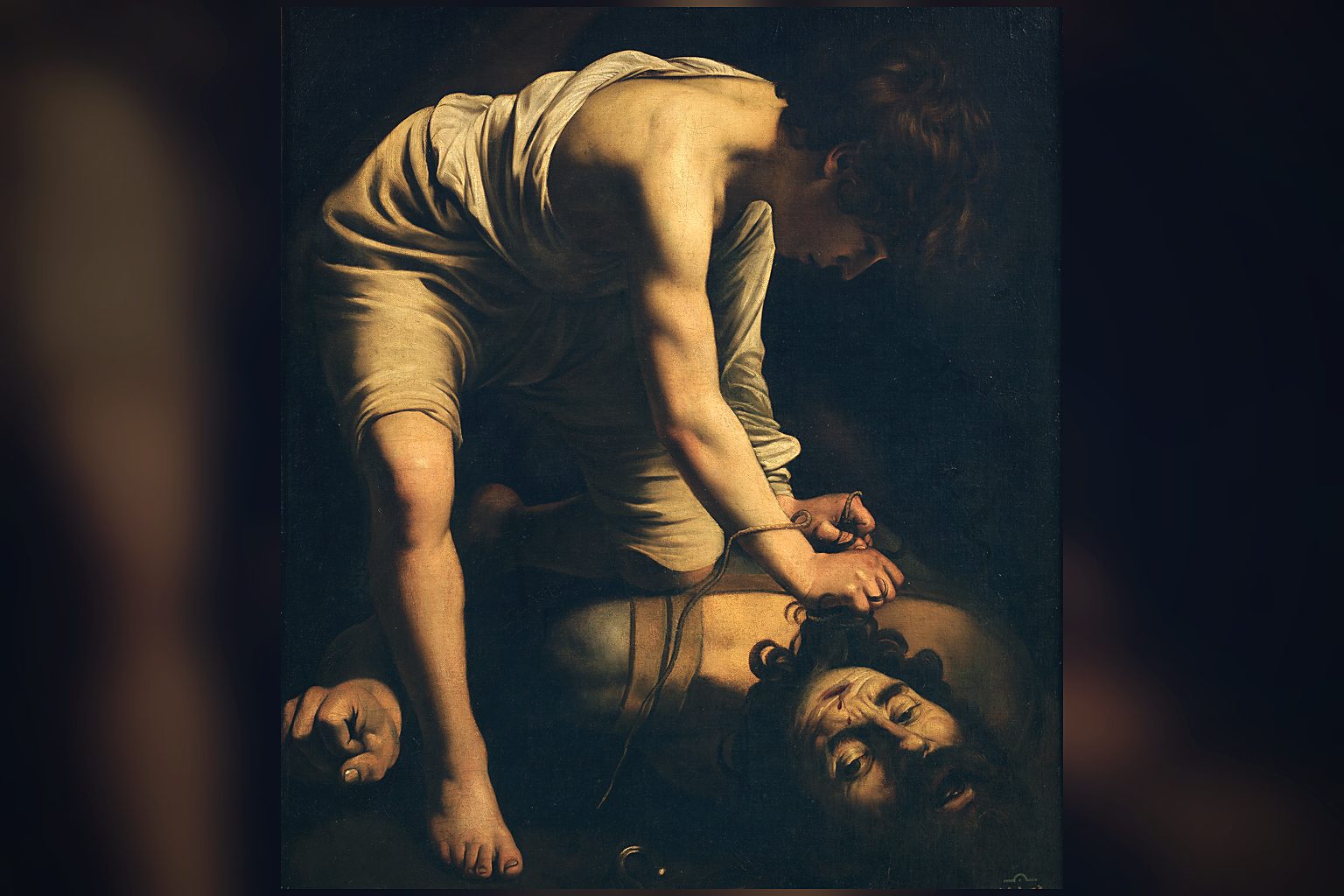
Ask how tall Goliath was and you will get a confident answer: nine feet nine inches. It is in countless children’s Bibles, sermons and encyclopaedias.
The problem is that the oldest surviving manuscripts do not say that. They say six foot nine.
The three-foot discrepancy is not a translation dispute or a modern sceptical revision. It is a documented difference between ancient copies of 1 Samuel — and the shorter figure appears in the two oldest witnesses we have.
That single number turns out to be the key to the whole question of giants in the Bible, because it exposes exactly how these accounts behave as they travel through time.
How Tall Was Goliath?
It depends on the manuscript.
| Source | Reading | Approximate height | Date of witness |
|---|---|---|---|
| Masoretic Text | Six cubits and a span | ~9 ft 9 in (2.97 m) | c. 10th century AD |
| Septuagint (Greek) | Four cubits and a span | ~6 ft 9 in (2.06 m) | c. 3rd-2nd century BC |
| Dead Sea Scrolls (4QSam^a) | Four cubits and a span | ~6 ft 9 in (2.06 m) | c. 1st century BC |
| Josephus, Antiquities | Four cubits and a span | ~6 ft 9 in (2.06 m) | 1st century AD |
The Masoretic Text is the basis of almost every modern translation, and it is an extraordinarily careful tradition. But the manuscripts behind it are roughly a thousand years younger than the Dead Sea Scrolls fragment of Samuel and the Greek Septuagint — and those two independent witnesses agree with each other, and with Josephus, on four cubits.
Textual critics generally regard the shorter reading as more likely original, for a specific reason: numbers are unusually vulnerable in transmission. In Hebrew manuscripts numerals were often written as letters, and a single character change alters a quantity in a way that leaves no grammatical trace. Scribes catch broken sentences. They do not catch a four that became a six.
Which Height Is More Impressive?
Here is the part that gets lost in the argument. Six foot nine is the better story.
The average male height in Iron Age Israel, based on skeletal remains, was somewhere around five foot two to five foot five. A man of 2.06 m (6 ft 9 in) would stand more than a foot and a half above the tallest soldiers in the field — a physically overwhelming, genuinely terrifying opponent, and one who plainly exists.
And it makes the rest of the description work. Goliath’s armour is itemised in 1 Samuel 17:5-7: a bronze helmet, a coat of mail weighing five thousand shekels (about 57 kg (126 lb)), bronze greaves, a bronze javelin, and a spear whose head alone weighed six hundred shekels of iron (about 6.8 kg (15 lb)). A man of 2.06 m (6 ft 9 in) with the build to match could carry that. At 2.97 m (9 ft 9 in), the square-cube law starts causing serious problems — and men who reach that height in the real world, through pituitary disorders, are not champions. They are frail.
The Medical Reality of Gigantism
This is worth understanding, because it explains why the taller reading creates difficulties the text does not acknowledge.
Extreme height in humans is almost always caused by excess growth hormone, usually from a benign pituitary tumour. If it occurs before the growth plates fuse, the result is gigantism; afterwards, acromegaly.
The condition carries consequences that are difficult to hide:
- Visual field loss. A pituitary tumour presses upward on the optic chiasm, characteristically destroying peripheral vision.
- Joint and cardiac strain. Enlarged hearts, arthritis, reduced stamina.
- Skeletal weakness. Bone grows in length faster than it gains density.
Robert Wadlow, the tallest documented person at 2.72 m (8 ft 11 in), needed leg braces to walk and had almost no feeling in his feet. He was not a warrior.
Some readers use this to argue Goliath had acromegaly — noting that he is led onto the field by a shield-bearer walking in front of him (1 Samuel 17:7, 41), which would be useful for a man with no peripheral vision, and that David’s approach from the side went unanswered.
It is an interesting reading. It also quietly concedes the point: a man tall enough to be pathological is a man with pathological weaknesses. At four cubits and a span, Goliath needs no diagnosis at all. He is simply an exceptionally large, healthy, professional soldier — which is what the text otherwise describes.
The Other Giants: Who Were the Rephaim?
Goliath is not presented as unique. He belongs to a named population.
“And there was yet a battle in Gath, where was a man of great stature, that had on every hand six fingers, and on every foot six toes, four and twenty in number; and he also was born to the giant.” (2 Samuel 21:20)
Several groups appear across the Hebrew Bible:
- Rephaim — the general term for the pre-Israelite giant clans, associated with the Transjordan.
- Anakim — descendants of Anak, living around Hebron. The spies’ report in Numbers 13:33 says “we were in our own sight as grasshoppers.”
- Emim and Zamzummim — Moabite and Ammonite names for Rephaim populations (Deuteronomy 2:10-11, 2:20-21).
- The sons of the giant in Gath — Goliath’s own group, including the man with twenty-four digits.
The single most concrete detail in the entire subject is Og, king of Bashan:
“Behold, his bedstead was a bedstead of iron… nine cubits was the length thereof, and four cubits the breadth of it, after the cubit of a man.” (Deuteronomy 3:11)
Nine cubits by four — roughly 4.1 by 1.8 metres (5 ft 11 in). And note the qualifier: “after the cubit of a man” — the writer is specifying which measuring standard he is using, as if aware the figure would be doubted.
A bed is not a body. A 4-metre bedstead indicates status as readily as stature; royal furniture is routinely oversized. But the detail is recorded in the manner of a physical object someone had seen, and the text says it was still on display in Rabbah at the time of writing.
Polydactyly Is Real
The six-fingered, six-toed man of Gath deserves attention, because this detail is medically genuine.
Polydactyly — extra digits — is one of the more common congenital differences, and certain forms are inherited as an autosomal dominant trait. Crucially, it clusters in families and in isolated populations where the gene pool is limited.
So the text records a specific, heritable, non-mythological trait appearing within a defined family group in a single city. That is exactly what a real founder effect in a small endogamous population looks like. It is not the kind of detail legend generates; legend gives heroes strength and size, not an inherited limb variant.
Where Did the Giants Come From?
Genesis 6 is the source of the tradition, and it is famously compressed:
“There were giants in the earth in those days; and also after that, when the sons of God came in unto the daughters of men, and they bare children to them, the same became mighty men which were of old, men of renown.” (Genesis 6:4)
The Hebrew word translated “giants” is Nephilim, from a root meaning to fall. The Septuagint rendered it gigantes, which is where the English comes from.
The phrase “and also after that” is the key problem. It means Nephilim existed both before and after the Flood — which is difficult, since the Flood was supposed to end that line. Proposed solutions range from a second incursion after the Flood, to transmission through one of the wives on the ark, to reading the later “giants” as unrelated large-statured peoples who inherited the name.
The extra-biblical literature is far more explicit. 1 Enoch names the Watchers, describes their descent on Mount Hermon, and attributes to their offspring enormous size and destructive appetite. That account is examined in detail in the Nephilim and in Enoch’s own story.
What Archaeology Actually Shows
This needs saying plainly, because the internet is saturated with the opposite.
No giant human skeletons have ever been recovered. Every widely-circulated photograph of an enormous excavated skeleton is a digital composite; the best-known set originated in a photo-manipulation contest in 2002 and has been recycled ever since. There is no suppressed Smithsonian archive.
What archaeology does show is more modest and more useful:
- Gath has been excavated. Tell es-Safi is a major Philistine city, and excavation has confirmed substantial Iron Age fortifications consistent with the city Goliath is said to have come from.
- An inscription from Gath dated to around the 9th century BC preserves two names, alwt and wlt, which are linguistically close to Goliath. It does not name the man in 1 Samuel, but it establishes that names of that form were in use in that city at roughly that period.
- Skeletal remains from the region show a normal human height distribution. Individuals above two metres occur, as they do in any population, and would have been startling among men averaging five foot three.
Frequently Asked Questions
How tall was Goliath?
It depends on the manuscript. The Masoretic Text says six cubits and a span, about 9 ft 9 in. The Septuagint, the Dead Sea Scrolls fragment 4QSam^a and Josephus all say four cubits and a span, about 6 ft 9 in. The older witnesses agree on the shorter figure.
Why do Bibles disagree about Goliath’s height?
Because they follow different manuscript traditions. Most modern translations follow the Masoretic Text, which is about a thousand years younger than the Dead Sea Scrolls and Septuagint witnesses that give the shorter reading. Numbers are especially prone to scribal error, since Hebrew wrote them as letters.
Were there really giants in the Bible?
The Bible names several large-statured peoples — Rephaim, Anakim, Emim and Zamzummim — and describes individuals of exceptional size. Whether these were a distinct population or simply unusually tall people among a short-statured population is disputed. No giant skeletons have ever been recovered archaeologically.
Who were the Nephilim?
The Nephilim appear in Genesis 6:4 as offspring of “the sons of God” and “the daughters of men,” described as mighty men of renown. The Hebrew name derives from a root meaning “to fall.” The Book of Enoch expands the account considerably.
How tall was Og, king of Bashan?
His height is never given. Deuteronomy 3:11 records only that his iron bedstead measured nine cubits by four — about 4.1 by 1.8 metres (5 ft 11 in) — and notes it was still on display in Rabbah.
Did Goliath have a medical condition?
Some readers suggest acromegaly or pituitary gigantism, noting that a shield-bearer walked ahead of him and that he did not react to David’s approach, which could indicate the peripheral vision loss such tumours cause. At the shorter manuscript height of 6 ft 9 in, no medical explanation is needed.
What about the six-fingered giant?
2 Samuel 21:20 describes a man of great stature at Gath with six fingers on each hand and six toes on each foot. Polydactyly is a real, heritable condition that clusters in families and isolated populations, which makes this one of the more plausible details in the account.
Have giant skeletons ever been found?
No. Every circulating photograph of a giant excavation is a digital fabrication, most traceable to a 2002 photo-manipulation contest. No verified remains of a human over about 2.7 metres (8 ft 10 in) exist.
Conclusion: The Number That Grew
There is a quiet irony in this subject.
The manuscripts most likely to preserve the original reading describe a man of six foot nine — genuinely enormous for his time and place, carrying 57 kilograms of bronze, standing a foot and a half above the best soldiers Israel could field, and terrifying an entire army into paralysis for forty days.
Somewhere in the centuries of copying, four cubits became six. The giant got taller. And in getting taller, he became less believable, less physically coherent, and easier to dismiss as folklore.
The account did not need the help. A 2.06-metre professional champion from a Philistine city that archaeologists have excavated, bearing a name of a form attested in an inscription from that city, is a far harder thing to explain away than a nine-foot monster.
David did not kill a myth. On the oldest evidence available, he killed a very large man — and the text has been quietly losing credibility ever since a scribe made him larger still.
Continue Reading
- The Book of Enoch Giants: The Lost Book That Names Them — They were enormous and they ate people — that is the part everyone knows. The part nobody knows is that a second book…
- The Nephilim: What Genesis 6 Actually Describes — Four verses describe something happening, and five verses later the planet is scheduled for erasure. Who the sons of…
- Who Was Enoch? The Man Who Never Died — Genesis 5 lists the patriarchs and every entry ends the same way: and he died. On the seventh entry the ledger simply…