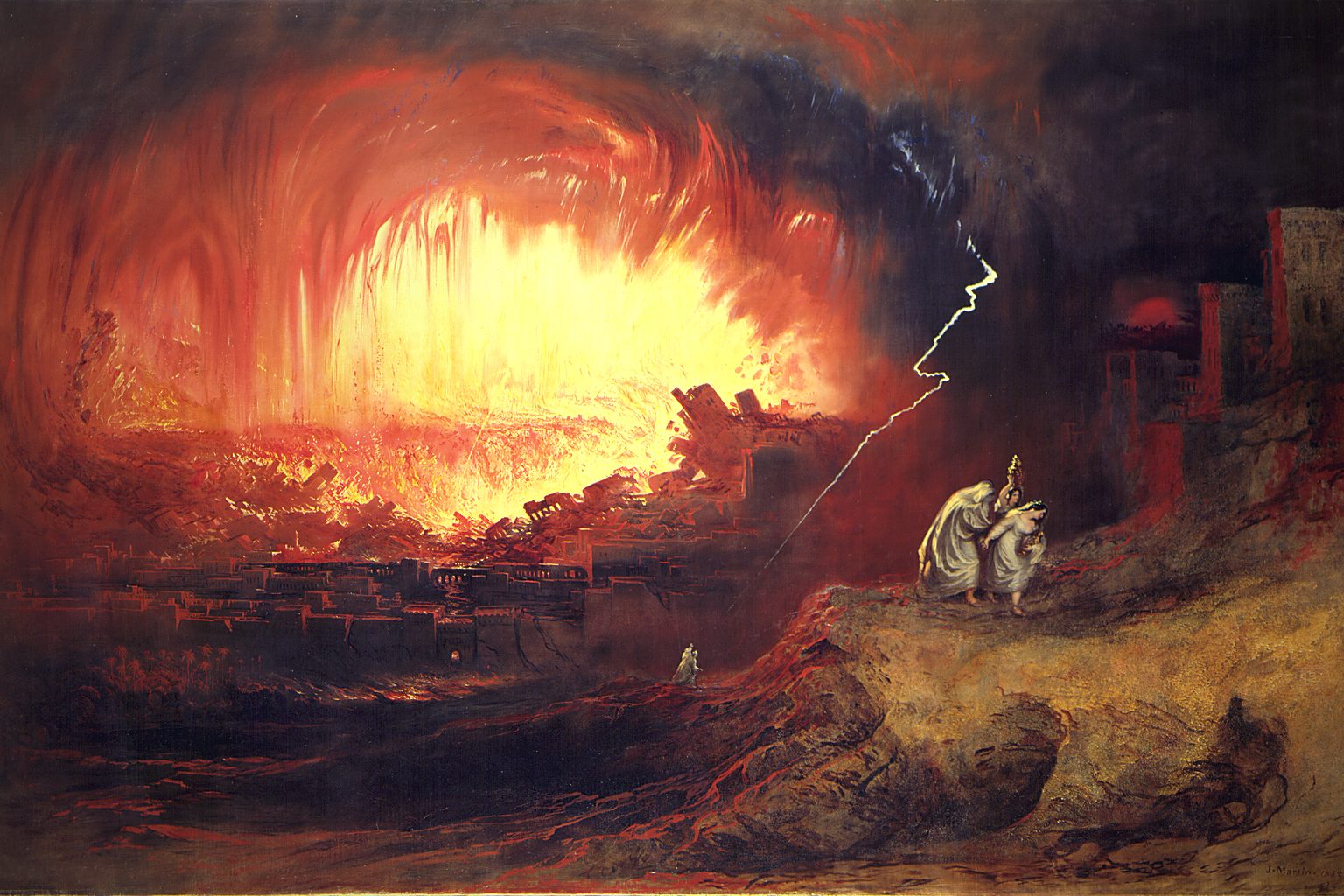
In 2021, a team of scientists published a paper in Scientific Reports claiming they had found the physical evidence: a Bronze Age city in the Jordan Valley obliterated by a cosmic airburst, the shockwave scouring its walls to the foundations, the event possibly preserved in memory as the destruction of Sodom.
Here at last, it seemed, was the answer to what destroyed Sodom and Gomorrah. The story went everywhere. It is still everywhere.
In April 2025, the journal retracted the paper.
Almost none of the articles that spread the original claim have been updated. So if you have read that science proved Sodom was destroyed by an exploding meteor, you have read something that the publishing journal itself no longer stands behind — and the real story, once you dig into it, is considerably more interesting.
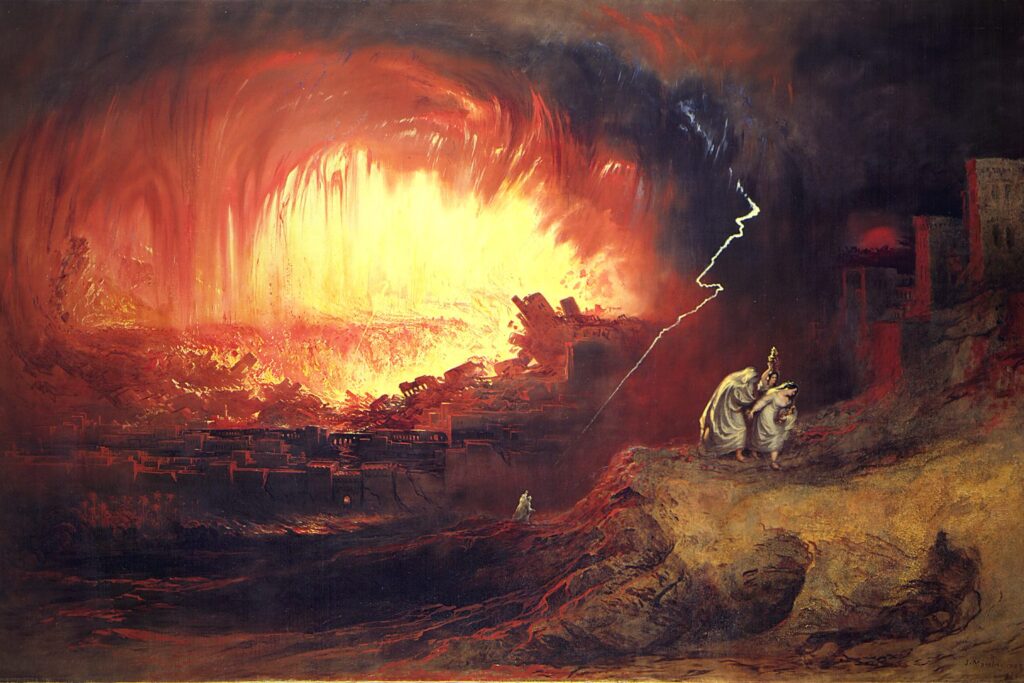
What Destroyed Sodom and Gomorrah?
The Bible says fire and brimstone fell from the sky (Genesis 19:24). Beyond that, there is no scientific consensus, because there is not even consensus on where the cities were — or whether they existed.
The leading natural explanation involves the Dead Sea region’s own geology: a tectonically active rift valley saturated with bitumen, methane and sulphur, where an earthquake could plausibly ignite a catastrophic firestorm. The widely-publicised airburst theory was retracted by its own journal in 2025.
What the Text Actually Says
Genesis 19 is more specific than most people remember.
“Then the LORD rained upon Sodom and upon Gomorrah brimstone and fire from the LORD out of heaven; And he overthrew those cities, and all the plain, and all the inhabitants of the cities, and that which grew upon the ground.” (Genesis 19:24-25)
Four elements are worth isolating:
- Brimstone — Hebrew gophrith, meaning sulphur. Not a vague word for fire; a named substance.
- From heaven — the source is above, not below. This is not described as a volcano or a fissure.
- The whole plain — regional destruction, not a single city.
- And that which grew upon the ground — the vegetation, and by implication the soil, were sterilised.
Then the aftermath:
“And he looked toward Sodom and Gomorrah… and beheld, and, lo, the smoke of the country went up as the smoke of a furnace.” (Genesis 19:28)
Abraham sees this from near Hebron — roughly 50 km (31 miles) away. Whatever happened produced a smoke column visible across that distance.
And one detail that is almost always turned into a joke and is worth taking literally:
“But his wife looked back from behind him, and she became a pillar of salt.” (Genesis 19:26)
The Dead Sea region is the most saline environment on earth, and Mount Sodom — Jebel Usdum, on its southwestern shore — is a genuine geological feature: a ridge roughly 11 km (6.8 miles) long composed largely of halite, rock salt, capped with sediment. Erosion carves pillars out of it continuously. Local tradition has pointed at one or another of them as Lot’s wife for at least two thousand years.
The Airburst Theory and Its Retraction
This matters enough to lay out carefully, because it is the single biggest source of misinformation on the topic.
The site. Tall el-Hammam is a large Bronze Age settlement in the southern Jordan Valley, north-east of the Dead Sea. Excavations found a destruction layer at the end of the Middle Bronze Age, around 1650 BC, after which the site was abandoned for centuries.
The claim. A 2021 paper argued this layer showed signatures of a Tunguska-scale cosmic airburst — an object exploding in the atmosphere. The evidence offered included shocked quartz, melted pottery and mudbrick, spherules, elevated iridium and platinum, and unusually high salt content, which the authors suggested was blasted from the Dead Sea and rendered the plain agriculturally dead.
The collapse. Critics moved quickly:
- Geologists Scott Jaret and R. Scott Harris (2022) challenged the mineralogical and geochemical evidence, particularly the identification of shocked quartz, which is the key diagnostic for impact-level pressures.
- Physicists Mark Boslough and Ari Bruno (2025) argued the Tunguska comparison was applied incorrectly and that the data did not support the energy estimates.
- The paper accumulated more than 180 comments on post-publication review platforms.
- Archaeologists publicly criticised the work as sensationalist, arguing the biblical framing functioned as publicity rather than science.
The outcome. On 24 April 2025, Scientific Reports retracted the paper, stating that the technical critiques left the editors no longer confident in its conclusions. Several of the original authors disagreed with the retraction.
What the Retraction Does and Does Not Mean
It does not mean Tall el-Hammam was never destroyed. The destruction layer is real, the abandonment is real, and the site is a legitimate subject of ongoing archaeology.
It does mean that the specific claim — a cosmic airburst, on the evidence presented — did not survive scrutiny, and that anyone still citing it as settled science is working from a withdrawn source.
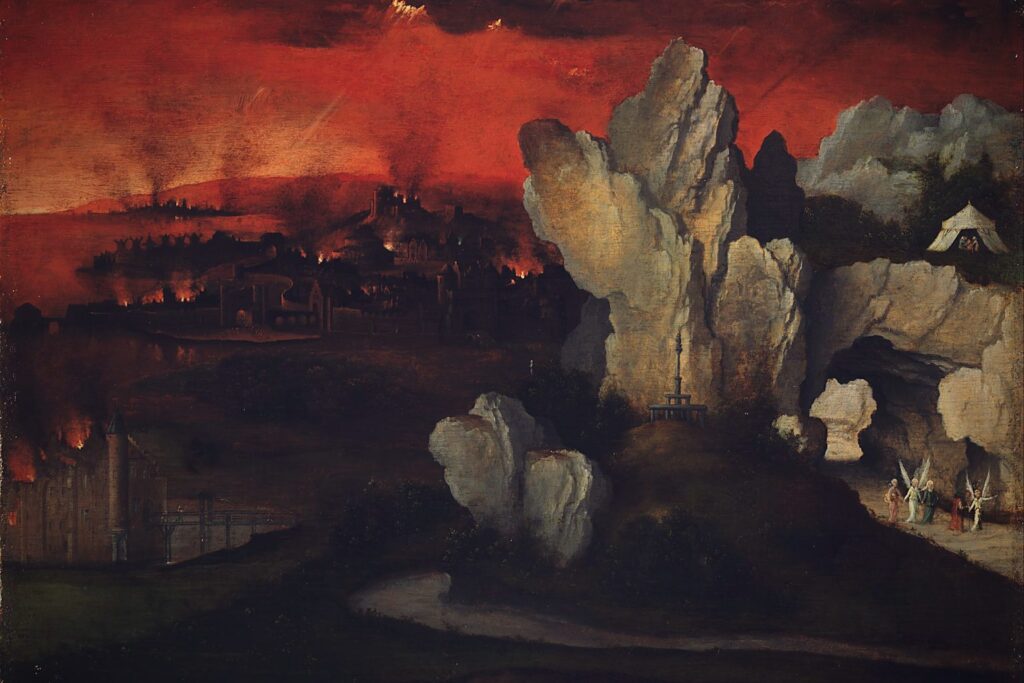
Where Were Sodom and Gomorrah?
There is no agreement, and the candidates split along a north-south line.
| Candidate | Location | Case for | Case against |
|---|---|---|---|
| Bab edh-Dhra and Numeira | SE of the Dead Sea | Early Bronze Age towns, both destroyed by fire; large cemetery; charred debris layers | Destroyed around 2350 BC, far earlier than most Abraham chronologies |
| Tall el-Hammam | NE of the Dead Sea | Largest site in the region; Middle Bronze destruction layer; long abandonment | Identification is disputed; the airburst paper supporting it was retracted |
| Submerged, beneath the Dead Sea | Southern basin | Explains the total absence of remains; ancient writers place the cities near the sea | Untestable; no survey has located structures |
| Non-historical | — | Many scholars read Genesis 19 as an aetiological narrative explaining a strange landscape | Does not account for the specificity of the geography given in Genesis 14 |
Genesis 14:3 places the cities in “the vale of Siddim, which is the salt sea” — language that suggests the writer understood the site to be at, or under, the Dead Sea.
The Geological Explanation Nobody Publicises
Strip away the meteor and the Dead Sea rift supplies a mechanism of its own — one that requires nothing exotic.
The region is a tectonic fault. The Dead Sea sits in the Jordan Rift Valley, on the transform boundary between the African and Arabian plates. It is seismically active and always has been.
It is saturated with hydrocarbons. Bitumen — natural asphalt — seeps from the Dead Sea floor in quantities large enough that blocks of it float to the surface after earthquakes. The Romans called it Lacus Asphaltites, the Asphalt Lake. Genesis 14:10 notes that the vale of Siddim was “full of slimepits” — bitumen pits — and that fleeing kings fell into them.
It contains sulphur. Free sulphur deposits occur in the sediments around the southern basin, often mixed with the bitumen.
Petroleum-associated gas is under pressure. Methane and hydrogen sulphide accumulate in such formations.
Put those together and a single earthquake produces a sequence that reads almost line-for-line like Genesis 19: the fault ruptures; pressurised gas and bitumen are ejected upward through the fissures; the aerosolised mixture ignites on any open flame in a Bronze Age town; burning sulphurous material falls back over the plain. Fire and brimstone, falling from above, exactly as described — and the salt-laden ground poisoned afterward.
This hypothesis was proposed as early as the 1920s by the archaeologist Frederick Clapp, and it has never been refuted. It gets far less attention than the airburst theory for the simple reason that it is less dramatic.
What the Story Is Actually About
It is worth noting what Genesis and later Scripture say the judgement was for, because the popular assumption is not what the prophets emphasise.
Ezekiel states it directly:
“Behold, this was the iniquity of thy sister Sodom, pride, fulness of bread, and abundance of idleness was in her and in her daughters, neither did she strengthen the hand of the poor and needy.” (Ezekiel 16:49)
Pride, excess, complacency, and refusal to help the vulnerable. That is the charge sheet Ezekiel gives — a society that had everything and shared none of it, in which the treatment of strangers in Genesis 19 is the symptom rather than the whole disease.
The Pattern of Containment
Read alongside the rest of the record, Sodom belongs to a recognisable category.
The Flood is a global reset with a single ark of survivors. Sodom is a regional reset with a single family evacuated. In both cases the operation runs the same way: a warning is issued, a specific group is extracted, a deadline is enforced, and the affected zone is sterilised — “and that which grew upon the ground.”
The extraction protocol in Genesis 19 is notably procedural. The messengers arrive with a schedule. Lot is told to gather everyone who will come. He delays, and they physically take him by the hand and put him outside the city (Genesis 19:16). There is a designated destination, a prohibition on looking back, and an explicit statement that the operation cannot begin until he is clear:
“Haste thee, escape thither; for I cannot do any thing till thou be come thither.” (Genesis 19:22)
The destruction is gated on the evacuation being complete. That is not the language of divine temper. It is the language of a controlled demolition waiting for the site to be cleared.
The same angelic agents who conduct the evacuation had, a chapter earlier, sat under a tree and eaten a meal with Abraham — and when the mob surrounded Lot’s house, they dropped the human appearance and blinded everyone outside.
Frequently Asked Questions
What destroyed Sodom and Gomorrah?
Genesis 19:24 describes brimstone — sulphur — and fire falling from the sky. There is no scientific consensus. The leading natural explanation is an earthquake igniting the bitumen, sulphur and pressurised gas of the Dead Sea rift. A widely-reported cosmic airburst theory was retracted by its journal in 2025.
Was the Tall el-Hammam airburst study retracted?
Yes. Scientific Reports retracted the 2021 paper on 24 April 2025, citing errors in methodology, data analysis and interpretation, and unsupported comparison with the Tunguska event. Several original authors disagreed with the retraction.
Where were Sodom and Gomorrah located?
Unconfirmed. The main candidates are Bab edh-Dhra and Numeira southeast of the Dead Sea, Tall el-Hammam to the northeast, and a submerged location beneath the southern basin. Genesis 14:3 places the cities in the vale of Siddim, “which is the salt sea.”
Is there archaeological evidence for Sodom?
There are Bronze Age sites in the region with genuine fire-destruction layers, including Bab edh-Dhra, Numeira and Tall el-Hammam. None has been confirmed as Sodom, and the identification of any of them remains disputed.
Did Lot’s wife really turn into a pillar of salt?
Genesis 19:26 states it. Mount Sodom, on the southwestern shore of the Dead Sea, is a real ridge of rock salt around 11 km (6.8 miles) long, and erosion continually produces salt pillars there. Local tradition has identified one as Lot’s wife for millennia.
What does brimstone mean in the Bible?
The Hebrew is gophrith, meaning sulphur. It is a specific substance, not a general word for fire. Free sulphur occurs naturally in the sediments around the southern Dead Sea.
Why were Sodom and Gomorrah destroyed?
Ezekiel 16:49 names the iniquity of Sodom as pride, abundance of food, idleness, and failing to help the poor and needy. Genesis 19 records the attempted assault on Lot’s guests as the immediate provocation.
When were Sodom and Gomorrah destroyed?
It depends entirely on which site is accepted and which chronology for Abraham. Bab edh-Dhra was destroyed around 2350 BC; Tall el-Hammam’s destruction layer dates to roughly 1650 BC. Neither identification is settled.
Conclusion: The Story Survived the Science
There is something worth noticing in how this episode has played out.
A dramatic scientific claim attached itself to an ancient text, travelled around the world, and then quietly failed peer review four years later — while the coverage it generated remained online, uncorrected, indefinitely.
Meanwhile, the unglamorous explanation — a fault line, a bitumen field, a sulphur deposit, and an earthquake — has sat there since the 1920s, fitting the text closely, requiring nothing extraordinary, and attracting almost no attention.
The narrative in Genesis 19 does not need a meteor. It needs a rift valley full of flammable material and a tremor, which is precisely what that part of the world has always been. What it describes is a plain that burned, a family pulled out on a deadline, a smoke column visible from fifty kilometres, and ground that would not grow anything afterward.
Four thousand years later the Dead Sea basin remains one of the most lifeless landscapes on the planet — and the story that explains why is still, for the moment, ahead of the science sent to check it.
Continue Reading
- King Solomon: What the Archaeology Actually Shows — No inscription names him. But radiocarbon put industrial copper smelting in the Arava in his century, and a 2021…
- The Shroud of Turin: A Negative Nobody Ordered — Dust vacuumed from the cloth in 1978 has now been sequenced, and the result was reported as evidence the Shroud came…
- The Third Temple: What Is Actually Ready, and What Is Not — The vessels are finished, the garments are woven and the plans exist. What does not exist is a valid set of ashes, an…