Most prophecy is weather. It tells you a storm is coming without telling you when, and it can be read as fulfilled by almost anything that later happens to arrive.
Daniel 9 is not weather. The seventy weeks of Daniel give a starting event, a unit of time, a count, a division of that count into three unequal parts, and a list of six things that will be finished when the count runs out. It is the closest thing in the Hebrew Bible to a specification, and it is the reason this passage has been argued over for two thousand years while vaguer prophecies are quietly left alone.
The argument is not really about whether it came true. It is about arithmetic — and the striking thing, once you lay the numbers out, is that every reading has a number in it that does not quite fit.
What Are the Seventy Weeks of Daniel?
The seventy weeks are a period announced to Daniel by the angel Gabriel in Daniel 9:24–27. The Hebrew word is shavu’im, “sevens” — seventy sevens, almost universally read as 490 years rather than 490 days, because a week of days makes nonsense of the events described.
The count begins at “the going forth of the commandment to restore and to build Jerusalem”. It is divided into 7 sevens, then 62 sevens, then a final single seven. And it ends with six accomplishments: transgression finished, sins ended, reconciliation made, everlasting righteousness brought in, vision and prophecy sealed up, and the most holy anointed.
Everything after that is interpretation, and the interpretation turns on three questions: which commandment, how long a year, and whether the last seven follows the other sixty-nine without a break.
The man receiving it is by this point an old courtier in his eighties. Sixty-six years earlier he had arrived in Babylon as a captive teenager and asked for vegetables and water instead of the king’s meat. He has outlasted the empire that took him.
The Text’s Own Division
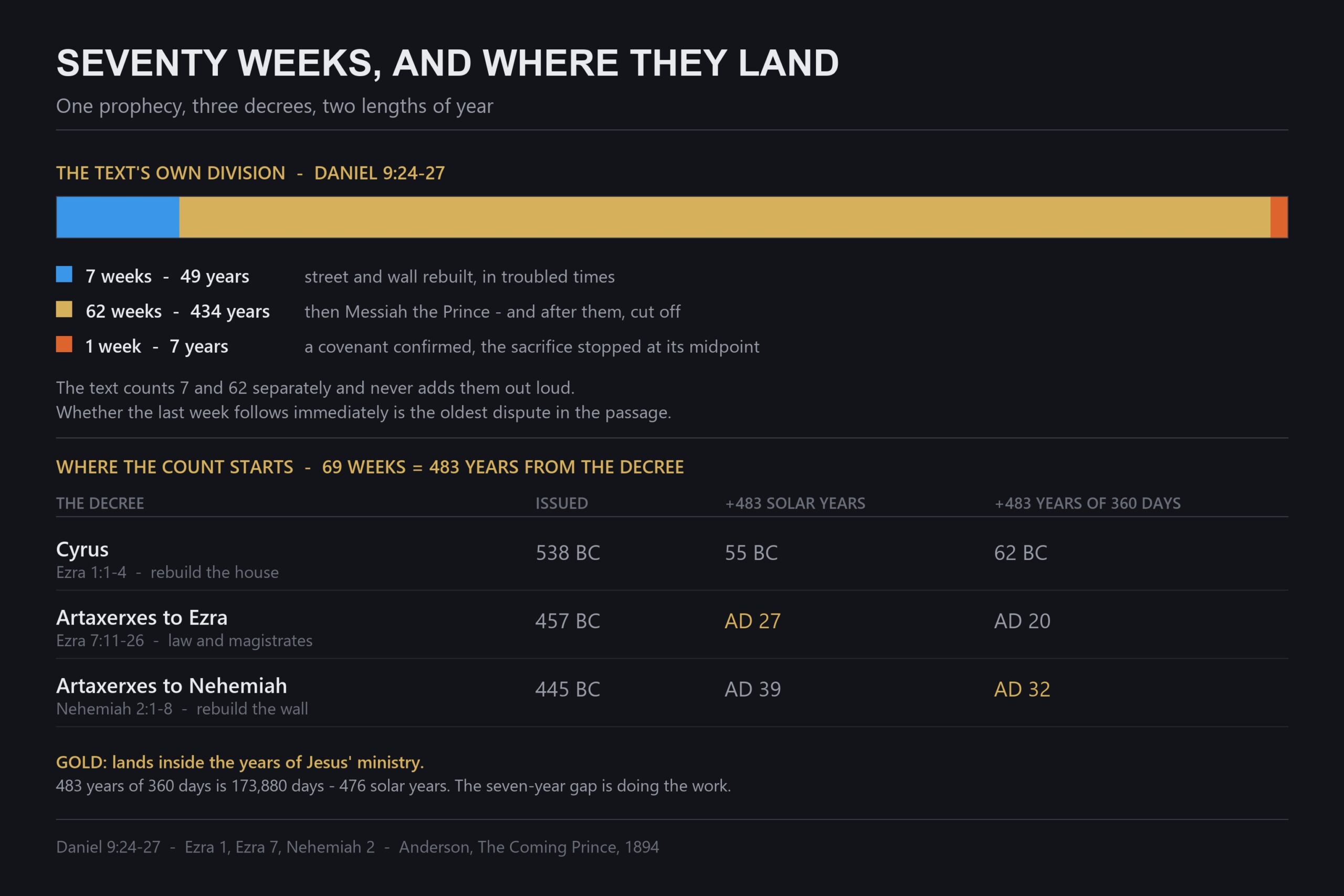
The passage counts 7 and 62 separately, and — this matters more than almost anything else in the dispute — it never adds them together out loud.
Know therefore and understand, that from the going forth of the commandment to restore and to build Jerusalem unto the Messiah the Prince shall be seven weeks, and threescore and two weeks: the street shall be built again, and the wall, even in troublous times. (Daniel 9:25)
The 7 sevens — 49 years — are attached to the rebuilding: street and wall, in troubled times. The 62 sevens — 434 years — run from there to “Messiah the Prince”. Then verse 26 says that after the 62 weeks, Messiah shall be cut off, “but not for himself”, and that a people of a coming prince shall destroy the city and the sanctuary. Verse 27 describes one week in which a covenant is confirmed and, at its midpoint, sacrifice and offering are caused to cease.
Note what verse 26 does. It puts the cutting off after the sixty-nine weeks, not inside the seventieth. That single preposition is the seed of the oldest structural argument in the passage.
Where the Count Starts
Four decrees are recorded in the Persian period, and three of them have been used as the starting gun.
| The decree | Year | What it authorised |
|---|---|---|
| Cyrus, Ezra 1:1–4 | 538 BC | rebuilding the house of God |
| Darius, Ezra 6:1–12 | 520 BC | confirming Cyrus’s order |
| Artaxerxes to Ezra, Ezra 7:11–26 | 457 BC | law, magistrates, temple funding |
| Artaxerxes to Nehemiah, Nehemiah 2:1–8 | 445 BC | timber for the wall and gates |
Each has a problem. Cyrus and Darius authorise a temple, and the text says “restore and build Jerusalem” — a city, with a street and a wall. Nehemiah’s commission is unambiguously about the city wall, which fits the wording best, but 483 solar years from 445 BC lands in AD 39, well past any candidate event. Artaxerxes’ decree to Ezra lands at AD 27, squarely inside the range for the start of Jesus’ ministry, but it is a grant of judicial and religious authority rather than a building permit.
There is no reading on which all three of wording, date and outcome line up without strain. Anyone who tells you otherwise has chosen which strain to stop mentioning.
The Case for the Messianic Reading
This is the oldest surviving interpretation and the one the site’s own reading starts from, so it should be stated at full strength.
The count from Artaxerxes’ seventh year, 457 BC, plus 483 years, arrives at AD 27. Luke dates the beginning of John’s ministry to the fifteenth year of Tiberius, which puts Jesus’ baptism somewhere between AD 26 and AD 29. “Messiah the Prince” is mashiach nagid — anointed one, ruler — and the anointing at baptism is the event the reading points to.
Then verse 26: after the sixty-nine, Messiah is cut off, not for himself. A crucifixion three and a half years after AD 27 falls in AD 30 or 31, at the midpoint of the seventieth week, which is exactly where verse 27 places the ceasing of sacrifice. And the destruction of the city and sanctuary by “the people of the prince that shall come” happened in AD 70, when Titus burned the temple.
The six accomplishments of verse 24 — an end of sin, reconciliation, everlasting righteousness — are not political outcomes. They are the vocabulary of atonement, and no second-century political crisis supplies them. The rest of that vocabulary lives in the closing chapters of Revelation, which is the company this verse keeps.
Julius Africanus was making a version of this argument by about AD 221. Tertullian made another. Whatever else it is, it is not a modern invention retrofitted onto the text.
The Case for the Maccabean Reading
Most critical scholars read the passage differently, and the reading deserves the same care.
On this view the seventy weeks run from Jeremiah’s prophecy of seventy years of exile — which is what Daniel 9 opens by praying about — to the crisis under Antiochus IV Epiphanes. The “anointed one cut off” is Onias III, the legitimate high priest, deposed and murdered around 171 BC. The “prince that shall come” is Antiochus. The abomination that makes desolate is the altar to Olympian Zeus set up in the temple in 167 BC.
And the final week fits that crisis with unusual precision. Antiochus’s desecration lasted from 167 BC until Judas Maccabeus rededicated the temple in December 164 BC — three years and some months, which is the half-week of verse 27, the period in which sacrifice and offering are caused to cease. No other reading puts a documented, dated, three-and-a-half-year suspension of the temple sacrifices anywhere near the seventieth week.
The reading also accounts for the book’s Aramaic sections, its detailed knowledge of Seleucid court politics, and the fact that its account of history becomes noticeably less accurate after about 165 BC — which is the standard argument that the book reached its final form around then.
The Reply From the Other Side
That case has an answer, and the exchange is worth following to the end rather than stopping where one side happens to be speaking.
The Maccabean arithmetic does not work either. From the destruction of Jerusalem in 587 BC to the desecration in 167 BC is 420 years. From Jeremiah’s first oracle around 605 BC it is 438. Neither is 490. The reading that most loudly accuses the Messianic calculation of fudging its numbers is between fifty and seventy years short of its own.
The manuscript evidence is tighter than the theory wants. The oldest copy of Daniel from Qumran, 4QDan-c, is dated palaeographically to the late second century BC. If the book was composed around 165 BC, that manuscript is a copy made within roughly fifty years of the original — and by then Daniel was already circulating at Qumran in multiple copies, already being quoted, and already treated as authoritative. That is a fast climb for a book that new.
Antiochus did not end. Verse 27 says the desolator continues “until the consummation, and that determined shall be poured upon the desolate”. Antiochus IV died of illness in Persia in 164 BC, and the sacrifices resumed. The six accomplishments of verse 24 did not happen in 164 BC by anyone’s account, including the account of those who wrote the books of Maccabees.
The Arithmetic Problem Nobody Owns
Here is the part that is usually left out of both cases, and it is the most interesting thing in the passage.
The best-known Messianic calculation is Sir Robert Anderson’s, from The Coming Prince (1894). Anderson started from Nehemiah’s decree in 445 BC and solved the AD 39 problem by using years of 360 days — twelve months of thirty, the “prophetic year”. 483 such years are 173,880 days, which is about 476 solar years, and 476 years from 445 BC lands in AD 32. Anderson identified the terminus as 10 Nisan, the day of the triumphal entry.
It is an elegant piece of work and it is not sound. Harold Hoehner revised it in the 1970s, moving the decree to 444 BC and the terminus to AD 33, because 445 BC was Artaxerxes’ accession year rather than his first regnal year. But both calculations have since been shown to mix Julian and Gregorian reckoning partway through, and both require a 1 Nisan several weeks earlier in the solar year than the Jewish calendar ever placed it — Hoehner’s date falls in late February, which no reconstruction of the calendar allows.
So the position is this. The two most cited Messianic calculations contain calendar errors. The Maccabean reading is short by decades. The 457 BC count lands correctly but starts from a decree about magistrates rather than masonry. Every road out of Daniel 9 has a pothole in it, and the arguments are mostly about whose pothole is more forgivable.
The Gap
One more structural question, and it is the one that has done the most work in modern prophecy writing.
Verse 26 puts the cutting off after the sixty-nine weeks. Verse 27 then describes the seventieth. Between them sits the destruction of the city — an event that, on the Messianic reading, happened in AD 70, roughly forty years after the sixty-ninth week ended.
The continuous reading says the seventieth week followed immediately and the destruction is a later consequence mentioned out of order, which Hebrew prophecy does constantly. The gap reading says the clock stopped: sixty-nine weeks ran, the Messiah was cut off, the count paused, and the seventieth week is still ahead of us. That reading is what turns Daniel 9:27 into a seven-year tribulation, which is where it connects to the mark and the covenant in Revelation 13 and to the temple that would have to exist for a sacrifice to be stopped.
The honest summary is that the text does not say. It gives no explicit interval and no explicit continuity. The gap is neither stated nor excluded, and a reader’s answer usually arrives from the rest of their framework rather than from these four verses.
What Is Genuinely Unresolved
Which decree. Not resolvable from the text, which says “the commandment to restore and to build Jerusalem” without naming a king.
How long a year. The 360-day year is real in the sense that Revelation treats 42 months and 1,260 days as equivalent, and Genesis 7–8 counts a five-month span as 150 days. It is not established that Daniel 9 uses one.
Whether the count is continuous. Two thousand years of commentary, no textual settlement.
The date of composition. The manuscript evidence constrains it more tightly than the older critical consensus assumed, without settling it.
Frequently Asked Questions
What are the seventy weeks of Daniel?
A period of 490 years announced in Daniel 9:24–27, divided into 7 sevens, 62 sevens and a final seven, beginning with a commandment to restore and rebuild Jerusalem. What the period ends in, and which commandment starts it, are the two things interpreters disagree about.
When do the seventy weeks of Daniel start?
Three Persian decrees are candidates: Cyrus in 538 BC, Artaxerxes to Ezra in 457 BC, and Artaxerxes to Nehemiah in 445 BC. Nehemiah’s fits the wording best because it concerns the city wall; Ezra’s produces the date most often cited, AD 27. There is no reading on which wording and date both line up cleanly.
How do you calculate 483 years from the decree?
Sixty-nine sevens is 483 years. Counted as ordinary solar years from 457 BC, remembering that there is no year zero between 1 BC and AD 1, the count reaches AD 27. Counted as 483 years of 360 days — 173,880 days, or about 476 solar years — from 445 BC, it reaches AD 32. Which method is correct is the calculation’s central dispute.
Does the seventy weeks prophecy point to Jesus?
That is the oldest surviving reading, attested by Julius Africanus around AD 221, and it rests on three things: the AD 27 terminus, a cutting off “not for himself” in the middle of a seven, and the destruction of the temple in AD 70. Critical scholarship reads the same verses as describing Onias III and Antiochus IV in the 170s and 160s BC. Both readings have a number in them that does not fit, and neither side has a calculation free of calendar errors.
What is the Maccabean interpretation of Daniel 9?
That the seventy weeks run from Jeremiah’s prophecy to the crisis under Antiochus IV: Onias III as the anointed one cut off in 171 BC, the altar to Zeus in 167 BC as the abomination, and the three-and-a-half years until the rededication in 164 BC as the half-week. Its strength is the precision of that last period. Its weakness is that the total comes to roughly 420 years rather than 490.
Is there a gap between the 69th and 70th week?
The text places the cutting off after the sixty-nine weeks and then describes the seventieth, without saying whether anything comes between. A gap is neither stated nor excluded. The continuous reading treats the destruction of the temple as a later consequence mentioned out of sequence; the gap reading treats the seventieth week as still future.
When was the book of Daniel written?
The critical consensus places its final form around 165 BC, during the Antiochene crisis. The traditional view places it in the sixth century BC with Daniel himself. The oldest Qumran copy, 4QDan-c, is dated to the late second century BC, which is close enough to 165 BC to make the transmission history unusually compressed on the later dating.
What is the abomination of desolation in Daniel 9?
In verse 27 it is something set up in the temple that causes sacrifice to cease. The Maccabean reading identifies it as the altar to Olympian Zeus installed in 167 BC. Jesus refers to it in Matthew 24:15 as still future in his own day, which is the main reason the Messianic reading treats verse 27 as unfulfilled or partly unfulfilled.
What Would Settle It
Two things would move this, and one of them is closer than people assume.
The decree. If a Persian-period document turned up that framed one of these commissions explicitly as authorisation to rebuild the city — street and wall, in those terms — the starting date would stop being a choice. Persepolis and Elephantine have both produced administrative archives of exactly this kind, and neither has been fully published.
The calendar. The Elephantine papyri contain dated documents in both the Egyptian and Jewish systems, which is what has already shown that Anderson’s and Hoehner’s Nisan dates are impossible. More of that material would either rescue a 360-day reckoning or finish it.
Until then, what sits on the table is this. A sixth-century document, or a second-century one, contains a count in years that lands, depending on which of three decrees you start from, either fifty-five years before Christ, or at the beginning of his ministry, or seven years after the crucifixion. The best-known calculation that gets it exactly right gets it right through a calendar error. The reading that calls that fudging is seventy years short itself.
And the text still says what it says: from a commandment, to an anointed one, sixty-nine sevens — and then, after them, cut off, but not for himself.
Continue Reading
- Biblical Prophecies That Came True — and the Test That Sorts Them — Four questions decide whether a prophecy can be checked at all. Tyre, Cyrus, the temple and one that failed outright…
- The Third Temple: What Is Actually Ready, and What Is Not — The vessels are finished, the garments are woven and the plans exist. What does not exist is a valid set of ashes, an…
- The Book of Enoch Giants: The Lost Book That Names Them — They were enormous and they ate people — that is the part everyone knows. The part nobody knows is that a second book…