On the morning of 20 October 1966, a ten-year-old girl in the Welsh village of Aberfan told her mother about a dream. Her mother later reported the words: “I dreamt I went to school and there was no school there. Something black had come down all over it.”
The next morning, a colliery spoil tip above the village liquefied after heavy rain and slid down the mountainside into Pantglas Junior School. It killed 144 people. A hundred and sixteen of them were children. Eryl Mai Jones was one of them.
A London psychiatrist named John Barker went to Aberfan to study shock in survivors and came away asking whether dreams predict the future — specifically, how many people had seen this one coming, and whether any of them had said so before it happened.
Do Dreams Predict the Future?
Sometimes a dream matches an event that has not happened yet, closely enough that the match is hard to wave away. What is in dispute is whether anything is being transmitted, or whether the matches are what you would expect from eight billion sleeping brains generating material every night and one waking world for it to be matched against afterwards.
Both answers have serious people behind them and both have a weak point. The interesting part is that the weak points are not symmetrical, and neither is the evidence.
The Experiment That Followed Aberfan
Barker wrote to Peter Fairley, science editor at the London Evening Standard. On 28 October 1966 the paper asked its readers whether any of them had foreseen the disaster. Seventy-six people wrote in.
Barker did the thing that makes this story worth telling: he threw most of them out. A memory of a premonition, recalled after the event, is worth nothing, because memory reconstructs. He looked for cases where the dream had been described to another person before the tip moved, and those were the only ones he counted. Eryl Mai’s was one, because her mother had heard it at breakfast.
Then he did something stranger. He and Fairley set up a standing office — the British Premonitions Bureau — where anyone could register a prediction in advance, dated and logged, before the thing predicted had a chance to happen. This is the correct design. Whatever else you think of it, it removes the memory problem entirely.
In roughly eighteen months it took in close to a thousand submissions.
What the Bureau Actually Found
The great majority went nowhere. Over ninety per cent matched no subsequent event at all, and not one of them prevented a disaster, which had been the entire point of building the thing.
What it did find was narrower and odder. A small number of correspondents produced a disproportionate share of the apparent hits — two of them accounted for most of what the Bureau considered striking. That is either a signal concentrated in a few sensitive people, or exactly what happens when a few prolific submitters send in far more predictions than everyone else and therefore win more lotteries. The Bureau’s records do not let you tell those apart, because it never logged how many submissions each person made against how many landed.
That is the failure that matters. The design was right and the bookkeeping was wrong, and it has never been properly redone at scale.
The Case That Something Is Happening
The prospective records exist. J. W. Dunne, an aeronautical engineer, published An Experiment with Time in 1927 after noticing his own dreams anticipating news he had not yet read. His method was to write dreams down immediately on waking, before the day could contaminate them — and he asked his readers to do the same rather than take his word for it. Written-in-advance records are a different category of evidence from remembered ones, and a body of them accumulated.
The laboratory work was not casual. At the Maimonides Medical Center in Brooklyn through the 1960s and 70s, Montague Ullman, Stanley Krippner and colleagues ran dream telepathy and precognition studies with EEG monitoring, blind judging and randomly selected targets. Sleepers were woken during REM, their dream reports transcribed, and independent judges matched transcripts against targets without knowing which was which. The reported hit rates ran above chance across the series.
The effect survived being taken seriously. In 2011 Daryl Bem, a respected social psychologist at Cornell, published nine experiments in the Journal of Personality and Social Psychology under the title “Feeling the Future”, reversing standard psychological procedures in time. Eight of the nine returned statistically significant results. Whatever happened afterwards, the paper cleared peer review at a mainstream journal using mainstream methods, which is not what a fringe claim usually manages.
And the anecdotes are not all the same shape. The Aberfan cases that Barker kept were specific, dated, and described to a witness in advance. A prediction of “something bad” is worthless. “There is no school there, something black has come down all over it”, told at breakfast the day before, is a different object.
The Case That Nothing Is
The numbers are enormous and people are bad at enormous numbers. Take eight billion people. Say each one remembers a dream on a given night — a generous assumption, but the arithmetic survives much smaller ones. That is eight billion dreams a night, near enough three trillion a year. An event with a one-in-a-million chance of matching something will therefore be matched about eight thousand times every night, worldwide, by chance alone. Mathematicians call this the law of truly large numbers: with a big enough sample, outrageous coincidences are not merely possible but mandatory.
Memory does not store, it rebuilds. A dream is vague, fragmentary and quickly lost — which is exactly why lucid dreaming had to be proved with eye movements rather than with testimony. An event is sharp. When the sharp thing arrives, it supplies the missing detail in the vague one, and the reconstructed memory feels like the original. This is not lying. It is the ordinary operation of recall, and it is why Barker’s insistence on prior testimony was the single most important methodological decision in the whole episode.
Nobody reports the misses. You do not remember the ten thousand dreams that matched nothing. There is no register in your head of failed premonitions, which means your personal hit rate is unknowable to you and always looks excellent.
Bem’s result did not replicate. Three pre-registered independent attempts at his retroactive-recall experiment, published in 2012 by Stuart Ritchie, Richard Wiseman and Chris French, found nothing. The statistical critique that followed — about optional stopping, flexible analysis and the way significance had been extracted — was severe enough that the episode is widely credited with kicking off psychology’s replication crisis. It is one of the rare cases where a parapsychology paper changed mainstream science, though not in the direction its author intended.
The Maimonides results have the same problem. Some laboratories replicated the basic finding and others did not, and the series was never turned into a procedure that works reliably in anyone’s hands. An effect that only appears for particular experimenters is the signature of a methodological artefact rather more often than it is the signature of a real one. The same objection is made, and answered differently, in the literature on what people report during cardiac arrest.
| What it has | What it lacks | |
|---|---|---|
| Prospective diaries | records written before the event | any count of the non-matches |
| The Premonitions Bureau | correct design, dated submissions | submissions-per-person bookkeeping |
| Maimonides dream lab | blind judging, EEG, randomised targets | replication outside the original group |
| Bem 2011 | mainstream journal, standard methods | three failed pre-registered replications |
| Aberfan | prior testimony, specific content | a base rate for dreams about that school |
The pattern is consistent and it is not flattering to either camp. Every time the evidence gets better designed, the effect gets smaller; and every time the sceptical account is asked for the base rate it says a case requires, it does not have one either.
What the Bible Does With Dreams
This is where the subject stops being modern, because the oldest sustained treatment of predictive dreaming is in scripture — and it is far more careful than either side of the current argument.
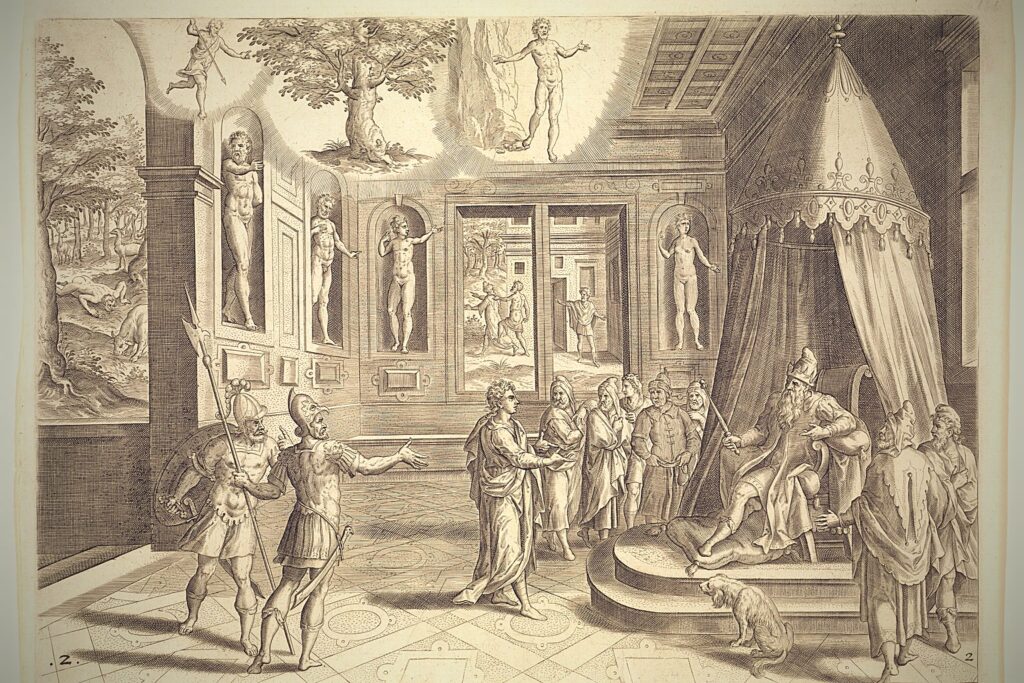
Genesis 41 has Pharaoh dream of seven fat cattle and seven lean, and of seven full ears of grain and seven withered. Joseph reads it as fourteen years — seven of plenty, seven of famine — and adds a claim that the doubling of the dream means the thing is established, and will happen shortly. The dream is treated as information with a structure, and the structure is what carries the meaning.
Daniel 2 goes further. Nebuchadnezzar dreams of a statue of four metals and demands that his advisers tell him the dream itself before interpreting it — which they cannot do, and which Daniel does. Those two chapters are the reason dream interpretation has a place in this tradition at all. The same book that gives us a count of years so precise that people are still doing the arithmetic begins with a man reading a king’s sleep.
But notice what the texts are actually claiming. In Numbers 12:6 the dream is a channel: I the LORD will make myself known unto him in a vision, and will speak unto him in a dream. In Job 33 it is the same — God “openeth the ears of men” while they sleep. These are not descriptions of a human faculty. They describe a message being sent to someone, which is a different claim from precognition, and it is a claim that a laboratory cannot test, because the variable is not in the sleeper.
And the same scriptures are sharply sceptical about dream claims in general.
I have heard what the prophets said, that prophesy lies in my name, saying, I have dreamed, I have dreamed… The prophet that hath a dream, let him tell a dream; and he that hath my word, let him speak my word faithfully. What is the chaff to the wheat? (Jeremiah 23:25, 28)
Ecclesiastes 5 is blunter still: a dream cometh through the multitude of business, and in the multitude of dreams and many words there are also divers vanities. That is a base-rate argument, written roughly three thousand years before anyone had the phrase.
Deuteronomy then supplies a test, and the test is stricter than accuracy. Deuteronomy 18:22 says a word that does not come to pass was not spoken by God. But Deuteronomy 13:1–3 adds the harder clause: if a dreamer of dreams gives you a sign, and the sign comes to pass, and he then tells you to follow other gods, you still do not listen to him. Coming true is a necessary condition and not a sufficient one.
That is a more demanding standard than either modern camp applies. The sceptic’s test is “did it beat chance”. The believer’s test is often “did it come true”. Scripture’s test is both of those and then a third one about where it is pointing you.
The Detail Neither Account Covers
Set aside the theology and the statistics and one stubborn thing is left.
The coincidence account is correct that three trillion dreams a year will produce startling matches. But it makes a prediction of its own that nobody has checked: the matches should be distributed like coincidences. They should be evenly spread across dreamers, unremarkable in content, and no more likely before a disaster than before a Tuesday.
The Aberfan material does not obviously look like that, and neither did the Bureau’s. The apparent hits clustered in a handful of people, and clustered around a small number of events. That is the observation the sceptical account has to explain, and “prolific submitters win more lotteries” is a good explanation that has never actually been tested against the submission counts, because the submission counts were not kept.
Sixty years on, that is still the state of it. The one experiment designed correctly was run by two men with a newspaper column and a filing cabinet, and the bookkeeping that would have settled it was the part they did not do.
Frequently Asked Questions
Do dreams predict the future?
Dreams sometimes match later events closely, and in a small number of documented cases the dream was described to a witness before the event happened. Whether that requires anything beyond chance is unsettled: the number of dreams generated worldwide each year is large enough that extraordinary coincidences are statistically guaranteed, and no study has yet measured how often the matches happen against how often they do not.
What is a precognitive dream?
A dream whose content corresponds to an event that has not yet occurred. Researchers distinguish sharply between dreams recalled after the event, which memory can reshape, and dreams written down or told to someone beforehand, which cannot be reshaped. Only the second category counts as evidence.
What happened at Aberfan?
On 21 October 1966 a colliery spoil tip above the Welsh village of Aberfan collapsed into Pantglas Junior School, killing 144 people, 116 of them children. Psychiatrist John Barker collected 76 reported premonitions afterwards and kept only those that had been described to another person before the disaster, including a schoolgirl’s dream of the school being covered by “something black”.
Was there really a Premonitions Bureau?
Yes. Barker and journalist Peter Fairley founded the British Premonitions Bureau in 1967 so that predictions could be logged and dated in advance. It collected close to a thousand submissions in about eighteen months, over ninety per cent of which matched nothing, and it never prevented a disaster.
Has precognition been proved in a laboratory?
No result has held up under independent replication. The Maimonides dream studies of the 1960s and 70s reported above-chance hit rates with blind judging, but the findings replicated for some groups and not others. Daryl Bem’s 2011 experiments cleared peer review at a mainstream journal and then failed three pre-registered replications in 2012.
Why do so many people have dreams that come true?
Because the numbers are vast. If the world’s sleepers recall even one dream a night, that is roughly three trillion dreams a year, and an event with a one-in-a-million match rate would still be matched thousands of times every night by chance. Memory also fills in a vague dream with sharp detail from the event afterwards, which makes an approximate match feel exact.
What does the Bible say about dreams that predict the future?
It contains the most famous cases — Pharaoh’s cattle and grain in Genesis 41, Nebuchadnezzar’s statue in Daniel 2 — and treats them as messages sent rather than as a human ability. It is also unusually sceptical of dream claims in general: Jeremiah 23 dismisses professional dreamers as chaff beside wheat, and Ecclesiastes 5 puts most dreams down to a busy mind.
How do you test whether a dream was genuinely predictive?
Tell someone, or write it down, before anything happens, and record the ones that come to nothing as carefully as the ones that land. Deuteronomy 18:22 adds the obvious test, that it must come to pass; Deuteronomy 13:1–3 adds a less obvious one, that coming to pass is not on its own enough.
What Would Settle It
The design already exists. It was built in 1967 and run with a filing cabinet, and what it needed was the one thing it never had — a denominator.
A modern version is not difficult to imagine: dated, timestamped submissions that cannot be edited afterwards, a fixed panel of registered dreamers, every submission counted whether or not anything follows it, and judging done blind by people who do not know which entries preceded which events. That produces a hit rate with a bottom half. Nobody has run it at scale.
Until then the position is this. Three trillion dreams a year will manufacture any coincidence you like, and that is the strongest thing the sceptical case has. It is also, so far, an argument rather than a measurement, because the count of misses that would turn it into one has never been kept.
And a girl in Aberfan told her mother, on the morning before, that the school was gone and something black had come down over it.
Continue Reading
- Lucid Dreaming: The Message Sent From Inside a Dream — In 1975 a sleeping man moved his eyes in a pre-agreed pattern and proved lucid dreaming is real. What the brain does…
- Demonic Possession vs Mental Illness: The Argument That Never Ended — For thousands of years, madness meant possession. Then psychiatry relabelled the symptoms and offered drugs that work…
- The Mandela Effect: Seven Images That Made Strangers Agree — A room full of strangers remembered a death that never happened. Then somebody tested it properly: forty famous images…