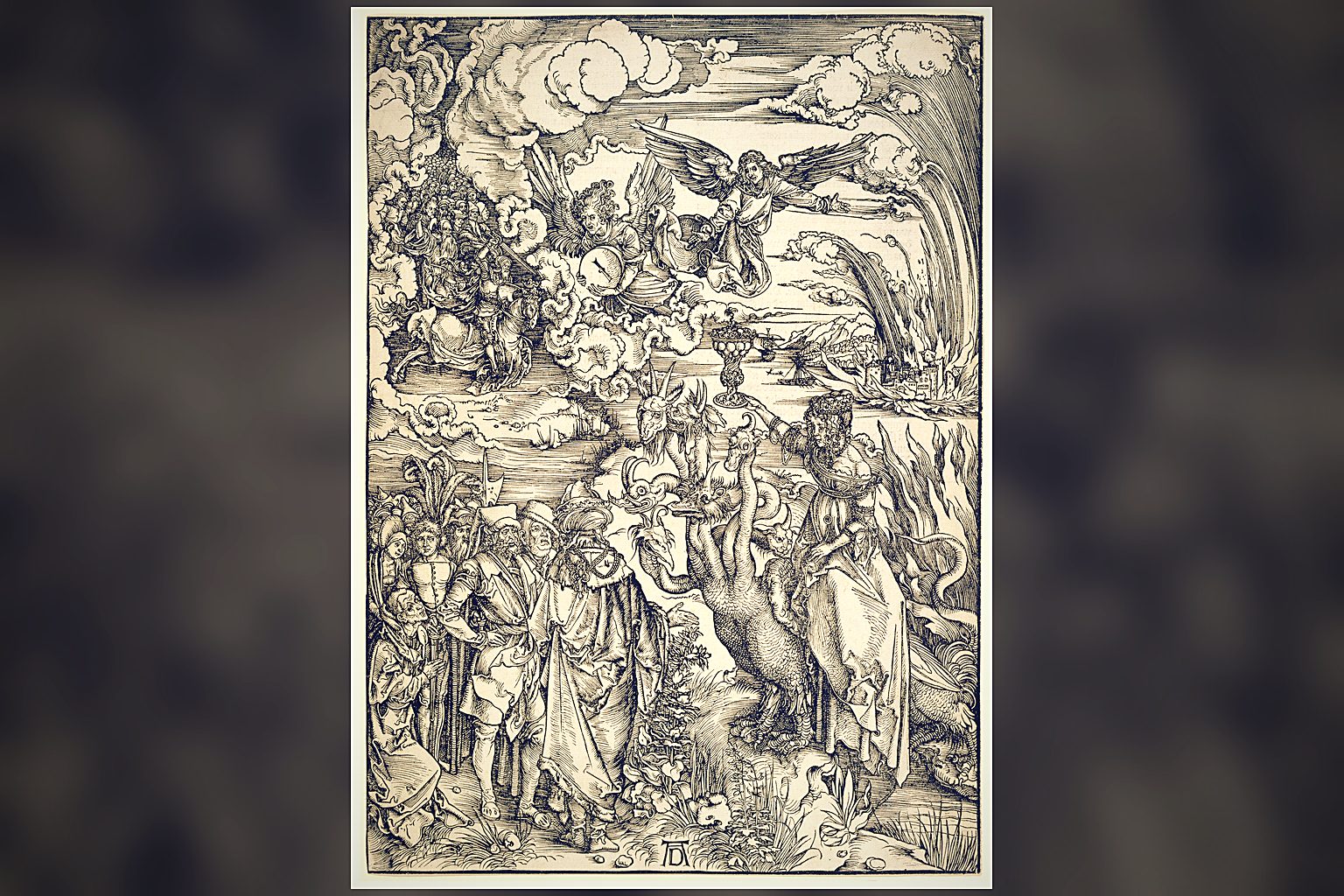
The Mark of the Beast is one of the few things in Revelation that comes with a technical specification.
“And he causeth all, both small and great, rich and poor, free and bond, to receive a mark in their right hand, or in their foreheads: And that no man might buy or sell, save he that had the mark, or the name of the beast, or the number of his name.” (Revelation 13:16-17)
Location: right hand or forehead. Function: authorisation to transact. Scope: universal, across every economic and social class.
That is not apocalyptic imagery in the usual sense. It is a description of an access control system — a credential, bound to a body, that gates participation in the economy.
What the Text Actually Specifies
Four features are given, and it is worth separating them from everything that has been added over the centuries.
1. It is received, not imposed by stealth. The Greek lambano means to take or receive. Revelation 14:9 warns against anyone who “receives” it. The text consistently presents it as something accepted rather than administered to an unwitting population.
2. It is located on the body. Right hand or forehead — the two places a person presents deliberately.
3. It functions as economic authorisation. No buying or selling without it. This is its stated purpose.
4. It is tied to allegiance. Revelation 14:11 links it to worship of the beast. The mark is not merely a credential; it is the visible token of a loyalty.
The fourth point is the one most often lost, and it is the one that does the most work. Whatever the mark is physically, the text treats the allegiance as the substance and the mark as its expression.
The Counter-Mark Nobody Mentions
Here is a detail that reframes the whole passage, and it is in the same book.
Revelation 7:3 describes God’s servants being sealed in their foreheads. Revelation 14:1 describes the 144,000 with the Father’s name “written in their foreheads.” Revelation 22:4 says of the redeemed: “his name shall be in their foreheads.”
So there are two marks, in the same location, doing the same job — identifying whose you are.
That symmetry matters enormously for interpretation. If the seal of God on the forehead is understood as a spiritual designation rather than a physical stamp, consistency requires taking the mark of the beast the same way. And if the mark is a literal physical implant, then so is the seal.
Most readings quietly apply one standard to one and a different standard to the other. The text does not.
There is also a deep Hebrew background here. Deuteronomy 6:8 instructs Israel to bind the commandments “for a sign upon thine hand” and “as frontlets between thine eyes” — hand and forehead, the same two locations. In Jewish practice this became the tefillin, worn literally. So the imagery of hand-and-forehead marking as a token of allegiance predates Revelation by centuries and already carried a specific meaning: this is what owns me.
666: What the Number Is Doing
“Here is wisdom. Let him that hath understanding count the number of the beast: for it is the number of a man; and his number is Six hundred threescore and six.” (Revelation 13:18)
Two things are worth knowing.
The manuscript variant. Some early manuscripts — notably Papyrus 115, one of the oldest witnesses to Revelation — read 616, not 666. Irenaeus knew of the variant in the 2nd century and argued against it. The reading is not certain.
Gematria. In Greek and Hebrew, letters double as numerals, so any name has a numerical value. This is the mechanism the verse invokes when it says to count the number. The most widely supported historical decoding is Nero Caesar — written in Hebrew characters as Neron Kesar, it sums to 666. Drop the final n, as the Latin form Nero Caesar does, and it sums to 616, which elegantly explains the variant.
This is the strongest single explanation on the table, and it points to a first-century referent: a persecuting emperor, identified by a code his contemporaries could crack and a Roman censor could not.
That does not necessarily exhaust the passage. But any reading that ignores the gematria is ignoring the method the text explicitly tells the reader to use.
The Transhumanism Question
The modern reading connects the mark to implantable technology, and the connection is not unreasonable — but it needs to be made carefully.
What is actually true today:
- Implantable payment chips exist and are commercially available. Several thousand people, mostly in Sweden, carry NFC implants used for access control and payments.
- Brain-computer interfaces have moved from research into human trials. Neuralink and others have implanted devices in human patients.
- Biometric identity systems operate at national scale — India’s Aadhaar enrols over a billion people using fingerprints and iris scans.
- Cash use is declining sharply across many economies, and programmable central bank digital currencies are in development in dozens of countries.
What does not follow:
None of that is the mark, and saying so requires ignoring the text’s own criteria. A payment chip is not received as an act of worship. Aadhaar is not tied to the name of a beast. A cochlear implant or a deep-brain stimulator for Parkinson’s is not an allegiance.
The text’s decisive criterion is allegiance, not hardware. Revelation 14:9 condemns those who worship the beast and receive the mark; the two are joined. A technology that merely makes universal economic gatekeeping possible is infrastructure, not the mark itself.
The honest formulation is this: Revelation describes a system in which participation in the economy is gated by a credential bound to a person and tied to loyalty. For most of history that was technologically unimaginable. It is now straightforwardly buildable. That is a meaningful observation about capability — and capability is not the same as fulfilment.
The Deeper Pattern: “Ye Shall Be As Gods”
Where the transhumanist reading does have real force is not in the hardware. It is in the pitch.
The original offer in Eden was not “disobey God.” It was an upgrade:
“For God doth know that in the day ye eat thereof, then your eyes shall be opened, and ye shall be as gods, knowing good and evil.” (Genesis 3:5)
Enhanced perception. Expanded knowledge. A transcended limit. The temptation was framed as improvement, and it was accepted on those terms.
The same structure appears in the rebellion that started everything — “I will be like the most High” — and again in the Watchers’ curriculum, where knowledge arrives before the restraint to hold it, and again at Babel, where the problem is explicitly that nothing will be restrained from them.
Four episodes, one shape: capability offered ahead of the wisdom to carry it, and accepted because it is framed as advancement.
That is the pattern worth watching for, and it does not require any particular technology. It has been running since Genesis 3.
Frequently Asked Questions
What is the Mark of the Beast?
Revelation 13:16-17 describes a mark received in the right hand or forehead, without which no one may buy or sell. Revelation 14:9-11 ties it to worship of the beast, making allegiance rather than the physical token the defining element.
Is the Mark of the Beast a microchip?
The text does not describe technology. Implantable payment chips and biometric ID systems exist, but Revelation’s criterion is allegiance — the mark accompanies worship of the beast. A payment implant by itself does not meet that description.
What does 666 mean?
Revelation 13:18 calls it the number of a man and instructs readers to count it, invoking gematria, where letters carry numerical values. The most widely supported decoding is Nero Caesar, which in Hebrew characters sums to 666.
Why do some manuscripts say 616?
Papyrus 115, one of the oldest surviving witnesses to Revelation, reads 616. This fits the Nero decoding: the Hebrew form Neron Kesar gives 666, while the Latin form Nero Caesar, without the final n, gives 616. Irenaeus knew of the variant in the 2nd century.
Can you take the Mark of the Beast accidentally?
The Greek verb used is lambano, to receive or take, and Revelation consistently presents it as accepted alongside worship of the beast. The text describes a deliberate act of allegiance, not an unwitting one.
Is there a mark of God too?
Yes. Revelation 7:3 describes God’s servants sealed in their foreheads, Revelation 14:1 has the Father’s name written in their foreheads, and Revelation 22:4 says the redeemed have his name in their foreheads — the same location and the same function.
Where does the hand-and-forehead imagery come from?
Deuteronomy 6:8 instructs Israel to bind God’s commandments as a sign on the hand and as frontlets between the eyes, which became the practice of tefillin. The two locations were already established symbols of allegiance long before Revelation.
Conclusion: The Question Is Not What, But Whose
Most discussion of the Mark of the Beast asks what it will be — a chip, a tattoo, a code, a currency.
The text asks a different question, and it asks it twice.
There are two marks in Revelation, in the same place on the body, doing the same job. One carries the name of the beast. The other carries the name of God. Neither is described as a piece of equipment. Both are described as an answer to the question of ownership — a visible statement of who a person belongs to.
That is why the number is “the number of a man.” Not the number of a device.
Whatever technology eventually makes universal economic gatekeeping practical — and that technology now exists — the criterion Revelation gives has not changed and cannot be met by hardware alone. The mark is not what goes into the hand.
It is what the hand was extended to accept, and why.
Continue Reading
- The End of the World According to Revelation — Seals take a quarter, trumpets a third, bowls take everything. The fractions are the tell. Revelation is not a…
- The Third Temple: What Is Actually Ready, and What Is Not — The vessels are finished, the garments are woven and the plans exist. What does not exist is a valid set of ashes, an…
- The New Jerusalem: Is the City of God a Divine Mothership? — Revelation gives the New Jerusalem a size, a shape and a materials list. Twelve thousand furlongs a side, walls of only…