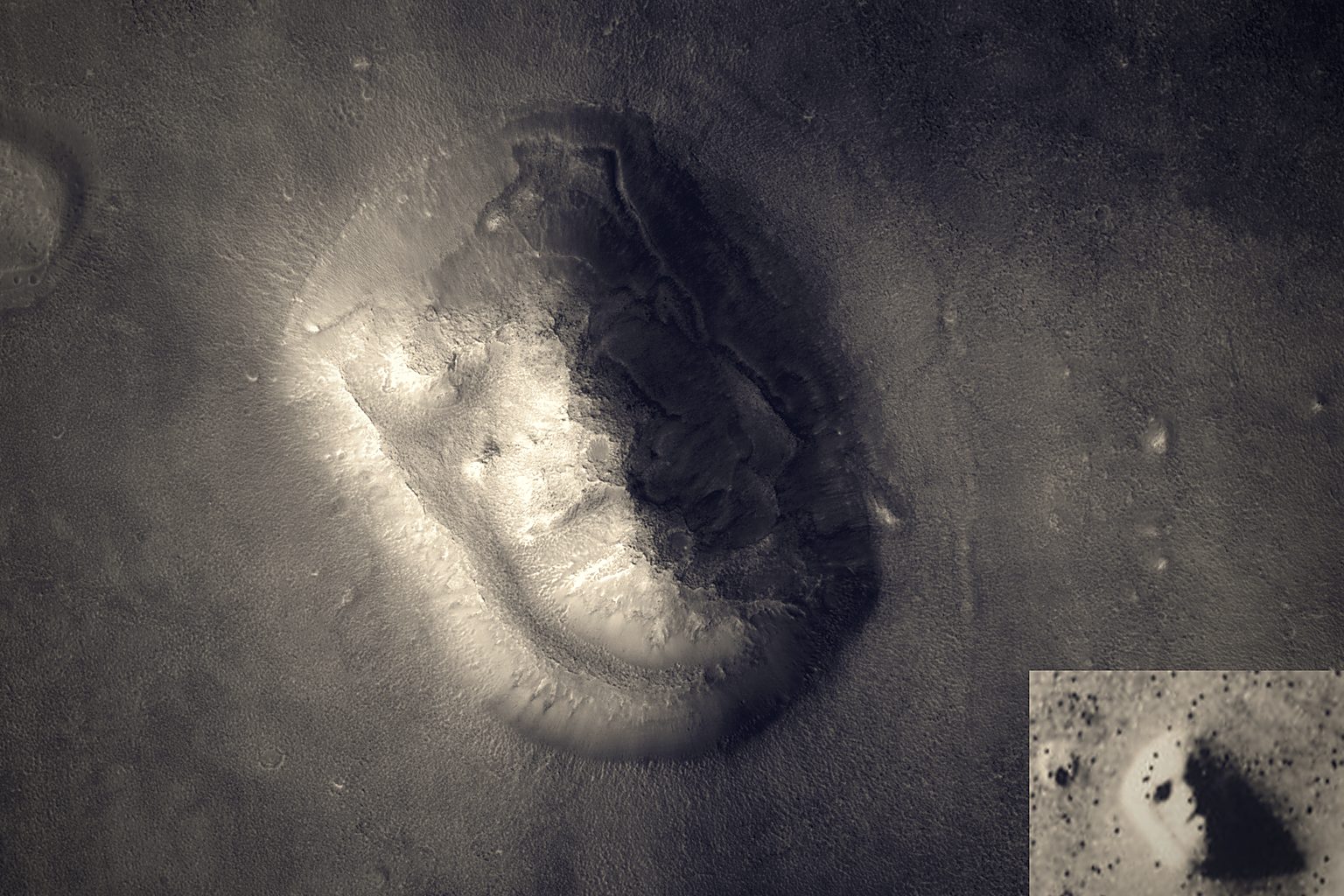
On 25 July 1976, the Viking 1 orbiter was looking for somewhere safe to put a lander. It photographed a region of the northern Martian plains called Cydonia, and one of the frames it returned, catalogued 35A72, contained a mesa about two kilometres (1.2 miles) long with a shadow across it.
Six days later NASA put the picture out at a press briefing. The caption described a rock formation resembling a human head, and added that the resemblance was a trick of light and shadow.
That sentence is the reason the Face on Mars is famous. NASA had not buried it. NASA had published it, joked about it, and moved on — and for the next thirty years a great many people worked very hard to show that the moving on had been premature.
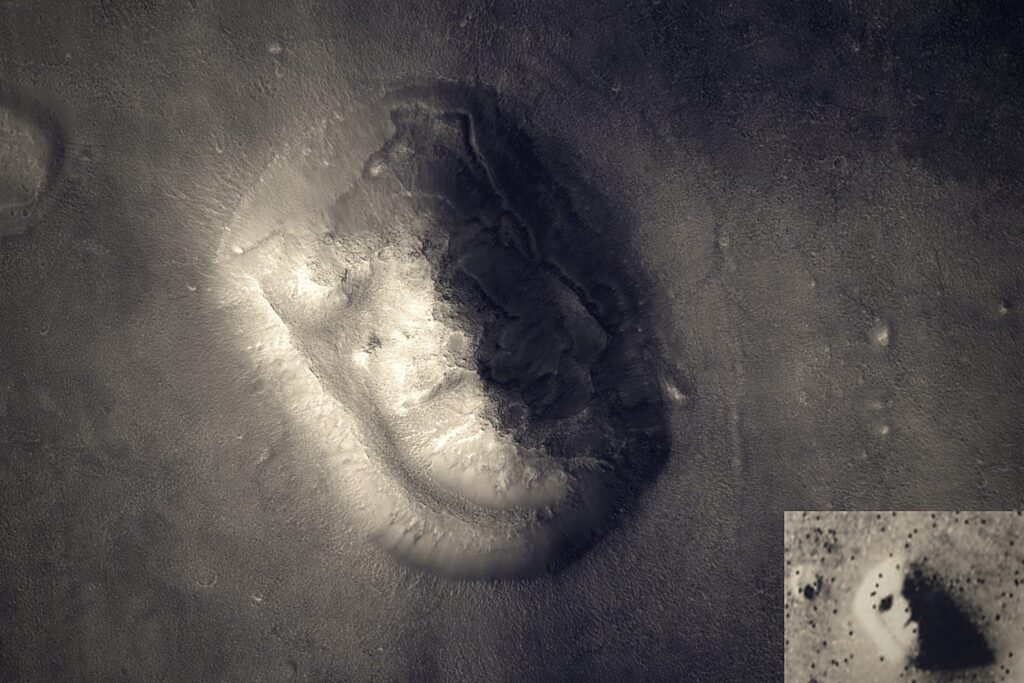
What Is the Face on Mars?
The Face on Mars is a mesa in the Cydonia Mensae region, at roughly 40.7° north and 9.5° west, which in a low-resolution photograph taken at a low sun angle looks like a human face staring upward. Later photographs, taken by four different spacecraft at up to a hundred and thirty times the resolution, show an eroded hill.
That is the short version, and it is not the interesting part. The interesting part is what happened in between: a twenty-two-year gap in which the only data anybody had was one photograph, and in which the argument about that photograph produced a peer-reviewed paper, a bestselling book, a congressional letter-writing campaign and a feature film.
The Photograph Nobody Could Improve On
Viking’s camera resolved about 43 metres (140 feet) per pixel. The Face occupied roughly fifty pixels across. At that scale the eye is not reading a face; it is reading a suggestion of one, and filling in the rest.
Two things made the suggestion hard to dismiss.
The first was that the shadow fell the wrong way for a simple illusion. The sun was about 10° above the horizon, which is the worst possible lighting for reading topography — it turns every slope into a wall of black. A critic could say the shadow made the face. An advocate could reply that the shadow made the face and that a shadow does not, on its own, produce symmetry.
The second was frame 70A13. Thirty-five days after the first image, Viking photographed Cydonia again at a different sun angle, and the formation still looked like a face. The trick-of-light explanation had been offered before that second frame was examined closely, and it had been offered fast.
The Case That It Is Artificial
It deserves to be stated properly, because it was not made by cranks alone.
Vincent DiPietro and Gregory Molenaar, both computer engineers working on NASA contracts, found the original data in 1979 and applied an image enhancement of their own design, the Starburst Pixel Interleaving Technique, to squeeze more out of the limited dynamic range. Their enhanced version showed what looked like a second eye socket on the shadowed side and fine structure across the surface. They published it in 1982 as Unusual Martian Surface Features.
Mark Carlotto, an optical engineer, went further and asked a statistical question rather than a visual one. In Applied Optics in 1988 he reported a shape-from-shading reconstruction of the Face, and in follow-up work with Michael Stein he applied fractal analysis to the terrain — the reasoning being that natural landscapes are fractal in a measurable way, and manufactured objects are not. The Face came out as the most anomalous feature in the frame by that measure.
Richard Hoagland turned it into a system. The Monuments of Mars (1987) argued that the Face did not stand alone: there was a five-sided formation nearby he called the D&M Pyramid, a cluster he called the City, and a set of angles between them that he said encoded mathematical constants.
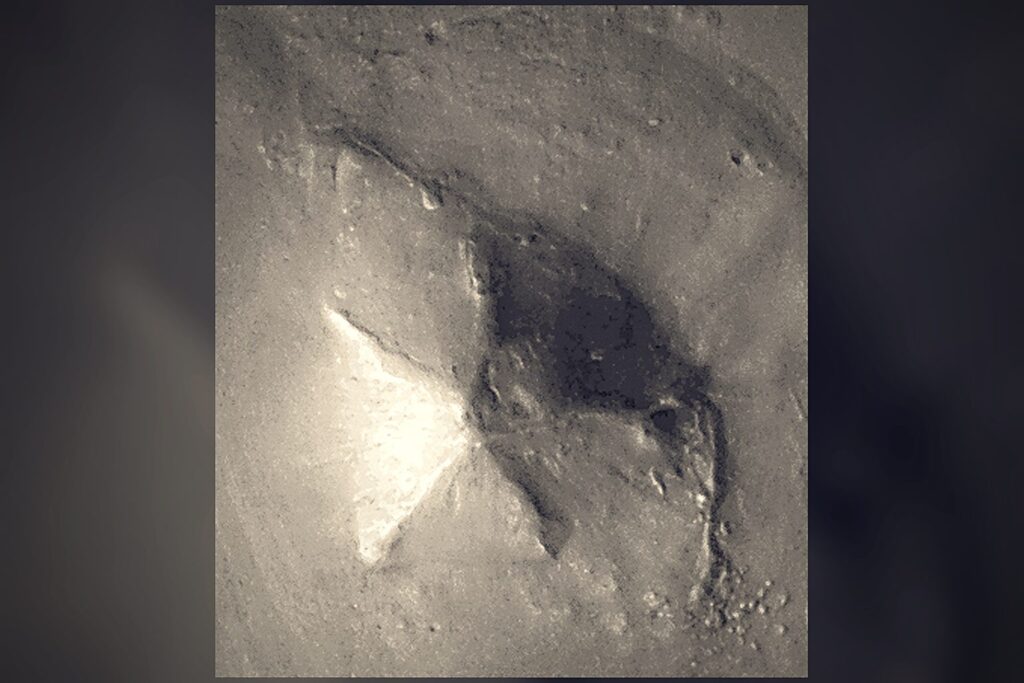
The argument at its strongest is not “it looks like a face”. It is this: a single anomalous shape on a planet is meaningless, because planets are large and rocks are numerous. A shape that is anomalous by an objective measure, that survives a change in lighting, and that sits in a group with other anomalous shapes, is a different kind of claim. Whether that claim was true is a separate question from whether it was reasonable to make.
The Case That It Is a Landform
It is equally worth stating in full.
Mars has a great many mesas. Cydonia in particular sits in a transition zone between the southern highlands and the northern lowlands, a belt of knobby, heavily eroded terrain where isolated flat-topped hills are the normal furniture of the landscape. A formation roughly two kilometres long and a few hundred metres high is ordinary there. What was unusual was the pixel count and the sun angle, not the hill.
The symmetry argument also cuts both ways. The Face is not symmetrical in the Viking image. One side is in shadow, and the enhancements that produced the second eye socket were reconstructing data that the camera never recorded — the detail was inferred from the processing, not extracted from the surface.
And the statistical case had a weakness its own authors acknowledged: a fractal measure tells you a feature is unlike its surroundings. It does not tell you why. Erosion produces unusual shapes routinely, and “most anomalous object in this frame” is a description that some object has to satisfy in every frame ever taken.
| The artificial reading | The landform reading | |
|---|---|---|
| The resemblance | too specific for chance | fifty pixels and a low sun |
| The second frame | survives a lighting change | a mesa looks like a mesa from any angle |
| The enhancements | recovered real structure | invented structure from noise |
| The nearby formations | a group, not a coincidence | a knobby terrain field, as mapped |
| What would settle it | a better photograph | a better photograph |
Both sides agreed on the last line. That is the rarest thing in this whole story, and it is why what happened next mattered.
The Second Photograph
On 5 April 1998, the Mars Orbiter Camera aboard Mars Global Surveyor photographed Cydonia from 444 kilometres (276 miles) away. The image was about ten times sharper than Viking’s.
It showed a hill.
The response was immediate and, in its own way, reasonable: the image had been taken through haze, the processing had been aggressive, and the released version had been high-pass filtered in a way that flattened contrast. Hoagland’s side called it the “catbox” image and said the detail had been processed out rather than photographed away.
So the spacecraft went back. On 8 April 2001 it imaged Cydonia again under clear conditions at about 1.6 metres (5 feet) per pixel. In 2006 the European Mars Express returned colour and stereo data, producing a genuine three-dimensional model of the landform rather than an inference from shadow. In April 2007 the HiRISE camera on Mars Reconnaissance Orbiter photographed it at roughly 30 centimetres (12 inches) per pixel — about a hundred and thirty times the resolution of the frame that started everything.
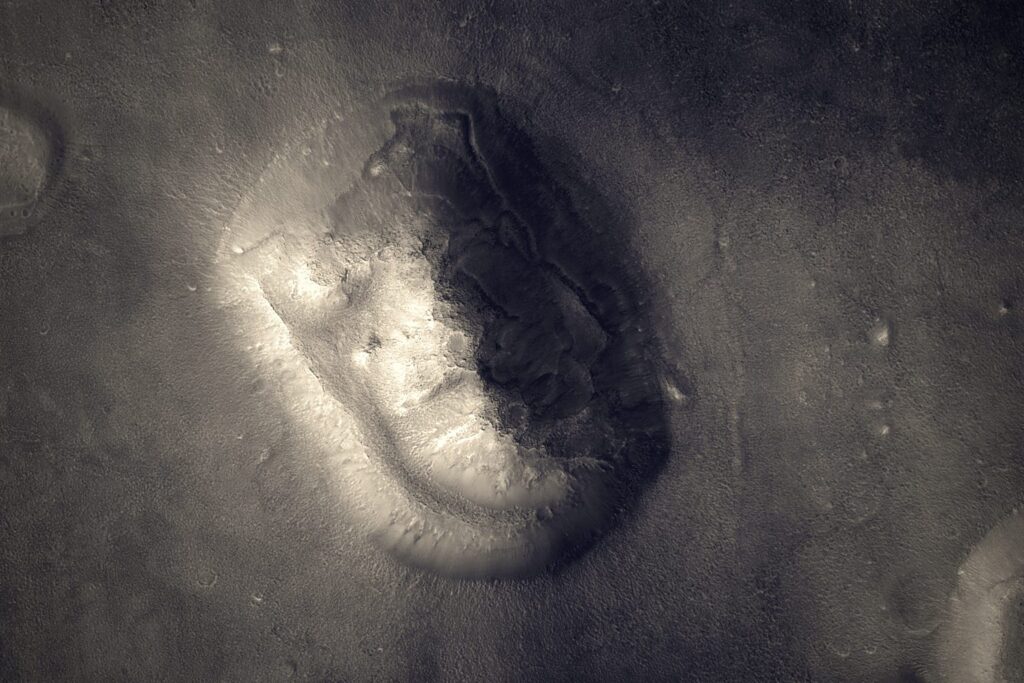
Four spacecraft, three space agencies, four lighting conditions, and a 3D elevation model. The structure is a mesa with a ridge along it and erosional scarps down its flanks.
What the Resolution Settled, and What It Did Not
It settled the shape. At 30 centimetres per pixel you would see a wall if there were a wall, a joint if there were a joint, a straight edge holding its line for more than a few metres. None of that is there.
What it did not settle is the question underneath, and that question is genuinely open.
How would you recognise an artificial structure on another world if you saw one? The Face was the first real test case, and the test went badly for everybody. The advocates had a criterion — statistical anomaly relative to surrounding terrain — and it produced a false positive. The critics had a criterion — it looks like a natural feature and natural is the default — which is not a criterion at all, because it would have rejected a genuine artefact just as fast.
This is not a rhetorical point. Archaeology on Earth has the same problem and solves it with context: tool marks, spoil heaps, a quarry, a road, a midden. At interplanetary distance there is no context, only a shape, and shape alone has now been demonstrated to be insufficient in both directions.
Why the Brain Does This
Pareidolia is the name for seeing a meaningful pattern, usually a face, in something that does not contain one. It is not a defect and not a sign of credulity. It is the ordinary operation of a system that is running all the time.
The human brain has a dedicated region for it. The fusiform face area, identified by Nancy Kanwisher and colleagues in 1997, responds far more strongly to faces than to other objects, and it responds to face-like arrangements too — two dots and a line will do it.
The detector is present at the start. Newborns, tested within days of birth, turn their eyes and heads further to follow a schematic face pattern than to follow the same elements scrambled. They have not had time to learn what a face is. They arrive already looking for one.
That is worth sitting with before mocking anyone who saw a face at Cydonia. The system that found it is the same system that lets an infant find its mother, and it is tuned to accept a bad match rather than miss a good one. Given fifty grey pixels and a shadow, it will deliver a face, and it will deliver it before you have finished deciding whether you want one.
The Part That Still Deserves an Answer
Set the mesa aside. Three things about the episode remain interesting.
NASA published it. The most-cited cover-up in modern space history began with a government agency releasing the image, describing what it looked like, and putting it on the wire. Whatever the argument is about, it is not about suppression.
The enhancements were the problem, not the camera. Almost every claimed detail — the second eye, the teeth, the headdress bands — came out of processing rather than out of Mars. That is a general lesson with a long reach, and it is getting longer as image reconstruction gets more capable of producing plausible detail that was never recorded.
The question the Face was standing in for has not gone away. People did not care about a hill. They cared whether anything had ever built anything out there. The passages in scripture that get read as contact accounts, the Dogon and their knowledge of Sirius B, the lines cut into the Nazca desert and the stones at Puma Punku are all, underneath, the same question asked in different materials. Cydonia is the one case where somebody could go back with a better camera. Most of the others, nobody can.
Frequently Asked Questions
What is the Face on Mars?
A mesa in the Cydonia region of Mars, about two kilometres (1.2 miles) long, which resembled a human face in a low-resolution Viking orbiter photograph taken on 25 July 1976. Higher-resolution images from four later spacecraft show an eroded hill with a ridge along its top.
Is the Face on Mars real?
The landform is real and you can see it today in HiRISE data at 30 centimetres per pixel. The face is not: at that resolution the features that made the resemblance in 1976 resolve into erosional scarps and a central ridge. What remains genuinely disputed is not the shape but the wider question of how artificiality could be recognised at a distance at all.
Who discovered the Face on Mars?
It was in a NASA Viking 1 image released in July 1976, and NASA’s own caption pointed out the resemblance. The detailed case that it was artificial was developed later, chiefly by Vincent DiPietro and Gregory Molenaar from 1979, and by Richard Hoagland from the mid-1980s.
Did NASA cover up the Face on Mars?
NASA released the original image itself, at a press conference, six days after it was taken. The specific complaint that does have substance is narrower: the first Mars Global Surveyor image in April 1998 was released after high-pass filtering that reduced contrast, and critics argued the processing flattened detail. Two later imaging campaigns, in 2001 and 2007, were run under clear conditions and are not open to that objection.
How big is the Face on Mars?
Roughly two kilometres (1.2 miles) long and a few hundred metres high, sitting on the Cydonia Mensae plain. For scale, the whole formation would comfortably contain a large airport.
Why does the Face on Mars look like a face?
Because the human visual system contains a face detector that fires on very thin evidence. The fusiform face area responds to any arrangement resembling two eyes and a mouth, and newborns already prefer face-like patterns within days of birth. At 43 metres (140 feet) per pixel and a sun 10° above the horizon, a mesa with a ridge and two depressions supplies exactly the arrangement that detector is looking for.
Are there pyramids on Mars?
There are several formations in Cydonia with straight-looking edges, including the five-sided one Richard Hoagland named the D&M Pyramid. Higher-resolution imaging shows them as eroded knobs and mesas of the kind common in that terrain belt. Whether any natural process produces edges that straight is the part still argued over, and it is a question about erosion rather than about builders.
What ended the argument?
Resolution, not authority. Between 1998 and 2007 four spacecraft photographed the same landform under four sets of conditions, one of them building a stereo elevation model. Both sides had said in advance that a better photograph would settle it, which is the clearest thing either side did.
Where That Leaves You
A shape on a distant world convinced a great many careful people that something had been built. They were wrong, and the way they were wrong is more useful than the fact of it.
They had a criterion. It was objective, it was published, it was applied honestly, and it returned the wrong answer — because “unlike everything around it” is a property that some object in every photograph must have. The people on the other side had no criterion at all, only a default, and a default that always says “natural” cannot detect an artefact by construction.
Nobody has fixed that. If a probe returns an image tomorrow of something genuinely manufactured on a moon of Saturn, the argument will run exactly as this one did, with the same tools, and the resolution to settle it will be twenty years away again.
The mesa at Cydonia is a hill. The question it was standing in for is still standing.
Continue Reading
- What Is Under Antarctica’s Ice: The Claims and the Radar — Pyramids, a Nazi base, a fleet that went home early, an opening at the pole. Then what the radar actually found: a…
- The Sumerian King List: 241,200 Years Before the Flood — Eight kings, 241,200 years, then a flood. Almost every retelling adds the numbers up — and what that shape means is the…
- Demonic Possession vs Mental Illness: The Argument That Never Ended — For thousands of years, madness meant possession. Then psychiatry relabelled the symptoms and offered drugs that work…