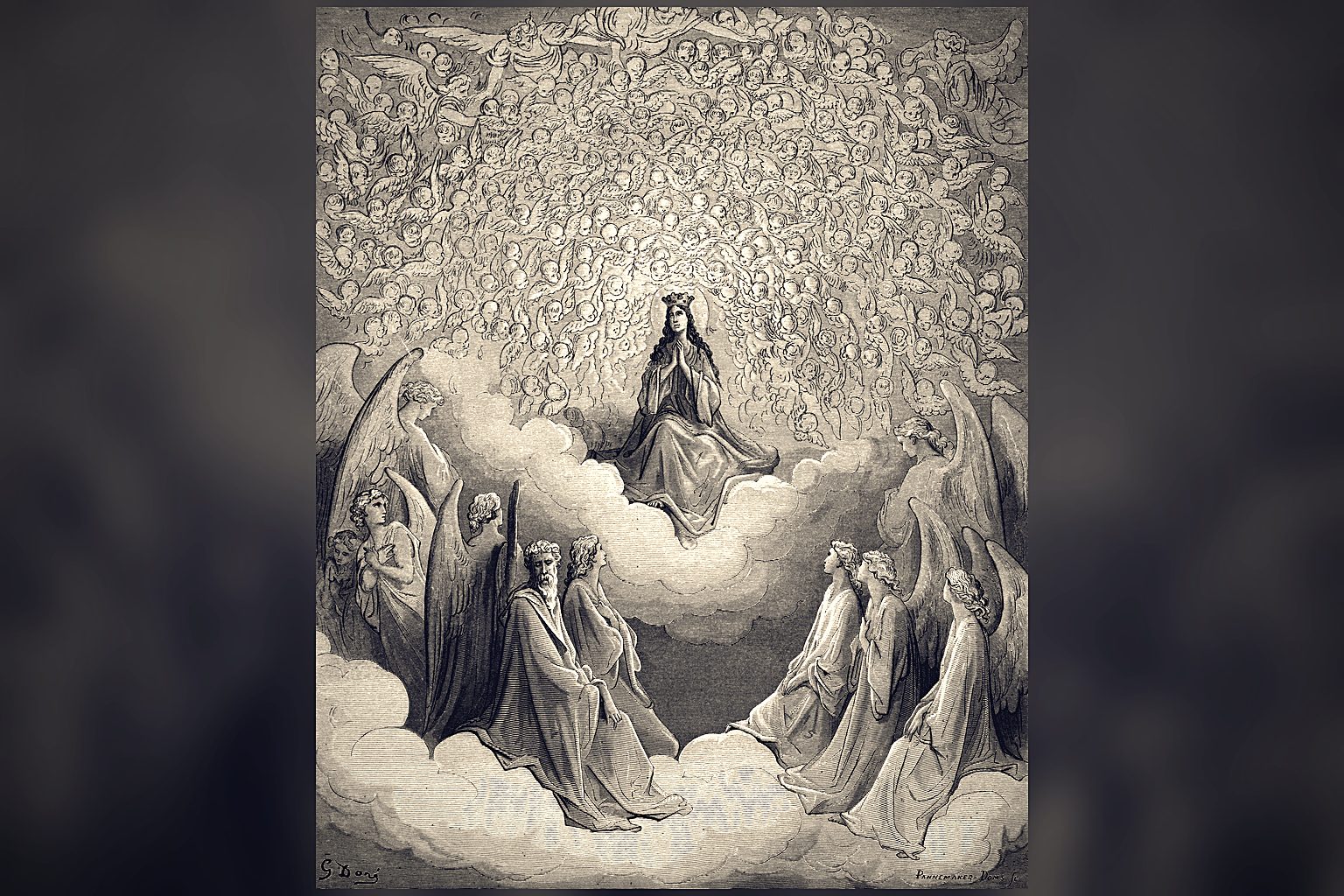
Almost nothing popular culture tells you about angels comes from the Bible. What does come from it is considerably stranger.
There are no harps. There are very few wings — most angels who appear to people are mistaken for ordinary men. Nobody becomes an angel after dying. And the cherub, which centuries of religious art have reduced to a chubby infant with a bow, is described in Ezekiel as a four-faced entity moving alongside wheels covered in eyes, at a sight that made the prophet fall on his face.
The biblical angelic realm is not soft. It is structured — ranked, assigned and organised around function — though the hierarchy of angels most people can recite is not the one in the Bible.
What Is the Hierarchy of Angels in the Bible?
The Bible never sets out a single ordered list of angelic ranks. What it provides instead are named classes scattered across different books — seraphim, cherubim, ophanim, archangels, messengers — plus a set of collective terms used by Paul: thrones, dominions, principalities and powers.
The familiar nine-choir hierarchy is not biblical in origin. It was systematised around the 5th-6th century AD by an anonymous writer known as Pseudo-Dionysius the Areopagite, in a work called The Celestial Hierarchy. He assembled the scattered biblical terms into a nine-rank structure organised in three triads — an arrangement later adopted by Thomas Aquinas and embedded in Western tradition ever since.
Both are worth knowing. But it matters enormously which one you are looking at, because they are not the same thing.
The Nine Choirs of Angels
Pseudo-Dionysius arranged the ranks in three triads, ordered by proximity to God:
| Triad | Rank | Primary scriptural source | Function |
|---|---|---|---|
| First | Seraphim | Isaiah 6:2-3 | Closest to the throne; continuous worship |
| First | Cherubim | Genesis 3:24; Ezekiel 10 | Guardians; bearers of the divine presence |
| First | Thrones | Colossians 1:16 | Seats of divine judgement and authority |
| Second | Dominions | Colossians 1:16 | Regulate the duties of lower ranks |
| Second | Virtues | Ephesians 1:21 (implied) | Govern natural order; associated with signs |
| Second | Powers | Colossians 1:16; 1 Peter 3:22 | Restrain hostile forces |
| Third | Principalities | Ephesians 6:12; Colossians 1:16 | Authority over nations and regions |
| Third | Archangels | Jude 1:9; 1 Thessalonians 4:16 | Chief messengers; commanders |
| Third | Angels | Throughout | Direct contact with humanity |
An important caution: the second triad in particular is built on thin ground. “Virtues” as an angelic rank rests on a debatable reading of Greek terms that elsewhere simply mean powers or mighty works. Paul’s lists in Colossians 1:16 and Ephesians 6:12 are almost certainly categories of authority, not a personnel chart — and in Ephesians they describe hostile powers, not loyal ones.
The nine choirs are a coherent theological system. They are not an inventory the Bible provides.
The Ranks the Bible Actually Names
Seraphim — The Burning Ones
They appear once, in Isaiah 6, and the appearance is overwhelming enough that the prophet’s immediate reaction is to declare himself undone.
“Above it stood the seraphims: each one had six wings; with twain he covered his face, and with twain he covered his feet, and with twain he did fly.” (Isaiah 6:2)
The name comes from the Hebrew root saraph, meaning to burn. The same word is used for the fiery serpents of Numbers 21.
The wing arrangement is the detail worth pausing on. Of six wings, only one pair is used for flight. Two shield the face; two cover the feet. Two-thirds of their anatomy is dedicated not to movement but to shielding — and what they are shielded from is the thing they are closest to.
Their cry — “Holy, holy, holy” — is not addressed to God but to one another (Isaiah 6:3), a continuous antiphonal loop. The Hebrew kadosh means “set apart,” and the threefold repetition is the strongest intensifier the language has.
Cherubim — The Guardians
Forget the infants. The cherubim of Ezekiel 1 and 10 are composite beings with four faces — a man, a lion, an ox and an eagle — and four wings, moving in straight lines without turning.
Their function across Scripture is consistently boundary enforcement:
- They are stationed at the east of Eden with a flaming sword “which turned every way, to keep the way of the tree of life” (Genesis 3:24). Note what that verse actually says: the sword is not held by the cherubim. It turns by itself, in every direction, as a standing barrier.
- Two cherubim are formed in gold on the mercy seat of the Ark of the Covenant (Exodus 25:18-22), with the point of communication located in the gap between their wings.
- They are described as bearing the throne itself in Ezekiel’s vision.
They are not decorative. Wherever access to something must be restricted, cherubim are what stands there.
Ophanim — The Wheels
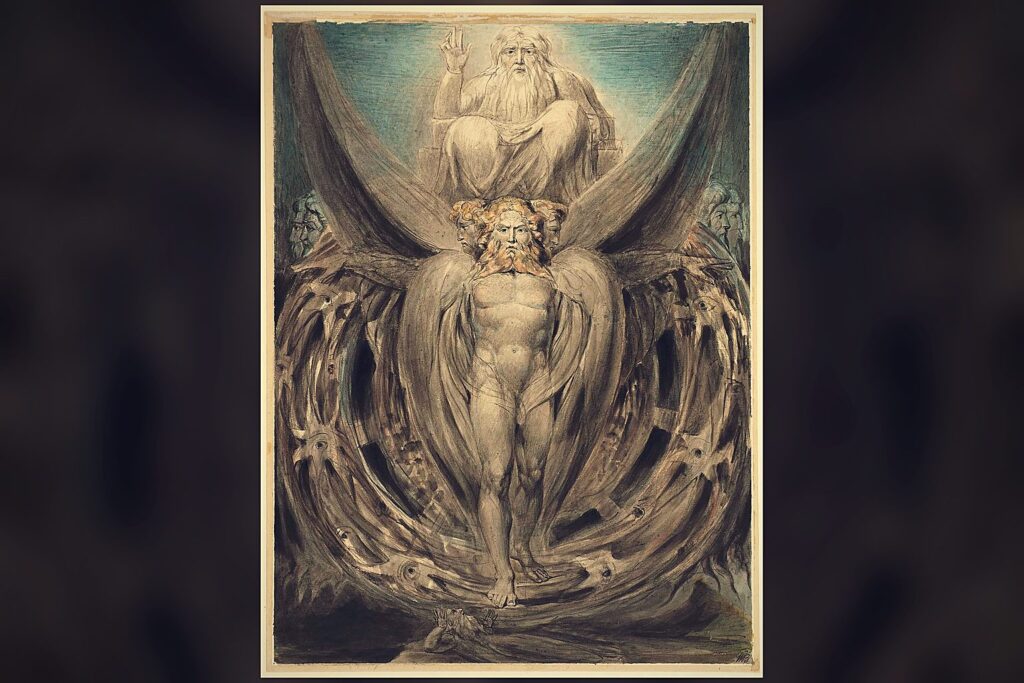
The strangest entities in Scripture appear in Ezekiel 1:15-21, beside the cherubim.
“The appearance of the wheels and their work was like unto the colour of a beryl… and their appearance and their work was as it were a wheel in the middle of a wheel.”
Wheels within wheels, their rims “full of eyes round about” (Ezekiel 1:18). And then the mechanical detail:
“When they went, they went upon their four sides: and they turned not when they went.”
They change direction without rotating. That is a description of omnidirectional movement — a wheel arrangement that can travel along any axis without reorienting the body it carries. The modern engineering equivalent is an omni-wheel or a gimbal. It is a very odd thing for a 6th-century BC exile to describe.
Ezekiel also notes they move in complete synchronisation with the living creatures, “for the spirit of the living creature was in the wheels” — a single system, not two objects travelling together.
Archangels — The Commanders
The word appears only twice in Scripture, and only one being is explicitly given the title:
“Yet Michael the archangel, when contending with the devil…” (Jude 1:9)
Michael is the only named archangel in the Protestant canon. Gabriel appears as a high-ranking messenger (Daniel 8:16, Luke 1:26) but is never called an archangel in Scripture. Raphael is named as one of seven who stand before God in the Book of Tobit, which is canonical in Catholic and Orthodox Bibles and not in Protestant ones. Uriel appears in 2 Esdras and 1 Enoch.
So the popular set of four archangels is assembled from several sources of different canonical status — worth knowing before repeating it as biblical.
Michael’s function is military. He commands the loyal host in the war in heaven (Revelation 12:7), contends for the body of Moses (Jude 1:9), and is named in Daniel 10:13 and 12:1 as the prince who stands for Israel. His name — Mi ka-el, “Who is like God?” — is a challenge, and it is aimed directly at the rebel’s claim to be like the Most High.
Malakim — The Messengers
The ordinary Hebrew word for angel is malakh, and it simply means messenger. The Greek angelos means the same. The English word “angel” is not a description of a nature; it is a job title.
This is why most angelic appearances in Scripture involve no wings and no glow. They look like men. Abraham hosts three of them in Genesis 18 and offers them a meal — which they eat.
What Are Angels Made Of?
The Bible’s only direct definition is functional rather than material:
“Are they not all ministering spirits, sent forth to minister for them who shall be heirs of salvation?” (Hebrews 1:14)
Ministering spirits. Hebrews 1:7 adds that God “maketh his angels spirits, and his ministers a flame of fire.”
But the behaviour described is not what we usually mean by “spirit.” Angels in Scripture are consistently localised. They arrive from somewhere. They depart. They can be blocked in transit — in Daniel 10:13 a messenger explains he was delayed twenty-one days by the prince of Persia, until Michael came to assist.
Delay implies distance and resistance. That is the behaviour of an entity moving through a medium with rules, not an omnipresent spirit.
The picture the text gives is not of immaterial ghosts but of beings that occupy a domain adjacent to ours, with its own geography and its own obstacles — and that can cross into this one under certain conditions.
Can Angels Take Human Form?
Yes, and the text treats it as a practical problem:
“Be not forgetful to entertain strangers: for thereby some have entertained angels unawares.” (Hebrews 13:2)
Unawares. The instruction only makes sense if the disguise is complete — if there is no reliable way to tell.
Genesis 18-19 shows the full range. Three “men” visit Abraham, sit under a tree, converse, and eat curds, milk and a dressed calf. Their biology functions. Then two of them proceed to Sodom, and when the house is surrounded, they drop the appearance entirely and strike the entire crowd with blindness (Genesis 19:11).
The human form is operational cover. It is maintained while it is useful and discarded when it is not.
Are Angels Invisible?
Not inherently — conditionally.
The clearest case is 2 Kings 6. Elisha’s servant wakes to find the city surrounded by an enemy army and panics. Elisha prays:
“LORD, I pray thee, open his eyes, that he may see. And the LORD opened the eyes of the young man; and he saw: and, behold, the mountain was full of horses and chariots of fire round about Elisha.” (2 Kings 6:17)
Nothing arrives. Nothing is summoned. The host was already there, in position, the entire time. What changed was the servant’s perception.
That is a consistent pattern: Balaam cannot see the angel standing in the road, but his donkey can (Numbers 22:23). The limitation is on the observer, not on the entity.
Where Lucifer Sat in the Hierarchy
Ezekiel 28 gives the rank precisely:
“Thou art the anointed cherub that covereth; and I have set thee so: thou wast upon the holy mountain of God; thou hast walked up and down in the midst of the stones of fire.” (Ezekiel 28:14)
The anointed cherub that covereth. Not a messenger. Not a low rank. A cherub — the guardian class — and specifically the covering one, positioned closest to the throne. The being who defected held the highest security clearance in the created order.
This is why the rebellion was so damaging. It did not come from the periphery. It came from the inner ring.
Demons Are Not a Separate Creation
One distinction that clears up a great deal of confusion: God did not create demons.
Scripture describes the creation of angels, and it describes a defection. Revelation 12:4 indicates a third of the host fell with the dragon. Jude 1:6 speaks of angels who “kept not their first estate, but left their own habitation.”
Demons, on this reading, are not a different species with different powers. They are the same beings, with the same capabilities, minus their station and their access. Nothing was added to them. Something was taken away — which is precisely why they remain dangerous. Rank was lost. Capability was not.
Frequently Asked Questions
What is the hierarchy of angels in the Bible?
The Bible names individual classes — seraphim, cherubim, ophanim, archangels and messengers — but never arranges them into a single ranked list. Paul adds collective terms in Colossians 1:16: thrones, dominions, principalities and powers.
What are the nine choirs of angels?
Seraphim, Cherubim, Thrones, Dominions, Virtues, Powers, Principalities, Archangels and Angels. The arrangement comes from The Celestial Hierarchy by Pseudo-Dionysius, written around the 5th-6th century AD, not from Scripture itself.
How many archangels are there?
Scripture names only Michael as an archangel (Jude 1:9). Gabriel is a high-ranking messenger but is never given the title. Raphael appears in Tobit and Uriel in 2 Esdras and 1 Enoch, books whose canonical status varies between traditions.
What is the highest rank of angel?
In the Pseudo-Dionysian system, the seraphim stand closest to God. In Scripture itself the cherubim are the class associated with the throne and with guarding access, and Ezekiel 28:14 identifies the being who fell as “the anointed cherub that covereth.”
Are angels invisible?
Not inherently. In 2 Kings 6:17 an entire angelic army is already present and becomes visible only when the servant’s eyes are opened. The limitation is described as being on human perception rather than on the angels.
Do angels have wings?
Some classes do. Seraphim have six wings (Isaiah 6:2) and cherubim four (Ezekiel 1:6). But most angels who appear to people in Scripture are described simply as men, with no wings mentioned at all.
What are the ophanim?
The “wheels” of Ezekiel 1:15-21 — wheels within wheels, rims full of eyes, moving alongside the cherubim. They change direction without turning, and Ezekiel says the spirit of the living creatures was in them.
Are demons fallen angels?
Scripture describes angels who abandoned their station (Jude 1:6) and a third of the host falling with the dragon (Revelation 12:4). On that reading demons are not a separate creation but the same beings, retaining their capabilities while having lost their rank and access.
Do humans become angels when they die?
No. Scripture consistently presents angels as a separate order of created beings, never as transformed humans. Hebrews 1:14 describes them as ministering spirits sent to serve those who inherit salvation — which places humans and angels in different categories.
Conclusion: A Populated Realm
What the biblical texts describe is not a vague spiritual atmosphere. It is a populated, structured domain with ranks, assignments, restricted zones, transit times and chains of command — a realm that overlaps ours closely enough that its inhabitants can be delayed on the way here, blocked at a border, or mistaken for a traveller at a dinner table.
The most unsettling verse in the whole subject is not one about fire or wings. It is 2 Kings 6:17, and its implication is simple: the host was on the mountain the entire time. The army was in position. Nothing had to arrive.
The only thing that changed was that someone was allowed to see it.
Continue Reading
- Ezekiel’s Wheel: The Vision a Priest Had No Words For — A wheel in the middle of a wheel, rims full of eyes, moving in four directions without turning. What Ezekiel 1 actually…
- Demonic Possession in the Bible: Every Case, and the One That Comes Back — The evil spirit on Saul. Legion in the tombs. The boy the disciples could not help. Every case of demonic possession in…
- Adam’s First Wife: The Lilith Story Has One Source — The first wife, the refusal, the exile – all of it enters the record in a single medieval book of proverbs that half…