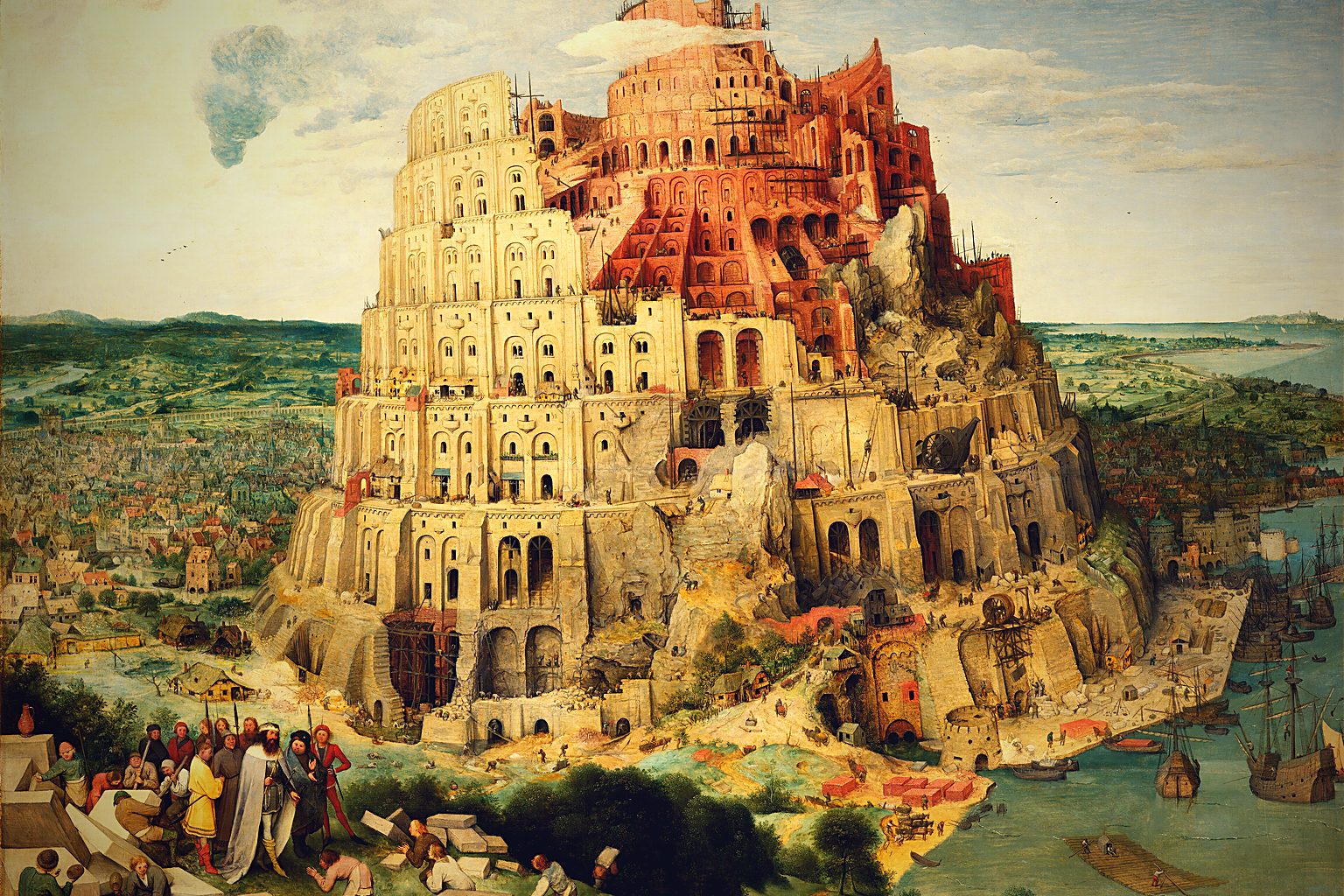
The Tower of Babel is nine verses long. It is one of the shortest episodes in Genesis, and one of the strangest, because of what God says about it.
Not “they have sinned.” Not “they have blasphemed.” This:
“Behold, the people is one, and they have all one language; and this they begin to do: and now nothing will be restrained from them, which they have imagined to do.” (Genesis 11:6)
Read that again. It is not a condemnation. It is an assessment of capability — and the conclusion is that the capability has no ceiling.
The intervention that follows does not destroy the tower. It does not punish the builders. It disables one specific thing: their ability to coordinate.
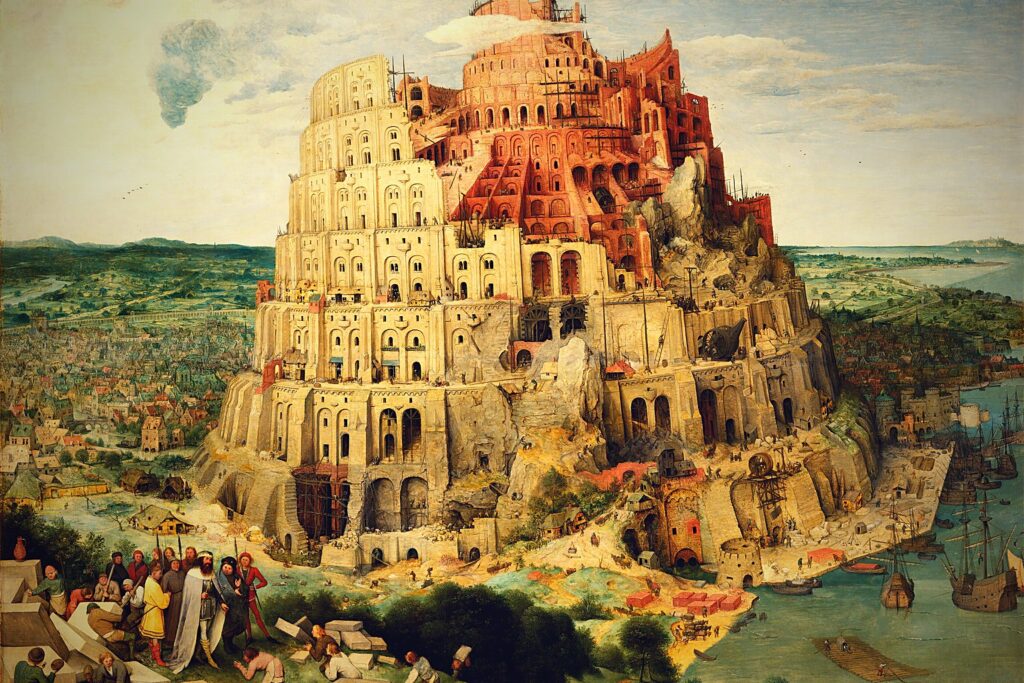
What Was the Tower of Babel?
The Tower of Babel is the structure described in Genesis 11:1-9, built on a plain in the land of Shinar — southern Mesopotamia — by a people who all spoke one language. Their stated aim was to build a city and a tower “whose top may reach unto heaven” and to make themselves a name, “lest we be scattered abroad upon the face of the whole earth.”
God’s response was to confuse their language so they could not understand one another, and the project stopped. The name Babel is connected in the text to the Hebrew balal, “to confuse.”
Why Were They Building It?
The usual reading is arrogance — humanity storming heaven. The text gives two motives, and neither is quite that.
“Go to, let us build us a city and a tower, whose top may reach unto heaven; and let us make us a name, lest we be scattered abroad upon the face of the whole earth.” (Genesis 11:4)
Motive one: to make a name. A monument. Permanence, reputation, a mark that outlasts the people who made it.
Motive two: to avoid being scattered. This is the more revealing one, because it is a direct refusal of a standing instruction. In Genesis 9:1, after the Flood, the command to Noah’s family was “Be fruitful, and multiply, and replenish the earth.” Fill it. Spread out.
Babel is a decision to do the opposite: to concentrate in one place, build one centre, and stay. The tower is not primarily an attack upward. It is an anchor — a refusal to disperse.
That reframes the divine response. Scattering them is not an arbitrary punishment. It is the enforcement of the original instruction, using the only lever that mattered.
The Construction Detail
Genesis records something oddly technical:
“And they said one to another, Go to, let us make brick, and burn them throughly. And they had brick for stone, and slime had they for morter.” (Genesis 11:3)
Brick for stone, and slime for mortar. The word translated “slime” is chemar — bitumen, natural asphalt.
This is an accurate description of Mesopotamian construction. Southern Iraq has no building stone; it has river clay and bitumen seeps. Fired mudbrick set in bitumen is exactly how the ziggurats were built, and it is a genuinely durable technique — bitumen is waterproof and remains slightly plastic, which helps a massive structure absorb settlement.
Whoever wrote Genesis 11 knew how large Mesopotamian buildings were actually made, and thought the method was worth recording.
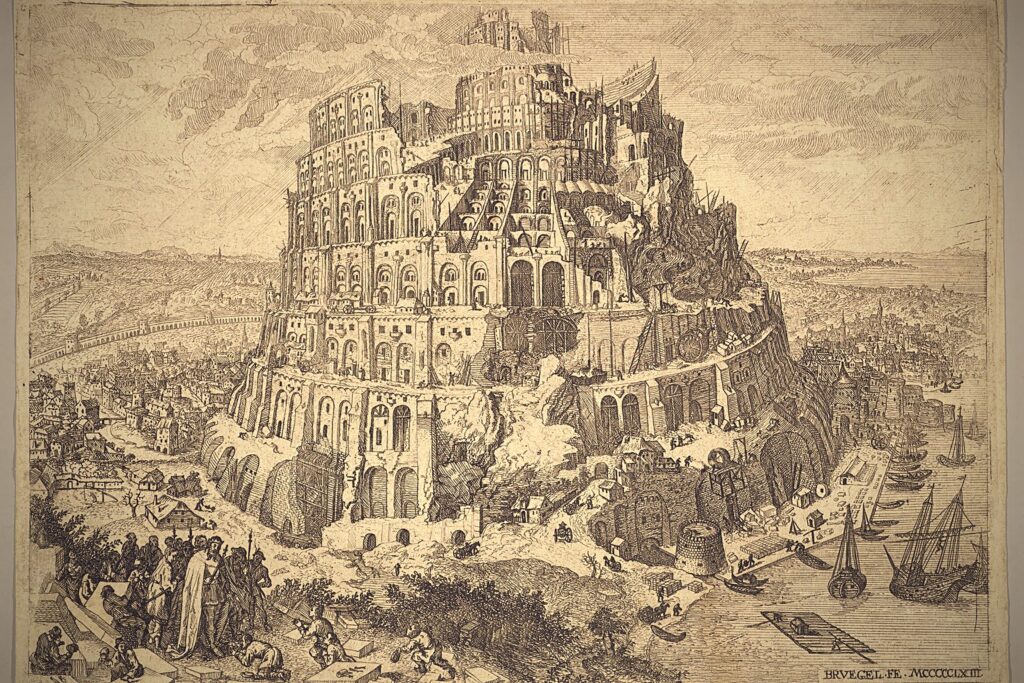
Was There a Real Tower?
Babylon had one, and it was famous.
Etemenanki — the name means “the foundation of heaven and earth” — was the great ziggurat of Babylon, dedicated to Marduk. It stood immediately north of the Esagila temple complex. Herodotus described it; Nebuchadnezzar II rebuilt it in the 6th century BC, and inscriptions record the work.
Its footprint, established by excavation, was roughly 91 by 91 metres (299 by 299 ft). Reconstructions based on the Esagila Tablet give a height in the region of 91 metres (299 ft) as well — comparable to a thirty-storey building, in mudbrick, in the ancient world.
Etemenanki was not the first ziggurat, and it was not the tower of Genesis 11 in any literal sense — it postdates the setting of the story by a long way. But it stood in the right place, it was built exactly as Genesis 11:3 describes, and it was left unfinished and ruined for long stretches of its history. Alexander the Great ordered its demolition intending to rebuild, and died before the work was done, leaving the site a heap of rubble.
A colossal, half-finished tower in Babylon, abandoned by builders who could not complete it, was a real feature of the ancient landscape for centuries.
The Confusion of Languages
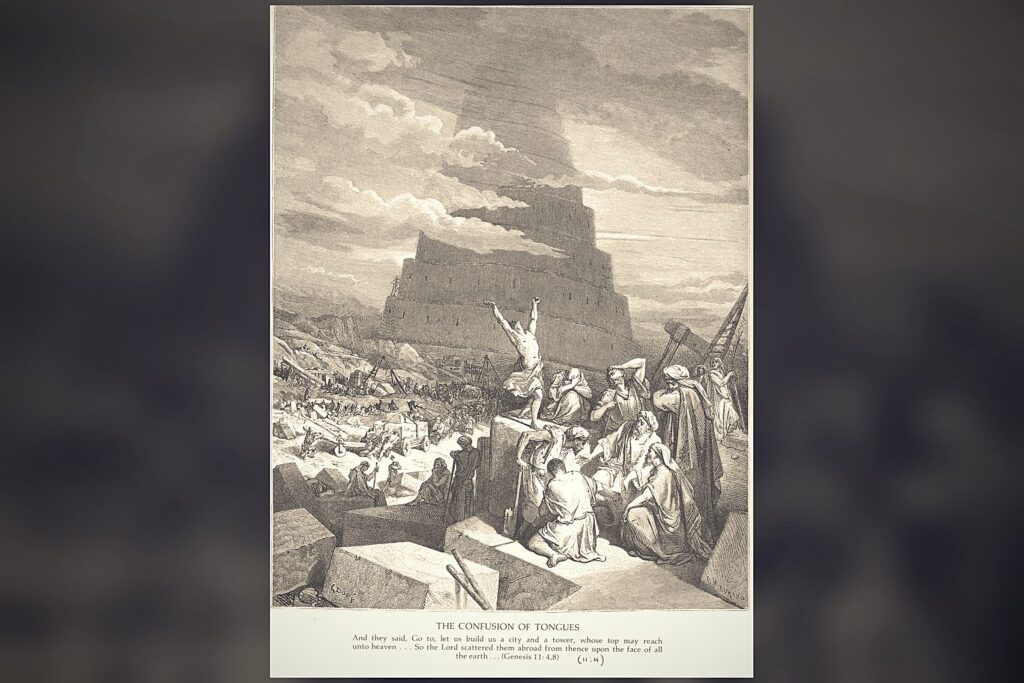
“Go to, let us go down, and there confound their language, that they may not understand one another’s speech.” (Genesis 11:7)
Notice the precision of the target. Not their strength. Not their tools. Not their knowledge. Their shared protocol.
This is worth dwelling on, because it identifies the actual bottleneck on collective human capability, and it identifies it correctly.
A large construction project is not limited by muscle or materials. It is limited by coordination bandwidth — the ability to pass instructions, correct errors, specify tolerances, and synchronise thousands of people across time. Remove the common language and nothing physical is lost. Every individual retains full skill, full strength, full memory. What is lost is the capacity to combine them.
Genesis 11:6 states the stakes in exactly those terms: nothing will be restrained from them. Unlimited coordination among a unified population is presented as approaching unlimited capability — and the countermeasure is aimed with surgical precision at the coordination layer alone.
What Linguistics Actually Says
Here is where honesty matters, because this is a subject where overclaiming is easy.
Is there evidence of a single original human language? Historical linguistics can reconstruct proto-languages with real confidence over a few thousand years — Proto-Indo-European, Proto-Semitic, Proto-Bantu. Beyond roughly 6,000-10,000 years, the signal degrades below the noise floor. Words change too fast; chance resemblance overwhelms genuine inheritance.
Attempts to push further — the Nostratic and Proto-World hypotheses — exist, but are rejected by most historical linguists as methodologically unsound. A single ancestral human language is entirely plausible on general grounds, since language almost certainly arose once in a small population. It is simply not recoverable by current methods.
Did languages diverge suddenly or gradually? All observed language change is gradual. Latin becoming French, Spanish and Romanian took centuries, and it happened through accumulated drift in isolated populations — which is precisely what scattering produces. If you disperse a unified population across a large region, mutual unintelligibility follows within a handful of generations without any further intervention.
So the biblical sequence — confusion, then scattering — and the linguistic sequence — scattering, then divergence — are not the same causal order. That is a real tension, and it should be stated rather than smoothed over.
The FOXP2 Question
A related piece of genuine science is often invoked here, usually incorrectly.
FOXP2 is a gene on human chromosome 7. It came to attention through the KE family, a London family in which roughly half the members across three generations had a severe speech and language disorder. The cause was traced to a single point mutation in FOXP2.
It is frequently called “the language gene.” It is not. FOXP2 is a transcription factor — a regulator that switches other genes on and off — and it is involved in the development of neural circuits for fine motor sequencing, including the orofacial control that speech requires. It exists in mice and songbirds, where it is involved in vocal learning. The human version differs from the chimpanzee version by two amino acid substitutions.
What FOXP2 demonstrates is real and important: speech capability has a genetic substrate, and a single mutation can disable it. What it does not demonstrate is that any gene encodes a particular language, or that language diversity has a genetic cause. Human language variation is cultural, not genetic — any infant can acquire any language natively.
Anyone telling you FOXP2 explains Babel is overselling a real finding.
The Pattern: Capability Without Restraint
Set Babel beside the other episodes in the primeval history and a structure emerges.
Before the Flood, the problem in Genesis 6 is that knowledge arrived before restraint — the Watchers of 1 Enoch teaching metallurgy, weapons, cosmetics and pharmacology to a civilisation not ready for them, with the Nephilim as the result and the Flood as the response.
At Babel, the problem is not knowledge. It is coordination. And the response is not destruction. It is a limiter.
That difference is the most interesting thing in the chapter. The Flood removes the population. Babel removes only the capacity to act as one. Nobody dies at Babel. No building is levelled. The intervention is calibrated to the exact minimum needed to stop the trajectory, and no more.
Genesis 11:6 is, on this reading, a statement about the danger of unbounded collective capability in a population that has not demonstrated the judgement to hold it. Which is not a question that has aged into irrelevance.
Frequently Asked Questions
What was the Tower of Babel?
A city and tower described in Genesis 11:1-9, built on a plain in Shinar (southern Mesopotamia) by people who all spoke one language, intending the top to reach heaven. Construction stopped when their language was confused.
Why did God destroy the Tower of Babel?
He did not destroy it. Genesis 11 records that God confused the builders’ language so they could not understand one another, and they stopped building and were scattered. The tower itself is never said to be damaged.
Where was the Tower of Babel?
Genesis places it in the land of Shinar, southern Mesopotamia. The most commonly associated real structure is Etemenanki, the great ziggurat of Babylon, whose excavated base measures roughly 91 by 91 metres (299 ft).
What was the Tower of Babel made of?
Genesis 11:3 specifies fired brick used in place of stone, with “slime” — bitumen, natural asphalt — as mortar. This accurately describes Mesopotamian construction, where building stone is unavailable but clay and bitumen are abundant.
Was there really one original human language?
Linguists generally accept that language probably arose once, but historical reconstruction loses reliability beyond roughly 6,000 to 10,000 years. Proposals such as Nostratic and Proto-World attempt to go further and are rejected by most specialists as methodologically unsound.
Is FOXP2 the language gene?
No. FOXP2 is a transcription factor involved in developing neural circuits for fine motor sequencing, including speech. A mutation in it caused severe speech disorder in the KE family. It does not encode any particular language, and language diversity is cultural rather than genetic.
How many languages came from Babel?
Genesis gives no number. The Table of Nations in Genesis 10 lists seventy descendants of Noah’s sons, and later Jewish tradition connected this to seventy nations and seventy languages, but the text itself makes no such claim.
What does the name Babel mean?
Genesis 11:9 connects it to the Hebrew verb balal, “to confuse.” In Akkadian, Bab-ilu means “gate of god,” which is the likely actual etymology of Babylon. The Hebrew text is making a deliberate wordplay.
The Limiter Reading
Almost every retelling of Babel makes it a story about pride and gets the ending wrong — smiting, ruin, a tower thrown down.
That is not what Genesis 11 says. The tower stands. The builders live. Their skills, tools and knowledge are untouched. One thing is removed, and it is the thing that turned a crowd into a single instrument.
The chapter’s own explanation is not that the builders had offended. It is that nothing would be restrained from them — that a unified population with a shared protocol and no internal friction had no upper bound on what it could attempt, and that this was judged to be the wrong condition for humanity at that moment in its development.
So a limiter was installed. Not a wall, not a flood, not a fire. A small, permanent increase in the cost of working together.
Every treaty, every translation, every standards body and interface specification since has been an attempt to undo it.
The older reading does not vanish because of that. Most of the commentary tradition, Jewish and Christian, takes the scattering as judgement whatever the chapter withholds — the builders sought a name for themselves, and what followed was the answer to it. Both readings are working from the same five verses, and the text declines to say which one it meant.
Continue Reading
- The Daniel Fast: What Daniel 1 Actually Describes — A captive proposed a ten-day controlled trial with a comparison group and an agreed endpoint. What the Daniel Fast…
- King Solomon: What the Archaeology Actually Shows — No inscription names him. But radiocarbon put industrial copper smelting in the Arava in his century, and a 2021…
- Atlantis: One Source, and It Stops Mid-Sentence — Every Atlantis expedition in history traces back to two unfinished dialogues by one Athenian. What Plato actually…