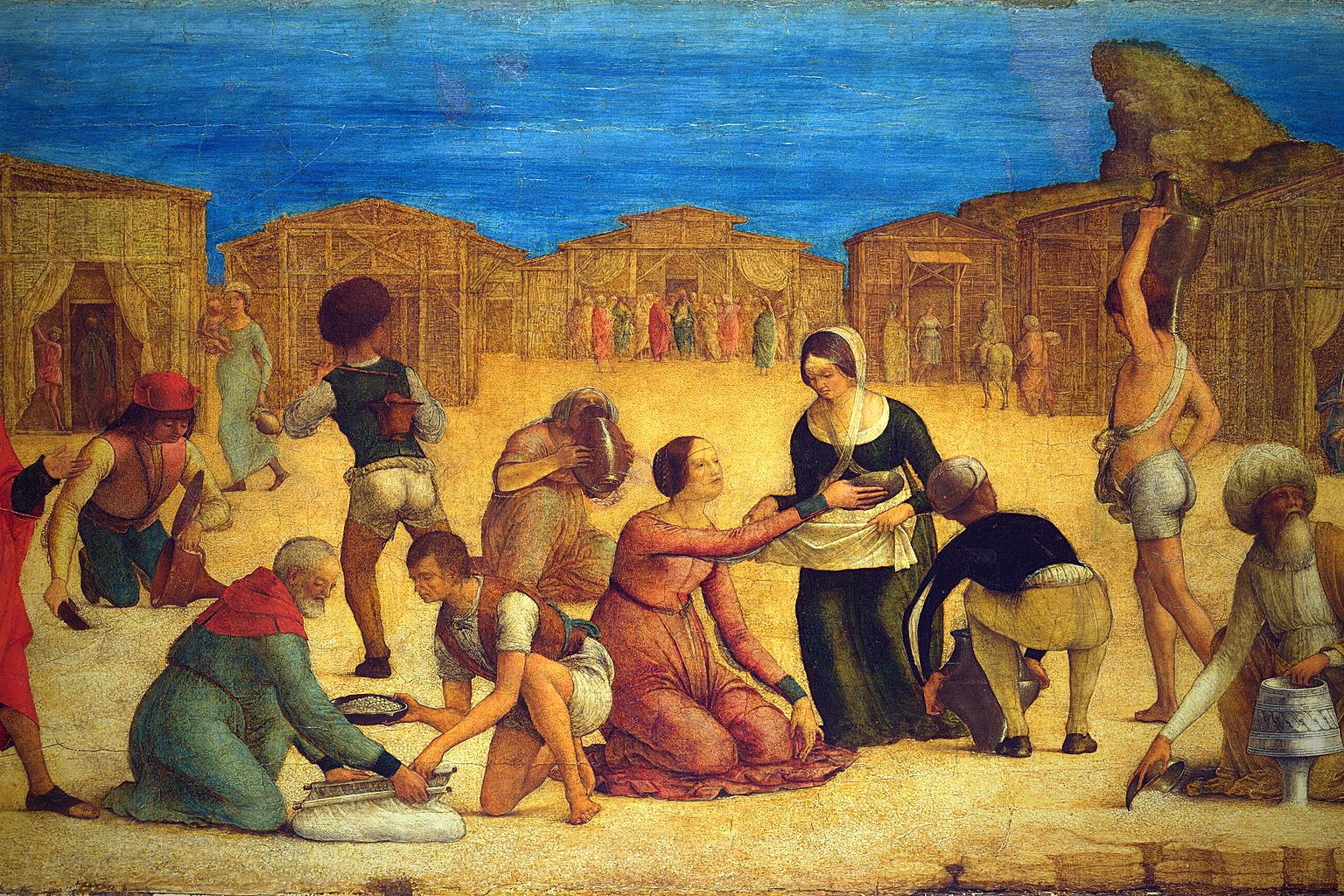
Feeding an army is harder than fighting with one. Every general in history has learned this, usually the expensive way.
The Exodus, as the Bible describes it, is a logistics problem with no solution. A population walks into a desert that grows nothing, carries no supply train, establishes no farms, and stays for forty years. And it survives — on one substance, gathered fresh every morning, that arrives for fourteen thousand consecutive days and then stops the day the people reach cultivated land.
What is manna made of? The text is unusually specific about what it was, how it behaved, and how it had to be stored. That specificity is what makes it worth examining.
What Is Manna?
Manna was the food that sustained Israel during the forty years in the wilderness after the Exodus. Exodus 16 describes it appearing on the ground each morning with the dew, in an amount gathered at roughly one omer — about 2.2 litres — per person per day. It could be ground, baked or boiled. It spoiled within 24 hours, with a single, regular exception. It stopped permanently the day the people ate the produce of Canaan (Joshua 5:12).
The name itself records confusion. When the Israelites first saw it, they said man hu — Hebrew for “What is it?” The substance is literally named after the question nobody could answer.
What Was Manna Made Of?
The Bible gives a physical description in three separate places, and the details are consistent:
“And the house of Israel called the name thereof Manna: and it was like coriander seed, white; and the taste of it was like wafers made with honey.” (Exodus 16:31)
“And the manna was as coriander seed, and the colour thereof as the colour of bdellium… and the taste of it was as the taste of fresh oil.” (Numbers 11:7-8)
From these, a reasonably precise profile emerges:
| Property | Description | What it suggests |
|---|---|---|
| Size and shape | “Like coriander seed” — small, round grains | A granular solid, roughly 2-4 mm / 0.08-0.16 in |
| Colour | White; “as the colour of bdellium” (a pale, waxy resin) | Translucent-to-white, resinous appearance |
| Taste (Exodus) | Wafers made with honey | Carbohydrate, sugars |
| Taste (Numbers) | Fresh oil | Lipid content |
| Preparation | Ground in mills, beaten in mortars, baked or boiled | Behaves like a grain or seed, not a syrup |
| Appearance on ground | “A small round thing, as small as the hoar frost” | Deposited overnight, distributed across the ground |
The two taste descriptions are the interesting part. Honey and oil are not the same flavour profile. One is sugar; the other is fat. A substance described both ways contains carbohydrate and lipid — which is exactly what a food designed to be a sole source of nutrition would need.
And it would need more than that. Forty years on a single food with no protein source would produce catastrophic muscle wasting, immune collapse and death. Whatever manna was, if the account is accurate, it carried a complete amino acid profile as well.
Why the Natural Explanations Fall Short
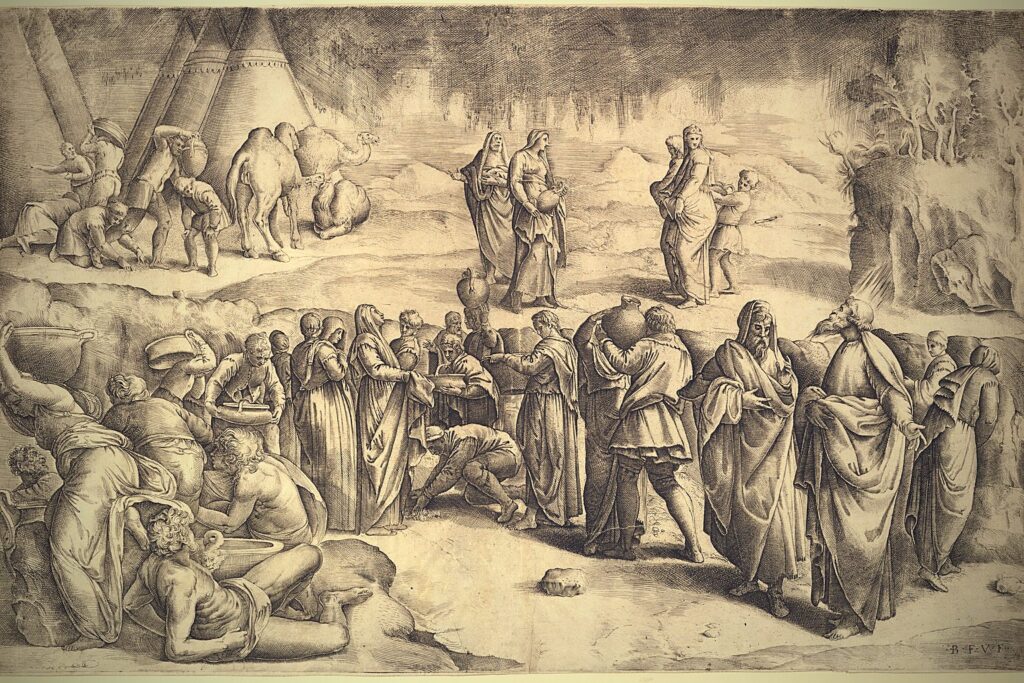
Most reference works propose a natural candidate. There are three, and each has a specific problem.
Tamarisk honeydew. Scale insects feeding on tamarisk trees in the Sinai excrete a sweet, sticky substance that crystallises in the dry air and drops to the ground. Bedouin have collected it for centuries and call it man. The name match is real and the appearance is broadly right.
The problem: it is essentially pure sugar, with negligible protein or fat. It is also seasonal — available for a few weeks in early summer — and the total annual yield across the entire Sinai is measured in hundreds of kilograms, not thousands of tonnes.
Lichen. Lecanora esculenta, sometimes called manna lichen, grows in arid regions, detaches, and can be blown considerable distances, accumulating in drifts. It has been eaten in famine conditions.
The problem: it is mostly indigestible carbohydrate and calcium oxalate, low in usable calories, and its appearance is sporadic and weather-dependent — not daily for four decades.
Psychoactive fungi. A fringe theory identifies manna with Psilocybe or Amanita muscaria mushrooms.
The problem: it explains none of the described properties — not the granular form, not the daily deposition, not the spoilage rule — and fungi of this kind do not grow in the Sinai desert.
The Arithmetic Nobody Runs
Here is the constraint that rules out every natural candidate at once.
Exodus 12:37 records 600,000 men on foot, besides women and children — which conventionally yields a total population somewhere between two and three million.
At an omer per person per day, roughly 1.5 kg (3 lb), that is about 3,700 tonnes (4,079 US tons) of food every single day. Over forty years, something on the order of 54 million tonnes.
For comparison, that is a daily tonnage in the range of a major port’s grain throughput, deposited on open desert, every morning, for 14,600 consecutive days, without a supply chain.
An honest caveat: many scholars dispute the population figure. The Hebrew word eleph, translated “thousand,” can also mean a clan, a squad, or a military unit — which would reduce the total dramatically, perhaps to tens of thousands. This is a serious and unresolved textual question, and anyone quoting the three-million figure without mentioning it is overselling.
But it does not rescue the natural explanations. Even at a hundredth of that population, you still need 37 tonnes (41 US tons) a day, every day, for forty years, in a desert, from a source that is otherwise seasonal and measured in kilograms. The scaling problem does not go away. It just gets smaller.
The Spoilage Mechanism: The Detail That Changes Everything
The instruction was explicit:
“Let no man leave of it till the morning.” (Exodus 16:19)
Some ignored it, and the result is recorded precisely:
“…but some of them left of it until the morning, and it bred worms, and stank.” (Exodus 16:20)
Within a single day. Not mould over a week, not slow staling — total decomposition inside 24 hours.
That is fast. Bread takes days to spoil. Grain, kept dry, keeps for years — and the Sinai is one of the driest environments on earth, which is precisely where food preserves best. A granular, dry substance rotting overnight in desert air is the opposite of what the environment should produce.
And Then the Exception
This is the part that is genuinely difficult to explain by any natural mechanism.
On the sixth day, the people were told to gather a double portion. Moses told them it would keep. It did:
“And they laid it up till the morning, as Moses bade: and it did not stink, neither was there any worm therein.” (Exodus 16:24)
The same substance. The same storage conditions. The same overnight interval. Different outcome — on a weekly schedule.
Natural processes do not keep a calendar. Bacterial decay, enzymatic breakdown and oxidation respond to temperature, moisture and oxygen. None of them respond to the day of the week. A substance that reliably spoils in 24 hours on five days and reliably keeps for 48 hours on the sixth is not exhibiting a natural property. It is exhibiting a rule.
Whatever else manna was, its behaviour was conditional — and the condition was a schedule.
The Manna Machine: What the Theory Actually Says
Anyone researching this eventually meets the phrase “manna machine,” and it deserves a straight account.
The Manna Machine is a 1978 book by George Sassoon and Rodney Dale. Sassoon was an engineer; Dale a writer. Their argument rests on a section of the Zohar — the central text of Jewish mysticism, compiled in 13th-century Spain — called the Ancient of Days.
That passage describes, in dense symbolic language, a structure with a head, a skull, dew distilling from it, a “beard” of channels, and a “great sea.” Traditionally this is read as a mystical anthropomorphic image of the divine.
Sassoon and Dale read it as a technical description read by someone who did not understand what they were looking at. On their reading, the components map to:
- A culture tank — the “great sea” — growing Chlorella algae
- A network of pipes for filtration and gas exchange, described as a “beard”
- A dew output: the processed algae, extruded and dried into wafers
- A nuclear reactor housed in the Ark of the Covenant, supplying power
- A weekly shutdown for cleaning and maintenance — which they propose as the origin of the Sabbath
Sassoon, as an engineer, attempted to reconstruct the device from the description.
Why It Is Interesting
The theory earns attention for one reason: the Sabbath shutdown. It is the only explanation on offer that accounts for a weekly change in behaviour by a physical mechanism rather than by decree. Any machine requires maintenance cycles. A device taken offline every seventh day would produce exactly the pattern Exodus 16 records — including the need to run a double batch beforehand.
Algae is also a serious answer to the nutrition problem. Chlorella is roughly 50-60% protein by dry weight, with a broad amino-acid profile plus lipids and vitamins — genuinely close to a complete food, and cultivated today for exactly that reason.
Why It Is Doubted
The objections are substantial, and they should be stated as plainly as the theory:
- The Zohar is far too late. It was compiled around 1280 AD, roughly 2,500 years after the Exodus. Using a medieval mystical text as an eyewitness technical record of a Bronze Age event requires assuming a chain of transmission for which there is no evidence.
- The reading is unconstrained. Symbolic language can be mapped onto almost any mechanism if you are free to choose which images are “technical” and which are ornamental. The method has no way of being wrong.
- The nuclear reactor is imported. Nothing in the Zohar or Exodus describes a power source. It is added to make the machine work.
- A hundredweight problem remains. Even a large algae plant does not produce thousands of tonnes a day, and no such facility could be transported by a migrating population.
- No physical trace. Forty years of industrial-scale food production leaves residue, structures, tooling. None has been found.
The honest verdict: The Manna Machine is a creative piece of mid-century speculative literature, not a finding. Its one genuine contribution is noticing that the Sabbath exception demands a mechanism — a point that remains unresolved whether or not you accept the rest.
Reading Manna as a Specification
Set the machinery aside and look only at what the text reports about the substance itself. The properties form a coherent list:
- Nutritionally sufficient. Sole food source for forty years, sustaining a population through childbirth, labour and warfare.
- Carbohydrate and lipid present. Honey and oil, described independently in two books.
- Granular and stable enough to process. Ground in mills, beaten in mortars, baked into cakes.
- Deliberately perishable. Total breakdown within 24 hours, in the environment least favourable to decay.
- Conditionally stable. The 24-hour limit suspended on a weekly cycle.
- Quantity-limited in practice. Exodus 16:18 notes that whoever gathered much had nothing over, and whoever gathered little had no lack.
- Terminated on condition. It stopped the day the people ate the produce of the land (Joshua 5:12) — not on a date, but on a trigger.
Points 4, 5 and 7 are the ones that resist natural explanation, and they all point the same direction. A food that cannot be hoarded, that keeps only when keeping is permitted, and that stops the moment it is no longer needed is not behaving like a resource. It is behaving like a rationing system with the rules built into the chemistry.
That is the same pattern the biblical record keeps producing: the Ark of the Covenant with handling protocols enforced by lethal outcome, Noah’s Ark with hull ratios optimised for survival, the New Jerusalem with published dimensions. Instructions and tolerances, where we were taught to expect symbolism.
Frequently Asked Questions
What is manna made of?
The Bible does not state a composition. It describes manna as white, grain-like, “as coriander seed,” with the appearance of bdellium resin, tasting of honey wafers in Exodus 16:31 and of fresh oil in Numbers 11:8. The two taste descriptions together imply both carbohydrate and fat content.
Is manna rice?
No. Rice is not native to the Sinai, requires flooded cultivation, and does not appear overnight or decompose within 24 hours. The comparison is to coriander seed, not to any cultivated grain — and manna was gathered, never sown.
What is the manna machine?
The Manna Machine is a 1978 book by George Sassoon and Rodney Dale arguing that a passage of the Zohar called the Ancient of Days is a garbled technical description of a machine that cultivated Chlorella algae, powered by a reactor in the Ark of the Covenant, and shut down weekly for maintenance. It is speculative and not accepted by scholars, chiefly because the Zohar dates to around 1280 AD.
How much manna did the Israelites gather?
Exodus 16:16 specifies an omer per person per day — roughly 2.2 litres. On the sixth day they gathered a double portion to cover the Sabbath.
Why did manna spoil overnight but not on the Sabbath?
This is the central puzzle. The same substance, stored the same way, rotted within 24 hours on five days and kept for 48 hours when gathered on the sixth. No natural decay process — bacterial, enzymatic or oxidative — varies by the day of the week.
Could manna have been tamarisk resin?
Tamarisk honeydew exists in the Sinai and is locally called man, but it is almost pure sugar, seasonal, and produced in quantities measured in hundreds of kilograms per year. It could not sustain a population for four decades.
When did manna stop?
Joshua 5:12 records that it ceased the day after the Israelites ate the produce of Canaan. It ended on a condition being met, not on a fixed date.
What does the word manna mean?
It comes from the Hebrew man hu — “What is it?” — the question the Israelites asked on first seeing it. The substance is named after the fact that nobody could identify it.
Conclusion: Named After a Question
Every explanation offered for manna solves part of the problem and breaks on the rest.
The natural candidates account for the appearance and the name, and then collapse on volume and nutrition. The Manna Machine accounts for the Sabbath cycle and the nutritional completeness, and then collapses on its 2,500-year evidentiary gap. The purely miraculous reading accounts for everything and explains nothing, because it is not the kind of claim that can be examined.
What remains is a description written with unusual care: a granular white solid with the taste of honey and oil, deposited overnight, gathered by measure, ground and baked, decomposing on a 24-hour timer that was suspended once a week, and discontinued the moment an alternative food supply became available.
The Israelites called it “What is it?” because they had no category for it. Three and a half thousand years later, with considerably more chemistry available, the name is still doing accurate work.
Continue Reading
- What Did Jesus Say to Satan? Three Answers, One Book — Nobody else was there, so the account can only have come from him. The three offers in order, what forty days without…
- The Viking Sunstone: How It Works, and What Has Been Found — The physics is settled: a calcite crystal really can locate the sun through cloud. Everything else is argued — the one…
- Derinkuyu: The Doors Only Close From Inside — Eighty-five metres down, eight levels open of an estimated eighteen, and a half-tonne stone wheel with a spear-hole…