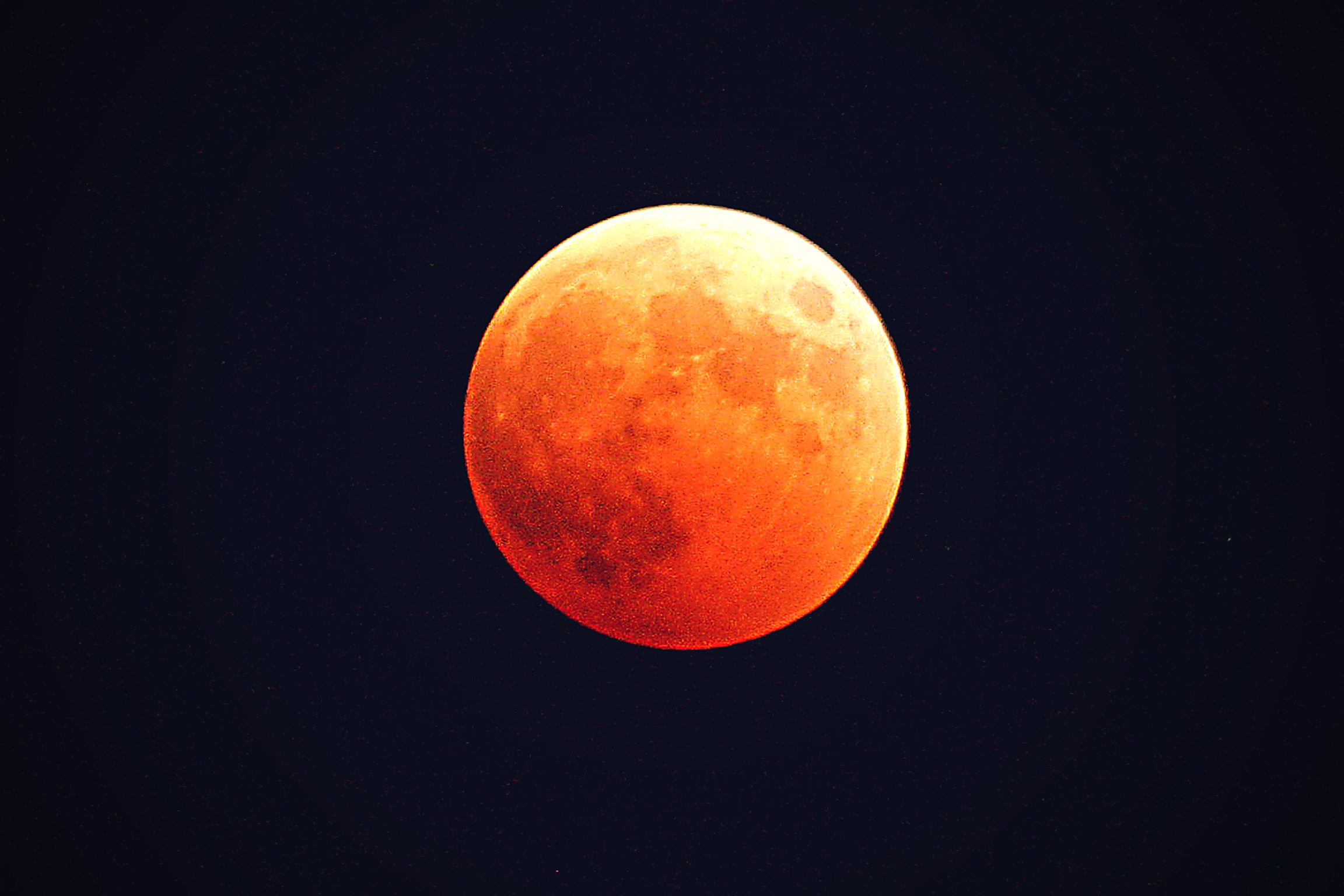
The blood moon prophecy rests on three Bible verses, one astronomical event, and an argument about whether the calendar is the point or the coincidence.
In Joel 2:31, God says the moon will turn to blood before the great and terrible day of the LORD. Peter quotes the same verse at Pentecost in Acts 2:20. And in Revelation 6:12, the sixth seal produces a great earthquake and a full moon that becomes like blood. Three texts, separated by centuries, describing the same image — and a total lunar eclipse produces exactly that image, on a schedule NASA can predict to the minute.
The question is whether the schedule is the sign, or whether it explains the sign away.
What Is a Blood Moon?
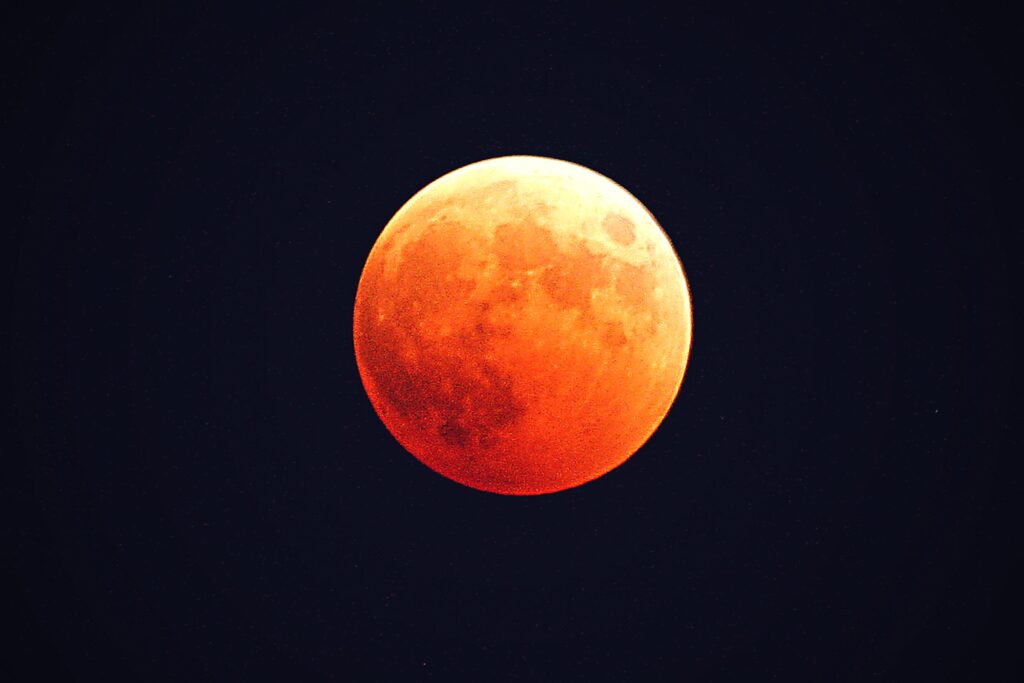
A blood moon is a total lunar eclipse — the Moon passing entirely into Earth’s shadow and turning red. The colour is not symbolic. It is Rayleigh scattering: the same physics that makes a sunset red. When the Earth blocks direct sunlight, the only light reaching the Moon is what passes through Earth’s atmosphere. The atmosphere scatters short wavelengths (blue) far more efficiently than long ones (red), so what arrives at the lunar surface is a deep copper to crimson glow.
The exact shade depends on conditions. Volcanic ash and dust in the atmosphere deepen the red. A clean atmosphere produces a brighter, more orange eclipse. But the result is always the same: the Moon does not go dark. It turns the colour of blood.
Total lunar eclipses happen roughly two to three times per year. They are predictable, well understood, and entirely natural. None of this is disputed by anyone on either side of the prophecy argument. The question is not what causes them. It is what they mean.
The Three Texts
The phrase “blood moon” does not appear in any English translation of the Bible. What the text says is that the moon will turn to blood — or become like blood. The distinction matters because it separates the astronomical event from the theological claim.
Joel 2:31 (ESV): “The sun shall be turned to darkness, and the moon to blood, before the great and awesome day of the LORD comes.”
Joel is writing before the exile, and the context is the Day of the LORD — a future event in which God intervenes directly in history. The sun going dark and the moon turning to blood are signs that precede it. The word is “before.” The signs are a warning, not the event itself.
Acts 2:20 (ESV): “The sun shall be turned to darkness and the moon to blood, before the day of the Lord comes, the great and magnificent day.”
Peter quotes Joel verbatim at Pentecost. What makes this significant is his introduction: “This is what was spoken by the prophet Joel.” Scholars have argued for centuries about what Peter meant. Was he saying Joel’s prophecy was being fulfilled at that moment — the Spirit was being poured out, the cosmic signs were beginning? Or was he saying the age Joel described had opened, but the signs in the sky were still ahead? The “already/not yet” reading is standard in both Reformed and Pentecostal theology: the Spirit arrives, the cosmic signs remain future. That reading keeps the passage live for end-times application — but it also means anyone who claims to know when those signs will appear is reading more certainty into the text than Peter did.
Revelation 6:12 (ESV): “When he opened the sixth seal, I looked, and behold, there was a great earthquake, and the sun became black as sackcloth, the full moon became like blood.”
John’s vision pairs the blood moon with a great earthquake and a darkened sun — the same combination Joel described. Here the sequence is part of the breaking of the seals, a series of catastrophic events leading to the day of God’s wrath. The broader structure of Revelation’s three sevens — seals, trumpets, bowls — is covered separately.
Three texts. Same image. The moon becomes blood before something vast happens.
Genesis 1:14 and the Appointed Times
A verse usually missing from the astronomical critique but central to the theological one:
“And God said, Let there be lights in the firmament of the heaven to divide the day from the night; and let them be for signs, and for seasons, and for days, and years.” (Genesis 1:14, KJV)
The Hebrew word translated “seasons” is moadim — the same word used in Leviticus 23 for God’s appointed feasts: Passover, Pentecost, the Day of Atonement, Sukkot. Advocates of the blood moon prophecy argue that this verse establishes the principle: the sun and moon were placed in the sky, among other things, to mark the feast calendar. A total lunar eclipse occurring on the exact day of a divinely appointed feast is therefore exactly the kind of sign the verse describes.
The critique is straightforward: Genesis 1:14 says the luminaries mark times, not that every eclipse is a message. The verse is about the calendar, not about prophecy — and the fact that the Jewish calendar is based on lunar cycles makes the overlap between eclipses and feasts a mathematical property, not a miracle.
Both readings are grammatically defensible.
The Tetrad Theory
A tetrad is a sequence of four consecutive total lunar eclipses, with no partial eclipses in between. They are not common, but they are not rare either: at least eight will occur during the twenty-first century.
The blood moon prophecy in its modern form was proposed by Mark Biltz in 2008. Biltz, pastor of El Shaddai Ministries in Puyallup, Washington, noticed while studying NASA’s eclipse database that the upcoming 2014–2015 tetrad would fall on Jewish feast days. He initially predicted that the tribulation would begin in the autumn of 2008 and extend to 2015. When 2008 passed without incident, he removed the article from his website but continued advocating for the prophetic significance of tetrads on Jewish feasts.
In 2013, John Hagee published Four Blood Moons: Something Is About to Change [1], which reached number four on the New York Times advice bestseller list by April 2014. Hagee was more careful than Biltz. He did not predict the second coming or name a specific event. His claim was that “something big” would happen in connection with Israel, and that God was sending a signal through the eclipse calendar.
The distinction matters. Biltz made a falsifiable prediction, and it failed. Hagee made an unfalsifiable one, and it has not been tested — because “something big” can always be found after the fact, or deferred.
The 2014–2015 Tetrad
The tetrad that launched the modern prophecy:
| Eclipse | Date | Jewish feast |
|---|---|---|
| 1st | 15 April 2014 | Passover (15 Nisan) |
| 2nd | 8 October 2014 | Sukkot (15 Tishrei) |
| 3rd | 4 April 2015 | Passover (15 Nisan) |
| 4th | 28 September 2015 | Sukkot (15 Tishrei) |
All four fell on the first day of Passover or the first day of Sukkot — the two pilgrimage festivals. That alignment is the core of the argument.
There is a detail the books rarely mention. Only one of the four — the September 28, 2015 eclipse — was fully visible from Israel. The other three were either not visible or barely visible from the land the prophecy concerns. A sign from God to Israel that Israel cannot see is, at a minimum, a feature that requires explanation.
The Three Historical Tetrads
Biltz and Hagee point to three previous tetrads that also fell on Passover and Sukkot, each coinciding with a major event in Jewish history.
1493–1494: The Spanish Expulsion. The Alhambra Decree was signed on 31 March 1492. Jews who refused to convert were given until 31 July 1492 to leave. The tetrad eclipses began on 2 April 1493 — eight months after the expulsion was complete and over a year after the decree.
1949–1950: The Founding of Israel. Israel declared independence on 14 May 1948. Its first elected government was seated on 25 January 1949. The tetrad began on 13 April 1949 — eleven months after independence and three months after the government formed.
1967–1968: The Six-Day War. The war ran from 5 to 10 June 1967. The tetrad’s first eclipse fell on 24 April 1967 — six weeks before the war. This is the strongest case for the advocates: an eclipse preceded the event. But the remaining three eclipses all fell after the war was over.
The pattern is real. Three tetrads on Jewish feasts, three pivotal events. The question is the direction. Joel says the signs come “before the great and awesome day.” In two of the three cases, the eclipses came after the event, not before. Only the 1967 tetrad places an eclipse before the war, and even there, the majority of the sequence followed it.
The Tetrads Nobody Mentions
The three-tetrad correlation depends on another number: how many tetrads have fallen on Jewish feasts with no corresponding event. The standard presentations do not volunteer this. At least four additional tetrads fell on Passover and Sukkot in the last two millennia:
- AD 162–163
- AD 795–796
- AD 841–843
- AD 860–861
None corresponds to any known major event in Jewish history. The pattern holds for three cases and fails for four.
This does not disprove the theory. A sign could be given at some times and not at others. But a correlation that works half the time and is presented as though it works every time is a selection problem, and it cuts the statistical force of the argument in half before anything else is weighed.
Why the Calendar Makes It Happen
Here is the astronomical fact that the books do not emphasise.
The Jewish calendar is lunisolar. Each month begins at the new moon. That means the 15th of any Jewish month is always a full moon — by definition, not by coincidence. Passover falls on 15 Nisan. Sukkot falls on 15 Tishrei. Both are always full moons.
A total lunar eclipse can only occur at a full moon. It cannot happen at any other phase.
So a total lunar eclipse falling on Passover or Sukkot is not a celestial coincidence. It is a mathematical near-certainty whenever an eclipse occurs in spring or autumn. Given that three Jewish holidays each year coincide with full moons, the odds of any given lunar eclipse hitting a Jewish feast day are roughly one in four to one in six.
The advocate’s reply: the question is not whether individual eclipses land on feasts (many do), but whether a full tetrad of four consecutive total eclipses all land on the same two feasts in consecutive years. That is rarer. But it is still a calculable probability, not a miracle — and the frequency (eight tetrads in a century, a subset on feast days) is well within the range of things that happen without anyone arranging them.
What Happened After 2015
The 2014–2015 tetrad ended on 28 September 2015. The Mark of the Beast, the four horsemen, the final sequence described in Revelation — none of it followed. No identifiable event matching “the great and awesome day of the LORD” occurred. Hagee’s “something big” did not materialise in any form distinguishable from ordinary geopolitics.
Biltz’s earlier, more specific prediction had already failed. The tribulation did not begin in 2008. The second coming did not occur in 2015.
The standard response from prophecy advocates is that the signs are accumulating, that the convergence of eclipses with feasts is a warning sequence rather than a countdown to a single event. That reading is possible — but it is not what Joel says. Joel says “before,” singular, pointing at one day, not a sequence of escalating hints.
The Next Tetrad
The next tetrad falls in 2032–2033. Two of its four eclipses — 14 April 2033 and 8 October 2033 — fall during Passover and Sukkot. The other two — 25 April 2032 and 18 October 2032 — do not. By Biltz and Hagee’s own criteria, which require all four to align, this is not a qualifying tetrad.
Whether a full four-on-four alignment will occur again this century remains unclear from publicly available NASA data. It may not.
The Case for Prophetic Significance
- Genesis 1:14 states God set the luminaries for “signs” (otot) and “appointed times” (moadim). A total eclipse on an appointed feast is the kind of sign the verse describes.
- Three consecutive tetrads on Passover and Sukkot coincided with the Spanish expulsion, the founding of Israel, and the Six-Day War — three of the most significant events in Jewish history in two thousand years.
- Joel, Jesus (Matthew 24:29), and Revelation all describe cosmic signs preceding the end: sun darkened, moon to blood. A total lunar eclipse produces that image literally.
- The 2014–2015 tetrad is the only one in recorded history where all four eclipses fell on both Passover and Sukkot in consecutive years and were widely publicised in advance.
The Case Against
- The Jewish calendar makes the alignment arithmetic. Passover and Sukkot are always full moons. Eclipses require full moons. The overlap is a mathematical property, not a miracle.
- Four tetrads fell on feasts with no corresponding event. The theory selects three and ignores four.
- Joel says “before.” In two of the three historical cases, the eclipses followed the events, not preceded them.
- Three of four eclipses in the 2014–2015 tetrad were not visible from Israel.
- Nothing identifiable as “the great and terrible day” followed the 2015 tetrad.
- The number four is arbitrary. Select a different grouping of consecutive eclipses and different correlations appear.
Where That Leaves It
The test that applies to any biblical prophecy claim asks four questions: Was it written before the event? Is it specific enough to fail? Did it happen the way it was described? Could it have been engineered?
The blood moon prophecy scores differently depending on which version you test. Joel’s original passage is specific (moon to blood, before the Day of the LORD), clearly written before any modern event, and cannot be engineered — but it has not happened yet as described, because the Day of the LORD has not come. The Biltz/Hagee version scores well on advance notice (they identified the tetrad before it occurred) but poorly on specificity: “something big” is not a prediction, it is a bet that the world will continue to produce events.
The astronomical alignment is real. The three historical correlations are real. The calendar mechanics that produce the alignment are also real. The reader who walks into this argument holding Joel and Genesis 1:14 will find that the pattern speaks. The reader who walks in holding Fred Espenak’s eclipse tables will find that the pattern calculates. Both are looking at the same sky.
Sources
- Four Blood Moons: Something Is About to Change — goodreads.com/book/show/20388221
Frequently Asked Questions
What is the blood moon prophecy?
The blood moon prophecy is the claim that a tetrad — four consecutive total lunar eclipses falling on the Jewish feasts of Passover and Sukkot — is a sign from God, as described in Joel 2:31, Acts 2:20 and Revelation 6:12. The modern version was proposed by Mark Biltz in 2008 and popularised by John Hagee’s bestselling book in 2013. Advocates point to three historical tetrads that coincided with major events in Jewish history.
Does the Bible mention the blood moon?
The phrase “blood moon” does not appear in any standard translation. What the Bible says is that the moon will turn to blood (Joel 2:31, Acts 2:20) or become like blood (Revelation 6:12), as a sign preceding the Day of the LORD. The connection to lunar eclipses — which turn the moon red through Rayleigh scattering — is an interpretation, not a quotation.
How often do blood moons fall on Jewish holidays?
More often than the prophecy books suggest. Passover (15 Nisan) and Sukkot (15 Tishrei) always fall on a full moon because the Jewish calendar is lunar. Total lunar eclipses can only occur at full moon. So any total eclipse in spring or autumn has a significant chance of falling on one of these feasts. A full tetrad where all four land on both feasts is rarer, but at least seven such tetrads have occurred in the last two millennia.
Did anything happen after the 2014–2015 blood moons?
No event identifiable as “the great and awesome day of the LORD” followed the tetrad. Biltz had predicted the tribulation would begin in 2008 and end in 2015; neither occurred. Hagee predicted “something big” connected to Israel — a claim too vague to confirm or refute. The pattern of prophetic claims, tested against the record, is examined in detail elsewhere on this site.
When is the next blood moon tetrad?
The next tetrad falls in 2032–2033, but only two of its four eclipses (14 April 2033 and 8 October 2033) fall on Passover and Sukkot. The other two do not. By the criteria Biltz and Hagee use — all four on feasts — this tetrad does not qualify.
Why does the moon turn red during a lunar eclipse?
Rayleigh scattering — the same physics that makes sunsets red. When the Earth blocks direct sunlight, the only light reaching the Moon passes through Earth’s atmosphere, which scatters blue wavelengths far more than red. The remaining reddish light gives the Moon its copper-to-crimson colour. Volcanic ash or dust in the atmosphere deepens the red.
What does Genesis 1:14 have to do with blood moons?
Genesis 1:14 says God placed lights in the sky for “signs” (otot) and “seasons” (moadim) — the same word used for the appointed feasts in Leviticus 23. Advocates argue that a total eclipse on a feast day is exactly the kind of sign the verse describes. Critics reply that the verse establishes the calendar, not a prophetic signal system, and that the Jewish calendar’s lunar structure makes the overlap inevitable.
Were the 2014–2015 blood moons visible from Israel?
Only one of the four — the 28 September 2015 eclipse — was fully visible from Israel. The other three were either not visible or barely visible from the land the prophecy concerns. This is a point the astronomical critique raises: a divine sign for Israel that Israel largely could not see requires an explanation the advocates have not provided.
Continue Reading
- The New Jerusalem: Is the City of God a Divine Mothership? — Revelation gives the New Jerusalem a size, a shape and a materials list. Twelve thousand furlongs a side, walls of only…
- The Third Temple: What Is Actually Ready, and What Is Not — The vessels are finished, the garments are woven and the plans exist. What does not exist is a valid set of ashes, an…
- The End of the World According to Revelation — Seals take a quarter, trumpets a third, bowls take everything. The fractions are the tell. Revelation is not a…