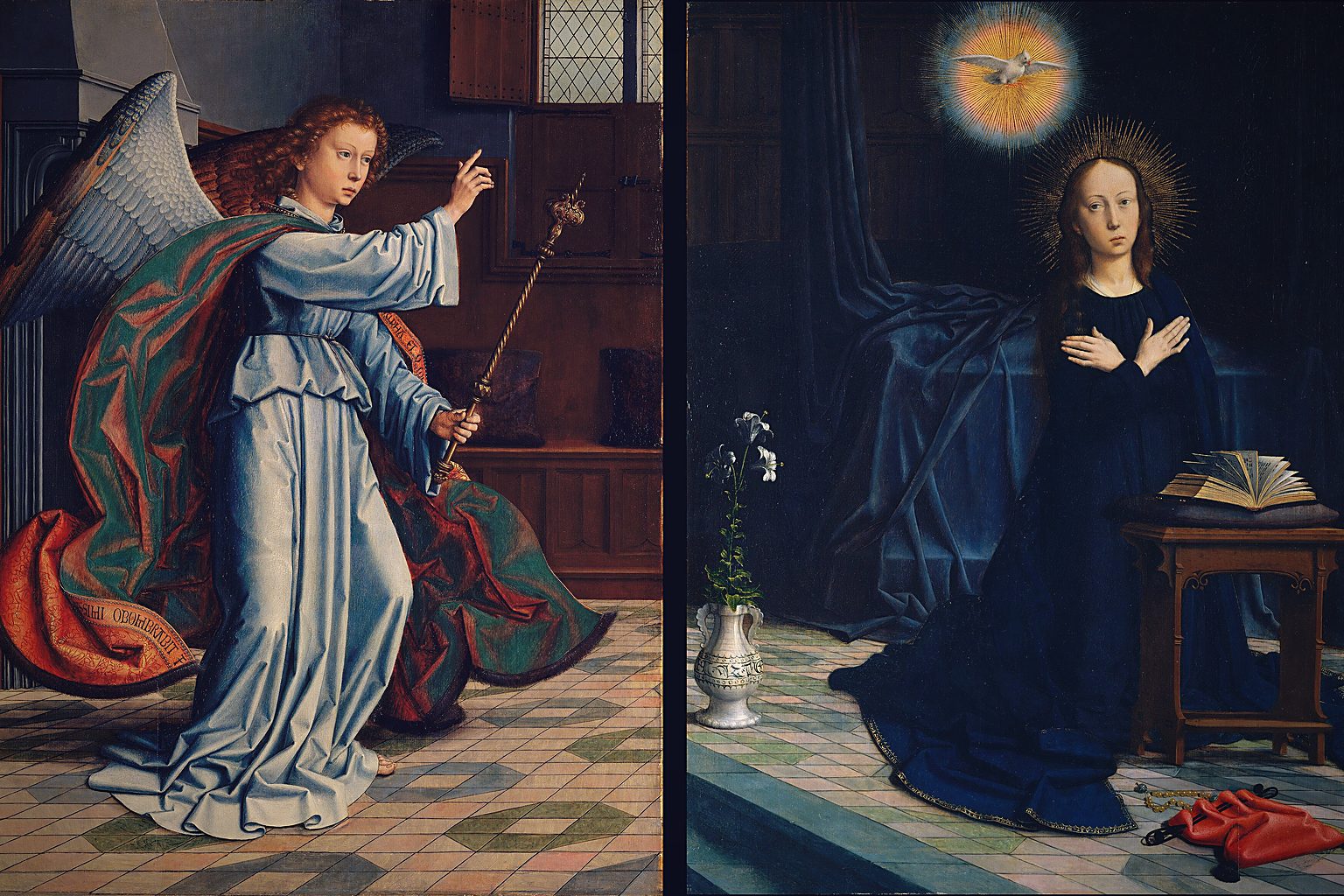
Mary asked the biological question first, and it is the same one genetics asks about a virgin birth: where does the Y chromosome come from?
When Gabriel told her she would bear a son, her reply was not doubt about God’s power. It was a technical objection:
“How shall this be, seeing I know not a man?” (Luke 1:34)
She understood the mechanism well enough to know that what she had just been told could not happen. And two thousand years of theology later, modern genetics can state her objection with a precision she did not have — and it turns out to be sharper than she realised.
The Genetic Problem With the Virgin Birth
Every human cell carries 46 chromosomes in 23 pairs — one of each pair from the mother, one from the father. The 23rd pair determines sex:
- Females are XX. Every egg a woman produces carries an X.
- Males are XY. The Y chromosome can only come from a father.
Mary was female. Her genome was XX. She had no Y chromosome to give, and no mechanism for producing one.
Jesus was male.
So the question is not the general one — can a woman conceive without a man? It is specific and much harder: where did the Y chromosome come from?
Why Parthenogenesis Does Not Solve It
Virgin birth is not unknown in biology. Parthenogenesis — development of an unfertilised egg — occurs naturally in aphids, some lizards, sharks, and Komodo dragons. It has been documented in captive animals with no male present.
It does not help here, for a decisive reason.
In parthenogenetic species, the offspring are produced from the mother’s genetic material alone. In birds and reptiles, whose sex-determination system differs from ours, this can yield males. In mammals it cannot. A mammalian parthenote has only maternal chromosomes, and a mother has no Y to contribute. Any offspring would necessarily be female.
There is a second obstacle, and it is absolute in mammals: genomic imprinting. A set of genes is chemically marked depending on whether it arrived from the mother or the father, and the two sets are not interchangeable. Paternally-imprinted genes drive placental development; maternally-imprinted genes restrain it. An embryo with two maternal genome copies fails — the placenta does not form properly. This is why mammalian parthenogenesis does not occur naturally, and why producing viable offspring from two female mice required deliberate, targeted editing of imprinted regions in a laboratory.
So the account in Luke 1 is not describing a rare natural event. On the genetics, it describes something that requires two separate impossibilities to be overcome: a Y chromosome from nowhere, and a paternal imprinting pattern with no father.
The Curious Phrase: “Her Seed”
The oddity turns up in the first prophecy in Scripture, spoken in Eden immediately after the fall:
“And I will put enmity between thee and the woman, and between thy seed and her seed; it shall bruise thy head, and thou shalt bruise his heel.” (Genesis 3:15)
“Her seed.”
In the biblical idiom — and in the ancient world generally — lineage runs through the man. The phrase is always the seed of Abraham, the seed of David, the loins of the father. Genealogies are patrilineal throughout Scripture; Matthew 1 and Luke 3 both trace descent through men.
Women are not described as having seed. The consistent picture is the man providing the seed and the woman providing the ground it grows in.
Genesis 3:15 breaks the pattern once, and it breaks it in the single verse that describes how the conflict ends.
It is worth being careful here. This is a literary observation, not a biological proof. Ancient writers did not know about gametes, and the phrase carries a clear theological function on its own — it identifies a descendant of the woman, in deliberate contrast to the serpent’s line. But the anomaly is real, it occurs exactly once, and it occurs at the one point where a man is conspicuously absent from the mechanism.
What “Overshadow” Actually Says
Gabriel’s answer to Mary’s objection is not an evasion. It is specific:
“The Holy Ghost shall come upon thee, and the power of the Highest shall overshadow thee: therefore also that holy thing which shall be born of thee shall be called the Son of God.” (Luke 1:35)
The Greek verb is episkiazo — to overshadow, to cast a shadow upon, to envelop. It is the same word used at the Transfiguration, when a bright cloud overshadows the disciples (Matthew 17:5), and it carries the sense of the shekinah presence in the Hebrew Bible — the cloud that filled the tabernacle so densely that the priests could not enter (Exodus 40:35).
It is not a euphemism for union. It is language about presence descending onto a location — the same vocabulary used for the cloud that settled over the tent of meeting and the glory that filled the temple.
And then the logic of the verse: therefore that holy thing shall be called the Son of God. The title follows from the manner of the conception, not merely from the mission.
Luke, who states in his prologue that he investigated everything carefully, records Mary’s biological objection and Gabriel’s answer without softening either. He does not minimise the difficulty. He presents it and then reports the answer given.
Why It Had to Work This Way
There is a structural reason the account gives for bypassing a human father, and it connects directly to the oldest problem in the book.
Scripture describes a corruption transmitted through descent from Adam:
“Wherefore, as by one man sin entered into the world, and death by sin; and so death passed upon all men, for that all have sinned.” (Romans 5:12)
By one man. The transmission is presented as inherited, passing down a line, affecting everyone born into it. Paul then draws the parallel that gives the whole scheme its shape:
“The first man Adam was made a living soul; the last Adam was made a quickening spirit.” (1 Corinthians 15:45)
The last Adam. Not a reformed member of the line — a second origin point.
If the corruption runs through inheritance, then a descendant born the ordinary way inherits the problem he came to solve. The line has to be broken, and it has to be broken at the point of origin rather than corrected later.
This is the same logic that runs through the rest of the record. The Flood preserved a line that was tamim — unblemished in its descent — because the crisis in Genesis 6 was a crisis of corrupted flesh. Genesis 3:15 then specifies that the resolution comes through a seed, which makes the bloodline the decisive asset and the obvious target.
Seen this way, the virgin birth is not an ornament on the story. It is the only configuration that satisfies both requirements at once: full humanity, inherited from Mary and connecting the line to David as Luke 3 and Matthew 1 both insist — and an origin outside the inherited corruption.
What Genetics Can and Cannot Say
Honesty matters here, because this subject invites overreach in both directions.
What genetics can say: the objection is real and it is sharper than the pre-modern version. A woman cannot supply a Y chromosome. Mammalian parthenogenesis cannot produce a male. Genomic imprinting independently blocks development from two maternal genomes. These are not gaps in current knowledge; they are well-established constraints.
What genetics cannot say: whether they were overcome. Science describes what happens under normal operation. A singular event, unrepeated and unobserved, is not the kind of claim that laboratory work can confirm or refute. Anyone claiming genetics proves the virgin birth is misusing the word, and anyone claiming it disproves it has only established that it could not have happened by ordinary means — which is precisely what the text asserts.
What the biology does establish is that the account is not naive. The objection Mary raised in Luke 1:34 is the correct objection. The narrative does not dodge it, does not offer a natural mechanism, and does not pretend the difficulty is small. It answers with a claim of direct intervention, and then names the consequence: therefore that holy thing shall be called the Son of God.
Frequently Asked Questions
Where did Jesus get his Y chromosome?
The Bible does not say. Genetically, a Y chromosome can only come from a father, and Mary as a female had none to give. Luke 1:35 attributes the conception to the Holy Spirit overshadowing Mary, which the text presents as a direct creative act rather than a natural process.
Could the virgin birth have been parthenogenesis?
No. Parthenogenesis occurs in some animals, but in mammals it can only produce females, since the mother has no Y chromosome. Genomic imprinting independently prevents mammalian embryos from developing with two maternal genomes.
What is genomic imprinting?
A mechanism by which certain genes are chemically marked according to whether they came from the mother or the father, and expressed differently as a result. Paternally-imprinted genes drive placental growth. An embryo with only maternal genomes fails to develop properly.
What does “her seed” mean in Genesis 3:15?
It is an anomaly. Biblical genealogy is consistently patrilineal — the standard idiom is the seed of Abraham or of David. Genesis 3:15 is the one place a woman is said to have seed, and it occurs in the verse describing how the conflict with the serpent ends.
What does “overshadow” mean in Luke 1:35?
The Greek episkiazo means to cast a shadow over or envelop. It is used at the Transfiguration in Matthew 17:5 and echoes the cloud of God’s presence filling the tabernacle in Exodus 40:35. It is language of presence descending, not of union.
Why did Jesus need to be born of a virgin?
Romans 5:12 describes corruption entering through one man and passing to all his descendants, and 1 Corinthians 15:45 calls Jesus “the last Adam.” If the corruption is inherited through descent, a new origin point is required rather than a correction within the existing line.
Does science disprove the virgin birth?
Science establishes that it could not occur by ordinary means, which is what the text itself claims. A singular, unrepeated event is not the kind of claim laboratory work can confirm or refute either way.
Conclusion: The Objection Was Always the Point
The most striking thing about Luke 1 is that the difficulty is raised inside the text, by the person it happened to.
Mary does not respond with acceptance or with worship. She responds with a mechanical objection: how shall this be, seeing I know not a man? She knew perfectly well that what she had been told does not happen.
Gabriel does not explain the mechanism. He names the cause and states the consequence, and the consequence follows from the cause: therefore that holy thing shall be called the Son of God.
Modern genetics has not dissolved her objection. It has sharpened it into something more precise than she could have formulated — a missing chromosome and an imprinting pattern with no source. Two thousand years of research has made the claim harder, not easier.
Which is, in a sense, exactly what a claim of direct intervention should look like. If the account had turned out to describe something biology could accommodate, it would have been describing something less than it said it was.
Continue Reading
- The Shroud of Turin: A Negative Nobody Ordered — Dust vacuumed from the cloth in 1978 has now been sequenced, and the result was reported as evidence the Shroud came…
- What Did Jesus Say to Satan? Three Answers, One Book — Nobody else was there, so the account can only have come from him. The three offers in order, what forty days without…
- Demonic Possession in the Bible: Every Case, and the One That Comes Back — The evil spirit on Saul. Legion in the tombs. The boy the disciples could not help. Every case of demonic possession in…