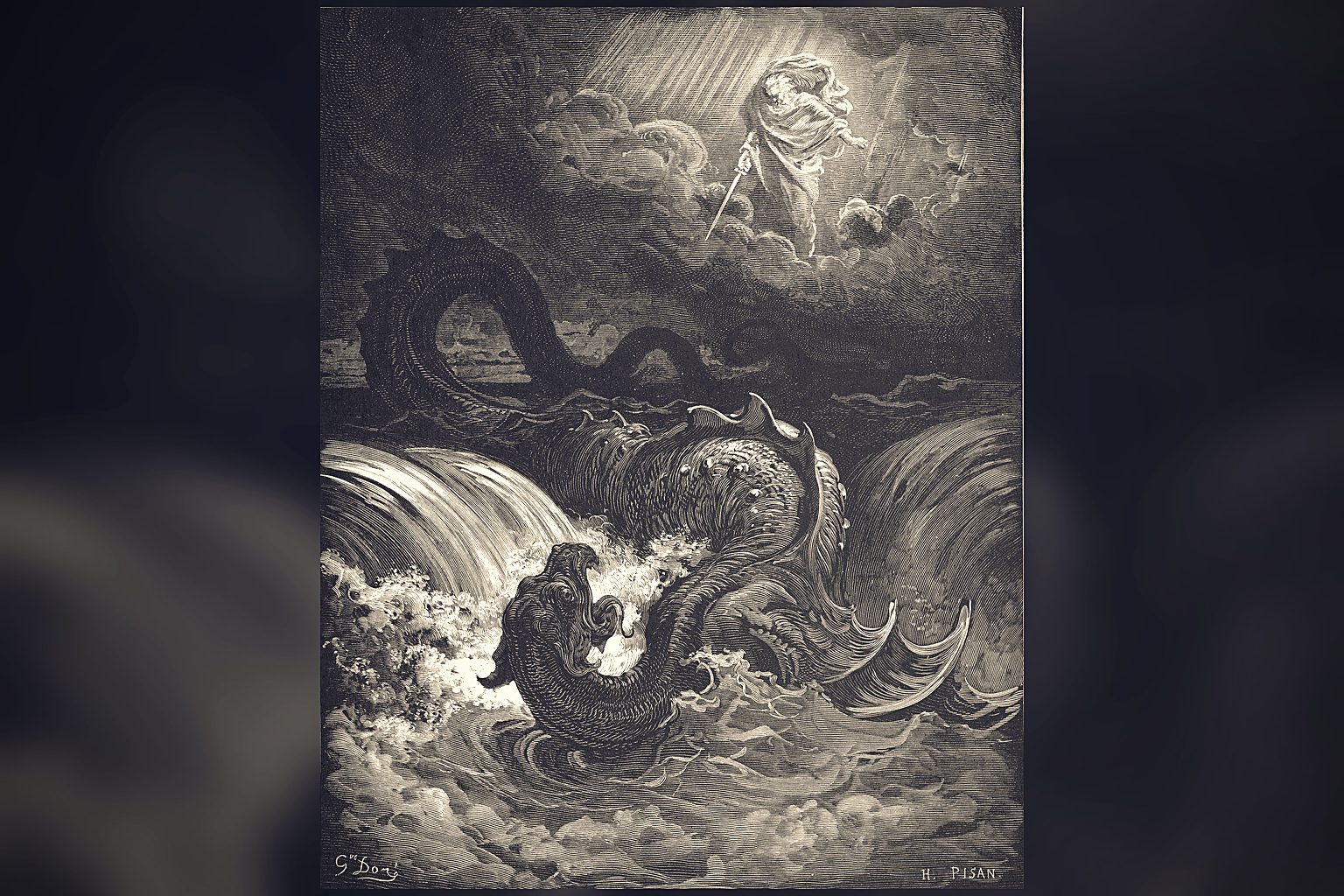
There is a contradiction in the Bible that almost nobody notices, and once you see it you cannot unsee it.
In Job 41, God spends an entire chapter describing Leviathan — and He does it with something close to pride. The armoured scales. The impenetrable hide. The terror it inspires. He calls it “king over all the children of pride.” It reads like a craftsman showing off his best work.
Then, elsewhere in Scripture, God kills it. Why did God kill the Leviathan, having just spent a chapter admiring it?
Psalm 74 says He broke its heads. Isaiah 27 promises He will hunt it down with a sword. The same creature described as a masterpiece is later executed by its maker.
Why?
Did God Create the Leviathan?
Yes. Scripture is explicit about it, and not grudgingly. Psalm 104, a psalm entirely devoted to celebrating creation, lists Leviathan among God’s works:
“So is this great and wide sea… There go the ships: there is that leviathan, whom thou hast made to play therein.” (Psalm 104:25-26)
Whom thou hast made to play therein. Not a mistake. Not an intrusion. A creature made deliberately, and made to play — the Hebrew sachaq carries the sense of sporting or frolicking.
And in Job 41, God devotes thirty-four verses to it, more detailed attention than He gives to any other animal in Scripture. He describes its scales as shields joined so tightly no air passes between them, its eyes like the dawn, its breath kindling coals, its heart as firm as a stone. He states that no weapon made by man can touch it.
So we have a creature that is deliberately made, praised at length, and then destroyed. That is the paradox.
How Many Leviathans Did God Create?
This is a question the Bible does not answer directly — but Jewish tradition does, and the answer is unexpectedly specific.
The Talmud, in Bava Batra 74b, records a teaching of Rav Yehuda in the name of Rav: everything God created in the world, He created male and female. Leviathan was no exception. Two were made — a male and a female.
And then this:
Had they mated and produced offspring, they would have destroyed the entire world.
So, according to the tradition, God castrated the male and killed the female, preserving her flesh in salt for the banquet of the righteous in the age to come. The Talmud links this directly to Isaiah 27:1 — “and he shall slay the dragon that is in the sea.”
Read it again, because the reasoning is remarkable. The creature was not killed for being evil. It was killed for being too successful. Two apex organisms, mating freely, with no natural predator and no upper limit on growth, would have consumed the world. The execution was a population control measure.
That reframes the entire paradox. God did not turn against His creation. He built something so effective that it could only be permitted to exist in the singular.
Why Did God Kill the Leviathan?
Scripture gives the act in two registers, and they point in slightly different directions.
Psalm 74:13-14 places it in the past, as an act of creation-ordering:
“Thou didst divide the sea by thy strength: thou brakest the heads of the dragons in the waters. Thou brakest the heads of leviathan in pieces, and gavest him to be meat to the people inhabiting the wilderness.”
Isaiah 27:1 places it in the future, as an act of final judgement:
“In that day the LORD with his sore and great and strong sword shall punish leviathan the piercing serpent, even leviathan that crooked serpent; and he shall slay the dragon that is in the sea.”
One text says it was done. The other says it will be done. That tension is not sloppiness — it is the signature of something the biblical writers treated as both a historical event and an unfinished one.
The Problem With the Heads
Here is the detail that changes the picture entirely.
In Job 41, Leviathan is singular throughout. It has a tongue, a nose, a jaw, a heart. One body, one head, described anatomically.
Psalm 74 says:
“Thou brakest the heads of leviathan in pieces.”
Plural.
This is not a translation artefact; the Hebrew is plural. And it connects to something outside the Bible entirely. In the Ugaritic texts recovered at Ras Shamra in Syria — Canaanite religious literature predating or contemporary with much of the Hebrew Bible — a sea monster called Lotan is described as “the fleeing serpent, the twisting serpent, the mighty one with seven heads.”
Lotan and Leviathan are the same word in different dialects. Isaiah 27:1 uses almost exactly the Ugaritic epithets — “the piercing serpent… that crooked serpent” — which is why scholars regard the parallel as deliberate rather than coincidental.
So the record contains two versions of the creature: a single-headed animal described anatomically in Job, and a seven-headed monster in the surrounding literature and in Psalm 74.
What Was Leviathan, Actually?
Three serious readings compete, and they are not mutually exclusive.
| Reading | What Leviathan is | Strongest evidence | Main weakness |
|---|---|---|---|
| Literal animal | A real creature — crocodile, whale, or an extinct marine reptile | Job 41’s detailed, physical anatomy; paired with Behemoth, also described physically | No known animal matches the fire and smoke imagery |
| Chaos symbol | A personification of the untamed sea and disorder | The Chaoskampf pattern across the ancient Near East; Psalm 74 places it at creation | Does not explain Job’s clinical anatomical detail |
| Spiritual entity | A physical vessel inhabited or driven by a hostile intelligence | Isaiah 27:1 calls it “the serpent”; Revelation 12:9 calls Satan “that old serpent… the dragon” | Requires reading across books written centuries apart |
The Chaoskampf reading deserves explanation, because it is the mainstream scholarly one. Across the ancient Near East, creation stories share a structure: a god defeats a sea monster and builds the ordered world from the victory. In Babylon, Marduk kills Tiamat. In Ugarit, Baal defeats Yam and Lotan. In Egypt, Ra fights Apophis nightly.
The Hebrew Bible knows this pattern and uses its vocabulary — Leviathan, Rahab, the dragon in the sea — but changes the outcome in one decisive way. In Genesis 1, there is no battle at all. God speaks, and the sea complies. The monsters of Genesis 1:21, the tanninim, are not enemies to be defeated; they are listed among the creatures God made and called good.
That is a deliberate theological move. The Bible takes the most feared entity in the regional imagination and files it under created wildlife.
The Corruption Hypothesis
There is a third possibility that sits between the literal and the symbolic reading, and it follows from a phrase in Genesis that is easy to skim past.
“And God looked upon the earth, and, behold, it was corrupt; for all flesh had corrupted his way upon the earth.” (Genesis 6:12)
All flesh. Not all people. Not all hearts. All flesh — a biological category.
The pre-Flood corruption described in Genesis 6 is not presented as a moral failing alone. It is described as something that happened to bodies. The ancient extra-biblical texts read it the same way: 1 Enoch and the Book of Jasher both describe the Watchers teaching forbidden knowledge and the resulting corruption of species boundaries, producing the Nephilim and, in Enoch’s account, abominations among the animals.
If that framework is taken seriously, then the two Leviathans in the record are not a contradiction. They are two states of the same organism:
- The Job 41 Leviathan — singular, anatomically coherent, armoured, magnificent. The original design.
- The Psalm 74 Leviathan — multi-headed, chaotic, destroyed. Something that was done to it.
Polycephaly is not an evolutionary strategy. In nature, multiple heads occur as a rare developmental defect, and the affected animal is almost always non-viable — it cannot feed, coordinate, or survive to maturity. A seven-headed apex predator does not arise by natural selection. It is the kind of thing that only exists if something built it.
Under this reading, the execution in Psalm 74 is not the destruction of God’s creature. It is the decommissioning of a weapon that had been made out of God’s creature — and the distinction matters, because it resolves the paradox without requiring God to change His mind.
This is speculative, and it should be labelled as such. It is a reading of the text, not a finding. But it is consistent with how the biblical record repeatedly treats corruption: not as a metaphor, but as damage done to something that was built correctly the first time.
Does Leviathan Still Exist?
Isaiah 27:1 is written in the future tense. “In that day the LORD… shall slay the dragon that is in the sea.”
If Leviathan were simply an animal that died in the ancient past, the future tense makes no sense. Something the prophet expects God to deal with is still, in his view, outstanding.
The answer depends entirely on which reading you hold. As a literal creature, there is no evidence any such animal exists; no fossil record supports a fire-breathing marine reptile. As a symbol of chaos, it persists as long as disorder does. As a spiritual entity operating through a physical host, Revelation 20 answers the question directly — the serpent is bound, and then finally dealt with.
Revelation returns to the image one last time, and gives it the ending Isaiah promised:
“And there was no more sea.” (Revelation 21:1)
Not “the sea was calmed.” No more sea at all. In a symbolic vocabulary where the sea is the domain of chaos and the home of the dragon, the final state of the world is one in which the habitat itself is removed. You do not need to keep killing the monster if you delete the water.
Frequently Asked Questions
Did God create the Leviathan?
Yes. Psalm 104:26 explicitly names Leviathan among God’s works, describing it as made to play in the sea. Job 41 devotes thirty-four verses to describing it, more detail than any other creature receives in Scripture.
How many Leviathans did God create?
The Bible does not give a number. Jewish tradition in the Talmud (Bava Batra 74b) teaches that God created two — a male and a female — and that if they had reproduced, their offspring would have destroyed the world.
Why did God kill the Leviathan?
According to the Talmud, God killed the female and castrated the male specifically to prevent them from multiplying and overwhelming creation. In Scripture, Psalm 74:14 describes the heads of Leviathan being broken as an act of ordering creation, and Isaiah 27:1 promises a future slaying.
How did God kill the Leviathan?
Psalm 74:14 says God broke its heads in pieces and gave it as food to the people of the wilderness. Isaiah 27:1 describes a future act, carried out with “his sore and great and strong sword.”
Why does Leviathan have multiple heads?
Job 41 describes a single-headed creature anatomically, but Psalm 74:14 uses the plural “heads.” The Ugaritic texts from Ras Shamra describe a parallel monster, Lotan, as having seven heads. Isaiah 27:1 borrows the Ugaritic epithets almost word for word.
Is Leviathan a real creature?
There is no fossil or biological evidence for an animal matching Job 41’s description, particularly the fire and smoke imagery. Readings range from a real animal such as a crocodile, to a personification of the chaotic sea, to a physical creature associated with a hostile spiritual power.
Is Leviathan the same as Satan?
They are not identified as the same being, but the vocabulary overlaps. Isaiah 27:1 calls Leviathan “the piercing serpent” and “that crooked serpent,” and Revelation 12:9 calls Satan “that old serpent… the Dragon.” Whether this is the same entity or a shared symbolic register is disputed.
What is the difference between Leviathan and Behemoth?
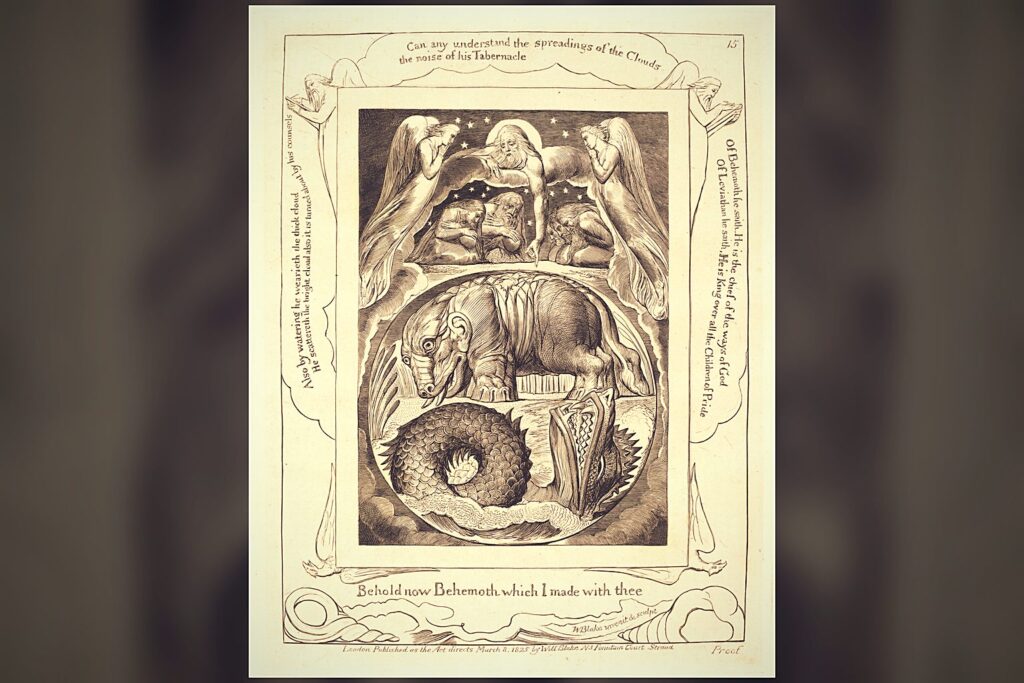
They are presented as a pair in the Book of Job — Behemoth in Job 40, Leviathan in Job 41. Behemoth is the unstoppable land creature; Leviathan is the unstoppable sea creature. Together they represent the limits of human power over the created world.
Conclusion: A Casualty, Not a Mistake
The tragedy of Leviathan is not that God made something wrong. Every text that mentions its origin treats it as deliberate, and Job 41 treats it as magnificent.
Two possibilities remain, and both preserve that.
Either it was made so formidable that it could only be permitted to exist in the singular — and the killing in Psalm 74 was containment, exactly as the Talmud describes. Or it was taken, in the corruption that swept the pre-Flood world, and turned into something that had to be destroyed because the original design could no longer be recovered.
In both readings the conclusion is the same, and it is the pattern this whole record keeps repeating. God builds something extraordinary. It becomes dangerous — through its own power or through interference. And the response is not regret but sterilisation: the removal of a thing that has become incompatible with a world that has to keep running.
Leviathan was not a mistake. It was a casualty of an older war — the same one that began when a third of the angels fell, and the same one that ends only when there is no more sea for the dragon to hide in.
Continue Reading
- Dinosaurs in the Bible: Behemoth, Dragons and the Evidence — Job 40 describes an animal with a tail like a cedar. The Paluxy tracks were retracted by the people who promoted them…
- The Nephilim: What Genesis 6 Actually Describes — Four verses describe something happening, and five verses later the planet is scheduled for erasure. Who the sons of…
- What Did Jesus Say to Satan? Three Answers, One Book — Nobody else was there, so the account can only have come from him. The three offers in order, what forty days without…