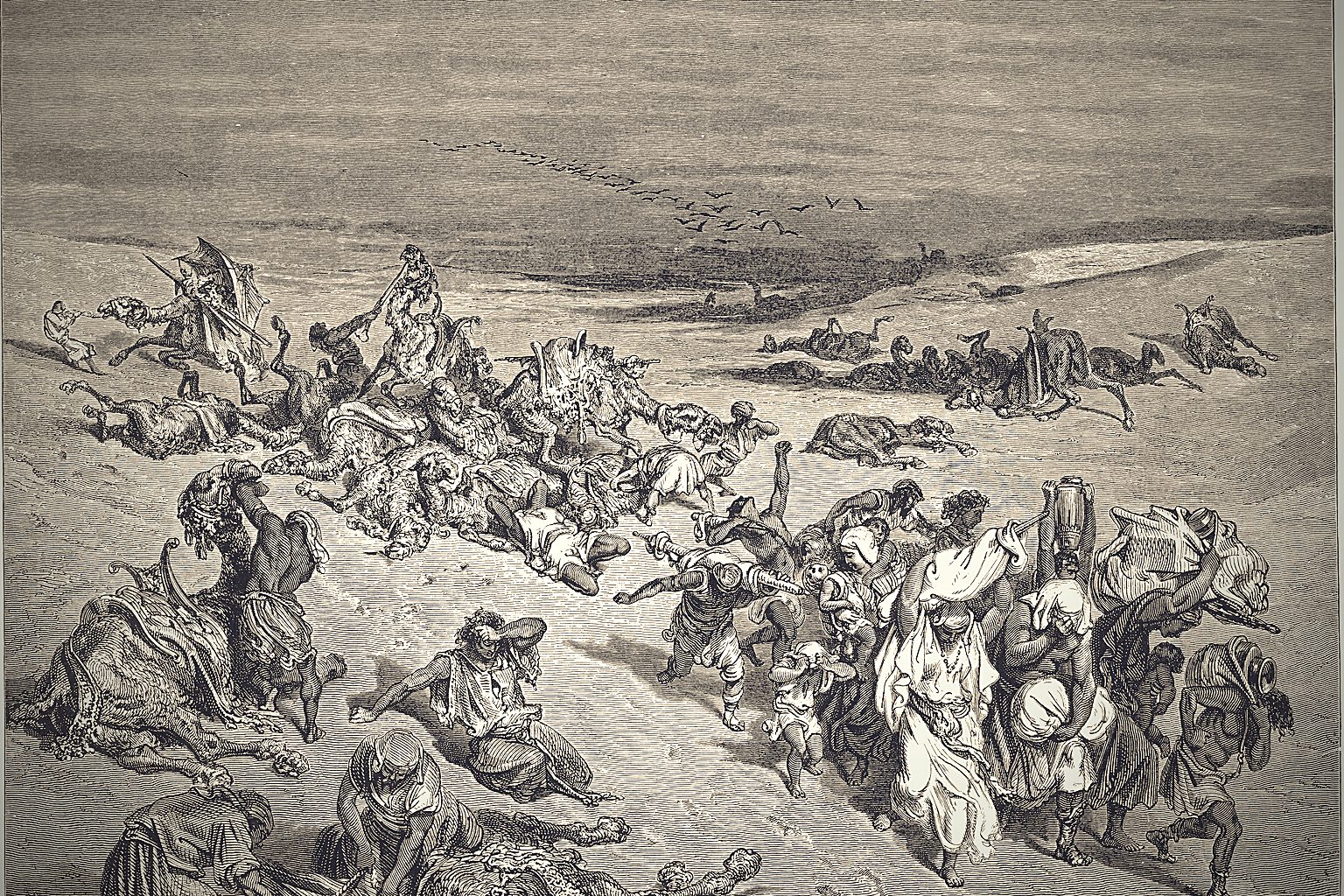
Ten disasters strike Egypt in sequence. A river turns to blood. Frogs swarm out of the water and die in heaps. Insects, disease, boils, hail, locusts, a darkness thick enough to feel — and finally the death of every firstborn in the land in a single night.
Two things about this account are usually missed.
The first is that the plagues are not random. Read in order, they form a chain in which each disaster creates the conditions for the next — a cascade that epidemiologists have been able to model.
The second is that Exodus itself says they were aimed at something specific. Not at the Egyptian people. At their gods.
“…and against all the gods of Egypt I will execute judgment: I am the LORD.” (Exodus 12:12)
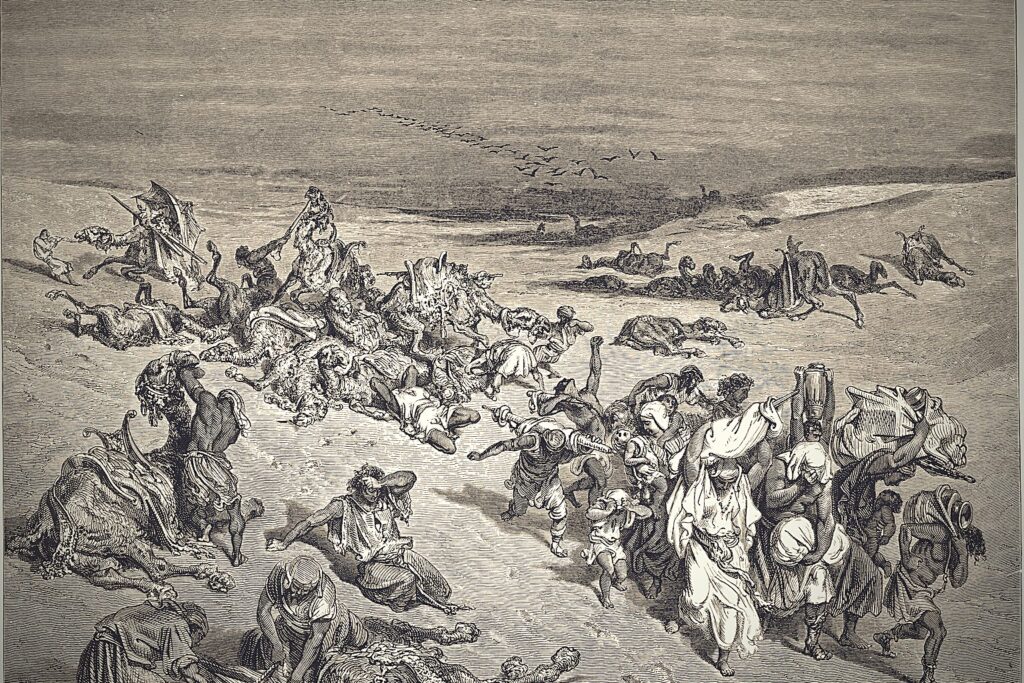
What Were the Ten Plagues of Egypt?
The ten plagues are the judgements described in Exodus 7-12, sent to compel Pharaoh to release the Israelites from slavery. In order: blood, frogs, lice, flies, livestock disease, boils, hail, locusts, darkness, and the death of the firstborn.
After the tenth, Pharaoh released the Israelites, and the Exodus began.
The Ten Plagues in Order
| # | Plague | Reference | Egyptian deity challenged |
|---|---|---|---|
| 1 | Water turned to blood | Exodus 7:14-25 | Hapi, god of the Nile |
| 2 | Frogs | Exodus 8:1-15 | Heqet, frog-headed goddess of fertility |
| 3 | Lice or gnats | Exodus 8:16-19 | Geb, god of the earth |
| 4 | Flies or swarms | Exodus 8:20-32 | Khepri, the scarab-headed god |
| 5 | Death of livestock | Exodus 9:1-7 | Hathor and Apis, cow and bull deities |
| 6 | Boils | Exodus 9:8-12 | Isis and Sekhmet, goddesses of healing |
| 7 | Hail and fire | Exodus 9:13-35 | Nut, goddess of the sky |
| 8 | Locusts | Exodus 10:1-20 | Seth and Osiris, crops and harvest |
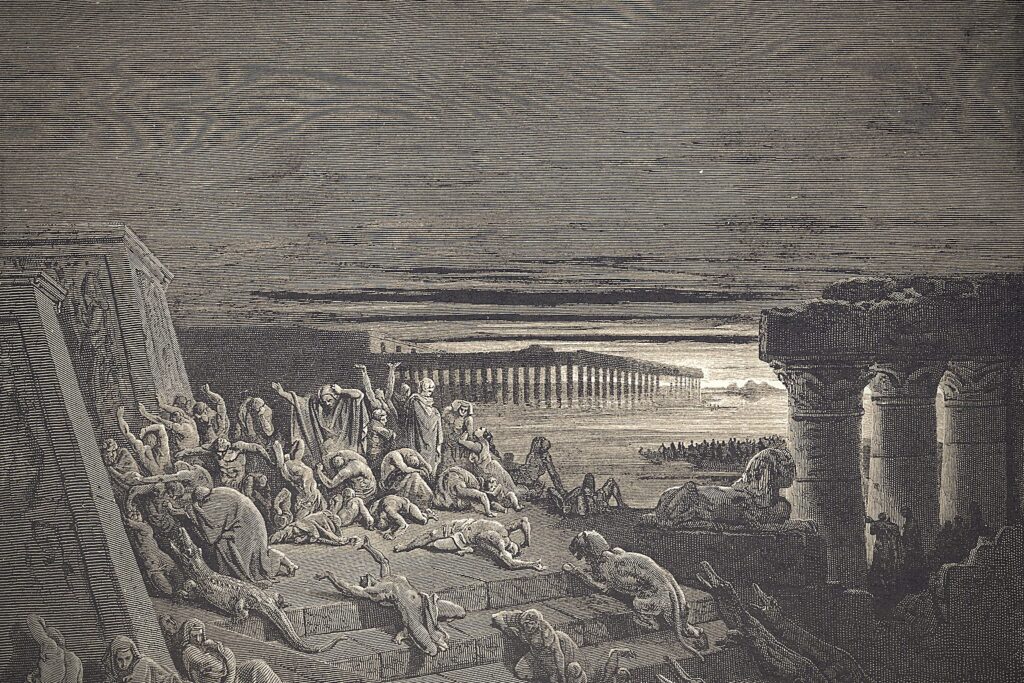
| 9 | Darkness | Exodus 10:21-29 | Ra, the sun god |
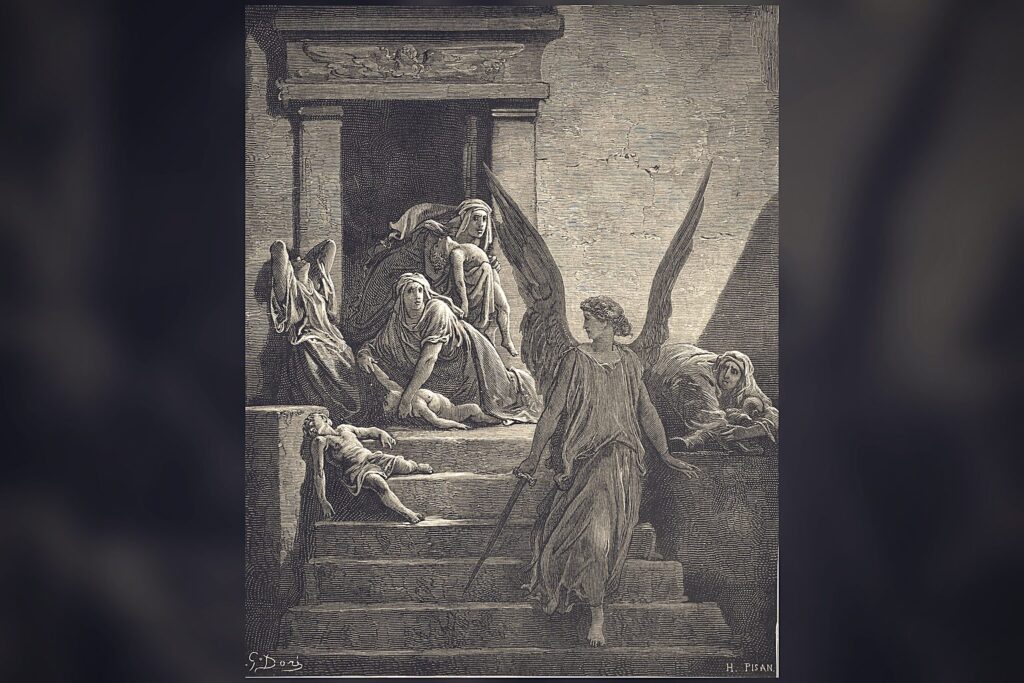
| 10 | Death of the firstborn | Exodus 11-12 | Pharaoh himself, the living god-king |
Laid out this way, the escalation is obvious. The sequence begins with the Nile — the source of Egypt’s existence — and climbs the pantheon rung by rung. The ninth plague blots out Ra, the chief deity. The tenth strikes the Pharaoh’s own household, and Pharaoh was not merely a king; he was understood to be divine, the living Horus and son of Ra.
The final two plagues are aimed at the top of the hierarchy.
The Cascade: A Chain Reaction
In 1996, epidemiologist John Marr and analyst Curtis Malloy published a model in which the plagues are treated as a single connected outbreak rather than ten separate events. Variations on it have been proposed by others since. The logic runs like this:
1. The river turns red. A toxic algal bloom — a red tide. Pfiesteria piscicida and similar dinoflagellates produce blooms that turn water blood-red, strip it of oxygen, and release toxins that kill fish in enormous numbers. Exodus 7:21 records exactly that: “the fish that was in the river died; and the river stank.”
2. Frogs abandon the water. Amphibians leave a contaminated, deoxygenated, fish-corpse-choked river en masse. Exodus 8:13 then records that they died in heaps, “and the land stank.”
3 and 4. Insects proliferate. Remove the frogs — the principal predator of insect larvae — and add rotting fish and rotting frogs, and you get an explosive rise in lice, gnats, mosquitoes and stable flies within weeks.
5. Livestock die. Insect vectors spread disease through herds. Candidate pathogens include African horse sickness and bluetongue, both midge-borne, and anthrax, which persists in soil and is disturbed by flooding.
6. Boils. The stable fly Stomoxys calcitrans is a plausible vector for glanders and for cutaneous anthrax, which produces exactly the kind of skin lesions described — “a boil breaking forth with blains upon man, and upon beast.”
7. Hail. Not part of the biological chain, but Egypt does receive destructive hailstorms, and Exodus 9:31-32 notes precisely which crops were destroyed and which survived: “the flax and the barley was smitten… but the wheat and the rie were not smitten: for they were not grown up.” That is a specific, checkable agricultural detail — barley and flax mature earlier than wheat and spelt. It places the event in roughly January-February.
8. Locusts. Locust swarms are favoured by unusual rainfall, which produces the vegetation their populations need to build. A wet, stormy season is the standard precursor to a plague of locusts.
9. Darkness. Two candidates. A khamsin — the seasonal Saharan sandstorm that can blot out the sun for days and coat everything in fine dust. Or volcanic ash. Exodus 10:21 uses the arresting phrase “darkness which may be felt,” which fits airborne particulate far better than a simple eclipse.
10. Death of the firstborn. The most-discussed hypothesis: mycotoxins. With granaries damaged by hail and locusts, stored grain would be spoiled and contaminated by moulds — Aspergillus, Fusarium — producing potent toxins. And in Egyptian custom, the firstborn son received a double portion of food, giving him roughly twice the exposure to a contaminated supply.
The Volcanic Variant
A second family of theories points to the eruption of Thera (Santorini) in the Aegean, one of the largest volcanic events of the Holocene. Ashfall and aerosols could account for the darkness, unusual storms, red-tinged water from iron-rich ash, and regional climate disruption.
The difficulty is chronological. Radiocarbon dating places Thera’s eruption around 1600 BC, while the conventional Exodus date is placed either around 1446 BC or in the 13th century BC. Neither fits comfortably, and bridging the gap requires revising Egyptian chronology in ways most Egyptologists do not accept.
Where the Natural Explanation Runs Out
The cascade model is elegant, and it is genuinely strong for plagues 1 through 8. It is worth being clear about where it stops working.
The timing is controlled. Repeatedly, Moses announces a plague in advance and names the moment it will end. In Exodus 8:9-10 he lets Pharaoh choose the hour for the frogs to depart, and it happens on schedule. Natural outbreaks do not take appointments.
The separation is selective. From the fourth plague onward, the text insists that Goshen — where the Israelites lived — is exempt. “I will sever in that day the land of Goshen” (Exodus 8:22). Flies, livestock disease, hail and darkness are all described as stopping at a geographic boundary. Insect vectors and weather systems do not respect district lines.
The tenth plague is too precise. Mycotoxins would not select firstborn sons with the accuracy described, and would not strike “the firstborn of Pharaoh that sat on his throne” and “the firstborn of the captive that was in the dungeon” (Exodus 12:29) in the same night. A contaminated-grain explanation predicts a mortality curve concentrated among the poor and the malnourished, not a single generational category cutting cleanly across every social class — including livestock.
The duration is compressed. A natural cascade of this kind would unfold over many months or years. The narrative compresses it into a confrontation with a schedule, driven by an ongoing negotiation.
The honest conclusion is that the naturalistic model explains the mechanism of most of the plagues very well, and explains the timing, targeting and selectivity of none of them. Those are the two halves of the problem, and a theory that solves one is not thereby entitled to claim the other.
The Hardening of Pharaoh’s Heart
One feature of the account troubles readers more than the plagues themselves.
The text says, in different places, that Pharaoh hardened his own heart (Exodus 8:15, 8:32, 9:34) — and that God hardened it (Exodus 9:12, 10:1, 10:20, 11:10).
The sequence matters. In the first five plagues, the hardening is consistently Pharaoh’s own act. Only from the sixth onward does the text say God hardened it. The pattern reads as a man repeatedly making the same choice until the choice becomes a disposition — and then being confirmed in the direction he selected.
It is the same structure described elsewhere in this record: a being with real capability, given real latitude, choosing an incoherent course and then being held to it. The rebellion in heaven follows the identical arc.
What the Plagues Were For
Exodus states the purpose three times, and it is not primarily about liberation.
“And the Egyptians shall know that I am the LORD, when I stretch forth mine hand upon Egypt.” (Exodus 7:5)
The plagues are framed as a demonstration — a systematic dismantling of the claim that Egypt’s gods controlled the Nile, the weather, the harvest, the herds, health, the sun, and life itself. Each plague takes one domain and shows who actually holds it.
This is why the order is not arbitrary and why it climbs. It is a sequence with a rhetorical structure, working upward through a pantheon until it reaches the god-king at the top.
And the final plague is answered by a protocol rather than an escape: blood applied to the doorframes of each house, a meal eaten in haste, nothing left until morning. The Israelites are not removed from Egypt before the tenth plague. They are marked, and the event passes over them — the same pattern of a marked exemption inside a general judgement that runs through the Flood and through the destruction of Sodom.
Frequently Asked Questions
What are the ten plagues of Egypt in order?
Blood, frogs, lice or gnats, flies, death of livestock, boils, hail, locusts, darkness, and the death of the firstborn. They are recorded in Exodus 7 through 12.
Is there a scientific explanation for the ten plagues?
A widely-discussed model treats them as a chain reaction beginning with a toxic algal bloom that killed the Nile’s fish, drove out the frogs, and allowed insect populations to explode, spreading disease. It accounts well for the mechanism of most plagues but not for their announced timing or their selective sparing of Goshen.
What turned the Nile to blood?
The leading naturalistic candidate is a red tide — a bloom of toxic dinoflagellates such as Pfiesteria piscicida that turns water red, strips its oxygen and kills fish. Exodus 7:21 records that the fish died and the river stank.
What killed the firstborn in the tenth plague?
The most-cited hypothesis is mycotoxin contamination of grain stored after the hail and locusts, with firstborn sons receiving a double portion and therefore double exposure. It does not explain the precision described, which cuts across every social class and includes livestock.
Which Egyptian gods did the plagues target?
Exodus 12:12 states the judgement was against the gods of Egypt. The sequence maps closely onto the pantheon: Hapi of the Nile, Heqet the frog goddess, Hathor and Apis for the herds, Nut for the sky, Ra for the sun, and finally Pharaoh himself, who was regarded as divine.
Were the Israelites affected by the plagues?
From the fourth plague onward the text repeatedly states Goshen was spared (Exodus 8:22, 9:26, 10:23). For the tenth, protection was conditional on applying blood to the doorposts.
Did the Thera eruption cause the plagues?
It has been proposed, since volcanic ash and aerosols could explain darkness, strange storms and reddened water. The main obstacle is chronology: Thera is dated to around 1600 BC, which does not align with either conventional date for the Exodus.
How long did the ten plagues last?
Exodus gives no total. Only the darkness has a stated duration, three days (Exodus 10:22). The hail account, which specifies that barley and flax were destroyed while wheat and spelt were not yet grown, places that plague around January or February.
Conclusion: A Demolition, in Order
What Exodus describes is not a tantrum. It is a sequence — and sequences have authors.
Each plague removes one pillar of a worldview. The river that made Egypt possible becomes undrinkable. The fertility goddess’s sacred animal piles up rotting in the streets. The sacred herds die. The healing goddesses cannot cure a boil. The sky turns against the crops. And then the sun god is switched off for three days, and the god-king’s own heir dies in the dark.
Modern epidemiology can plausibly reconstruct how most of it might have worked. It has never been able to explain why it arrived on schedule, stopped on request, and stopped at a border.
That gap is where the account has always lived, and three and a half thousand years of investigation have narrowed it without closing it.
Continue Reading
- What Did Jesus Say to Satan? Three Answers, One Book — Nobody else was there, so the account can only have come from him. The three offers in order, what forty days without…
- The Garden of Eden: Two of the Four Rivers Are Missing — Genesis gives the garden an address. Two rivers are on every map, two match nothing. The drowned Persian Gulf valley…
- Demonic Possession in the Bible: Every Case, and the One That Comes Back — The evil spirit on Saul. Legion in the tombs. The boy the disciples could not help. Every case of demonic possession in…