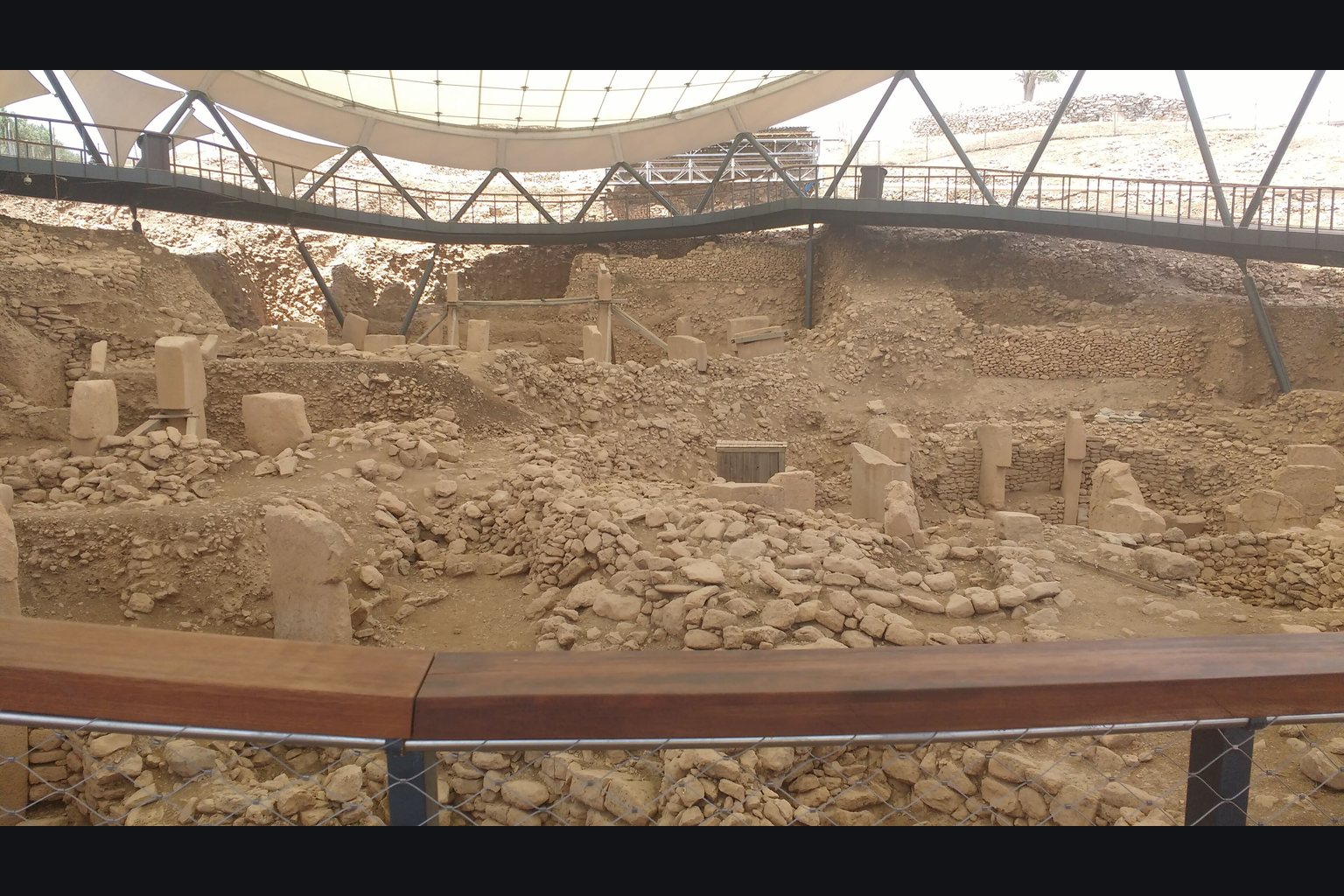
For most of the twentieth century, the story of civilisation had a fixed order. People learned to farm. Farming produced surplus. Surplus allowed permanent settlement. Settlement allowed specialists — priests, builders, artists. And only then, at the end of that chain, did anyone have the resources to raise monuments.
Agriculture first. Temples last.
Then a German archaeologist re-examined a hill in southeastern Turkey that a survey team had written off in 1963 as a medieval cemetery, and found something underneath it that was 11,600 years old — older than pottery, older than metal, older than the wheel, older than writing, and roughly six thousand years older than Stonehenge.
What Is Göbekli Tepe?
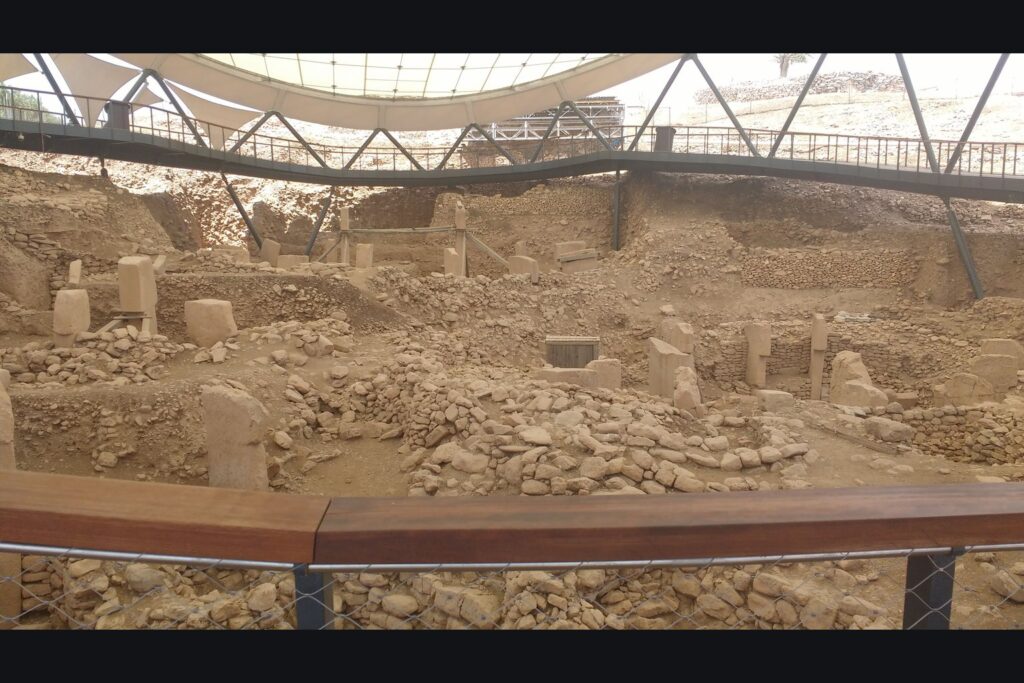
Göbekli Tepe is a megalithic site near Şanlıurfa in southeastern Turkey, built by hunter-gatherers around 9600 BC. It consists of large circular and oval enclosures formed by limestone pillars, many of them T-shaped, standing up to about 5.5 metres (18 ft) and weighing as much as 10 to 15 tonnes (11 to 17 US tons). The pillars carry carved reliefs of foxes, boars, snakes, scorpions, vultures, cranes and other animals.
Klaus Schmidt began excavating in 1995 and worked there until his death in 2014. UNESCO inscribed the site as a World Heritage Site in 2018. Excavation continues — and after thirty years, only a small fraction of the site has been dug.
Why the Date Breaks the Sequence
9600 BC sits in the Pre-Pottery Neolithic A, right at the boundary where the last hunter-gatherers were beginning to experiment with plants. The people who built Göbekli Tepe had:
- No pottery
- No metal tools
- No writing
- No wheel
- No draft animals
- No confirmed domesticated crops or livestock
They had flint, stone, rope, timber and labour. With that, they quarried multi-tonne limestone pillars, shaped them, carved high-relief animals into them, moved them hundreds of metres, and set them upright in planned arrangements.
To put the gap in perspective: Göbekli Tepe is closer in time to the last Ice Age than it is to the building of the Great Pyramid. Roughly seven thousand years separate it from Giza — more than separates Giza from us.
The Organisational Problem
The technical challenge is real but not the deepest one. Ropes, levers, ramps and enough people can move 10 tonnes (11 US tons).
The harder problem is coordination. A project like this requires many people working together for extended periods, fed by someone, organised by someone, following a plan that existed before the first stone was cut. That is a level of social complexity the standard model placed after agriculture, because agriculture was supposed to be what made it possible.
Schmidt’s proposal inverted the order: the need to feed large gatherings at a ritual site may have been one of the pressures that drove domestication, rather than its result. It is suggestive that the genetic origin point of domesticated einkorn wheat has been traced to Karacadağ, a mountain roughly 30 km (19 miles) from the site.
The temple came first, and the farm followed — or at least, the two grew together rather than in sequence.
What Excavation Has Changed Since Schmidt
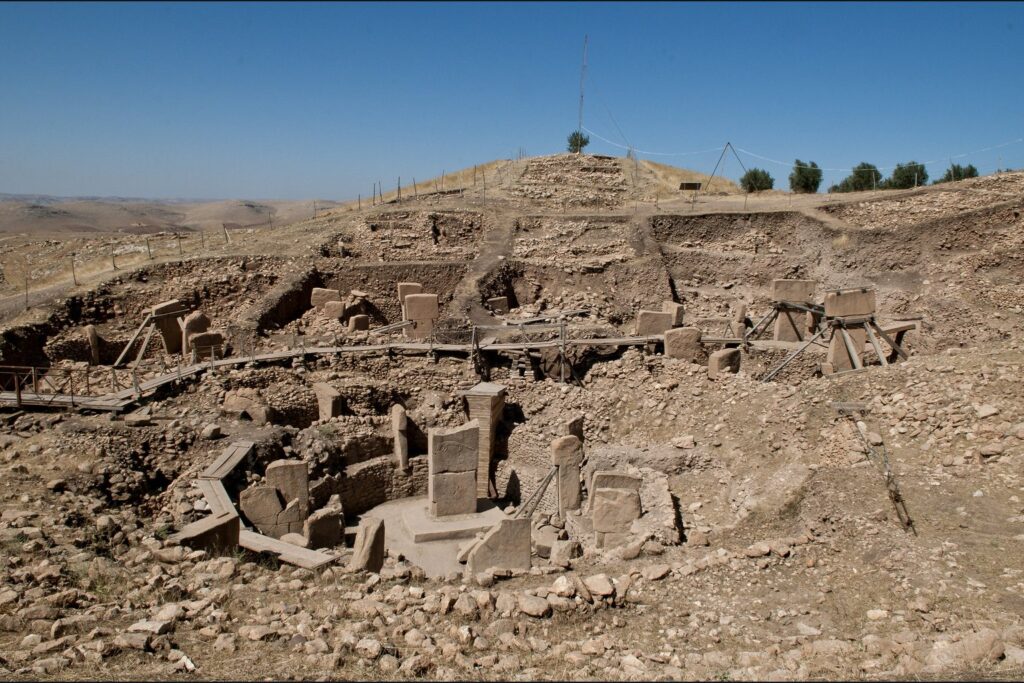
This is where most articles are out of date, and it matters, because two of Schmidt’s most-repeated claims have been substantially revised by later work.
“Nobody lived there.” Schmidt described Göbekli Tepe as a purely ceremonial site — a sanctuary visited by dispersed groups, with no resident population. Subsequent excavation has complicated that considerably. Archaeologists have found grinding stones, flint sickles, plant residues and structures that look domestic. The current picture is closer to a settlement with monumental architecture than to an isolated temple in an empty landscape.
“It was deliberately buried.” Schmidt argued the enclosures were intentionally backfilled at the end of their use. That is now debated, with erosion, slope wash and gradual accumulation offered as alternative explanations for the fill.
Neither revision makes the site less remarkable. The pillars are still there, still that old, still carved. But the popular version — a mysterious temple raised by nomads in an empty wilderness and then deliberately entombed — has been softened by the evidence on all three points.
And It Is Not Alone
The most important development since Schmidt is that Göbekli Tepe turned out not to be unique.
It belongs to a cluster of contemporary sites across the region now studied together as Taş Tepeler (“stone hills”). The most significant is Karahan Tepe, roughly 35 km (22 miles) away, where excavators have uncovered a chamber with pillars carved directly from bedrock and a human head emerging from the rock wall. In 2025, a standing stone bearing a detailed human face was recovered there — the first time a literal human face has been found integrated into a monumental pillar in the network.
Göbekli Tepe is not an anomaly. It is the best-known example of a regional culture that was building monumentally, at scale, across southeastern Anatolia, before agriculture was established.
What Is Actually Carved on the Pillars
The reliefs are the part that resists easy explanation.
The animal repertoire is heavily weighted toward the dangerous and the inedible: snakes, scorpions, spiders, boars, foxes, vultures, big cats. Very little of it is prey. For a hunter-gatherer society, that is a striking choice — these are not images of the food supply.
The T-shaped pillars themselves appear to be stylised human figures. Several carry arms carved in low relief down their sides, with hands meeting at the front, and some wear belts and loincloths. The horizontal top is a head, viewed in profile — which means the enclosures are rings of enormous, faceless anthropomorphic beings standing in a circle, with two larger ones in the centre.
Vultures appear repeatedly, sometimes with human heads or headless bodies nearby. At the related site of Çayönü and at Çatalhöyük, evidence points to excarnation — exposing the dead to scavenging birds before burial. Fragments of human skull at Göbekli Tepe carry deliberate carved grooves, which has been interpreted as a skull cult.
The Case for Something Older
The site has carried a second reading since the first photographs circulated, and it is worth stating properly rather than in the form it takes when someone is about to dismiss it.
There is no learning curve on the hill. The oldest enclosures are the largest, the most ambitious and the best executed. The later ones are smaller and rougher. For a skill developed on site you would expect the reverse — early attempts, then mastery. Advocates of an older source read that inversion as the signature of knowledge arriving already formed, and then decaying as the people holding it lost the thread.
The date sits on a boundary. Construction begins around 9600 BC, which is approximately when the Younger Dryas cold period ends — the same window as the proposed impact event and the meltwater pulse that followed. Those who connect the two argue that a coincidence this tight deserves an explanation rather than a shrug, and point to the Younger Dryas impact hypothesis as the mechanism.
The organisational problem is conceded by everyone. This is the strongest part of the case, and it is not fringe: the standard model placed this level of coordination after agriculture, and Göbekli Tepe put it before. Schmidt’s own answer inverted the sequence. Advocates of an older source say an inversion that large is a sign the sequence is missing a step, not that it simply ran the other way.
Most of it is still in the ground. Geophysical survey indicates roughly two hundred further pillars across some twenty more enclosures that have never been excavated. Any statement about what Göbekli Tepe does not contain is being made about the small fraction that has been dug.
And it is not one site. Karahan Tepe and the rest of the Taş Tepeler cluster mean a whole region was building this way at once, with no known precursor anywhere. A tradition usually has a shallow end.
The Reply From the Excavators
The excavation team and the wider Neolithic field have answers to most of that, and they are specific rather than dismissive:
On a lost advanced civilisation. The toolkit found at Göbekli Tepe is a Neolithic toolkit. Flint blades, stone tools, no metal. The construction is extraordinary for its date but entirely achievable with the technology present at the site. What it demonstrates is that hunter-gatherers were capable of far more organisation than assumed — not that someone else did it.
On Pillar 43 and the comet. A 2017 paper proposed that the Vulture Stone encodes a date via animal-as-constellation symbolism, linked to the Younger Dryas impact hypothesis. The Göbekli Tepe excavation team publicly rejected the reading, noting that the animal symbols recur across many pillars in ways inconsistent with a fixed zodiac, that the site’s own dating does not fit, and that the method allows almost any desired date to be extracted.
On outside help. The counter-argument runs through the same inversion the advocates cite, read the other way: the site shows learning. Earlier enclosures are larger and more accomplished; later ones are smaller and rougher — the opposite of what you would expect if the technique had been given to them. It looks like a tradition that peaked and then declined, which is what human traditions do.
On the Garden of Eden. A popular claim, resting on the region’s rivers and the transition to agriculture. There is nothing at the site connecting it to the Genesis narrative, and the identification is speculation rather than a finding.
What It Does Establish
Strip away the overreach and what remains is still a serious revision of prehistory:
- Monumental architecture predates agriculture. That is now a fact, not a theory.
- Large-scale coordination predates permanent settlement, or arrived alongside it rather than after it.
- Symbolic and ritual life was already sophisticated at the very beginning of the Neolithic, with a developed iconography.
- The standard sequence was wrong. Not wrong in every detail, but wrong in its order.
That last point is the one worth keeping. The model was not overturned by a theory. It was overturned by a hill that had been surveyed, catalogued, and dismissed — by professionals who were looking at it, and who saw what they expected to see.
The same shape recurs across this record: a retracted airburst paper that everyone still cites, footprints withdrawn by the people who promoted them, a giant whose height grew in transmission. What gets believed and what the evidence supports come apart in both directions, and the correction usually arrives late.
Frequently Asked Questions
How old is Göbekli Tepe?
Roughly 11,600 years, with the earliest monumental construction dated to around 9600 BC. That places it about 6,000 years before Stonehenge and about 7,000 years before the Great Pyramid.
Who built Göbekli Tepe?
Pre-Pottery Neolithic people of southeastern Anatolia, at the transition from hunting and gathering to early farming. They had no pottery, metal, writing or wheel, and worked with flint and stone tools.
Is Göbekli Tepe older than the pyramids?
Yes, by a very wide margin. The Great Pyramid dates to around 2560 BC; Göbekli Tepe’s earliest enclosures to around 9600 BC — roughly seven thousand years earlier.
Did people live at Göbekli Tepe?
Probably. Klaus Schmidt originally argued it was purely ceremonial, but later excavation has found grinding stones, flint sickles, plant residues and apparently domestic structures, pointing to a settlement with monumental architecture rather than an uninhabited sanctuary.
Was Göbekli Tepe deliberately buried?
Schmidt thought so, but the claim is now debated. Erosion, slope wash and gradual accumulation of fill are offered as alternative explanations for how the enclosures came to be covered.
What do the carvings at Göbekli Tepe mean?
Unknown. The reliefs are dominated by dangerous rather than edible animals — snakes, scorpions, boars, vultures, big cats. The T-shaped pillars appear to be stylised human figures, with arms and hands carved in relief and belts on some examples.
Does Pillar 43 record a comet impact?
A 2017 paper proposed that the Vulture Stone encodes a date around 10,950 BC linked to the Younger Dryas impact hypothesis. The excavation team rejected the interpretation, noting that the same animal symbols recur across pillars in ways inconsistent with a fixed zodiac.
What is Karahan Tepe?
A contemporary site roughly 35 km (22 miles) from Göbekli Tepe, part of the Taş Tepeler group. Excavators have found pillars carved from bedrock and a human head emerging from the rock wall, and in 2025 a standing stone bearing a detailed human face.
Conclusion: The Hill That Was Already Catalogued
The most instructive thing about Göbekli Tepe is not its age. It is that it was found twice.
A University of Chicago and Istanbul University survey visited the hill in 1963, noted the broken limestone slabs on the surface, concluded they were gravestones from a medieval cemetery, and moved on. The site sat in the record, described and dismissed, for more than thirty years — until Klaus Schmidt read the report in 1994, recognised that the description did not fit a cemetery, and went to look.
Nothing new had to be discovered. The pillars had been sticking out of the ground the whole time. What changed was that somebody read the notes without already knowing what the answer was.
The sequence everyone had learned — farming, then surplus, then settlement, then temples — was not defeated by an argument. It was defeated by a hill in Turkey that had been sitting in a filing cabinet since 1963.
Continue Reading
- Derinkuyu: The Doors Only Close From Inside — Eighty-five metres down, eight levels open of an estimated eighteen, and a half-tonne stone wheel with a spear-hole…
- Atlantis: One Source, and It Stops Mid-Sentence — Every Atlantis expedition in history traces back to two unfinished dialogues by one Athenian. What Plato actually…
- The Viking Sunstone: How It Works, and What Has Been Found — The physics is settled: a calcite crystal really can locate the sun through cloud. Everything else is argued — the one…