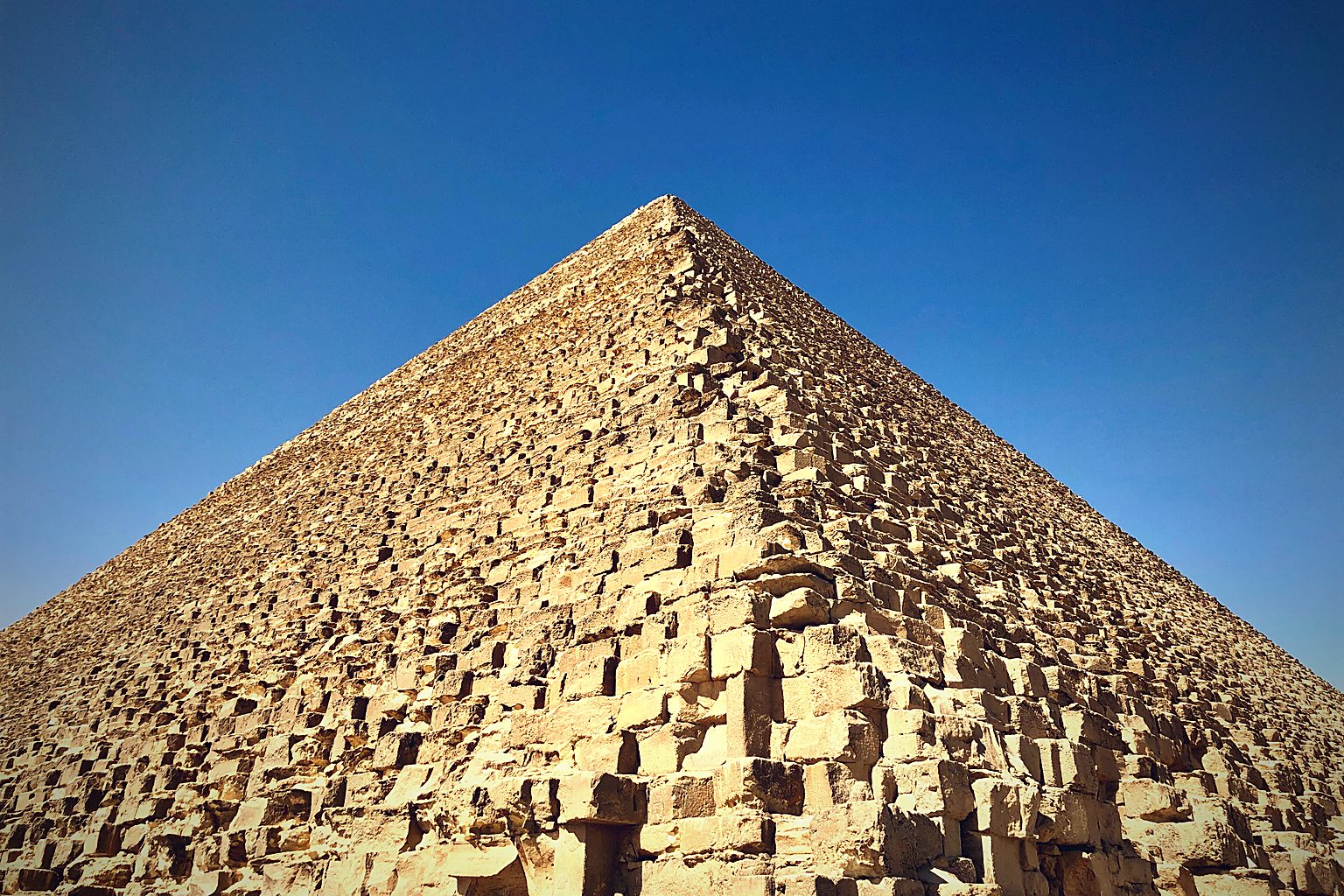
The Great Pyramid held the record for the tallest structure on earth for 3,800 years. Nothing built by anyone, anywhere, exceeded it until Lincoln Cathedral’s spire in about 1311 AD — and that spire fell down in 1548.
It is made of roughly 2.3 million blocks. Its base covers 5.3 hectares (13 acres). It was raised in about twenty years by a civilisation working with copper tools, stone hammers, wooden sledges and rope.
The engineering is not in dispute. What is disputed is almost everything about how, and the honest version of that argument is considerably more interesting than the popular one.
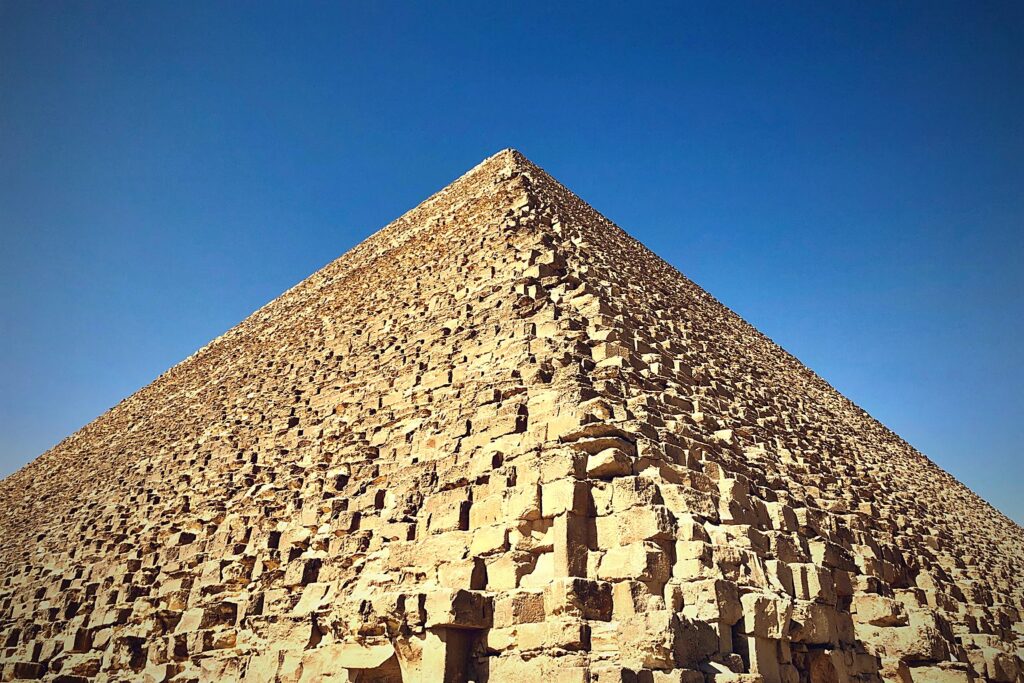
The Numbers
| Property | Figure |
|---|---|
| Original height | 146.6 m / 481 ft (now ~138.5 m / 454 ft) |
| Base length | ~230.3 m / 756 ft per side |
| Base area | ~5.3 hectares / 13 acres |
| Estimated blocks | ~2.3 million |
| Average block mass | ~2.5 tonnes (2.8 US tons) |
| Granite beams in the King’s Chamber | up to ~50-80 tonnes / 55-88 US tons |
| Date | c. 2560 BC, Fourth Dynasty, reign of Khufu |
| Construction period | approximately 20 years |
Twenty years is the figure that does the work. If the pyramid was built in roughly two decades of continuous labour, that averages out to a block placed every two to three minutes across a ten-hour working day, for twenty years, without interruption.
That number is the real problem. Not lifting the stones — scheduling them.
The Precision That Is Genuinely Remarkable
Some claims about the pyramid’s accuracy are inflated. These are not.
Cardinal alignment. The sides are oriented to true north with an error of about 1/15th of a degree — roughly four arcminutes. No compass existed. Magnetic north would not have been good enough anyway, since it drifts and does not match true north.
The most convincing explanation is the simultaneous transit method: watching two circumpolar stars and marking the moment one sits directly above the other, giving a true north-south line. Egyptologist Kate Spence proposed this in 2000, and it has the attractive feature of predicting a slow drift in alignment error across successive pyramids as the stars precess — which is broadly what the record shows.
Base levelling. The base is level to within about 2.1 cm (0.8 in) across 230 metres (755 ft). This is achievable with water: flood a trench network around the site, mark the waterline, cut to it. Egyptians had the method.
Squareness. The corners are within a small fraction of a degree of right angles, and the four sides differ in length by only centimetres.
This is exceptional work. It is also work that can be done with plumb bobs, set squares, cord, water and enormous care — which the Egyptians demonstrably possessed, because they left the tools and the unfinished work behind.
How the Blocks Were Moved
For a long time the ramp question was entirely theoretical. It is less so now.
Water transport is confirmed. In 2013 the Diary of Merer was discovered at Wadi al-Jarf — the logbook of a boat captain working in Khufu’s reign. It is the oldest inscribed papyrus ever found, and it records Merer’s crew transporting limestone blocks from the Tura quarries by boat to Giza, describing the journey in practical detail. We now have an eyewitness administrative record of the supply chain.
A now-dry Nile branch reached the plateau. Sediment coring published in 2022 established that a branch of the Nile — the Khufu branch — ran close to the Giza plateau and was navigable during the construction period, then dried up. Materials could be floated almost to the base.
Ramps existed. Remains of construction ramps survive at several Egyptian sites. A steep ramp system with post holes, found at the Hatnub alabaster quarry in 2018, shows sledges being hauled up gradients far steeper than previously thought possible, using a central staircase and flanking post rows as a pulley-like system.
Sledges on wetted sand. A 2014 study in Physical Review Letters showed that pouring water on sand ahead of a sledge roughly halves the required pulling force — and a scene in the tomb of Djehutihotep shows exactly that: a man pouring liquid in front of a sledge carrying a colossal statue. The picture was always there; it had been read as a ritual act.
Labour, not slaves. Excavation of the workers’ village at Giza by Mark Lehner and Zahi Hawass uncovered bakeries, breweries, dormitories, medical care — including healed fractures indicating long-term treatment — and tombs built for workers close to the pyramid, an honour no slave would receive. The workforce was organised into named gangs whose graffiti survives inside the monument.
The unglamorous answer is that we know a great deal about how it was done, and the gaps that remain are engineering details rather than mysteries requiring outside help.
What Is Actually Unexplained
Being honest cuts both ways. Several things genuinely lack a settled explanation.
The King’s Chamber granite. The roof beams are granite, quarried at Aswan roughly 900 km (559 miles) upriver, and some weigh 50 to 80 tonnes (55 to 88 US tons). They had to be transported that distance and then raised to a height of about 43 metres (141 ft) inside a structure already largely built. No ramp design fully accounts for this.
The relieving chambers. Five stacked voids sit above the King’s Chamber, with rough, undressed granite surfaces — clearly structural rather than decorative. They work: they divert load away from the ceiling. But that implies a grasp of load distribution that is not documented anywhere in Egyptian writing.
The “air shafts.” Two narrow shafts run from the King’s Chamber to the exterior, and two from the Queen’s Chamber stop short of it, blocked by small limestone doors with copper fittings. Robotic exploration in 1993, 2002 and 2011 found further blocking stones and red ochre marks behind them. Their purpose is unknown. Their stellar alignments are argued but contested.
The Big Void. In 2017 the ScanPyramids project used muon radiography — imaging with cosmic-ray particles — and detected a large cavity at least 30 metres (98 ft) long above the Grand Gallery. Further work has confirmed its existence and refined its dimensions. Nobody knows what it is. It may be a construction void, a further relieving space, or something else entirely. It has never been entered.
A structure this heavily studied still containing an unexplored 30-metre space is a fair measure of how much remains unresolved.
Checking the Popular Claims
“It could not be built today.” It could. It would be expensive and pointless, but not difficult.
“The blocks fit so tightly you cannot insert a knife blade.” True in places — the outer casing stones at the base were finished to a fraction of a millimetre. Not true generally. Most of the core masonry is rough, irregular, and packed with gypsum mortar and rubble. The precision is concentrated where it was seen.
“Its dimensions encode pi, the speed of light, or the earth’s circumference.” The pi relationship is real in the sense that the perimeter divided by the height approximates 2π — but this falls out automatically if the slope was set using a seked, the Egyptian measure of run-per-rise, which is how their texts actually describe defining a slope. The result is a by-product of the method, not a message. Claims about the speed of light rely on converting ancient units into modern ones chosen after the fact, which will produce a hit somewhere in almost any large building.
“It was a power plant.” There is no residue, no conductor arrangement, no circuit, no output path. The chambers held a sarcophagus. Contrast this with the Ark of the Covenant, where the specified layer order genuinely matches a capacitor — that is a real textual observation. Nothing comparable exists for Giza.
“Aliens built it.” Egypt contains the entire developmental sequence: mastabas, then Djoser’s step pyramid, then Sneferu’s collapsed pyramid at Meidum, then the Bent Pyramid — where the angle was visibly changed mid-construction because it was failing — then the Red Pyramid, then Giza. That is a record of people learning, failing, and correcting. The Bent Pyramid is the single best argument against outside assistance: nobody with advanced technology makes a structural error halfway up and then changes the angle to save it.
Why It Was Built
The tomb explanation is sometimes dismissed as boring. It is also the one the evidence supports: the structure sits in a complex of mortuary temples, causeways and satellite pyramids that only make sense as a funerary installation, and it contains a granite sarcophagus.
But “tomb” undersells what the project was for. A pyramid of this scale is a state-formation engine. It requires a census, taxation, food production and distribution at scale, quarrying, shipping, tool manufacture, medical provision, and an administrative class capable of coordinating thousands of people for two decades.
Building it created the machinery of the Egyptian state as much as the state created it. The same logic runs through the Tower of Babel account, where the recorded concern is not the height of the tower but what a unified, coordinated population becomes capable of.
Frequently Asked Questions
How was the Great Pyramid built?
Through quarrying, river transport and ramps. The 2013 Diary of Merer records limestone being shipped from Tura to Giza in Khufu’s reign, 2022 sediment coring confirmed a now-dry Nile branch reached the plateau, and surviving ramps plus wetted-sand sledge techniques account for moving blocks on site.
How old is the Great Pyramid?
It was built around 2560 BC during the Fourth Dynasty reign of Khufu, making it roughly 4,600 years old. Construction is generally estimated at about twenty years.
Who built the pyramids — slaves or paid workers?
Organised workers, not slaves. Excavation of the workers’ village at Giza revealed bakeries, breweries, dormitories and medical care including healed fractures, along with tombs built for workers near the pyramid.
How accurate is the Great Pyramid’s alignment?
Its sides align to true north within about 1/15th of a degree, and the base is level to within roughly 2.1 cm (0.8 in) across 230 metres (755 ft). The alignment was likely achieved by observing the simultaneous transit of two circumpolar stars.
What is the Big Void in the Great Pyramid?
A large cavity at least 30 metres (98 ft) long, detected above the Grand Gallery in 2017 by the ScanPyramids project using muon radiography. Its purpose is unknown and it has never been entered.
Does the Great Pyramid encode pi?
The perimeter divided by the height approximates 2π, but this follows automatically from defining the slope using the seked, the Egyptian run-per-rise measure. It is a by-product of the construction method rather than encoded information.
Was the Great Pyramid a power plant?
Nothing recovered from it supports that reading: no conductors, no circuit, no residue, no output path. The chamber contained a granite sarcophagus and the structure sits inside a mortuary complex. What the building does still hold are real unexplained things — the 80-tonne granite beams, the load-distribution scheme above the King’s Chamber, and a 30-metre void nobody has entered — and those are the parts worth arguing about.
What are the shafts in the Great Pyramid?
Four narrow shafts run from the King’s and Queen’s Chambers. The Queen’s Chamber shafts stop short of the exterior and are blocked by small limestone doors with copper fittings. Robotic exploration has found further blocking stones behind them, and their purpose remains unknown.
The Bent Pyramid, and What It Does Not Answer
If you want one object that bears on the question of who built the pyramids, it is not the Great Pyramid. It is the Bent Pyramid at Dahshur, built for Sneferu — Khufu’s father — about forty years earlier.
It starts at roughly 54 degrees. Partway up, the angle changes abruptly to about 43. The most widely accepted explanation is that the structure began to show signs of instability and the builders reduced the angle to lower the load and finish it safely.
That is a mistake, caught in progress, and corrected on the fly by people who did not have the theory to predict it and had to learn by watching their own building. Nearby at Meidum sits another Sneferu pyramid that appears to have collapsed outright.
Then, one generation later, at Giza, they got it right — and got it right to within four arcminutes of true north.
To most Egyptologists that sequence is decisive. It is the signature of a civilisation that failed, adjusted and tried again, at enormous cost, until it worked — and nobody working from borrowed technology makes a structural error halfway up a building and has to save it by changing the angle.
Those who read Giza as something more do not usually dispute that sequence. Their reply is that it explains the pyramids and not the anomalies inside this one: the 80-tonne granite beams lifted 43 metres (141 ft) into an already-standing structure by a method no reconstruction has yet demonstrated, the load-distribution scheme above the King’s Chamber that appears in no Egyptian text, and a cavity at least 30 metres (98 ft) long that a muon detector found in 2017 and nobody has entered.
Both of those can be true at the same time. The learning curve is documented in stone across four reigns. The hardest engineering questions inside the Great Pyramid are still open. What to make of the distance between them is the part this article cannot settle for you — and there is a void above the Grand Gallery that may yet settle it for everyone.
Continue Reading
- The Viking Sunstone: How It Works, and What Has Been Found — The physics is settled: a calcite crystal really can locate the sun through cloud. Everything else is argued — the one…
- Derinkuyu: The Doors Only Close From Inside — Eighty-five metres down, eight levels open of an estimated eighteen, and a half-tonne stone wheel with a spear-hole…
- Puma Punku: The H-Blocks and the Half-Finished Stones — The blocks look machined. But the giant stones are the soft ones, the precise ones are the hard ones, and the site is…