In 1963 a man in the Turkish town of Derinkuyu was renovating his house. He knocked through a wall in his basement and found a room on the other side that he had not built. Behind that room was a passage. Behind the passage was a city.
The story is true — Snopes has checked it, which tells you how often it gets told. It is also the only part of Derinkuyu underground city that most articles about it bother with. Search for who built it, or when, or why it was abandoned, and you get the basement anecdote again, followed by a number: eighteen storeys, twenty thousand people.
Both of those numbers deserve a closer look, and the answers to the real questions are better than the anecdote.
What Is the Derinkuyu Underground City?
It is a multi-level settlement carved roughly 85 metres (279 ft) straight down into volcanic rock in Cappadocia, central Turkey, built to hide a population underground for extended periods. Not a mine, not a tomb complex, not a bunker for a garrison — a place with stables, kitchens, storerooms, wine presses, wells and a church, sized for a town.
At its fullest use it could shelter as many as 20,000 people together with their livestock and food stores.
It is not the only one. Cappadocia has around two hundred underground complexes of varying size, and Derinkuyu is connected to another of them, Kaymaklı, by 8 to 9 kilometres of tunnel. That detail alone reframes the whole thing: this was not one hiding place but a network.
The Rock Is the Reason
None of it is possible anywhere else, and the geology is the part usually skipped.
Cappadocia sits on tuff — rock formed from compacted volcanic ash. Tuff is soft enough to cut with hand tools, which is why the region is full of carved churches, houses and pigeon lofts above ground as well as below.
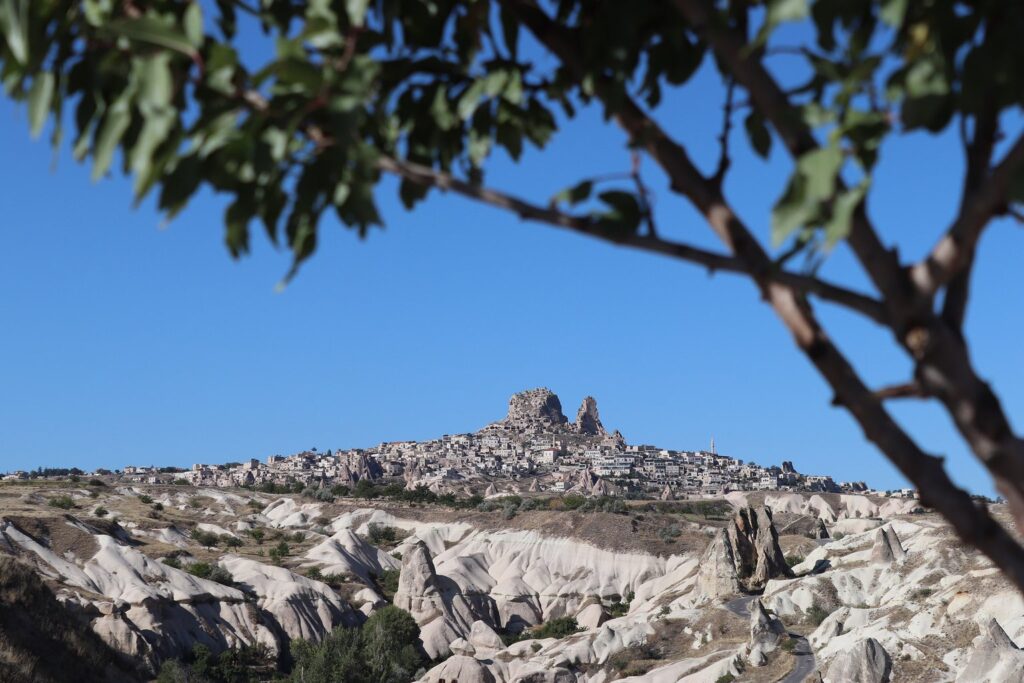
Two properties make it ideal. It is workable without iron-age metallurgy beyond simple picks, and it is stable enough to hold a ceiling without shoring. That combination is rare. The question “how did they dig this” has a boring answer, and the boring answer is the correct one: the rock let them.
Anatolia has form here. Six hundred kilometres east, the carved pillars of Göbekli Tepe were being raised eleven thousand years ago by people with no metal at all. Working stone at scale is not the anomaly in this part of the world. It is the local competence.
What is genuinely impressive is not the excavation. It is the engineering decisions made inside it.
Eighteen Levels, or Eight?
Here is the first number worth correcting.
You will read everywhere that Derinkuyu is eighteen storeys deep. Eight levels are open to visitors, reaching about 54 metres (177 ft). The figure usually quoted for the full depth is around 85 metres (279 ft). Estimates of the total number of levels run to eighteen, but that is an estimate of the complex’s extent, not a count of surveyed floors — and only something like 10 to 15 per cent of the total area is accessible at all.
| Claim | What is actually established |
|---|---|
| 18 levels | 8 open to the public; 18 is an estimate of total extent |
| 280 feet deep | ~85 m overall; the lowest public level is ~54 m / 177 ft |
| Housed 20,000 | A capacity estimate, at peak use, including livestock |
None of these are fabrications. They are estimates that lost their qualifiers somewhere between the archaeology and the headline. The city is remarkable at the measured figures; it does not need the rounded ones.
The Doors Only Close From Inside
This is the detail that tells you what the place was for.
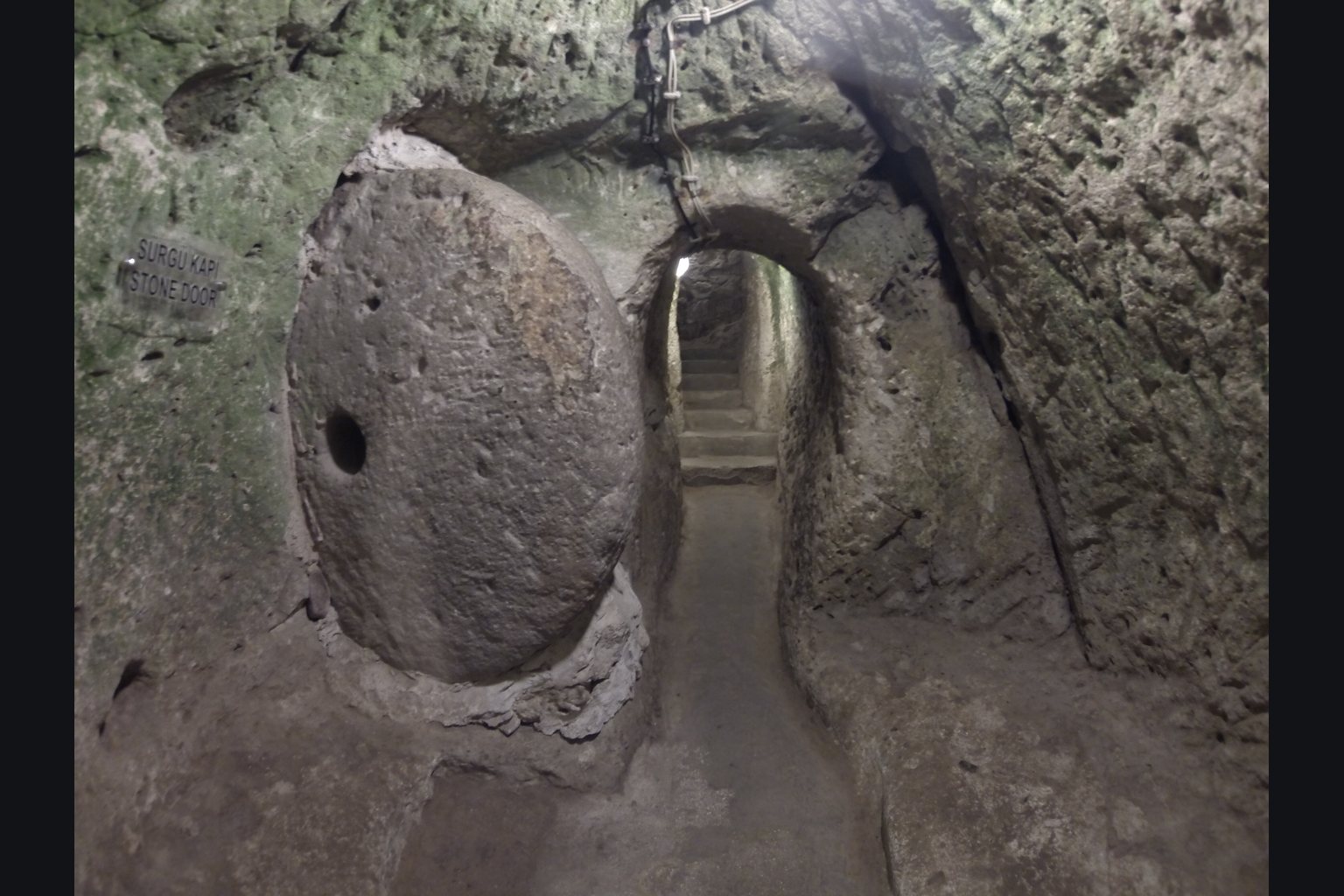
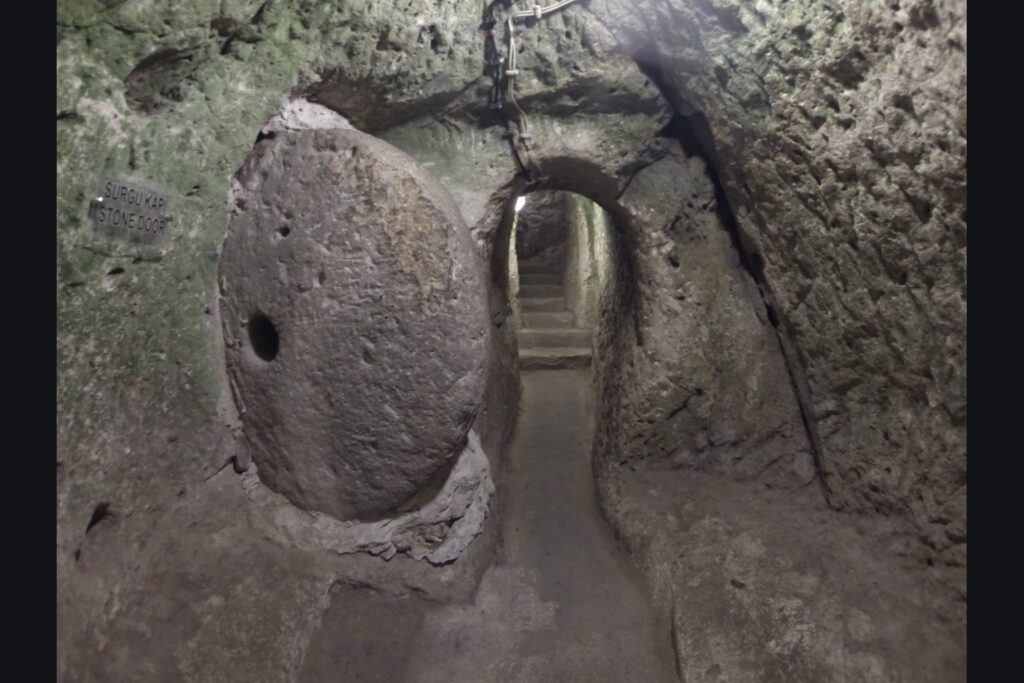
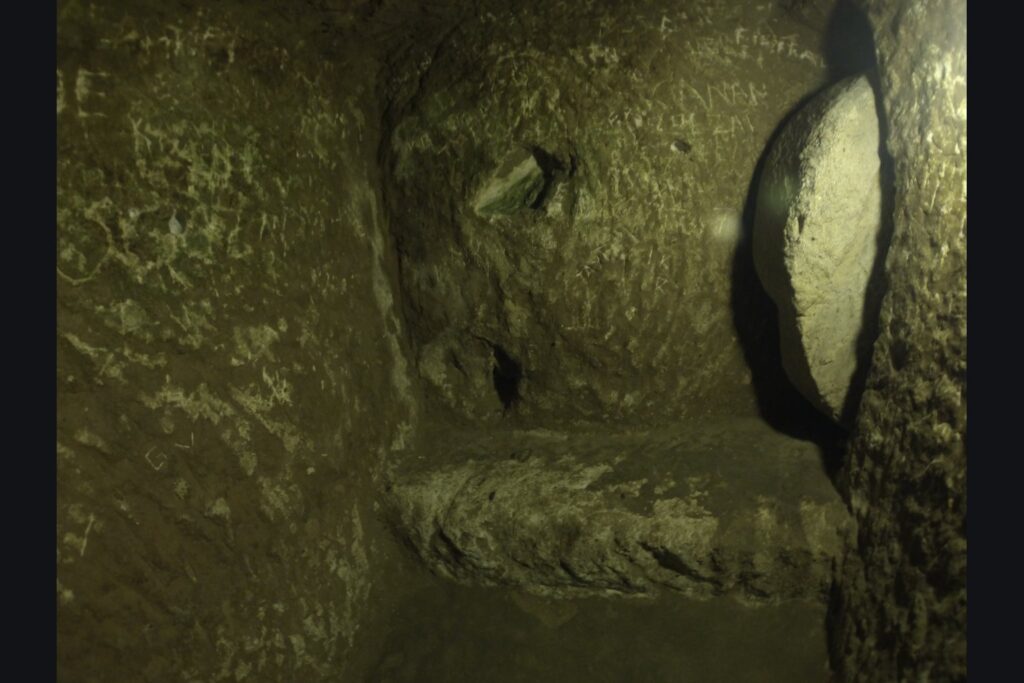
The passages are sealed by rolling stone doors — circular slabs, up to half a tonne, set in carved recesses beside the corridor. They roll across to block the passage, and they are operated from the inside only. A hole through the centre allows a spear to be pushed through at anyone working on the other side.
Each floor can be sealed separately. That is not a single front door; it is defence in depth. An attacker who forces one level finds the next one closed against him, in the dark, in a corridor deliberately cut low and narrow so he has to come through stooped and one at a time.
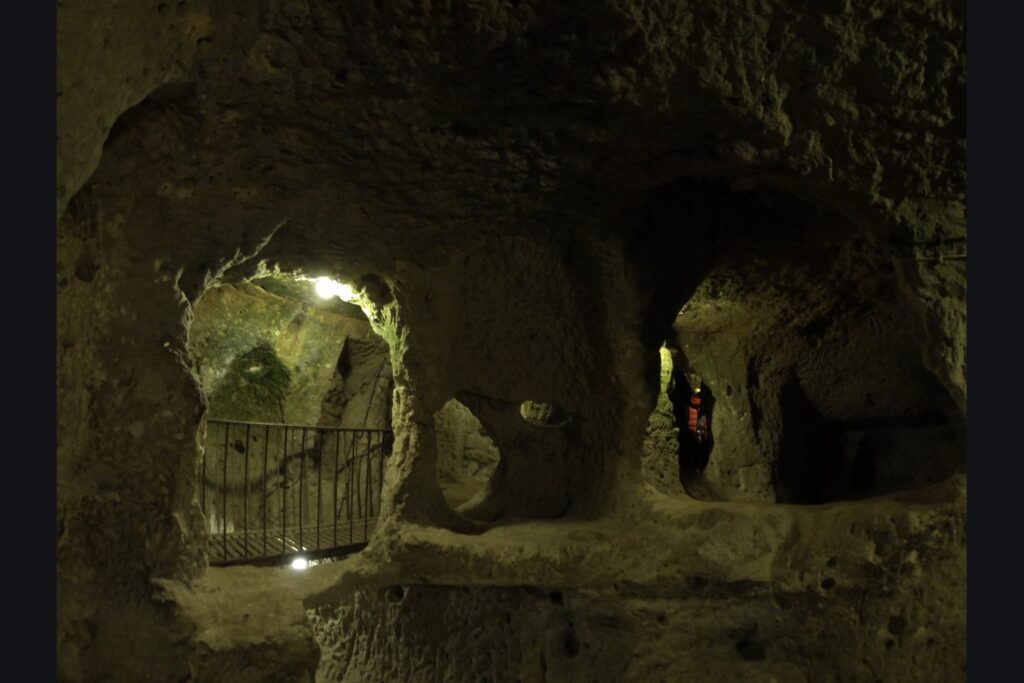
A building tells you its threat model. Derinkuyu’s is unambiguous: the danger came from outside, it came repeatedly, and the people who built it expected to lose the surface and need to wait.
Breathing Underground
Twenty thousand people and their animals, eighty-five metres down, for weeks. The hard problem was never digging. It was air.
The complex is threaded with a large number of vertical ventilation shafts, and the central one runs about 55 metres (180 ft). The openings of the shafts are deliberately arranged so they do not overlap between levels — which keeps air moving through the occupied spaces rather than falling straight down a single chimney, and stops a shaft becoming a speaking tube or a route for smoke poured in from above.
The wells are the other half. Some do not connect to the surface at all, which protects the water supply from being poisoned by anyone holding the ground above. That is a design decision made by people who had thought carefully about a siege, and it is a far better indicator of purpose than any number of storeys.
Who Built It, and When
The honest answer is that this is genuinely contested, and the confident versions on both sides are overreaching.
The most widely accepted attribution is to the Phrygians, in the 8th to 7th century BC, who are credited with cutting the first tunnels and rooms into the soft rock. They were Iron Age Anatolian builders with the means and the reason.
An earlier Hittite origin, around 1600 BC, is sometimes proposed. No definitive evidence links the Hittites to Derinkuyu specifically.
The dating problem is structural, not a failure of effort. Carving removes rock; it does not deposit datable layers. A tunnel cut in 700 BC and a tunnel cut in AD 700 look the same in the stone. What can be dated is what people left behind in the rooms — and the rooms were swept, reused and re-cut for two and a half thousand years. The city’s own use erased most of the evidence of its construction.
The Period We Can Actually Document
If the origin is murky, the heavy use is not.
The complex was significantly enlarged during the Arab–Byzantine wars, roughly AD 780 to 1180, when it sheltered the local Christian population. This is when it most likely came closest to that peak capacity of around 20,000. The chapels, the church on the lowest level, the scale of the storage — this is the layer we can see, and it is Byzantine Greek.
So the popular framing gets the emphasis backwards. Derinkuyu is usually sold as a mysterious prehistoric feat. What the evidence best supports is a Phrygian beginning expanded, centuries later, into something enormous by a medieval Christian population with a specific and well-documented enemy.
That is not a lesser story. A community that spent four hundred years enlarging a refuge is telling you something very direct about what those four hundred years were like.
Why It Was Abandoned
Not mysteriously, and not in antiquity.
Derinkuyu was in use, on and off, into the twentieth century. It was abandoned in 1923, during the population exchange between Greece and Turkey, when the Cappadocian Greeks who had maintained and used it were required to leave. The city emptied because its people were moved, and the knowledge of it went with them.
That is why a local man could knock through his basement wall forty years later and not know what he was looking at. The gap is four decades, not four millennia.
Checking the Popular Claims
Three things worth flagging.
“Nobody knows how it was built.” The reconstruction is not in much doubt: hand tools, in soft tuff, over a very long time, by people who lived there. Tuff is soft enough to cut with iron, the region is full of smaller rock-cut dwellings made the same way, and the tool marks are on the walls. What keeps the claim alive is the scale, and scale and mystery are not the same thing. It is the same move that turns the Great Pyramid into an unsolved problem when the ramps, the quarries and the workers’ town have all been found, and the same instinct behind confident claims about impossible stonework at Puma Punku, where the unfinished blocks answer the question.
“It was built to shelter from something in the sky.” There is no evidence for this and no need for it. The region was fought over continuously — Persians, Romans, Arab raiders, and later Turkish and Mongol incursions. A refuge from human armies explains every feature of the site, including the ones a cosmic threat would not require, like spear-holes in the doors.
The precise capacity. Twenty thousand is a capacity estimate, and estimates for underground occupancy are sensitive to assumptions about ventilation and how long people stayed. Treat it as an order of magnitude — a town, not a village — rather than a census.
Where This Stays Open
Two real uncertainties, stated as uncertainties.
The founding date is unresolved. The Phrygian attribution is the best-supported reading, not a proven one, and the Hittite proposal has not been refuted so much as left unevidenced. Anyone giving you a firm construction date for Derinkuyu is giving you a preference.
The full extent is unknown. With 10 to 15 per cent of the area accessible and excavation ongoing, the eighteen-level figure may eventually be vindicated, revised upward, or revised down. It is currently an estimate, and the correct thing to do with an estimate is label it.
Frequently Asked Questions
Where is the Derinkuyu underground city?
In the town of Derinkuyu, in Nevşehir Province in the Cappadocia region of central Turkey. It is connected to a second underground city, Kaymaklı, by 8 to 9 kilometres of tunnel, and is one of around two hundred underground complexes in the region.
Who built the Derinkuyu underground city?
Most probably the Phrygians, in the 8th to 7th century BC, who cut the first rooms and tunnels into the volcanic tuff. An earlier Hittite origin around 1600 BC is sometimes suggested but no definitive evidence links them to this site. It was greatly enlarged much later by Byzantine Greek Christians.
Why was the Derinkuyu underground city built?
As a refuge. Every feature points the same way: rolling stone doors that seal only from the inside, each level closable separately, narrow low passages, ventilation shafts with non-overlapping openings, and wells that do not reach the surface where they could be poisoned.
How was the Derinkuyu underground city found?
In 1963 a resident renovating his house knocked through a basement wall and found a room behind it that led into the complex. The story is accurate; it has been fact-checked. The site opened to visitors in the years following.
How deep is Derinkuyu and how many levels does it have?
About 85 metres (279 ft) at its deepest. Eight levels are open to the public, with the lowest public level around 54 metres (177 ft) down. The commonly quoted figure of eighteen levels is an estimate of the total extent, not a count of surveyed floors.
When was the Derinkuyu underground city abandoned?
In 1923, during the population exchange between Greece and Turkey, when the local Greek Cappadocian community that used and maintained it left. That is why it was forgotten within a single lifetime rather than over centuries.
How did people breathe in Derinkuyu?
Through a large number of vertical ventilation shafts, the central one running about 55 metres (180 ft). Their openings are offset so they do not line up between levels, which circulates air through the rooms instead of dropping it down one channel.
Is the Derinkuyu underground city real?
Yes. It is an excavated, surveyed archaeological site in Cappadocia, open to visitors, and one of many such complexes in the region. What is estimated rather than established is its full depth, its total number of levels and its exact capacity.
Conclusion: The Spear-Hole in the Door
Everything contested about Derinkuyu — who cut the first chamber, how many levels there really are, whether twenty thousand is right — sits on top of one object that is not contested at all.
A half-tonne stone wheel, set in a recess, that rolls across a corridor and can only be moved from the inside, with a hole bored through its centre at the height of a man’s chest.
You do not build that for storage. You do not build it for a religious retreat, or for a mystery. You build it because people with weapons came, more than once, and because you intended to be behind it when they did. The rest of the site is the same answer repeated at different scales: engineering read as a specification rather than as a riddle, and the specification says wait them out.
Continue Reading
- The Viking Sunstone: How It Works, and What Has Been Found — The physics is settled: a calcite crystal really can locate the sun through cloud. Everything else is argued — the one…
- Göbekli Tepe: The Temple That Came Before Farming — 11,600 years old – older than pottery, metal, writing and the wheel. Why Göbekli Tepe inverted the accepted order of…
- The Sumerian King List: 241,200 Years Before the Flood — Eight kings, 241,200 years, then a flood. Almost every retelling adds the numbers up — and what that shape means is the…