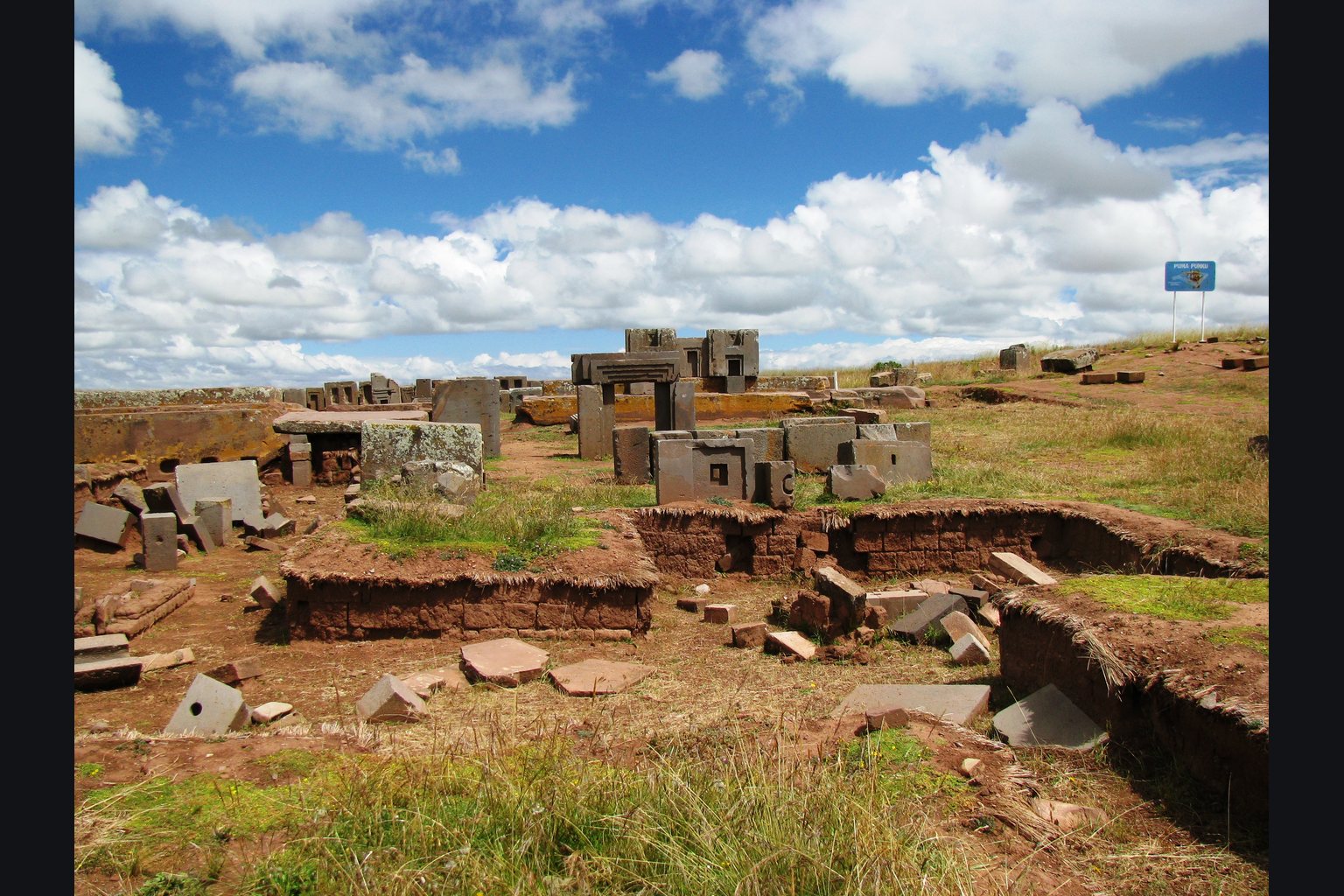
Puma Punku is the site that converts people. You can read about every other “impossible” ancient structure and remain unmoved, and then see photographs of the H-blocks — flat faces, interior right angles, repeated to a standard pattern — and think: that is machined.
The reaction is understandable. The stones really do look manufactured to a template rather than carved.
What is usually left out is that we know which stone they are made of, how hard it is, what tools were available, where the quarry was, and roughly when the site was built. When you put those facts next to the photographs, the picture changes — though not entirely in the direction sceptics usually claim, because one part of Puma Punku is genuinely harder to explain than the rest.
What Is Puma Punku?
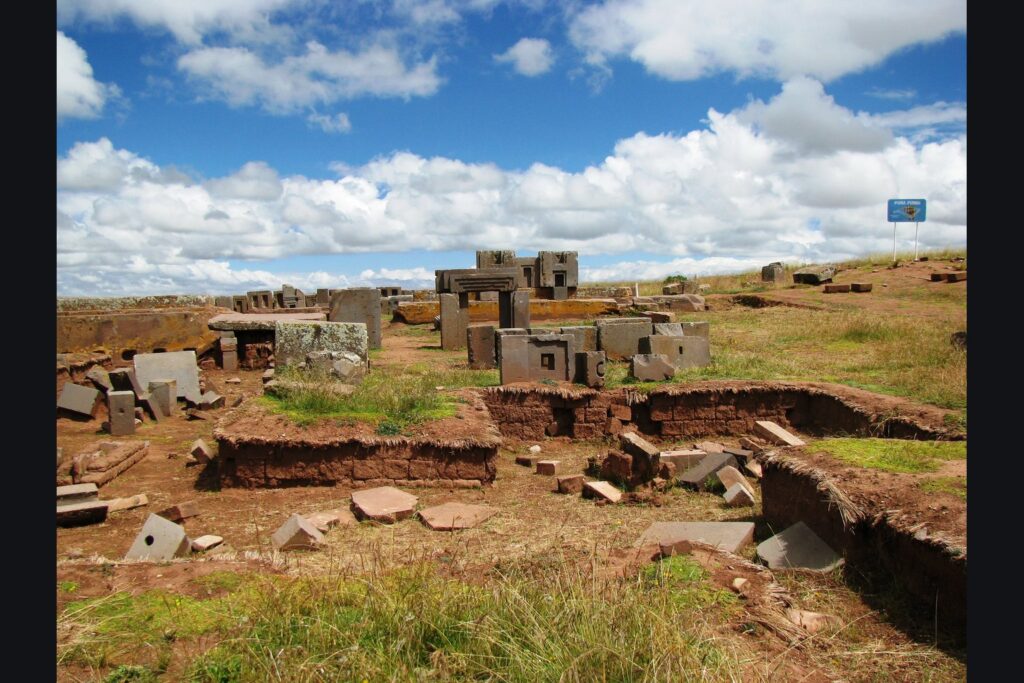
Puma Punku (“Door of the Puma” in Aymara) is a monumental platform complex at the southern edge of Tiwanaku, in western Bolivia, roughly 20 km (12 miles) from Lake Titicaca and at an altitude of about 3,850 metres (12,631 ft).
Tiwanaku was the centre of a major Andean state, and the site was a ceremonial and administrative complex rather than an isolated ruin. Puma Punku is one structure within it.
Radiocarbon dating of organic material from the lowest levels of the Puma Punku platform mound points to construction beginning around AD 500-600, with the broader Tiwanaku site occupied from earlier. That places it firmly within the archaeological record — not in deep prehistory.
Two Different Stones, Two Different Stories
This is the distinction that most discussion of the site misses entirely, and it matters enormously.
Puma Punku uses two principal stone types, and they were worked differently.
Red sandstone. The enormous platform slabs. The largest is roughly 131 tonnes (144 US tons), about 7.8 m long. Sandstone is soft — around 2 to 3 on the Mohs scale — and can be worked with harder stone hammers without much difficulty. It was quarried around 10 km (6.2 miles) away at Kheri Kala.
Grey andesite. The famous H-blocks and the finely finished architectural elements. Andesite is a volcanic rock, considerably harder at around 6 on the Mohs scale — comparable to steel. It was brought from quarries near Copacabana, roughly 90 km (56 miles) away across or around Lake Titicaca.
So the giant blocks are the soft stone, and the precise blocks are the hard stone. The two problems — moving mass and achieving precision — apply to different objects.
How the Precision Was Achieved
The H-blocks are the heart of the mystery, and several things about them are genuinely established.
They are modular. The blocks conform to repeated designs — the same interior angles, the same recesses, the same proportions across multiple examples. This is the observation that most suggests machining.
But modularity has an ordinary explanation: templates. If you produce a master pattern and work each block to it, you get interchangeable components. Tiwanaku was a state-level society with organised craft production; standardised architectural elements are exactly what such societies produce. Roman builders did the same with brick.
The tools existed. Andesite can be shaped by:
- Percussion with harder hammerstones — quartzite and haematite hammers have been found at Tiwanaku
- Abrasion with sand and water, which cuts andesite slowly but with excellent flatness
- Pecking and grinding to finish surfaces
Archaeologist Jean-Pierre Protzen, who studied Inca and Tiwanaku stonework in detail, demonstrated experimentally that Andean stoneworking techniques reproduce these results. He showed the surfaces retain tool marks consistent with pecking and grinding, not with rotary cutting.
The site is unfinished. Blocks at Puma Punku exist at every stage of completion — roughed out, partly shaped, nearly finished. If the components had been produced by some lost machine process, you would not expect a progression of half-made examples lying around. That progression is the signature of hand production interrupted.
Bronze cramps. Tiwanaku used I-shaped metal cramps to tie blocks together. Analysis has shown that at least some were poured molten into carved channels in situ — meaning the builders had portable smelting capability at the site. That is a genuinely sophisticated technique, and it is a documented, human one.
What Is Actually Hard to Explain
Being honest about the site means acknowledging what remains difficult.
The transport. Moving andesite roughly 90 km (56 miles) from Copacabana, across or around Lake Titicaca, at nearly 4,000 m (13,100 ft) altitude, without the wheel and without draught animals capable of the work — llamas cannot haul multi-tonne loads. Reed boats and ramps plus human labour are the proposed answer, and reed boat construction is well attested on Titicaca. It remains a formidable logistical achievement.
The flatness. Some surfaces are flat to a degree that is striking even accounting for abrasive finishing. Measurements of the flattest examples are debated, and precise published metrology is thinner than the topic deserves.
The altitude. Puma Punku sits at 3,850 m (12,631 ft), where sustained heavy labour is physiologically punishing. The Tiwanaku population was adapted to it; visitors are not, which is part of why the site feels so improbable to anyone who goes there.
The destruction. The site is a ruin of scattered, tumbled blocks. Earthquake, deliberate dismantling, and centuries of stone-robbing for colonial building and railway ballast have all contributed. Much of the original arrangement is simply gone, which makes reconstruction of the original design partly guesswork.
The Case for Lost Technology
The machining reading is the reason most people arrive at this site, and it deserves to be set out at its strongest before anything is said against it.
The modularity is the real argument, not the polish. The H-blocks are not merely well made; they are interchangeable. Several share the same internal angles, the same recesses and the same profile closely enough that one could stand in for another. That is the output of a repeated process working to a fixed specification, and in every other context we meet it, that means tooling.
Internal corners are the hard part. A flat face can be ground down with sand and patience. A crisp inside corner, at depth, in andesite, cannot be reached by an abrasive block — and andesite sits around 6 on the Mohs scale, harder than the bronze the Tiwanaku were casting. Advocates point out that no one has publicly produced an H-block to the same tolerance using only the toolkit recovered from the site, and that this is a reproducible experiment nobody has completed.
Drill holes and cramp sockets. The site carries small drilled holes and precisely cut sockets for the metal cramps. The cramps themselves were poured in place, which means metal was being worked to a high standard at 3,850 m (12,631 ft).
The dating rests on what survived. Radiocarbon dates come from organic material in the associated layers, not from the stone, which cannot be dated directly. Those who argue for an older site — a line going back to Arthur Posnansky — say that dates a phase of use rather than the cutting of the blocks, and that a ruin this thoroughly scattered and robbed may no longer hold its own earliest evidence.
The Reply From the Archaeology
On laser tolerances. No published metrological survey supports “laser” precision. The surfaces show pecking and grinding marks under examination. Photographs taken at favourable angles exaggerate the impression of perfection.
On the 17,000-year date. This originates with Arthur Posnansky, who in the early twentieth century dated Tiwanaku by assuming a temple alignment was intended to mark the solstice and calculating backwards using the slow change in Earth’s axial tilt. The method assumes the conclusion — that the alignment was exact and intentional — and radiocarbon dating of the site’s own organic material places construction in the mid-first millennium AD.
On an unknown material. They are andesite and red sandstone. Both have been petrologically identified, and both have located quarries.
On the absence of tool marks. There are tool marks. They have been photographed and published, and they are pecking and grinding marks.
Where That Leaves It
The archaeological reading is that Puma Punku is a remarkable achievement by a sophisticated Andean state that had:
- Organised labour at scale
- Standardised production using templates
- Metallurgy sufficient to pour bronze cramps on site
- Long-distance transport networks
- Stoneworking expertise refined over generations
On that reading it did not have machinery, and nothing recovered from the site requires it. The reply from the other side is that the site is a robbed ruin and the experiment has not been run.
There is also a reason the machining reading feels so natural, and it is worth naming, because the same thing happens at Nazca and Giza: we associate repeated, standardised precision with machines, because in our world that is where it comes from. But standardisation is a product of organisation, not of mechanisation. A workshop with a template, a supply of hammerstones and abrasive sand, and enough time will produce interchangeable parts.
What that costs is labour — enormous quantities of it — which is precisely what a state-level society is for.
Which of those two explanations you find more economical is the part this article cannot decide for you. One of them requires a great deal of organised human effort that left its marks on the stone. The other requires a technology that left nothing else behind at all.
Frequently Asked Questions
What is Puma Punku?
A monumental platform complex at the southern end of the Tiwanaku site in western Bolivia, at about 3,850 metres (12,631 ft) altitude near Lake Titicaca. It is known for precisely cut andesite blocks, including the modular H-shaped stones.
How old is Puma Punku?
Radiocarbon dating of organic material from the lowest levels of the platform mound points to construction beginning around AD 500-600. The claim of 17,000 years originates with Arthur Posnansky’s astronomical dating method, which assumes its own conclusion.
What stone is Puma Punku made of?
Two types. Red sandstone, used for the largest platform slabs including one of roughly 131 tonnes (144 US tons), quarried about 10 km (6.2 miles) away. And grey andesite, used for the finely finished H-blocks, brought roughly 90 km (56 miles) from near Copacabana.
How were the H-blocks cut so precisely?
Nobody has demonstrated it end to end, which is the honest starting point. The reconstruction most archaeologists work from is percussion with harder hammerstones, then abrasion with sand and water, then pecking and grinding to finish, with each block worked to a template — and marks consistent with all three stages are on the surfaces. What has not been done is producing an H-block to the same tolerance using only that toolkit, which is why the question is still argued over.
Are there tool marks on the Puma Punku stones?
Yes. Jean-Pierre Protzen documented pecking and grinding marks on the surfaces, consistent with Andean stoneworking methods and inconsistent with rotary cutting.
How were the stones transported?
Reed boats across Lake Titicaca and hauling by human labour with ramps and ropes are the proposed methods. Reed boat construction is well attested on the lake. The transport remains the most demanding part of the project.
What are the metal cramps at Puma Punku?
I-shaped bronze cramps used to tie blocks together. Analysis indicates at least some were poured molten into carved channels on site, meaning the builders had portable smelting capability.
Did aliens build Puma Punku?
Nothing recovered from the site requires it: blocks survive at every stage of completion, tool marks are present, the stone types and their quarries are identified, and the dating places it inside a known Andean state’s period of activity. Those who read it otherwise reply that the site is a scattered, robbed ruin and that what would settle it may no longer be there to find. Both positions are on the page above; the conclusion is yours.
Conclusion: The Half-Finished Blocks
If Puma Punku had been produced by some lost technology, the site would contain finished components and nothing else. Machines do not leave partial work scattered across a hillside.
What is actually there is a spectrum: blocks barely roughed out, blocks partly shaped, blocks nearly complete, blocks finished and placed. That range is the fingerprint of hand production — a workshop caught mid-task, its output frozen at whatever stage each piece had reached when the work stopped.
The H-blocks are astonishing. They are also the end of a process whose earlier stages are lying on the ground beside them, in a state that no machine would produce and no template alone would explain.
Somebody was still working on those when Tiwanaku fell.
Continue Reading
- The Nazca Lines: Two Readings of the Same Desert — A 370-metre hummingbird you cannot take in from the ground, cut into a desert that gets twenty minutes of rain a year…
- The Anunnaki: What the Sumerian Tablets Actually Say — The Anunnaki are real and the tablets are real. Whether they are the gold-mining aliens from Nibiru is the argument…
- The Dogon and Sirius B: A Star Nobody Should Have Seen — A farming people in Mali, no telescopes, describing an invisible star with a fifty-year orbit and impossible density…