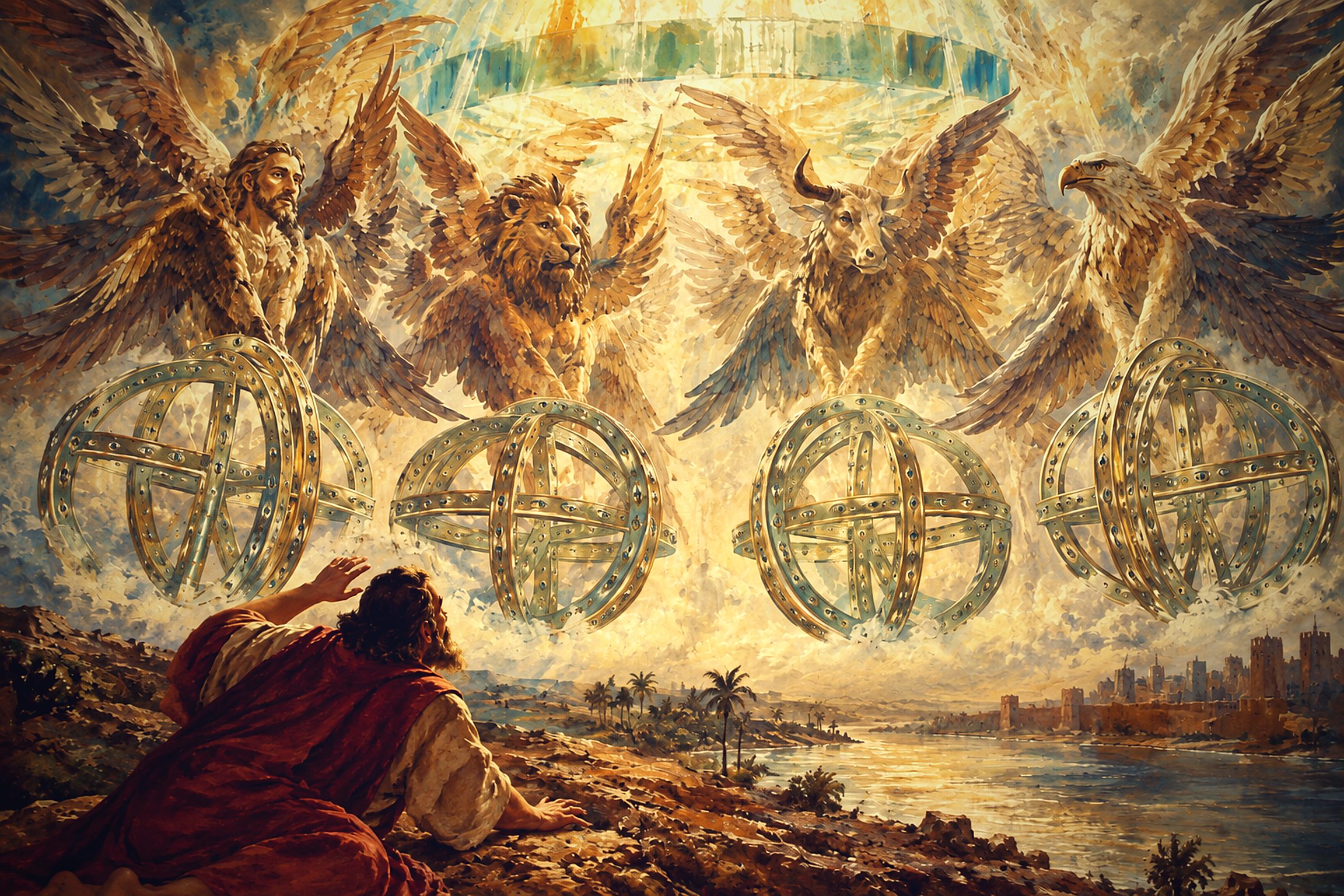
The thrones of Scripture are not furniture. They are the strangest entities in the biblical text — wheels made of something like sea-green gemstone, rims covered in eyes, spinning without turning, animated by the same spirit that drives the four-faced creatures above them. Ezekiel saw them by a canal in Babylon and spent two full chapters trying to describe what he was looking at.
The internet has turned them into memes — interlocking rings of eyes floating in space. But the text is more specific than the memes, and in several places more disturbing. Here is what thrones actually look like when you read every passage that describes them.
What Do Thrones Look Like?
The short answer: no single passage describes a being called a “throne.” What the Bible gives you is two things under two names that later tradition fused into one.
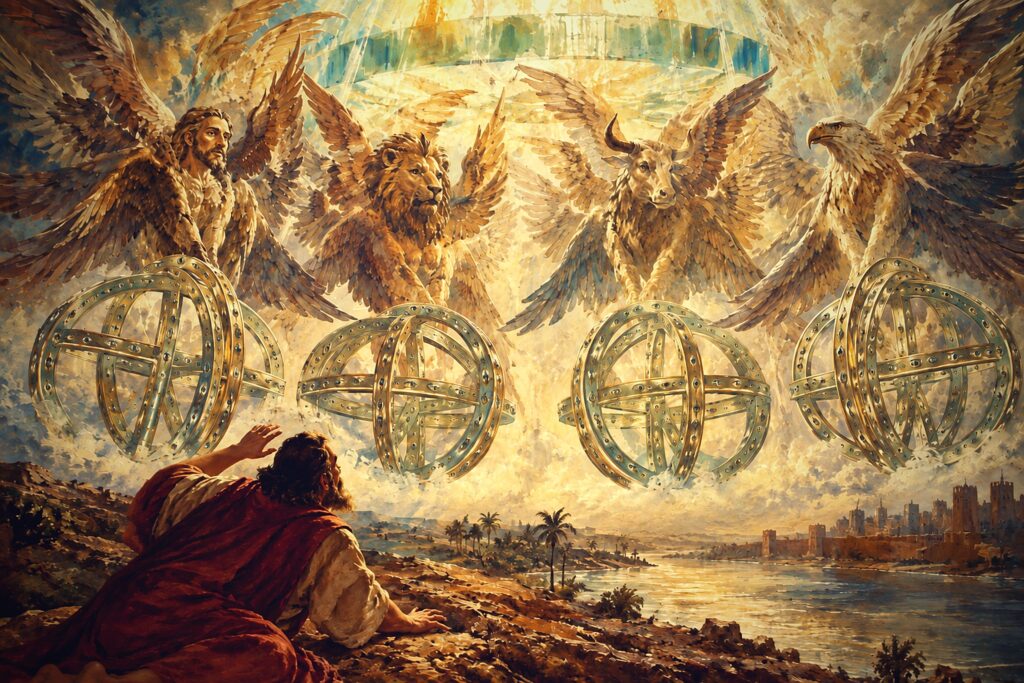
Ophanim — Hebrew for “wheels” — appear in Ezekiel 1 and 10. They are physical objects or entities made of translucent stone, shaped as a wheel within a wheel, covered in eyes, moving in any direction without reorienting. Each one stands beside one of the four living creatures, and the same spirit drives both.
Thrones — Greek thronoi — appear in Colossians 1:16 as one of four classes of cosmic powers Paul names without describing. He says Christ created them. He says nothing about what they look like.
Five centuries later, a writer calling himself Dionysius the Areopagite placed Thrones third in a nine-tier angelic hierarchy and identified them with Ezekiel’s wheels. The equation stuck. But it is theology, not exegesis — a connection the Bible itself never makes.
The Primary Text: Ezekiel 1:15-21
Ezekiel gives the only detailed physical description. He is a priest in exile by the river Chebar in Babylon, around 593 BC, and he is trying to describe something he has no vocabulary for.
“Now as I beheld the living creatures, behold one wheel upon the earth by the living creatures, with his four faces. The appearance of the wheels and their work was like unto the colour of a beryl: and they four had one likeness: and their appearance and their work was as it were a wheel in the middle of a wheel.” (Ezekiel 1:15-16)
“When they went, they went upon their four sides: and they turned not when they went. As for their rings, they were so high that they were dreadful; and their rings were full of eyes round about them four.” (Ezekiel 1:17-18)
“When the living creatures went, the wheels went by them: and when the living creatures were lifted up from the earth, the wheels were lifted up… for the spirit of the living creature was in the wheels.” (Ezekiel 1:20-21)
The passage repays slow reading. Ezekiel’s “the appearance of” and “as it were” constructions — repeated compulsively in these chapters — are not literary hedging. They are the tic of a man trained to measure things precisely, faced with something he can only describe by analogy. He does not say “it was beryl.” He says “the appearance of the wheels and their work was like unto the colour of a beryl.” The distinction is deliberate.
Five details are mechanically specific.
One wheel beside each creature. Four creatures, four wheels (Ezekiel 10:9 confirms this: “four wheels beside the cherubim, one wheel beside each cherub”). The wheels stood on the ground; the creatures were above them. The whole assembly — creatures, wheels, and the sapphire-like throne above them — is what Jewish tradition calls the Merkabah, the divine chariot.
Made of tarshish. The Hebrew eben tarshish — rendered “beryl” in most English Bibles — names a translucent gemstone, pale green to sea-blue, with a glassy lustre. The Septuagint translated it as chrysolite (gold-stone), and the Targums said colour of the sea. The identification is genuinely uncertain, but every candidate agrees on one property: the material was see-through. Whatever these wheels were made of, Ezekiel could see into them.
A wheel in the middle of a wheel. The Hebrew is ha-ophan betok ha-ophan — literally “the wheel in the midst of the wheel.” Two readings dominate. Most modern commentators favour two wheels intersecting at right angles, forming a gyroscope-like cage that can roll along any axis. The older artistic tradition prefers concentric rings, one inside the other. The first reading is favoured because it explains what comes next.
They turned not when they went. They could travel in any of four directions without rotating their body. A single wheel can only roll along the axis it faces. Two perpendicular wheels can move in any direction without reorienting. This is, in functional terms, an omni-wheel — a design patented in the 1970s and now standard on warehouse robots and omnidirectional platforms. It is a very odd thing for a 6th-century-BC exile to describe.
Their rims were full of eyes. The Hebrew gabbotam — their rims, or their arched surfaces — were covered in einayim (eyes). The word gabbotam (from gab, meaning “back” or “arched surface”) is itself ambiguous: some translations read “rings” (KJV), others “rims” (NIV, ESV), and the Anchor Bible Commentary [1]’s Moshe Greenberg noted it implies “a prominent brow-like curvature.” Whether the eyes covered just the outer rim or the entire curved surface of each wheel is unclear from the word alone. What is clear is their effect: Ezekiel says the rims were “so high that they were dreadful” — the height and the eyes together produced fear, not wonder. In chapter 1, the eyes appear on the wheel rims only. This changes in chapter 10.
A Name That Means “Wheels”
The Hebrew word is אוֹפָן (ophan, singular; ophanim, plural), from a root meaning “to revolve.” Ezekiel uses it throughout chapter 1. It is the ordinary Hebrew word for a wheel — the same word used for chariot wheels, potter’s wheels, and the wheels on the bronze stands in Solomon’s Temple (1 Kings 7:32-33).
A second name appears in Ezekiel 10:13, in a narrator’s aside: “As for the wheels, they were called in my hearing ha-galgal” — the whirling. The word galgal (from galal, “to roll”) emphasises spinning motion. It is not a separate entity. Ezekiel is telling you that the same objects had a second name, and someone — or something — spoke it in his hearing while the vision unfolded.
The same Aramaic cognate, galgillôhî, appears in Daniel 7:9: “His throne was fiery flames; its wheels were burning fire.” Whether Daniel saw the same things Ezekiel saw is debatable. That the tradition used the same word for them is not.
Eyes Round About: What the Text Says and What It Doesn’t
The eyes are the detail the internet seized on, and they are the detail the text handles most carefully.
In Ezekiel 1:18, the eyes are on the wheel rims only: “their rings were full of eyes round about them four.” The four living creatures in this chapter have faces and wings but no eyes covering their bodies.
In Ezekiel 10:12, the description expands dramatically: “their whole body, and their backs, and their hands, and their wings, and the wheels, were full of eyes round about.” Now the cherubim’s entire bodies are covered in eyes — and so are the wheels.
This is not a contradiction. Ezekiel is describing the same vision twice, and the second time adds detail the first omitted. Scholars such as Moshe Greenberg (Anchor Bible Commentary) note that Ezekiel’s second account reads like a closer observation of the same scene — the way a second visit to a building reveals what the first walk-through missed.
But there is one detail that genuinely changed. In 1:10, the four faces of each creature are man, lion, ox and eagle. In 10:14, the ox is replaced by “the face of a cherub.” The text does not explain the substitution, and scholars have debated it for centuries. Two readings dominate. The first: Ezekiel, having now recognised the creatures as cherubim (10:20), saw the ox face AS the face of a cherub — a re-identification, not a transformation. The face did not change; his understanding of it did. The second: the composite creature’s dominant face literally rotated between sightings, and what he saw first as an ox now presented as the cherub’s own face — whatever that means. Neither explanation is fully satisfying, and the text does not arbitrate between them.
The Throne That Burns: Daniel 7:9
Daniel’s vision is briefer and hotter.
“I beheld till the thrones were cast down, and the Ancient of days did sit, whose garment was white as snow, and the hair of his head like the pure wool: his throne was like the fiery flame, and his wheels as burning fire.” (Daniel 7:9)
The Aramaic word for wheels here is galgillôhî — the same root as Ezekiel’s galgal. But Daniel gives no detail. No structure. No eyes. No creatures beside them. Just wheels, burning.
What Daniel does add is fire. Ezekiel’s wheels are translucent stone. Daniel’s wheels are nur daliq — blazing fire. And the connection between ophanim and fire runs through the later literature. In 3 Enoch, seven rivers of fire flow beneath the ophanim. In 2 Enoch, the ophanim are called the “many-eyed ones” and stand beside the throne in fire.
The two visions — Ezekiel’s mechanical precision and Daniel’s apocalyptic fire — became the raw material from which later tradition built a single entity. Ezekiel gave the shape; Daniel gave the temperature. And the later texts — 1 Enoch, 2 Enoch, 3 Enoch — blended both into beings that guard a burning throne with wheels that never stop turning and eyes that never close.
How Wheels Became Angels
Ezekiel never calls the ophanim angels. He describes them as wheels — objects, not persons, animated by the same ruach (spirit) that drives the living creatures. They do not speak. They do not worship. They move.
Paul, writing around AD 60, lists thronoi (thrones) among four classes of cosmic powers in Colossians 1:16: “whether thrones, or dominions, or principalities, or powers.” He names them. He does not describe them. He does not connect them to Ezekiel’s wheels.
The connection was made five centuries later by Pseudo-Dionysius the Areopagite [2], whose De Coelesti Hierarchia — written between approximately 485 and 528 AD, not by Paul’s convert in Acts 17 — organised all angelic beings into nine ranks across three triads. He placed Thrones third, after Seraphim and Cherubim, in the first triad closest to God.
His reasoning was theological, not textual: God sits on a throne. The throne has wheels (Ezekiel, Daniel). Therefore “thrones” — the cosmic seats of divine authority that Paul named — must be the wheel-beings Ezekiel described. The logic is coherent. It is also nowhere stated in Scripture.
Pseudo-Dionysius described Thrones as manifesting “exaltation above every groveling inferiority” and possessing “receptivity of the supremely Divine approach, in the absence of all passion and earthly tendency.” He called them “divine places of the supremely Divine repose.” The language is Neoplatonic philosophy — Pseudo-Dionysius was likely a student of Proclus, who died in 485 AD — dressed in Christian terminology.
His system became canonical in Catholic and Orthodox theology. Thomas Aquinas adopted it wholesale in the Summa Theologica [3]. Dante built the Paradiso around it — in Canto 28, the Thrones complete the first circle around the divine point of light. Medieval art filled church ceilings with nine concentric rings of angels in the Dionysian order. The identification of thrones with ophanim is now so entrenched that most articles treat them as synonyms. But the distance between Ezekiel’s vision and Pseudo-Dionysius’s classification is five centuries, several layers of Neoplatonic philosophy, and a pseudonymous claim to apostolic authority.
Two Hierarchies, Two Rankings
The Christian ranking is not the only one. Maimonides, writing in the 12th century in his Mishneh Torah [4] (Yesodei HaTorah, chapter 2), listed ten ranks of angels in Jewish tradition:
| Rank | Name | Translation |
|---|---|---|
| 1st (highest) | Chayot HaKodesh | Holy Living Creatures |
| 2nd | Ophanim | Wheels |
| 3rd | Erelim | Valiant Ones |
| 4th | Hashmallim | Glowing Ones |
| 5th | Seraphim | Burning Ones |
| 6th | Malakhim | Messengers |
| 7th | Elohim | Godly Ones |
| 8th | B’nei Elohim | Sons of God |
| 9th | Cherubim | — |
| 10th | Ishim | Human-like Ones |
The inversions are striking. Pseudo-Dionysius placed Seraphim at the top; Maimonides placed them fifth. Pseudo-Dionysius placed Cherubim second; Maimonides placed them ninth. And Maimonides placed the Ophanim second — directly under the living creatures they serve in Ezekiel’s vision — while Pseudo-Dionysius placed them third under the name “Thrones.”
Both systems claim to describe the same reality. Neither can be verified. But the disagreement reveals something worth knowing: the angelic hierarchy is a theological construction, not a revealed fact, and its ordering depends on which tradition you ask.
In Jewish liturgy, the distinction is embedded in daily prayer. The Kedushah of the morning service (Yotzer Or) recites: “The ophanim and the holy chayot, with a great roaring, raise themselves toward the seraphim; facing them, they give praise.” Three distinct classes — ophanim, chayot, seraphim — treated as separate orders, each responding to the others.
What 3 Enoch Adds
The most elaborate extrabiblical description appears in 3 Enoch [5] (Sefer Hekhalot), a Jewish mystical text dated by most scholars to the 5th-7th century AD. The angel Metatron leads Rabbi Ishmael through the heavenly palaces and introduces the prince of the ophanim:
ʾOpanniʾel YHWH — the angel who commands the ophanim — is described as having sixteen faces (four on each side), one hundred wings on each side, and 8,466 eyes, a number that some manuscripts adjust to 8,766 to match the hours in a solar year (365.25 × 24).
The numbers are liturgical, not physical. They say: the ophanim see every hour of every day of every year. Nothing passes unwatched.
In the same text, seraphim and ophanim surround the throne while seven rivers of fire flow beneath the living creatures. The ophanim never sleep. They guard the throne continuously. And the whole arrangement — creatures above, wheels below, fire underneath — mirrors Ezekiel’s architecture exactly, scaled up to cosmic proportions.
2 Enoch (the Slavonic Enoch) offers a briefer but vivid line. In the seventh heaven, Enoch sees “cherubim and seraphim, thrones and many-eyed ones” — and the “many-eyed ones” are the ophanim, identified by their defining feature rather than their name. The designation stuck. In Eastern Orthodox iconography, when ophanim appear, they are labelled mnogoochitye — “the many-eyed” — and painted as interlocking rings filled with eyes, which is where the internet’s favourite angel meme ultimately comes from.
Sources
- Anchor Bible Commentary — openlibrary.org/books/OL4545123M/Ezekiel_1-20
- Pseudo-Dionysius the Areopagite — plato.stanford.edu/entries/pseudo-dionysius-areopagite
- Summa Theologica — newadvent.org/summa/1108.htm
- Mishneh Torah — en.wikipedia.org/wiki/Mishneh_Torah
- 3 Enoch — en.wikipedia.org/wiki/3_Enoch
Frequently Asked Questions
What do thrones look like in the Bible?
The Bible does not describe a being called a “throne.” What it describes are ophanim (wheels) in Ezekiel 1 and 10: wheel-within-a-wheel structures made of translucent stone, with rims full of eyes, moving in any direction without turning. Later tradition, beginning with Pseudo-Dionysius in the 5th-6th century, identified these with the “thrones” Paul named in Colossians 1:16.
Are thrones and ophanim the same thing?
In modern angelology, yes — they are treated as synonyms. In the Bible itself, no. “Ophanim” is Hebrew for “wheels” and refers to the structures in Ezekiel’s vision. “Thrones” (thronoi) is a Greek word Paul used in Colossians 1:16 for a class of cosmic powers he never described. The identification came centuries later.
What does “wheel within a wheel” mean?
Ezekiel 1:16 describes a wheel in the midst of a wheel. Most scholars interpret this as two wheels intersecting at right angles — a structure that allows movement along any axis without turning, which matches Ezekiel’s statement that “they turned not when they went.” This is functionally the same as an omni-wheel.
How many ophanim are there?
Ezekiel describes four — one beside each of the four living creatures. Ezekiel 10:9 confirms: “four wheels beside the cherubim, one wheel beside each cherub.”
Why do the ophanim have eyes?
Ezekiel 1:18 says their rims were “full of eyes round about.” In Ezekiel 10:12, the eyes expand to cover the entire bodies of both the cherubim and the wheels. The standard theological interpretation is omniscience — the throne sees everything. The Hebrew word einayim (eyes) is the same word used for ordinary eyes, though in other contexts it can mean “gleaming” or “sparkling.”
Where do thrones rank in the angelic hierarchy?
It depends on the tradition. In Pseudo-Dionysius’s Christian hierarchy, Thrones rank third (after Seraphim and Cherubim). In Maimonides’s Jewish hierarchy, Ophanim rank second (after the Holy Living Creatures), with Seraphim fifth and Cherubim ninth.
Are ophanim mentioned outside Ezekiel?
The word galgal (a synonym for ophanim) appears in Daniel 7:9, describing burning wheels on God’s throne. Ophanim appear in 1 Enoch 61 and 71 as throne guardians who never sleep. In 2 Enoch, they are called the “many-eyed ones.” 3 Enoch names their commander ʾOpanniʾel and gives him 8,466 eyes. They also appear in the Jewish morning liturgy (the Kedushah).
Do the ophanim speak?
In the biblical text, no. They do not speak, sing or worship. They move. The seraphim sing the Trisagion (Isaiah 6:3); the cherubim are associated with God’s glory. The ophanim are silent. In later tradition (the Kedushah prayer), they join in the praise, but the Bible gives them no voice.
What the Wheels Are and What They Are Not
The ophanim are the most concrete and the least personal entities in the biblical heavens. The seraphim speak; the cherubim are named; the ophanim move. They are described in the language of engineering — materials, geometry, kinematics — by a man whose profession (priest) trained him to measure and specify. And five centuries of theology turned them into something Ezekiel never called them: angels with a rank.
That does not make the later tradition wrong. It makes it honest about what it is. Pseudo-Dionysius was constructing a system, and he said so. Maimonides was constructing a different system, and he said so too. Both used the same text; both reached different conclusions. The text itself — Ezekiel, by the river Chebar, in exile — just describes what he saw: wheels that did not turn, eyes that covered every surface, and a spirit that bound it all into a single moving thing.
Continue Reading
- What Do Cherubim Look Like? Four Faces, Not Baby Wings — Four faces, eyes on every surface, and a body that gleams like burnished bronze. The Bible’s cherubim appear ninety-one…
- Ezekiel’s Wheel: The Vision a Priest Had No Words For — A wheel in the middle of a wheel, rims full of eyes, moving in four directions without turning. What Ezekiel 1 actually…
- What Do Seraphim Look Like? The Bible’s Burning Ones — Isaiah saw them above the throne of God — six wings, a voice that shook stone, and a name borrowed from the serpents of…