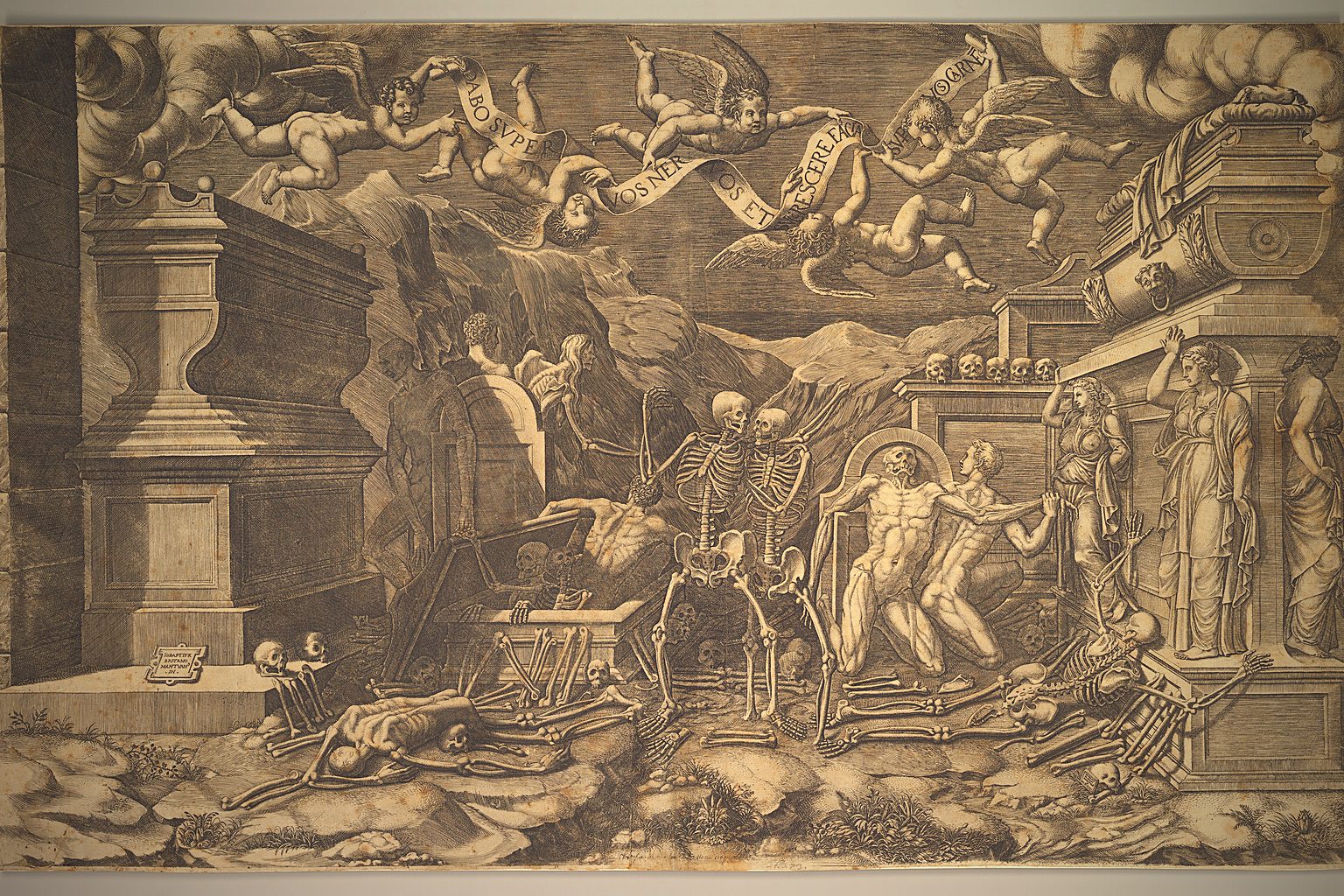
In 593 BC, a deported Judean priest sitting beside an irrigation canal in Babylon saw something come out of the north, and spent the rest of his life trying to describe it. What he wrote down is now known as Ezekiel’s wheel.
He was not a poet by trade. He was a priest — trained in measurement, materials and procedure, a man whose profession was precision about physical things. And the account he produced is one of the strangest passages in all ancient literature, not because it is vague, but because it is relentlessly specific while insisting at every turn that language is failing.
Read Ezekiel 1 carefully and you notice the tic. The text says the likeness of, the appearance of, as it were, as the colour of — over and over. He is not telling you what he saw. He is telling you what it resembled, because he has no vocabulary for the thing itself.
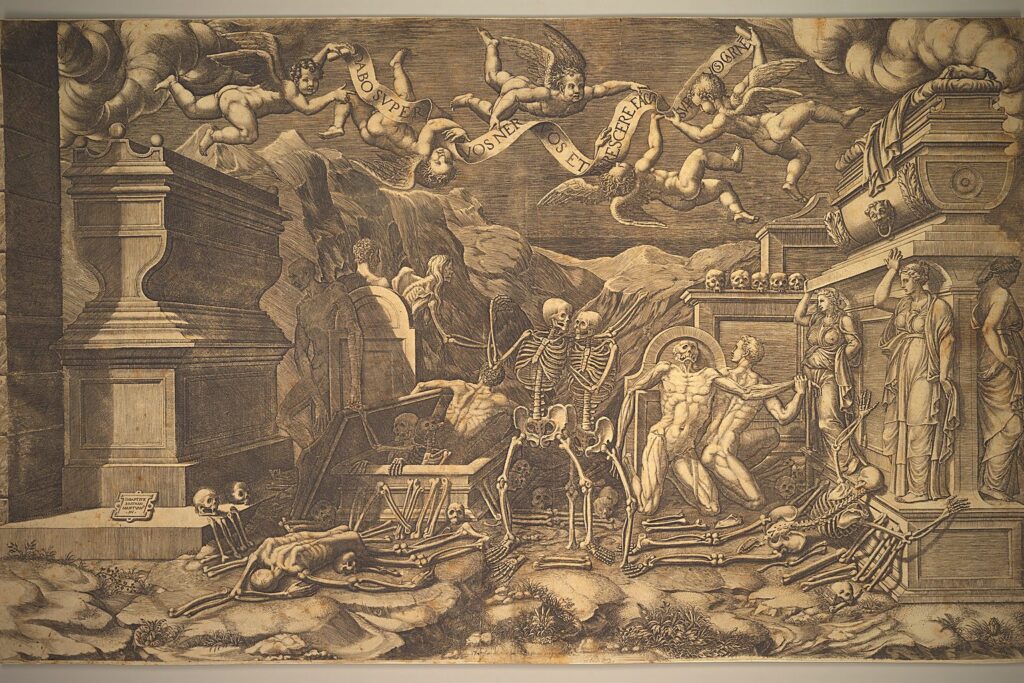
What Is Ezekiel’s Wheel?
Ezekiel’s wheel is the object described in Ezekiel 1:15-21, appearing beside four living creatures in the prophet’s vision by the river Chebar in Babylon. He describes it as “a wheel in the middle of a wheel” — four wheels, one beside each creature, with rims “full of eyes round about.”
Their defining property is how they move: they travel in any of four directions without turning, they rise from the earth with the creatures, and they are synchronised with them because “the spirit of the living creature was in the wheels.”
The whole assembly — creatures, wheels, and the throne above them — is known in Jewish tradition as the Merkabah, the divine chariot.
The Text, Read Slowly
“Now as I beheld the living creatures, behold one wheel upon the earth by the living creatures, with his four faces. The appearance of the wheels and their work was like unto the colour of a beryl: and they four had one likeness: and their appearance and their work was as it were a wheel in the middle of a wheel.” (Ezekiel 1:15-16)
Four separate details are packed into that, and each one is doing work.
“The colour of a beryl.” Beryl — Hebrew tarshish — is a translucent stone, typically pale green or blue-green, with a glassy lustre. He is describing something that is not opaque, not metallic in the ordinary sense, but vitreous.
“A wheel in the middle of a wheel.” Two interpretations dominate: concentric rings, one inside the other; or two wheels intersecting at right angles, forming a gyroscope-like arrangement. The second reading is favoured by many commentators precisely because it explains the next detail.
“They turned not when they went.”
“When they went, they went upon their four sides: and they turned not when they went.” (Ezekiel 1:17)
This is the line that should stop you. An ordinary wheel can only travel along the axis it faces; to change direction, it must rotate. Ezekiel is describing a wheel that changes direction without reorienting — motion along four axes from a fixed body attitude.
That is a real engineering problem with a real solution, and the solution is recent. Omni-wheels and Mecanum wheels — designs with rollers set around the circumference — allow a vehicle to move sideways, diagonally or rotate in place without changing which way it points. They were patented in the 1970s. Two intersecting perpendicular wheels is, functionally, the crudest possible description of the same idea.
“Full of eyes.”
“As for their rings, they were so high that they were dreadful; and their rings were full of eyes round about them four.” (Ezekiel 1:18)
The Hebrew word ayin means both eye and spring or source — and in some contexts, simply appearance or gleam. So the rims may be covered in watching eyes, or studded with points of light, or faceted so that they glitter. Ancient and modern commentators split on this, and the Hebrew genuinely permits all three.
The Four Living Creatures
The wheels do not appear alone. Each is beside one of four creatures, and Ezekiel describes them in detail:
- Each has four faces — a man, a lion, an ox, and an eagle (Ezekiel 1:10)
- Each has four wings, two spread upward and two covering the body
- Their feet are “straight” with soles like a calf’s hoof, and they gleam “like the colour of burnished brass”
- They move “straight forward” and do not turn as they go
- Between them move “burning coals of fire… and the fire was bright, and out of the fire went forth lightning”
In Ezekiel 10, the prophet identifies them explicitly: “This is the living creature that I saw under the God of Israel by the river of Chebar; and I knew that they were the cherubim.” (Ezekiel 10:20)
So the creatures are cherubim — the same class stationed at Eden and formed in gold on the Ark of the Covenant. The four faces correspond to the four domains of living things: humanity, wild beasts, domesticated animals, and birds. The assembly carries a representation of all created life.
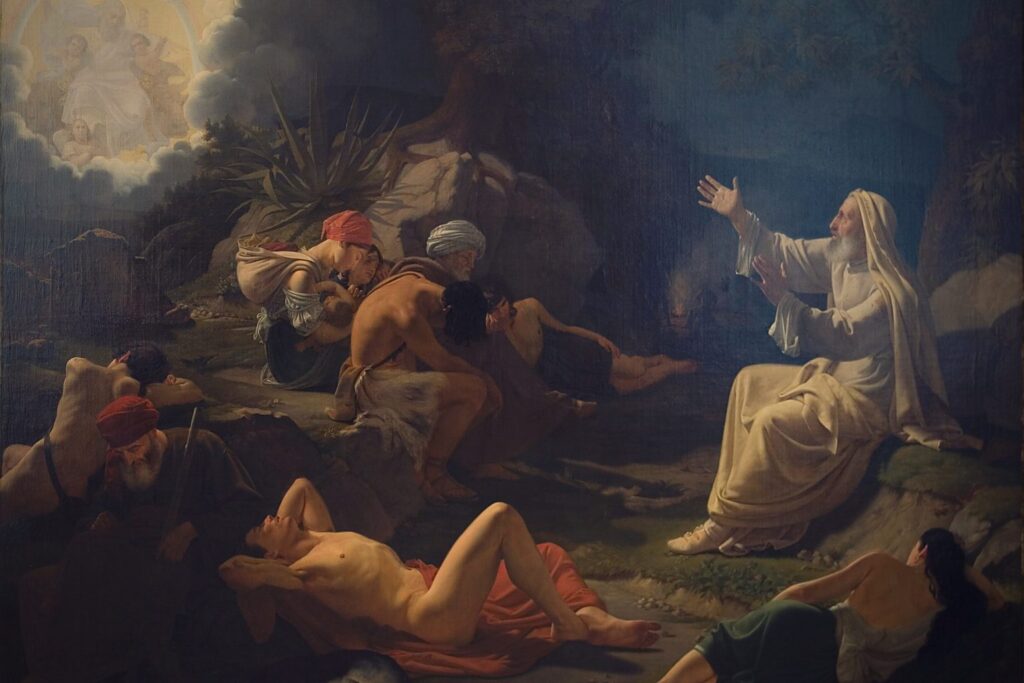
Above the Wheels: The Firmament and the Throne
The vision is built in layers, and the structure is deliberate:
| Level | What Ezekiel describes | Reference |
|---|---|---|
| Ground | The wheels, beryl-coloured, rims full of eyes | 1:15-18 |
| Lower | Four living creatures, four faces, four wings | 1:5-14 |
| Middle | A firmament “as the colour of the terrible crystal” stretched over their heads | 1:22 |
| Upper | A throne, “as the appearance of a sapphire stone” | 1:26 |
| Highest | “The likeness as the appearance of a man” upon it, amber and fire | 1:26-27 |
The word translated firmament is raqia — the same word used in Genesis 1 for the expanse separating the waters. Here it is “as the colour of the terrible crystal”: a transparent barrier, stretched over the creatures, with the throne above it.
And then Ezekiel does something no other biblical writer does. He describes the glory of God — and immediately retreats four layers of qualification:
“This was the appearance of the likeness of the glory of the LORD.” (Ezekiel 1:28)
The appearance of the likeness of the glory. Not God. Not even God’s glory. The likeness of the appearance of it. He is stacking disclaimers because he knows the description is inadequate and he refuses to overclaim.
He then falls on his face.
Three Ways to Read Ezekiel’s Wheel
1. Theological Vision
The mainstream scholarly reading. Ezekiel is writing to exiles who believe their God is territorially bound to a temple that has just been destroyed. The vision’s whole point is mobility: God’s throne has wheels. He is not confined to Jerusalem. He can move — and He has come to Babylon.
The four faces represent the totality of creation. The eyes represent omniscience. The wheels represent omnipresence. On this reading, the strangeness is theological compression, not machinery.
This reading has the strongest claim, because it fits the historical moment exactly and explains why the vision was given at all.
2. The Merkabah Tradition
In Jewish mysticism, Ezekiel 1 became the foundation of Merkabah (“chariot”) literature — a body of texts describing the ascent of the soul through heavenly palaces toward the throne.
The rabbis treated the chapter as dangerous. The Mishnah (Hagigah 2:1) restricts teaching Ma’aseh Merkabah, the Work of the Chariot, to a single student at a time, and only if that student is already wise enough to understand it unaided. Almost nothing else in Scripture carries a restriction like that.
3. The Technological Reading
Popularised in 1968 by Erich von Däniken, and given an engineering treatment in 1974 by Josef F. Blumrich, a NASA engineer who worked on the Saturn V programme. Blumrich set out to disprove von Däniken and instead wrote The Spaceships of Ezekiel, arguing the text describes a landing craft with a helicopter-like body and omnidirectional wheeled undercarriage.
Blumrich’s credentials were real. His conclusions were not adopted by engineers or by biblical scholars, and the book has been criticised for selecting the details that fit and reinterpreting those that do not. But he identified the one genuinely hard problem correctly: the wheels’ motion is mechanically specific, and the specification is coherent.
What Makes This Passage Different
Plenty of ancient texts describe gods and monsters. Very few describe mechanisms.
Compare Ezekiel to the rest of the prophetic literature. Isaiah sees the Lord high and lifted up, and seraphim with six wings. Daniel sees a throne of fiery flame with wheels of burning fire. Both are awe-struck and impressionistic.
Ezekiel gives you materials (beryl, burnished brass, crystal, sapphire, amber), geometry (a wheel within a wheel, four sides, four faces), kinematics (they turned not when they went; when the creatures rose, the wheels rose beside them), and a control principle (the spirit of the living creature was in the wheels).
That is not the vocabulary of religious awe. It is the vocabulary of someone describing an object — and struggling, because he is reaching for comparisons from a world of carts and looms and temple furnishings.
The honest conclusion is not that Ezekiel saw a spacecraft. It is that whatever he saw, he reported it the way a technically-minded observer reports an unfamiliar system: by material, by shape, by how it moved, and by what it was connected to. That pattern recurs throughout the biblical record — the Ark given as a materials specification, the New Jerusalem given as dimensions, Noah’s Ark given as a hull ratio.
Where Else the Wheels Appear
Ezekiel’s wheels are not isolated. Two other passages connect.
Daniel 7:9 describes the Ancient of Days on a throne “like the fiery flame, and his wheels as burning fire.” A throne with wheels, again.
Revelation 4:6-8 describes four living creatures around the throne — but redistributes the faces. In Ezekiel each creature has all four faces; in Revelation each of the four is one face: a lion, a calf, a man, an eagle. And these have six wings, like Isaiah’s seraphim, and are “full of eyes within.”
The eyes migrate. In Ezekiel they are on the wheels; in Revelation they are on the creatures. Whether that is development of a tradition or two views of the same arrangement is exactly the kind of question the text does not settle.
Frequently Asked Questions
What is a wheel within a wheel in Ezekiel?
Ezekiel 1:16 describes each wheel as “a wheel in the middle of a wheel.” The two main readings are concentric rings, one inside the other, or two wheels intersecting at right angles — an arrangement that would explain why they could move in four directions without turning.
What do the wheels in Ezekiel’s vision mean?
In the mainstream theological reading they signify God’s mobility and omnipresence — the throne is not fixed to Jerusalem but can move, which is the message the exiles in Babylon needed. The eyes on the rims are generally read as omniscience.
Was Ezekiel’s wheel a UFO?
That interpretation was popularised by Erich von Däniken in 1968 and developed by NASA engineer Josef Blumrich in 1974. It is not accepted by biblical scholars or engineers. What is unusual, and genuinely hard to dismiss, is that the text describes a specific and coherent mode of motion rather than simply describing glory.
What are the four faces in Ezekiel’s vision?
A man, a lion, an ox and an eagle (Ezekiel 1:10). They are generally understood to represent the four domains of living creatures: humanity, wild animals, domesticated animals and birds.
What is the Merkabah?
The Hebrew word for chariot, used for the whole assembly of creatures, wheels and throne in Ezekiel 1. It became the basis of Merkabah mysticism, a Jewish tradition of visionary ascent that the Mishnah restricted to teaching one student at a time.
Who were the living creatures in Ezekiel 1?
Ezekiel identifies them himself in Ezekiel 10:20 — they are the cherubim, the same class of being stationed at the entrance to Eden and represented in gold on the Ark of the Covenant.
Where and when did Ezekiel see the vision?
By the river Chebar, an irrigation canal in Babylonia, in the fifth year of King Jehoiachin’s exile — around 593 BC. Ezekiel was a deported priest living among the Judean exiles.
What does “the spirit of the living creature was in the wheels” mean?
Ezekiel 1:20-21 uses the phrase to explain why the wheels move in perfect synchronisation with the creatures, rising when they rise and stopping when they stop. The wheels are not towed; they and the creatures form a single system under one control.
Conclusion: A Priest Without Words
The most revealing thing about Ezekiel 1 is not the wheels. It is the grammar.
A man who spent his life among precisely specified objects — cubits of cloth, weights of gold, exact temple measurements — is reduced to saying the appearance of the likeness of. Four qualifiers deep, and still unwilling to claim he had described it.
That is not what invention sounds like. Someone constructing a vision for theological effect does not hedge; he asserts. Ezekiel hedges on every line, and then gives you the beryl and the brass and the crystal anyway, because the details are what he has.
He saw something come out of the north with a whirlwind and a great cloud. He wrote down the colour of the material, the geometry of the structure, and the way it moved. Then he fell on his face.
Two and a half thousand years later, we have the vocabulary he lacked for at least one part of it — the wheel that changes direction without turning. We still do not have a vocabulary for the rest.
Continue Reading
- The Hierarchy of Angels: Ranks of the Invisible Realm — Seraphim, cherubim, ophanim, archangels – what Scripture actually names, how the nine choirs were assembled centuries…
- Biblical Prophecies That Came True — and the Test That Sorts Them — Four questions decide whether a prophecy can be checked at all. Tyre, Cyrus, the temple and one that failed outright…
- Aliens and the Bible: Every Passage People Cite — Scripture is full of non-human intelligences – that is not in dispute. The real question is whether ‘extraterrestrial’…