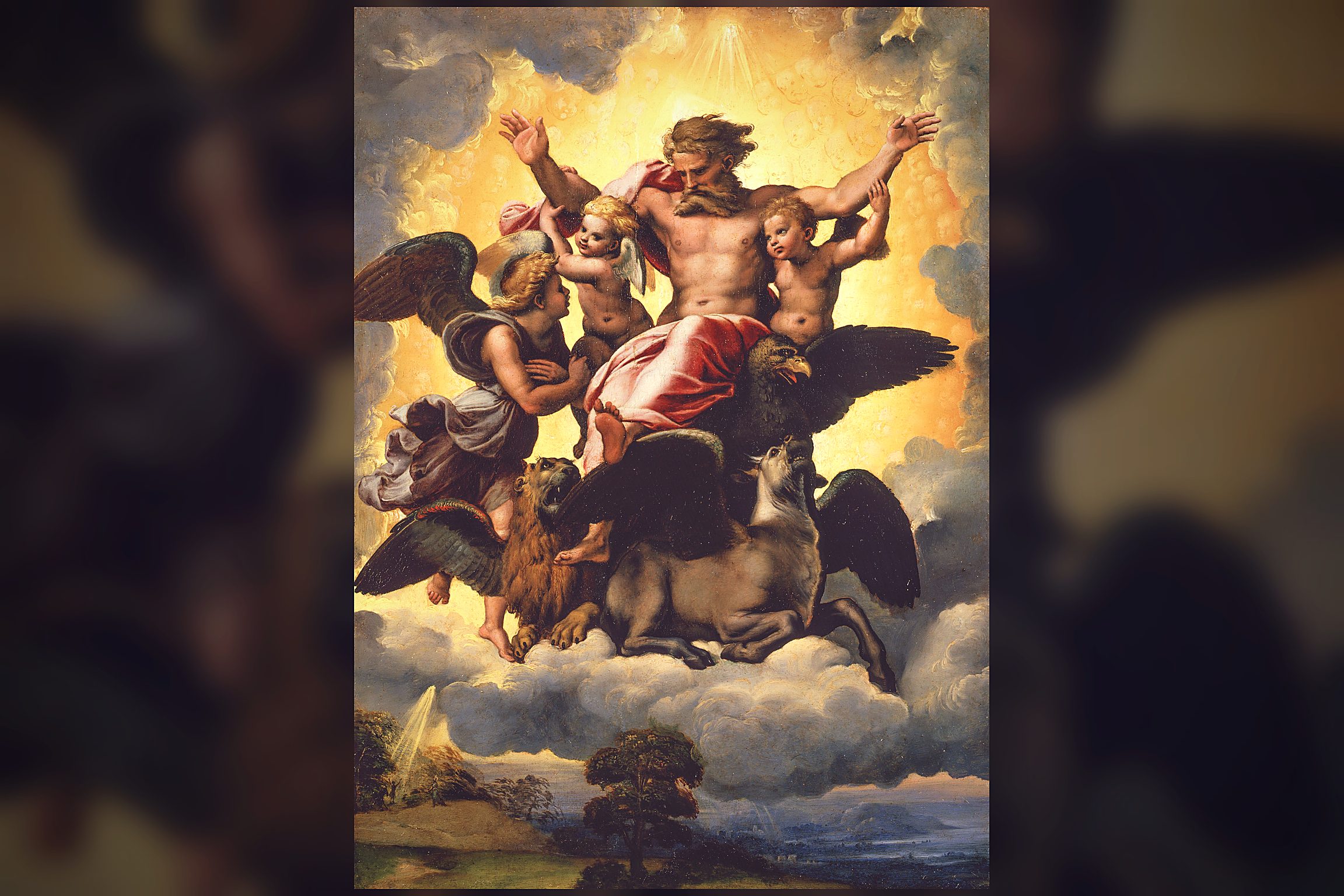
Cherubim appear ninety-one times in sixty-six verses of the Bible — more than any other class of angelic being. What cherubim look like depends on which passage you read.
In Genesis they guard Eden with a flaming sword. In Exodus they are small golden figures on the lid of the Ark, facing each other with outstretched wings. In 1 Kings they are enormous olive-wood statues, fifteen feet tall, spanning the width of Solomon’s Holy of Holies. And in Ezekiel they have four faces, four wings, human hands under their wings, straight legs with the hooves of a calf, and — according to chapter 10 — their entire bodies are covered in eyes.
That is what the Bible describes. What the Renaissance painted is a plump baby with two small wings. The distance between the two is total.
What Do Cherubim Look Like?
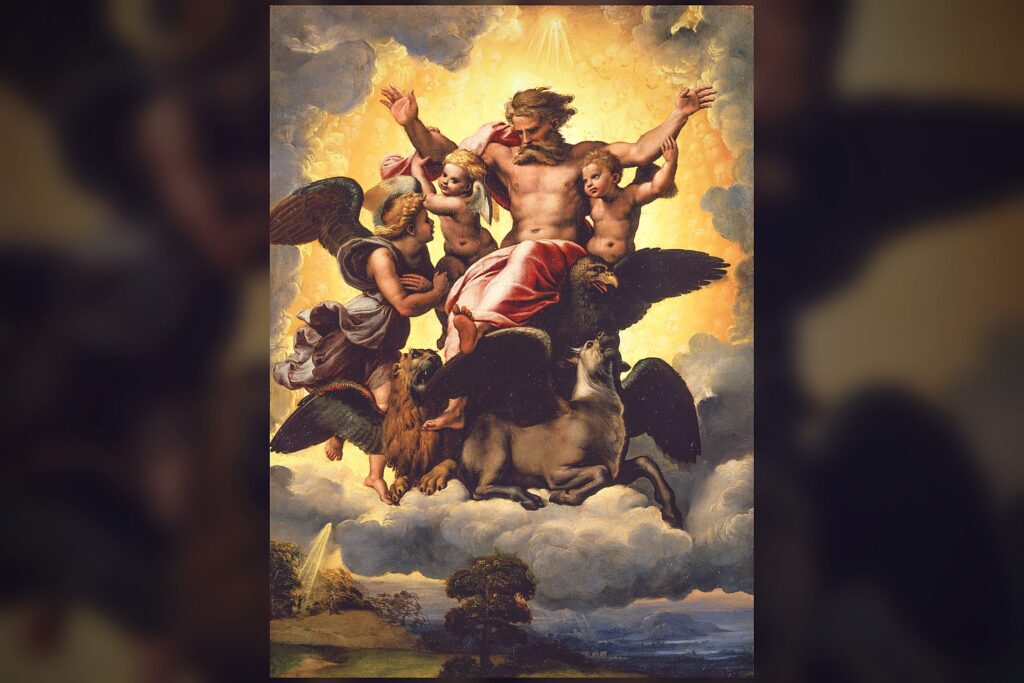
In their most detailed description (Ezekiel 1 and 10), each cherub has four faces — man, lion, ox and eagle — four wings, straight legs with calf-like hooves, and human hands beneath the wings. Their bodies gleam like burnished bronze. Between them move burning coals of fire, bright as torches, with lightning going out among them. They do not turn when they move — they go straight in any direction.
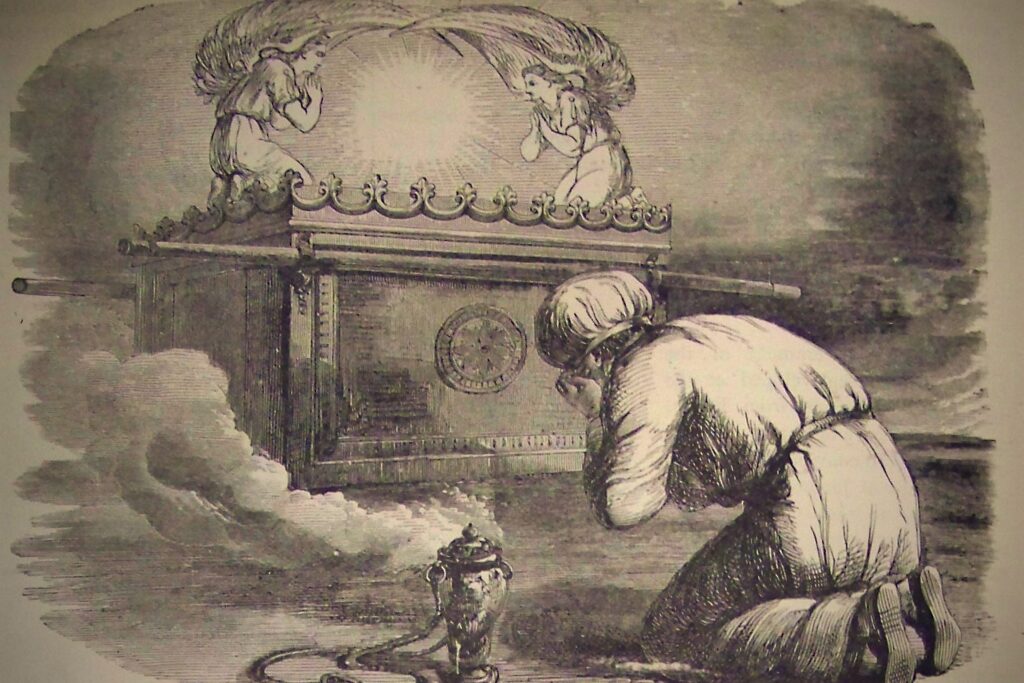
In their simplest form (Exodus 25), they are two gold figures on the mercy seat of the Ark of the Covenant, facing each other with wings spread upward. The text implies a single face and two wings — nothing like Ezekiel’s four-faced beings. The same word covers both.
Every Appearance, and Why They Disagree
Cherubim appear across more than a thousand years of biblical text. The descriptions shift:
| Passage | Setting | Faces | Wings | Eyes | Other |
|---|---|---|---|---|---|
| Genesis 3:24 | Guarding Eden | Not described | Not described | No | With a flaming sword |
| Exodus 25:18-22 | On the Ark | One (implied) | Two | No | Gold, facing each other |
| 1 Kings 6:23-28 | Solomon’s Temple | Not described | Two | No | Olive wood, 10 cubits (4.5 m / 15 ft) high |
| 2 Chronicles 3:13 | Solomon’s Temple | One (implied) | Two | No | Standing on their feet |
| Ezekiel 1:5-14 | Throne vision | Four | Four | No (in ch. 1) | Calf hooves, burnished bronze, human hands |
| Ezekiel 10:12-14 | Temple departure | Four (changed) | Four | Yes — entire body | The face of an ox becomes “the face of a cherub” |
| Ezekiel 41:18-20 | Temple carvings | Two (man and lion) | Not stated | No | Alternating with palm trees |
| Psalm 18:10 | Poetic | Not described | Implied | No | God rides upon a cherub |
The Ark’s cherubim have two wings and one face. Ezekiel’s have four wings and four faces. The carved ones on the restored temple walls have only two faces. These are not minor variations — they describe different configurations of the same class of being.
The word keruv (כְּרוּב) appears to be a broad category rather than a single body plan. The golden figures on the Ark are a stylised, portable representation. Solomon’s statues are monumental guardian forms. Ezekiel’s vision shows the beings in their full supernatural complexity — what the temple art only hints at.
The Four Faces — and the Face That Changed
In Ezekiel 1:10, each living creature has four faces: man, lion, ox and eagle. The four correspond to the four domains of living things — humanity, wild beasts, domesticated animals and birds — and together they carry a representation of all created life before the throne.
In Ezekiel 10:14, the same beings are identified as cherubim, and the list changes. The face of an ox becomes “the face of the cherub.”
Three explanations have been proposed, and none has settled the question:
The Greek translators dropped it. The Septuagint omits Ezekiel 10:14 entirely, suggesting the translators found the verse problematic or considered it a later addition.
“Cherub” meant “ox.” If keruv derives from Akkadian kāribu — a term associated with bull-like guardian figures — then “the face of a cherub” is the face of an ox stated differently. The colossal winged bulls at Assyrian gates were one form of the kāribu tradition.
The ox was removed because of the golden calf. A later editor may have replaced “ox” with “cherub” because the calf face had become associated with the idolatry at Sinai. A cherub who looks like a calf was theologically uncomfortable, and the substitution sanitised it.
The early church fathers took the four faces as symbols of the four Gospels. Jerome’s mapping — Matthew as the man, Mark as the lion, Luke as the ox, John as the eagle — became the standard in Western art and liturgy. At least four church fathers proposed four different mappings, and there are twenty-four possible arrangements. The Bible assigns none of them.
Full of Eyes: What the Text Actually Says
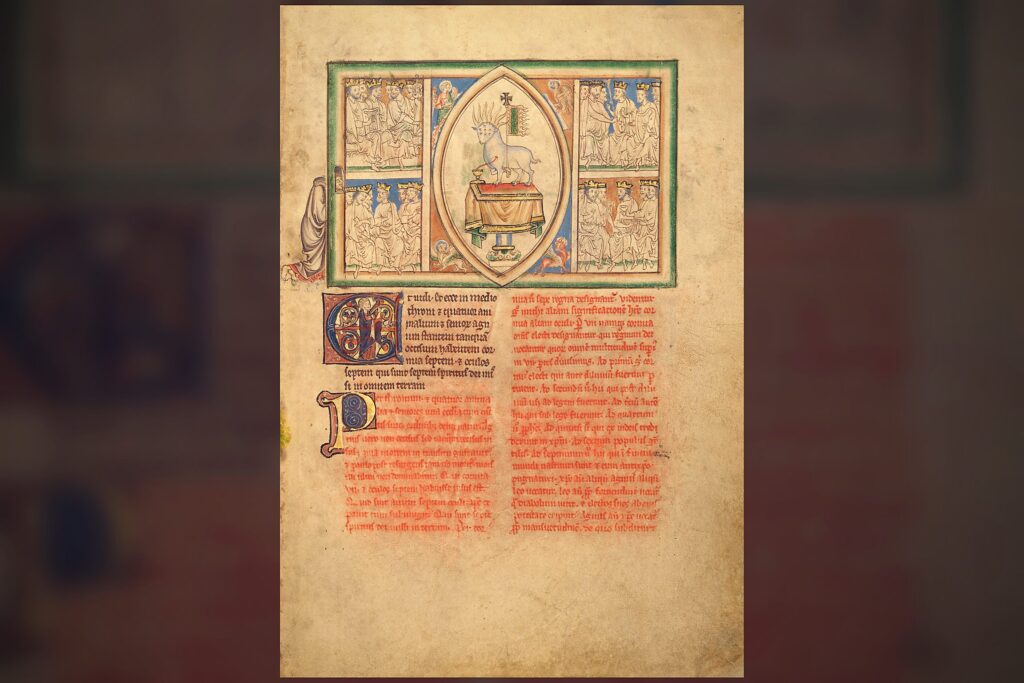
The “full of eyes” image is one of the most recognisable features of the “biblically accurate angel.” But the text is more precise than the meme, and the precision matters.
Ezekiel 1:18 — Only the wheels (ophanim) have eyes: “As for their rings, they were so high that they were dreadful; and their rings were full of eyes round about them four.” The Hebrew gabbehem refers specifically to the rims of the wheels. The cherubim’s bodies are not mentioned.
Ezekiel 10:12 — Now both the cherubim and the wheels have eyes: “And their whole body, and their backs, and their hands, and their wings, and the wheels, were full of eyes round about.” Between chapter 1 and chapter 10, the eyes spread from the wheels to everything — the cherubim’s entire anatomy. The Cambridge Bible notes that the Septuagint omits the phrase about bodies, adding textual uncertainty to the most striking detail.
Revelation 4:6-8 — The four living creatures are “full of eyes in front and behind” and “full of eyes all around and within” — both external and internal. They also have six wings (like Isaiah’s seraphim) and say “Holy, holy, holy” (like the seraphim). John’s vision combines the cherubim of Ezekiel with the seraphim of Isaiah into a single image.
The Hebrew word translated “eyes” — ayin (עַיִן) — also means “spring” or “gleam.” The rims may have been covered in watching eyes, or studded with points of light, or faceted so that they glittered. The Hebrew permits all three readings. What arrived in the memes was the first one only.
The Covering Cherub: Ezekiel 28 and the Fall
Ezekiel 28:14-16 addresses the King of Tyre, but the language exceeds any human ruler:
“Thou art the anointed cherub that covereth; and I have set thee so: thou wast upon the holy mountain of God; thou hast walked up and down in the midst of the stones of fire. Thou wast perfect in thy ways from the day that thou wast created, till iniquity was found in thee.” (Ezekiel 28:14-15)
The Hebrew hasokek means “to screen, to cover over, to protect.” It is the same verb used for the cherubim who cover the mercy seat of the Ark with their wings. The “anointed cherub who covers” held the heavenly equivalent of that role: the living counterpart of the golden figures that stood over God’s earthly throne.
The passage says this being was “in Eden, the garden of God,” was “on the holy mountain of God,” walked “in the midst of fiery stones,” and was perfect until iniquity was found in him. If this being was a cherub — the class that guards the throne, covers the mercy seat and forms the divine chariot — then the rebellion of the angels was led by the highest-ranking guardian in existence. Not an outsider. The one closest to what he betrayed.
What Ancient Art Actually Shows
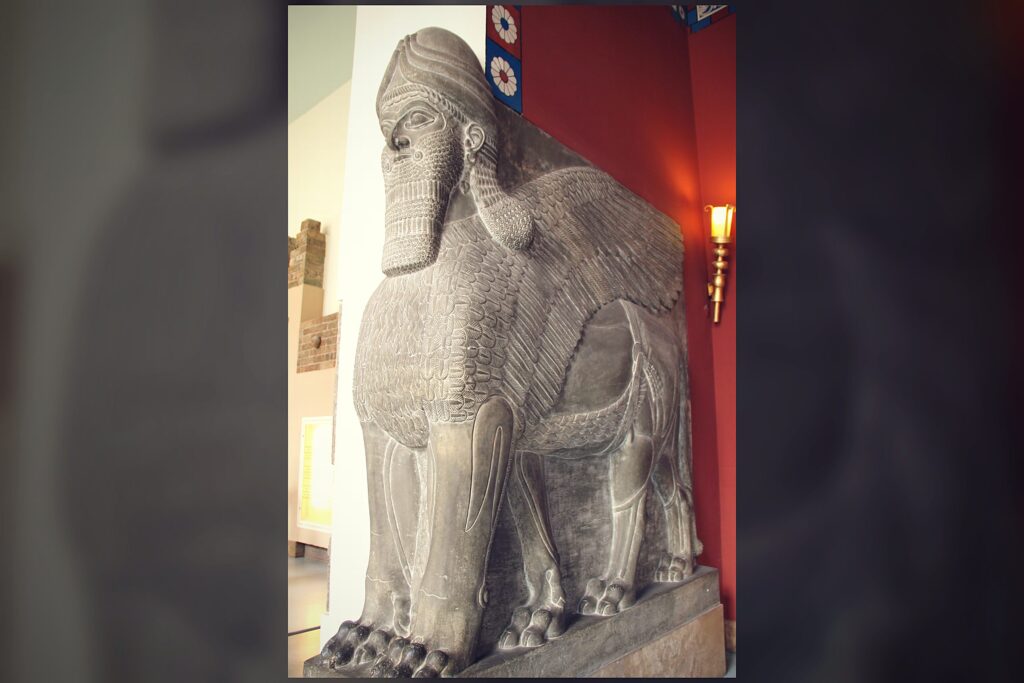
The word keruv almost certainly derives from the Akkadian kāribu — “one who prays,” “intercessor” — from the verb karābu, meaning “to bless.” The kāribu were divine beings who stood before the gods and interceded on behalf of worshippers. The Chicago Assyrian Dictionary classifies it more conservatively as an adjective describing a deity in a gesture of adoration, but the connection is broadly accepted.
The physical evidence is substantial. In the ancient Near East, divine guardians at thresholds and thrones took the form of composite creatures:
- The Ahiram Sarcophagus (Byblos, late second millennium BC) — the king seated on a throne flanked by winged sphinxes
- The Megiddo Ivories (13th-12th century BC) — carved sphinxes and griffins from Canaanite Megiddo, in the heart of ancient Israel’s territory
- The Samaria Ivories (9th-8th century BC) — winged beings with Egyptian crowns from the palace of the northern kingdom
- The Eshmun Temple (Sidon) — a marble throne bearing an inscription that identifies the flanking figures as “the throne of the cherubim.” The figures are sphinxes. Roughly a dozen similar thrones have been found at Phoenician temples
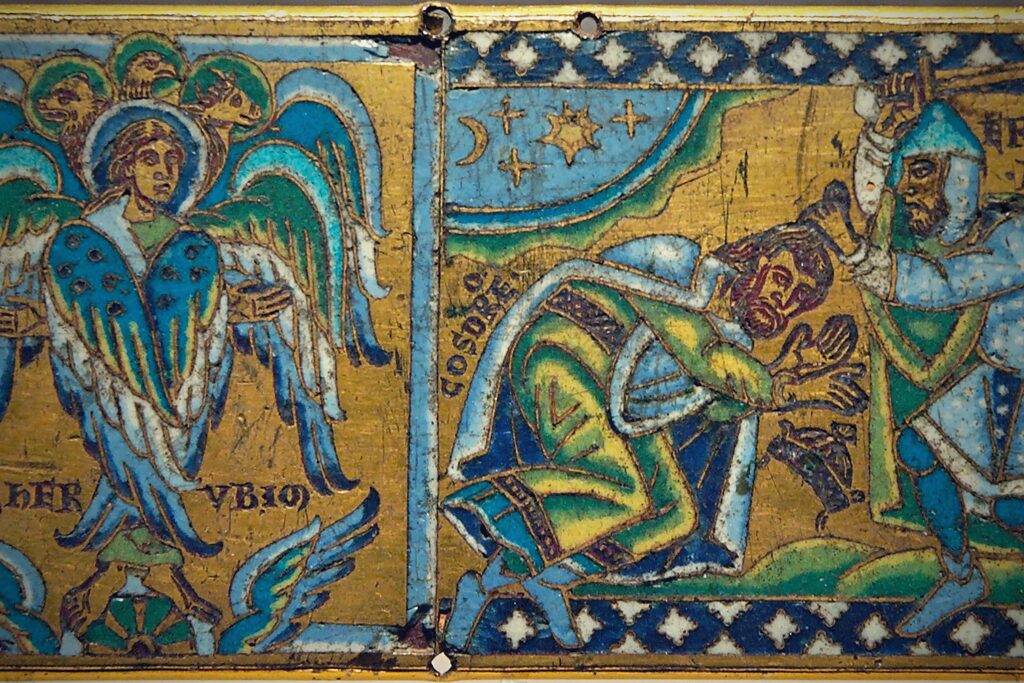
When the Bible describes God as “enthroned upon the cherubim” (Psalm 80:1, 99:1), the original audience knew what that looked like. It looked like a royal throne flanked by winged guardian creatures — a form they carved, traded and displayed. The claim was not that God sat on a chair. It was that the real throne, the one in heaven, was the original, and every earthly throne was a copy.
The Baby Angel Myth
The Renaissance cherub — a plump, winged baby, often bare — has nothing to do with the Bible. It comes from the fusion of three unrelated traditions:
The Talmudic child-face. Rabbi Abahu (Hagigah 13b) derived the word keruv from the Aramaic ke-ravya — “like a child.” Rashi adopted it, stating the cherubim had “the form of a child’s face.” This is almost certainly a folk etymology rather than a linguistic one, but it shaped Jewish art and commentary for centuries.
The Greco-Roman putto. Classical art used winged child figures — putti — as attendants of Eros. They represented playfulness and the erotic, not the divine.
The Renaissance merger. When Renaissance artists revived classical forms within Christian contexts, the putto lent its body to the cherub. Raphael’s Sistine Madonna [1] (1513-1514) placed two small winged figures at the bottom of the composition, added late for visual balance. They are the smallest figures in the painting. They became the most famous “cherubs” in Western art — and the least biblical.
The disconnect is total. A biblical cherub has four faces, multiple wings, hooves, eyes covering every surface of its body, and a voice like a waterfall. It guards the entrance to Paradise with a weapon, carries the throne of God through the sky, and shakes the earth when it moves. A Renaissance cherub has a round face and a bottom.
God’s Living Throne: The Merkabah
“He rode upon a cherub, and did fly: yea, he did fly upon the wings of the wind.” (Psalm 18:10)
Cherubim are not only guardians — they are God’s transport. Psalm 18:10 describes God riding a single cherub. 1 Chronicles 28:18 names the arrangement explicitly: “the chariot (merkavah) of the cherubim that spread their wings and covered the ark.” That verse is the only place in the Bible where the word merkavah — chariot — is applied to the cherubim.
It became the foundation of an entire branch of Jewish mysticism. The Merkabah tradition treats Ezekiel’s vision as its primary text: the four cherubim carrying the firmament, the throne above them, the glory seated upon it. The Mishnah (Hagigah 2:1) restricts teaching the Merkabah to one student at a time, and only if the student is already wise enough to understand it alone. Almost nothing else in Scripture carries a restriction like that.
The Songs of the Sabbath Sacrifice, found in ten copies at Qumran and one at Masada (dated to about 100 BC), show the tradition was already old by the time of the Dead Sea Scrolls. The fragments describe cherubim blessing “the image of the throne-chariot above the firmament” — using language taken directly from Ezekiel. By the first century BC, Jews were composing prayers as though they were standing in the throne room, participating in the angelic worship.
The Talmud (Yoma 54a) preserves a tradition about the two cherubim on the Ark. When Israel obeyed God, the two figures faced each other, their wings touching. When Israel disobeyed, they turned away. During the pilgrimage festivals, the priests would roll back the curtain and show the people the cherubim embracing — me’orim zeh bazeh — and say: “Your love before God is like the love between a man and a woman.”
Maimonides, writing in the twelfth century, placed cherubim ninth out of ten angelic orders — second from the bottom, above only the Ishim. In his system, the Chayot HaKodesh — the living creatures of Ezekiel 1 — rank highest, separated from the cherubim even though Ezekiel 10:20 identifies them as cherubim. Maimonides appears to distinguish the visionary cherubim of Ezekiel from the decorative cherubim of the Ark and ranks only the latter.
Sources
- Sistine Madonna — en.wikipedia.org/wiki/Sistine_Madonna
Frequently Asked Questions
What do cherubim look like according to the Bible?
The fullest description is in Ezekiel 1 and 10: each has four faces (man, lion, ox and eagle), four wings, straight legs with the hooves of a calf and human hands under the wings. Their bodies gleam like burnished bronze and are covered in eyes (Ezekiel 10:12). The cherubim on the Ark of the Covenant are simpler — two gold figures with one face and two wings each.
Why do cherubim have four faces?
The four faces — man, lion, ox and eagle — represent the four domains of living creatures: humanity, wild animals, domesticated animals and birds. Together they carry a representation of all created life before the throne of God.
Are cherubim really baby angels?
No. The baby-angel image comes from Renaissance art, where Greco-Roman putti were merged with the biblical cherub. Biblical cherubim are enormous, multi-faced composite beings. The Talmudic tradition that cherubim had “the face of a child” referred to the face alone, not the body, and is considered a folk etymology.
What is the covering cherub in Ezekiel 28?
Ezekiel 28:14 describes “the anointed cherub who covers” — a being on the holy mountain of God who was perfect until iniquity was found in him. The traditional reading identifies this as Satan before his fall. The “covering” role is the same verb used for the cherubim who cover the mercy seat of the Ark — the most intimate guardian position.
Where are cherubim mentioned in the Bible?
Cherubim appear in Genesis (guarding Eden), Exodus (on the Ark), 1 Kings and 2 Chronicles (in Solomon’s Temple), Ezekiel 1, 10, 28 and 41 (the throne vision, the covering cherub, the temple carvings), the Psalms (God enthroned upon them) and Hebrews 9:5 — the single New Testament mention, referring back to the Ark.
What changed between Ezekiel 1 and Ezekiel 10?
In chapter 1, only the wheels have eyes; in chapter 10, the cherubim’s bodies have them too. In chapter 1, the four faces are man, lion, ox and eagle; in chapter 10, “the face of a cherub” replaces the ox. The Septuagint omits the verse with the face change entirely, suggesting the Greek translators found it problematic.
Are cherubim and seraphim the same?
No. Seraphim appear only in Isaiah 6 and have six wings. Cherubim appear throughout the Bible with four wings and four faces. The four living creatures of Revelation 4 combine features of both — six wings from the seraphim and four faces from the cherubim — which is the main source of the confusion.
What does the word “cherub” mean?
The most widely accepted etymology connects the Hebrew keruv to the Akkadian kāribu, meaning “one who prays” or “intercessor,” from the verb karābu (to bless). The Talmudic interpretation ke-ravya (“like a child”) is a folk etymology that influenced art but is not linguistically sound.
What the Descriptions Keep Doing
The Bible’s cherubim change shape across a thousand years of text. The golden figures on the Ark are small enough to fit on a box lid. The olive-wood statues in Solomon’s Temple are fifteen feet tall. Ezekiel’s living creatures are so large and so strange that the prophet spends two full chapters trying to render them in words, and even then he hedges — “the likeness of,” “the appearance of,” over and over.
But one thing does not change. In every passage, the cherubim are where God is. They guard the tree. They stand on the lid of the Ark where God says He will meet Moses. They fill Solomon’s Holy of Holies. They carry the throne through Ezekiel’s sky. They attend the throne in the Psalms.
The form shifts. The position does not. Whatever cherubim are, the Bible stations them at every door, on every lid, under every throne — wherever the presence dwells and wherever it moves. The entrance to Paradise, the meeting point on the Ark, the chariot that carries the glory. The form can have four faces or two or none described at all. What it always has is a threshold to guard and a presence to carry.
Continue Reading
- What Do Thrones Look Like? The Bible’s Wheel Within a Wheel — The Bible never describes a being called a throne. What it describes are ophanim — wheels of translucent stone, rims…
- What Do Angels Look Like? Men More Often Than Wings — Abraham fed three of them and took them for travellers. Daniel saw one and lost his strength. The Bible describes…
- Ezekiel’s Wheel: The Vision a Priest Had No Words For — A wheel in the middle of a wheel, rims full of eyes, moving in four directions without turning. What Ezekiel 1 actually…