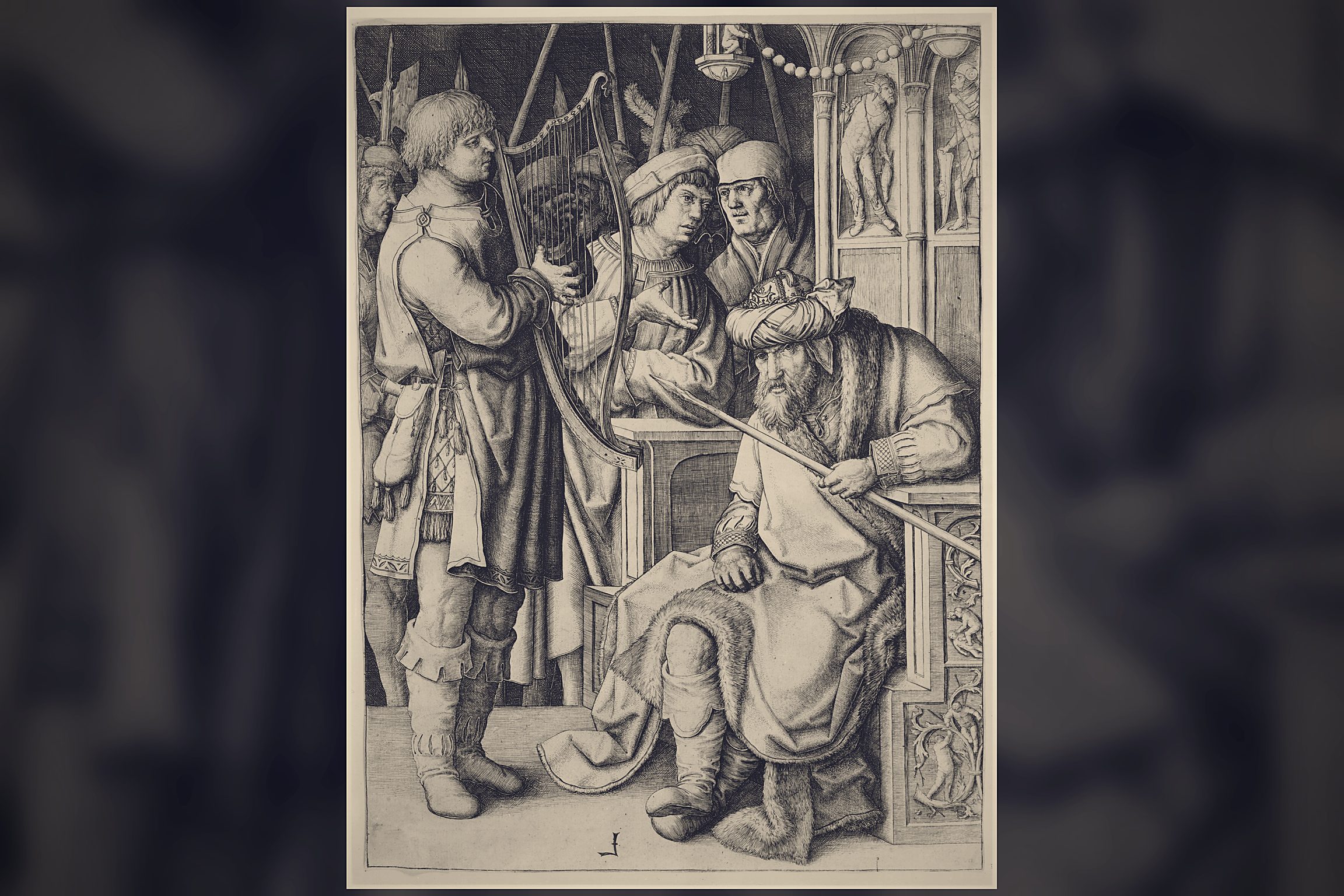
The first case of demonic possession in the Bible is not in the Gospels. It is in 1 Samuel, and what makes it strange is the phrase that introduces it: the Spirit of the Lord departed from Saul, and an evil spirit from the Lord troubled him (1 Samuel 16:14). A spirit leaves, and a spirit arrives, and both are described as coming from the same source.
That is the opening move in a subject the Bible treats in more detail than almost any other supernatural phenomenon. From Saul’s throne room to the tombs of Gerasa to a house in Ephesus where seven men fled naked and bleeding, the texts describe entities entering people, being expelled, and — in one of the most unsettling teachings Jesus gave — coming back.
Demonic Possession in the Old Testament
The Hebrew Bible does not use the language of possession the way the New Testament does. There is no Hebrew equivalent of the Greek daimonizomai — “to be under the power of a demon” — which appears thirteen times in the Synoptic Gospels. What the Old Testament has instead is a vocabulary of spirits sent, spirits dwelling, and sacrifices offered to entities that are not God.
The Evil Spirit on Saul
The fullest account is Saul’s. Three separate passages describe it:
1 Samuel 16:14–23. After God’s Spirit departs, an evil spirit from the Lord “troubles” Saul. His servants recognise the condition and prescribe music. David is brought to play the harp, and the text says plainly: the evil spirit departed from him (16:23). The same verb used later for demons being expelled in the Gospels — departure, not cure.
1 Samuel 18:10–11. The evil spirit comes upon Saul again, and he “prophesied in the midst of the house” — the Hebrew yitnabbe can mean ecstatic utterance rather than true prophecy. While in this state, he hurls a spear at David twice.
1 Samuel 19:9–10. It happens a third time. Again the evil spirit, again the spear thrown at David as he plays.
What makes the Saul account theologically difficult is the phrase from the Lord. The text does not say God merely permitted it; it says the spirit was from God. Commentators have debated this for centuries. Some read it as God actively sending an afflicting spirit, others as God withdrawing protection and allowing a spirit to come, and others as the Hebrew idiom attributing all causation to God because nothing happens outside his sovereignty. What no one disputes is the clinical description: a man who alternates between violent episodes and intervals of calm, triggered by a spiritual condition that responds to music.
The Spirit Between Abimelech and Shechem
An earlier, briefer case: God sent an evil spirit between Abimelech and the men of Shechem (Judges 9:23). The result is not possession in the New Testament sense — no one convulses or speaks with another voice — but mutual treachery that leads to destruction. The spirit here acts on relationships rather than on a body.
The Lying Spirit Before Ahab
In 1 Kings 22:19–23, the prophet Micaiah describes a scene in the heavenly court. A spirit volunteers to be a lying spirit in the mouth of all his prophets, and the Lord says, Go out and do so. Ahab’s four hundred prophets then prophesy falsely, and Ahab rides to his death at Ramoth-Gilead. This account describes something close to what the New Testament calls possession — a spirit entering the mouths of men — but the setting is the throne room of God, and the spirit acts with permission.
The Vocabulary of Demons in the Hebrew Bible
The Old Testament does not call these entities “demons” in most translations, but the Hebrew text has two specific words:
Shedim (Deuteronomy 32:17; Psalm 106:37) — usually translated “demons” or “devils”. The Septuagint translates it daimonia, exactly the word the New Testament uses. Deuteronomy 32:17 says Israel sacrificed to demons, not to God, to gods they had not known. Psalm 106:37 says they sacrificed their sons and their daughters to demons.
Se’irim (Leviticus 17:7; 2 Chronicles 11:15) — literally “hairy ones” or “goat-demons”. Israel is forbidden to sacrifice to them, and Jeroboam appoints priests for them alongside his golden calves. The connection to the wilderness is important: these are creatures of the desert, the uninhabited places — exactly where Jesus says an expelled spirit goes to wander.
And then there is Azazel (Leviticus 16:8–10), the name or entity to which the scapegoat is sent on the Day of Atonement. One goat is for the Lord and one is for Azazel, and the parallel construction suggests a personal entity, not merely a place. The Book of Enoch, which is not in most Bibles but is canonical in the Ethiopian Orthodox Tewahedo Church, names Azazel as a fallen angel who taught forbidden knowledge to humanity.
The pattern across the Old Testament is clear: spirits operate, spirits are sent, spirits receive sacrifices — but they do not “possess” people in the full sense the Gospels describe. That distinction appears to shift decisively between the Testaments.
Every Case of Demonic Possession in the Gospels
When the narrative moves to the New Testament, the vocabulary and the clinical detail both change. Luke, whom Paul calls “the beloved physician” (Colossians 4:14), writes with particular care about symptoms and outcomes. Matthew and Mark record the same events in briefer, harder strokes. Between them, the Synoptic Gospels describe at least eight distinct cases. The detail on the method Jesus used — and what made it unlike anything his contemporaries were doing — is covered elsewhere on the site. What matters here is what the accounts reveal about how demons enter, what they do inside, and what happens when they leave.
The Man in the Synagogue at Capernaum (Mark 1:21–28; Luke 4:31–37)
The first recorded exorcism. A man with “an unclean spirit” cries out during Jesus’s teaching: What have we to do with you, Jesus of Nazareth? Have you come to destroy us? I know who you are — the Holy One of God. Two details stand out. The spirit recognises Jesus before any human in the passage does. And it uses the plural us — either speaking for a group or identifying itself with a category.
Mary Magdalene (Luke 8:2; Mark 16:9)
Luke names her among several women who had been “healed of evil spirits and infirmities: Mary, called Magdalene, out of whom went seven demons.” No scene is described, no symptoms are listed, and no connection exists in any Gospel to the later identification with a prostitute — that equation first appears centuries later, in a homily by Pope Gregory I in 591 AD. The number seven, which in Hebrew usage indicates completeness, suggests the severity of the affliction rather than a literal count.
The Gerasene Demoniac (Mark 5:1–20; Matthew 8:28–34; Luke 8:26–39)
The longest and most detailed account. A man living among tombs on the eastern shore of the Sea of Galilee, uncontrollable — chains broken, shackles torn apart, no one strong enough to subdue him. Day and night, crying out and cutting himself with stones.
This is the only case with a sustained dialogue. Jesus asks the spirit’s name: My name is Legion, for we are many (Mark 5:9). A Roman legion at full strength comprised roughly six thousand soldiers; whether the number is literal or metaphorical, the name claims plurality. The spirits then make a request — send us to the pigs — and Jesus permits it. About two thousand pigs rush down the steep bank into the sea and drown.
Three features are unique to this case. First, the sheer number: this is the only time a named multitude of spirits inhabits one person. Second, the negotiation: the spirits ask, are heard, and are granted a specific destination. Third, the aftermath: the locals ask Jesus to leave. Matthew’s version names two demoniacs rather than one, which some scholars attribute to a different source; what is consistent across all three Synoptics is the dialogue, the pigs, and the request to depart.
When the man is found afterwards, he is “sitting, clothed, and in his right mind” (Mark 5:15). The transformation is immediate and total, which is part of what makes the medical readings difficult — neither psychosis nor a dissociative disorder resolves in a single moment.
The Mute Demoniac (Matthew 9:32–34)
After two blind men are healed, a man is brought who is mute and demon-possessed. The demon is cast out and the man speaks. The crowd says, Nothing like this has ever been seen in Israel. The Pharisees say, He casts out demons by the prince of demons. The split verdict matters. It is a hostile concession — the opponents do not deny the event, only the source of the power.
The Blind and Mute Demoniac (Matthew 12:22–28; Luke 11:14–20)
A man who is both blind and mute is brought to Jesus. The demon is cast out, and the man speaks and sees. This is the incident that triggers the Beelzebul accusation and Jesus’s reply about a kingdom divided against itself. It is also where Jesus makes one of his most direct claims about the significance of the exorcisms: If I cast out demons by the Spirit of God, then the kingdom of God has come upon you (Matthew 12:28). Luke’s version has finger of God instead of Spirit of God — an allusion to Exodus 8:19, where Pharaoh’s magicians recognise a power they cannot match.
The Syrophoenician Woman’s Daughter (Mark 7:24–30; Matthew 15:21–28)
The only case where the person being freed is absent. A Gentile woman — Mark calls her Syrophoenician, Matthew calls her Canaanite — begs Jesus to cast a demon out of her daughter. Jesus’s initial response sounds like a refusal: It is not right to take the children’s bread and throw it to the dogs. Her reply — Yes, Lord, yet even the dogs under the table eat the children’s crumbs — is the only case in the Gospels where a person argues with Jesus and is commended for it. He tells her the demon has gone, and when she arrives home, she finds her daughter lying in bed, the demon gone. No word spoken over the child, no physical presence required. Whatever happened, it happened at a distance.
The Boy with the Mute Spirit (Mark 9:14–29; Matthew 17:14–21; Luke 9:37–43)
A father brings his son to the disciples, who cannot help. The description is clinical enough that any neurologist can read it: the boy is thrown to the ground, foams at the mouth, grinds his teeth, becomes rigid, and has repeatedly fallen into fire and water during attacks. The seizure profile matches a tonic-clonic disorder with startling precision. Luke, the physician, is the most careful with the language.
Jesus addresses the spirit as you mute and deaf spirit — naming it by the symptoms it produces rather than by a personal name. When the spirit comes out, the boy looks so lifeless that the crowd says he is dead, and Jesus takes him by the hand and lifts him.
This is the case with the famous coda. The disciples ask privately why they failed. In the earliest manuscripts of Mark, Jesus answers: This kind cannot come out by anything but prayer (Mark 9:29). Many later manuscripts add and fasting, and the addition has its own textual history — some scholars argue the extra words were added by copyists who wanted to emphasise the ascetic disciplines, others that they were removed by copyists uncomfortable with the suggestion that even Jesus needed to fast before a difficult exorcism. The textual evidence is divided, and the question is genuine rather than settled.
The Bent-Over Woman (Luke 13:10–17)
A woman bent double for eighteen years, unable to straighten. Luke calls it a spirit of infirmity — the Greek is pneuma astheneias, literally “a spirit of weakness”. Jesus says she has been bound by Satan for eighteen years and releases her. The word for the release is loosing, the same term used for untying an animal, which is also the word Jesus uses in the argument that follows: Ought not this woman, being a daughter of Abraham, whom Satan has bound for eighteen years, be loosed from this bond on the Sabbath day?
This case is unusual because the condition looks like a medical one — spondylitis, kyphosis, any of several spinal conditions — and because the spirit is described as causing infirmity rather than controlling behaviour. It expands the category: not every spirit-caused condition presents as what most people imagine when they hear the word “possession”.
The Mechanism: How Demons Enter and How They Leave
The texts do not give a systematic manual, but they give more detail than is often noticed. Taken together, the accounts describe a pattern.
Entering
The Gospels never describe a moment of entry the way they describe moments of departure. Nobody witnesses a demon going in. What is described instead is a state — a person has an unclean spirit, or is demonised (the literal meaning of daimonizomai). The Greek phrasing used across the Synoptics varies: echon pneuma akatharton (“having an unclean spirit”), daimonizomenos (“demonised”), and ochloumenos (“troubled” or “vexed”).
The one passage that speaks directly about how a demon enters is the parable of the returning spirit (discussed below), and it says the demon comes back to a house that is empty. That is the key word. Whatever else entry requires, it requires vacancy.
What They Do Inside
The effects described in the Gospels include:
- Loss of speech — the mute demoniac (Matthew 9:32), the mute and deaf spirit in the boy (Mark 9:17)
- Loss of sight — the blind and mute demoniac (Matthew 12:22)
- Superhuman strength — the Gerasene demoniac breaking chains (Mark 5:3–4)
- Self-harm — the Gerasene cutting himself with stones (Mark 5:5), the boy falling into fire and water (Mark 9:22)
- Convulsions and rigidity — the boy foaming, grinding teeth, becoming rigid (Mark 9:18)
- Physical deformity — the woman bent for eighteen years (Luke 13:11)
- Altered voice and personality — the spirits speaking through the possessed person (Mark 1:24, 5:7)
- Supernatural knowledge — the spirits recognising Jesus before any human does (Mark 1:24, Luke 4:34)
The range is wider than popular images of possession suggest. It is not always a screaming figure writhing on the floor. Sometimes it is a woman with a curved spine, or a child who cannot speak, or a man who is simply blind.
Leaving
The departures are described more specifically than the arrivals. Several features recur:
Physical violence at the moment of exit. The spirit at Capernaum convulses the man and cries out with a loud voice before leaving (Mark 1:26). The spirit in the boy throws him into convulsions so severe he looks dead (Mark 9:26). The spirits at Samaria come out “crying with a loud voice” (Acts 8:7). The departure is not quiet.
The spirits speak as they leave. The Capernaum spirit cries out. The Gerasene spirits negotiate. In Acts, the spirits in Samaria shriek. Whatever these entities are, the texts describe them as having voice and will.
Transfer to another host. The Gerasene spirits ask to enter the pigs, and they are permitted to. The request itself is revealing — it implies that being disembodied is worse than inhabiting an animal, and that the spirits prefer any host to none.
Immediate transformation of the person. The Gerasene demoniac is found sitting, clothed, and sane. The boy is lifted to his feet, alive. The bent woman stands straight. The mute speak. The blind see. There is no recovery period described in any account.
The Return of the Unclean Spirit
This is the passage the topic turns on, and the one least discussed relative to its weight. It appears in Matthew 12:43–45 and Luke 11:24–26, and it is the only place where Jesus describes, in his own teaching rather than in a narrative, what a demon does after it leaves.
When the unclean spirit has gone out of a person, it passes through waterless places seeking rest, but finds none. Then it says, “I will return to my house from which I came.” And when it comes, it finds the house empty, swept, and put in order. Then it goes and brings with it seven other spirits more evil than itself, and they enter and live there, and the last state of that person is worse than the first.
Every clause carries weight.
Waterless places. The demon goes to the desert — the same environment the Old Testament associates with the se’irim, with Azazel, with the desolation described in Isaiah 13:21 and 34:14, where satyrs and night creatures dwell. The wilderness in Hebrew thought is the territory of the unclean, the place outside God’s ordered creation. The demon is not destroyed; it is displaced.
Seeking rest, finding none. The demon is uncomfortable without a host. It wants a “house” — the human body is described as a dwelling. This is the detail that opens the question theologians have wrestled with since the patristic era: why do spirits need bodies? What do they gain from inhabiting a person that they lack when they are unhoused?
“My house from which I came.” The possessive pronoun is chilling. The demon calls the person its house. It regards the body as its own property, temporarily vacated.
Empty, swept, and put in order. The house is clean but unoccupied. The person has been freed, perhaps reformed, perhaps outwardly improved — but the space has not been filled with anything that would keep the spirit out. The Greek scholazonta — “empty” or “at leisure” — implies a vacancy, a room that has been tidied but left without a resident. The early church fathers read this as the soul that undergoes external reformation without interior conversion: swept, but not inhabited.
Seven other spirits more evil than itself. The returning spirit does not come alone. It brings reinforcements, and they are worse than it was. The number seven signals completeness — the reoccupation is not partial but total, and it is worse than the original condition.
The last state is worse than the first. Jesus states the outcome as a rule, not an anecdote. The freed person who remains empty is not merely back where they started; they are in a worse position than before the deliverance.
Jesus then applies this to “this evil generation” (Matthew 12:45), which many commentators read as a reference to Israel’s religious reform without genuine repentance — the temple cleaned but the heart unchanged. But the teaching is broader than that application. It describes a mechanism, and the mechanism has no expiration date.
Authority Given, Authority Tested
The story of exorcism in the New Testament does not end with Jesus. He delegates authority, and the delegation itself becomes part of the evidence.
The Twelve
Jesus gives the twelve disciples specific authority over unclean spirits. Mark 3:14–15: he appointed twelve that they might be with him, and that he might send them out to preach, and to have authority to cast out demons. Mark 6:7: he sends them out two by two, giving them authority over unclean spirits. Luke 9:1: he gives them power and authority over all demons.
The authority is not inherent. It is given, specific, and comes with a commission.
The Seventy-Two
Luke 10:1–20 describes a second, larger commissioning — seventy-two others, sent out two by two. When they return, they are jubilant: Lord, even the demons are subject to us in your name! (Luke 10:17). Jesus’s reply is one of the strangest lines in the Gospels: I saw Satan fall like lightning from heaven (10:18) — a vision of the original rebellion in heaven triggered by a report about minor exorcisms in Galilean villages.
But then comes the correction: Nevertheless, do not rejoice in this, that the spirits are subject to you, but rejoice that your names are written in heaven (10:20). The power over demons is real, but it is not the point. The relationship is.
The Failed Exorcism (Mark 9:14–29)
The disciples try to cast a spirit out of the boy with seizures and fail. The failure is public and embarrassing — the scribes are arguing with them about it when Jesus arrives. After Jesus succeeds, the disciples ask privately what went wrong. His answer — this kind can come out only by prayer — implies that there are kinds. Not all spirits are alike. Some require more than a formula.
Philip in Samaria (Acts 8:5–8)
After the scattering of the church following Stephen’s stoning, Philip goes to Samaria and preaches. Unclean spirits come out of many people, crying with a loud voice, and many who were paralysed and lame are healed. The result is great joy in that city. The pattern is the same as Jesus’s exorcisms — authority exercised by someone who has been sent, spirits departing audibly, physical conditions resolved instantly — but now it is being replicated by a man who is not Jesus.
The Sons of Sceva (Acts 19:13–16)
This is the account that tests the boundary of the authority. In Ephesus, seven sons of a Jewish man named Sceva — described as a chief priest, though no high priest of that name appears in any surviving record and the title may be a claim to priestly lineage rather than office — attempt an exorcism using a formula: I adjure you by the Jesus whom Paul preaches.
The spirit’s answer has been analysed for its Greek since the patristic period. Jesus I know, and Paul I know about, but who are you? The two words translated “know” are different: ginosko for Jesus (deep, personal recognition) and epistamai for Paul (knowledge gained by observation, awareness of a figure one has been watching). The spirit ranks them. Then the possessed man attacks all seven, overpowers them, and they flee the house naked and wounded.
The point is not that the formula was wrong. It is that the formula was all they had. They had the words without the relationship, and the spirit — which itself could distinguish between kinds of knowing — was not fooled.
What followed in Ephesus was not embarrassment but fear. Acts 19:17–19 says fear fell on everyone, many believers confessed their practices, and those who had practised magic arts brought their books and burned them publicly. Luke tallies the value of the books at fifty thousand pieces of silver.
What the Accounts Tell Us About the Nature of Demons
Reading the full biblical record together — Old Testament spirits, Gospel exorcisms, apostolic-era encounters — a picture emerges that is more specific than popular imagination and more restrained than popular theology usually admits.
They are personal. They speak, they negotiate, they know things, they use names, they distinguish between different kinds of knowledge. The Gerasene spirits request a specific destination. The spirit in Ephesus makes a three-part distinction between Jesus, Paul, and the sons of Sceva. These are not impersonal forces.
They prefer embodiment. The returning spirit in Matthew 12 finds the disembodied state intolerable — passing through waterless places, seeking rest, and finding none. The Gerasene spirits beg for pigs rather than face being unhoused. Whatever they are, they want to be inside something, and a human body is their first choice.
They recognise spiritual authority instantly. The spirits know Jesus before the crowds do. They know Paul by reputation. They know the sons of Sceva are unauthorized. The hierarchy the Bible describes among angels appears to have a shadow counterpart: there are kinds, there are ranks, and there is intelligence.
They can be multiple in one person. Mary Magdalene had seven. The Gerasene had a legion. The boy had one. The number varies, and the severity appears to vary with it.
They are not omnipotent. They can be commanded out. They can be forbidden to speak. They can be told where to go. They obey Jesus without exception and his authorised delegates with one notable exception — the boy, where the disciples failed because they had not prayed. Even in the sons of Sceva incident, the spirit does not escape; it simply refuses to obey people who have no standing to command it.
They cause measurable physical effects. Muteness, blindness, seizures, spinal deformity, superhuman strength. These are not vague spiritual impressions; they are conditions a physician can observe and document. Luke, the physician, does exactly that.
The Pattern That Emerges
Across cultures that never met each other, the phenomenon of spirits inhabiting people appears in roughly ninety per cent of documented societies, according to Erika Bourguignon’s cross-cultural survey of 488 societies in the 1960s. The universality is a fact, not an interpretation. What it means is the argument.
The biblical accounts are more specific than most, and they carry a warning the popular treatment almost always drops. The exorcism is not the end of the story. The parable of the returning spirit says the person who is freed but left empty — swept and garnished but not filled — ends up worse than before, with seven spirits where there was one.
That teaching sits at the centre of the subject and it has never been comfortable to any audience, because it says that deliverance without occupation is not safety but a setup. The house metaphor makes the claim structural: a human being is a dwelling, and a dwelling that is not occupied by one tenant will eventually be occupied by another.
The texts do not answer every question. They do not explain why spirits need bodies, or where they go when expelled, or what exactly the “waterless places” are, or whether every case described could have a medical explanation, or whether both could be true at the same time — a seizure caused by a spirit, a spirit working through a seizure. What they do is describe a phenomenon with enough consistency, across enough witnesses and enough centuries, that dismissing it requires more work than most dismissals admit, and accepting it uncritically requires less caution than the texts themselves display.
Jesus did not tell the freed man to go home and feel safe. He told the parable about the returning spirit. That is the note the subject ends on in the text, and it is where any honest treatment of the subject has to end as well.
Frequently Asked Questions
What is demonic possession in the Bible?
The Bible describes cases of spirits entering and inhabiting people, causing physical symptoms such as muteness, blindness, seizures and superhuman strength. The Greek word daimonizomai appears thirteen times in the Synoptic Gospels and means “to be under the power of a demon.” The Old Testament uses different language — evil spirits sent from the Lord, as in the case of King Saul (1 Samuel 16:14) — but describes a similar phenomenon.
Is demonic possession mentioned in the Old Testament?
Not in the same way as in the Gospels. The closest case is King Saul, tormented by an evil spirit from the Lord (1 Samuel 16:14–23, 18:10, 19:9), which departed when David played the harp. The Old Testament also describes an evil spirit sent between Abimelech and Shechem (Judges 9:23), a lying spirit entering the mouths of Ahab’s prophets (1 Kings 22:21–23), and sacrifices offered to the shedim — demons — in Deuteronomy 32:17 and Psalm 106:37.
What are the seven spirits worse than the first?
In Matthew 12:43–45 and Luke 11:24–26, Jesus teaches that when an unclean spirit leaves a person, it wanders through waterless places seeking rest. Finding none, it returns to find its former host “empty, swept, and put in order,” then brings seven other spirits more evil than itself. The result: the person’s condition is worse than before. The teaching warns that deliverance without a filled spiritual life leaves a person vulnerable to a worse reoccupation.
How many cases of demonic possession did Jesus deal with?
The Synoptic Gospels record at least eight distinct cases: the man at Capernaum (Mark 1:21–28), Mary Magdalene (Luke 8:2), the Gerasene demoniac (Mark 5:1–20), the mute demoniac (Matthew 9:32–34), the blind and mute demoniac (Matthew 12:22–28), the Syrophoenician woman’s daughter (Mark 7:24–30), the boy with seizures (Mark 9:14–29), and the bent-over woman (Luke 13:10–17). The Gospels also state that Jesus cast out many other demons in summary passages (Mark 1:34, 39; Luke 4:41).
Why did the demons enter the pigs?
In Mark 5:12–13, the spirits called Legion asked Jesus to send them into a nearby herd of about two thousand pigs rather than being sent out of the region. Jesus permitted it, and the pigs ran down the steep bank into the sea and drowned. The request itself reveals something about the spirits: they preferred inhabiting animals to being disembodied, which aligns with the teaching in Matthew 12:43 that expelled spirits wander through waterless places seeking rest.
Who were the sons of Sceva?
Acts 19:14 describes seven sons of a Jewish man named Sceva, called a chief priest, who attempted to cast out demons by invoking “the Jesus whom Paul preaches.” The evil spirit replied, “Jesus I know, and Paul I know about, but who are you?” and the possessed man attacked all seven, overpowering them. The account distinguishes between genuine authority — which comes through relationship, not formula — and borrowed words.
Can a demon return after being cast out?
According to Jesus’s own teaching in Matthew 12:43–45, yes. He describes an unclean spirit that leaves a person, finds no rest, returns to find its former host empty, and brings seven worse spirits with it. The key word is “empty” — the person has been freed but not filled. The teaching implies that deliverance must be followed by a positive occupation of the spiritual life, not merely the removal of the afflicting entity.
Why do demons need a body?
The texts do not fully explain this, but they consistently show that demons prefer embodiment. The returning spirit finds the disembodied state intolerable (Matthew 12:43). The Gerasene spirits beg for pigs rather than face being unhoused (Mark 5:12). One reading is that as entities who rebelled against their proper place in the created order, they seek a material anchor they were never meant to have — a dwelling that gives them access to the physical world they no longer belong in.
Continue Reading
- Demonic Possession vs Mental Illness: The Argument That Never Ended — For thousands of years, madness meant possession. Then psychiatry relabelled the symptoms and offered drugs that work…
- How Jesus Cast Out Demons: The Method, and the Signs — The Capernaum crowd was not astonished that a demon left. Exorcists were common. They were astonished that nothing was…
- What Did Jesus Say to Satan? Three Answers, One Book — Nobody else was there, so the account can only have come from him. The three offers in order, what forty days without…