You wake up. You are aware of the room. You can see the ceiling, the door, the light under it.
You cannot move. Not your arms, not your legs, not your head. You try to shout and no sound comes. Your chest feels compressed, as though something is sitting on it. And you are certain — not suspecting, certain — that there is a presence in the room, standing near the bed, and that it means you harm.
This happens to somewhere between 8% and 50% of people at least once, depending on the population studied. It is called sleep paralysis, and it has a mechanism and an entry in the diagnostic literature.
It also has the same description in cultures that have never been in contact with one another, going back as far as we have records — and that is the part worth explaining.
What Is Sleep Paralysis?
Sleep paralysis is a temporary inability to move or speak occurring at the boundary between sleep and waking — either while falling asleep (hypnagogic) or on waking (hypnopompic). Episodes typically last from a few seconds to a couple of minutes and end spontaneously.
Prevalence estimates vary widely with methodology. A frequently cited review found roughly 8% of the general population, rising sharply in students and psychiatric populations, with lifetime rates over 30% in some samples.
It is not dangerous. It is frequently terrifying.
The Mechanism
The explanation is well established, and it is a straightforward failure of timing.
During REM sleep, your brain actively paralyses your body. Motor neurons are inhibited by signals from the brainstem — specifically involving glycine and GABA acting on the spinal cord — producing REM atonia. The reason is obvious once stated: your motor cortex is generating movement commands for the actions you are dreaming, and without the block you would execute them. People whose atonia fails have REM sleep behaviour disorder, and they do act out their dreams, often injuring themselves.
Two muscle groups are exempt. The eyes — which is what makes lucid dream signalling possible — and the diaphragm, since you need to keep breathing.
Sleep paralysis is what happens when consciousness returns before atonia is released. You are awake. Your body is still in REM lockdown. The two systems normally switch together, and occasionally they do not.
Why the Chest Feels Crushed
The diaphragm keeps working, but the intercostal muscles — the accessory muscles between the ribs that assist deeper breathing — remain paralysed. Breathing continues automatically and shallowly, and you cannot voluntarily take a deep breath.
The subjective result is a sensation of weight on the chest and restricted air. Combined with the inability to move, this produces intense panic, which itself increases air hunger.
Why There Is Someone in the Room
This is the most interesting component, and it is not simply fear.
Sleep paralysis frequently includes a felt presence — a specific, compelling sense of another being nearby, often reported as the very first element of the episode, before any visual or auditory hallucination.
The proposed mechanism involves the temporoparietal junction, the region that integrates body position and distinguishes self from other. Olaf Blanke’s work showed that direct stimulation of this area can reliably induce both out-of-body sensations and the distinct sense of a shadowy presence nearby — in one striking case, a patient reported a person standing behind her mimicking her posture, with no such person present.
During sleep paralysis, the body’s proprioceptive map is scrambled — the brain is receiving no movement feedback while attempting movement. One reading is that the unresolved body-map signal is attributed to another agent in the room, because agent-detection is the brain’s default interpretation of ambiguous input. Our threat-detection systems are tuned to produce false positives, since the cost of missing a real predator is far higher than the cost of imagining one.
Add REM dream imagery intruding into waking perception, and the presence acquires a form.
The Cross-Cultural Record
This is where the phenomenon becomes genuinely remarkable, because the descriptions match across societies with no contact.
| Culture | Name | Description |
|---|---|---|
| Old English | mare | A crushing spirit that sits on the sleeper’s chest — the origin of “nightmare” |
| Newfoundland | Old Hag | “Hagging” — an old woman who presses down on the sleeper |
| Japan | kanashibari | “Bound in metal” — the sensation of being bound |
| China | guǐ yā shēn | “Ghost pressing on body” |
| Turkey | karabasan | A dark presence that presses and suffocates |
| Brazil | Pisadeira | A thin old woman with long nails who stands on the chest of those sleeping on a full stomach |
| Nigeria | ogun oru | “Nocturnal warfare,” attributed to spiritual attack |
| Italy | Pandafeche | A witch, cat or ghostly figure |
The convergence is very specific. Not merely “bad dreams” — but consistently: pressure on the chest, inability to move, a malevolent entity nearby, and occurrence at the threshold of sleep.
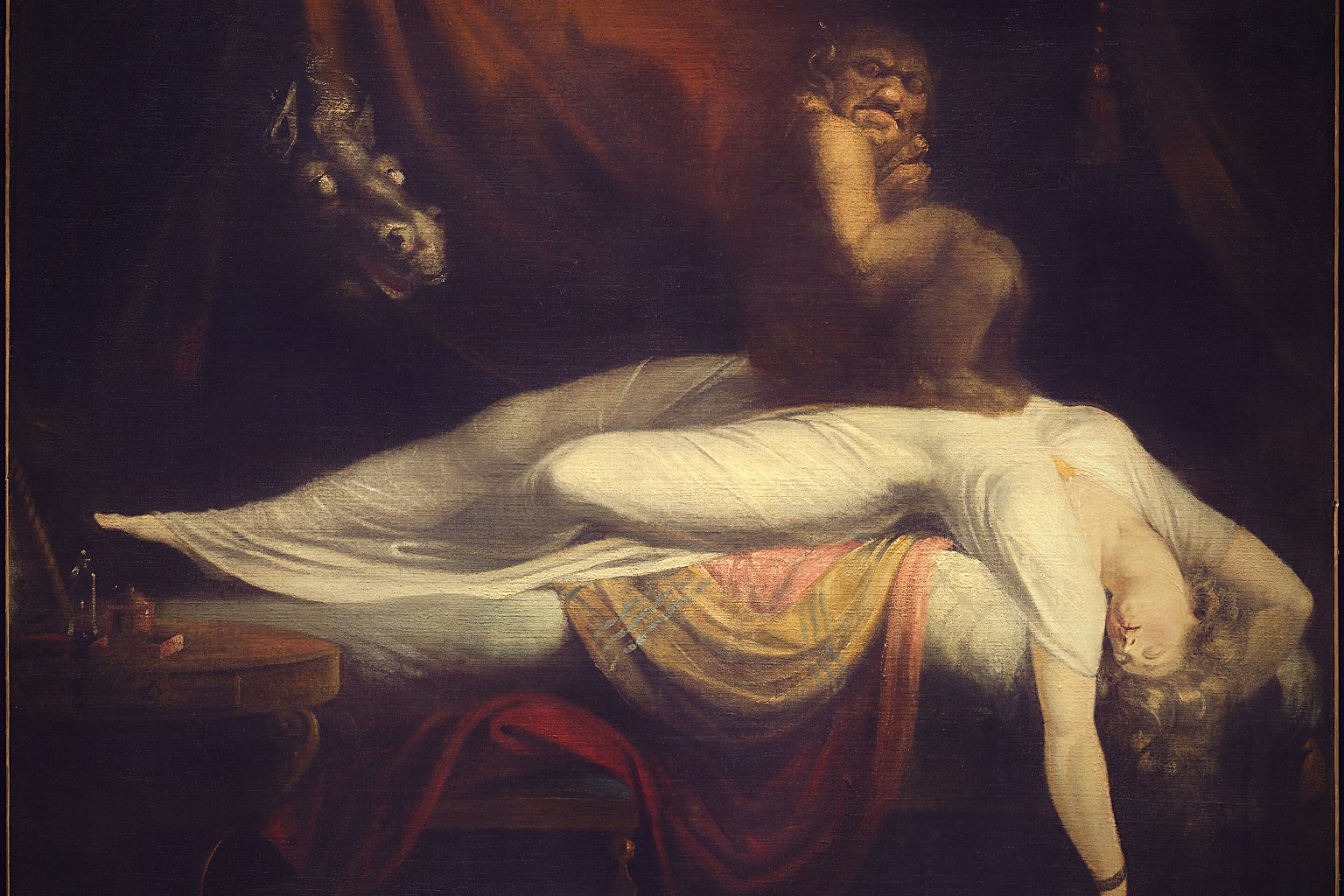
Fuseli’s The Nightmare (1781) is the most famous depiction: a woman sprawled on her back, a squat demon crouched on her sternum. It was painted from the folk tradition, and it is clinically accurate.
The universality is strong evidence that the experience is generated by shared neurology, not transmitted by culture. The mechanism produces the same raw material everywhere; local tradition supplies the identity of the figure.
That last point matters. The interpretation is cultural — hag, demon, jinn, ghost, and in the twentieth century, alien abduction. Researchers including Susan Blackmore have noted the close correspondence between classic abduction narratives and hypnopompic sleep paralysis: paralysis, a presence, figures near the bed, a sense of being examined, and an inability to cry out.
Who Gets It
Risk factors are reasonably well characterised:
- Sleep deprivation and irregular schedules — the strongest modifiable factors
- Sleeping supine. Consistently associated; face-up posture increases episodes substantially
- Stress and anxiety, including PTSD
- Shift work and jet lag
- Narcolepsy, where it is one of the defining tetrad of symptoms
- Genetics — twin studies indicate a heritable component
- Some substances, including certain medications and withdrawal states
Isolated sleep paralysis, without narcolepsy, is common and benign.
What Helps
Practical, evidence-informed measures:
Prevention. Regular sleep schedule, adequate duration, and avoiding sleeping on your back are the interventions with the clearest support. Reducing evening alcohol and managing stress help.
During an episode. Attempting to move a small extremity — a finger or toe — or focusing on controlling eye movement is often reported as effective, since the eyes are not paralysed. Deliberately slowing and regulating the breath reduces the panic loop. Knowing what is happening is itself substantially protective: people who understand the mechanism report far less distress.
When to seek help. If episodes are frequent, accompanied by daytime sleepiness, cataplexy or sleep attacks, narcolepsy should be excluded. Frequent distressing episodes are treatable, and cognitive-behavioural approaches adapted for sleep paralysis have shown promise.
Why This Matters Beyond the Bedroom
Sleep paralysis is one of the cleanest demonstrations available of something important: a specific, reproducible neurological state can generate an experience that the person undergoing it is completely certain was real — including the presence of another being.
The person is awake. Their reasoning is intact. They can see the actual room. And they will tell you afterwards, with total conviction, that something was standing beside the bed.
That should inform how we read a great deal of testimony — historical, religious and contemporary. It does not mean every reported encounter is sleep paralysis. It does mean that sincerity, clarity and certainty are not evidence, because here is a mechanism that produces all three on demand, in millions of people, and has been doing so for as long as there have been people to record it.
The same caution applies to entity encounters under DMT and to what people report during cardiac arrest. The brain has more than one route to producing a convincing other.
Frequently Asked Questions
What causes sleep paralysis?
Consciousness returning before REM muscle atonia has been released. During REM sleep the brainstem inhibits motor neurons so you do not act out dreams; in sleep paralysis you wake while that inhibition is still active.
Why does it feel like something is sitting on my chest?
The diaphragm continues working, but the intercostal muscles between the ribs remain paralysed, so you cannot voluntarily take a deep breath. That restriction is experienced as weight or pressure on the chest.
Why do I see a figure in the room?
The felt presence is associated with the temporoparietal junction, which integrates body position and distinguishes self from other. Stimulating this region can reliably induce the sense of a shadowy presence. Scrambled body-map signals during paralysis appear to be attributed to another agent.
Is sleep paralysis dangerous?
No. Episodes are self-limiting, typically lasting seconds to a couple of minutes, and cause no physical harm. They can be extremely frightening, and frequent episodes are worth discussing with a doctor.
How do I stop a sleep paralysis episode?
Attempting to move a small extremity such as a finger or toe, or focusing on eye movement since the eyes are not paralysed, is commonly reported to help. Slow, controlled breathing reduces panic. Recognising what is happening substantially lowers distress.
Does sleeping on your back cause sleep paralysis?
Supine sleeping is consistently associated with a higher rate of episodes across studies. Changing sleep position is one of the simplest preventive measures.
Why do different cultures describe the same experience?
Because the mechanism is shared human neurology. The Old English mare, Japanese kanashibari, Chinese “ghost pressing on body,” Turkish karabasan and Newfoundland Old Hag all describe chest pressure, immobility and a malevolent presence at the edge of sleep.
Are alien abduction reports sleep paralysis?
Researchers including Susan Blackmore have noted close correspondence between classic abduction narratives and hypnopompic sleep paralysis — paralysis, a felt presence, figures beside the bed, a sense of examination and inability to call out.
Conclusion: The Demon Has a Job Title
Fuseli painted The Nightmare in 1781 from folklore: a sleeping woman, and a squat incubus crouched on her sternum.
He was not illustrating a superstition. He was illustrating a symptom cluster — one that Old English speakers called the mare, that Japanese speakers call being bound in metal, and that a sleep laboratory would today record as an intrusion of REM atonia into waking consciousness.
Every culture that has left records describes it, because every culture is made of the same nervous system, and this particular failure mode has been available for as long as the system has existed.
The demon on the chest is real in the only sense that matters for the person underneath it. What is not real is that it came from outside.
Continue Reading
- Lucid Dreaming: The Message Sent From Inside a Dream — In 1975 a sleeping man moved his eyes in a pre-agreed pattern and proved lucid dreaming is real. What the brain does…
- Demonic Possession vs Mental Illness: The Argument That Never Ended — For thousands of years, madness meant possession. Then psychiatry relabelled the symptoms and offered drugs that work…
- The Mandela Effect: Seven Images That Made Strangers Agree — A room full of strangers remembered a death that never happened. Then somebody tested it properly: forty famous images…