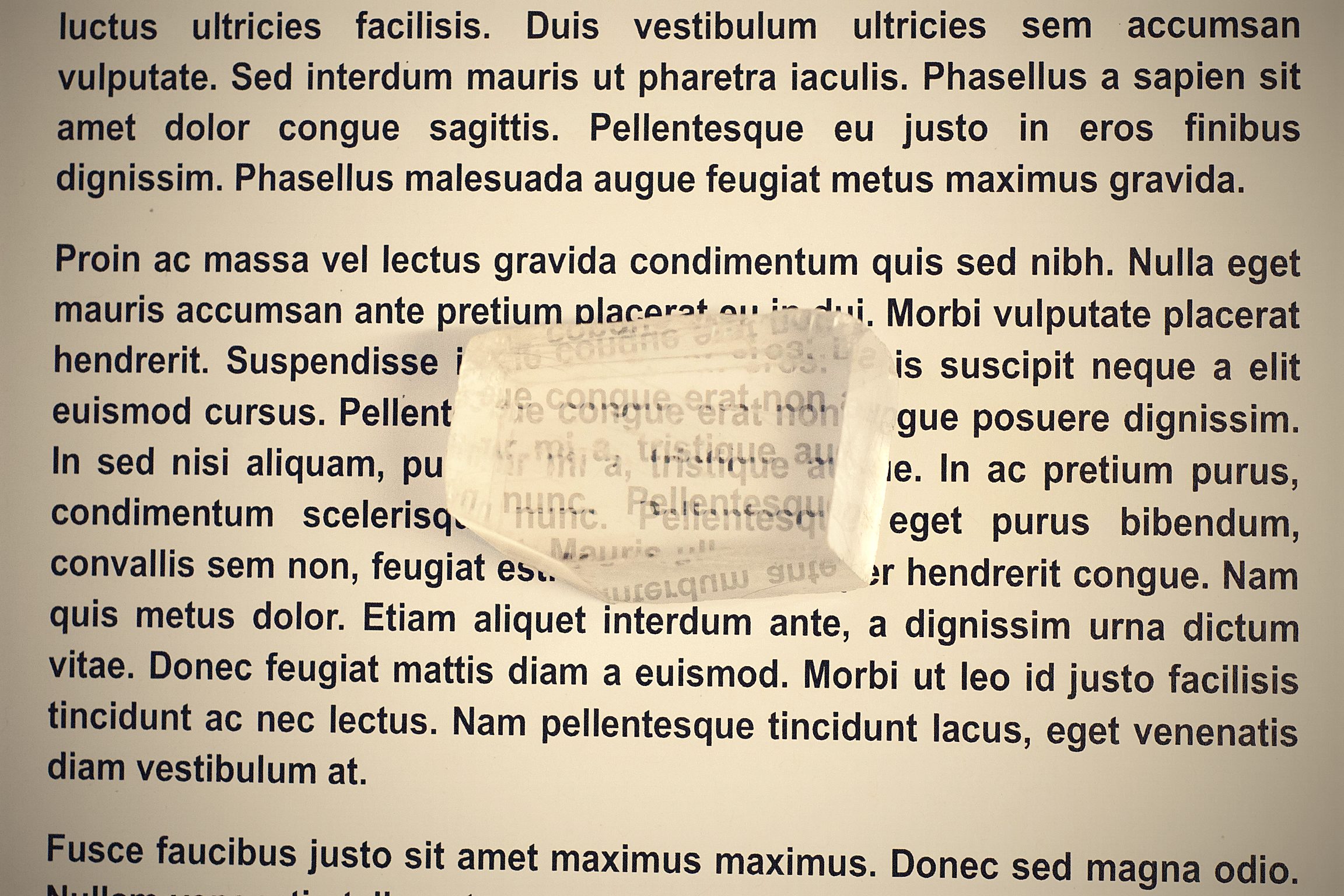
A Viking sunstone is supposed to do something that sounds impossible: find the sun on a day when you cannot see it. Overcast, fog, the long blue dusk of a northern summer — hold the crystal up, turn it, and it tells you where the sun is.
The strange part is that this half of the story is not in dispute. The physics has been tested in a laboratory and it works. What is in dispute is everything else: whether anyone in the Viking age actually did it, whether the one text describing it means what it appears to mean, and whether the crystal everybody pictures is even the right crystal.
How a Viking Sunstone Works
Start with the sky, because the sky is doing the work.
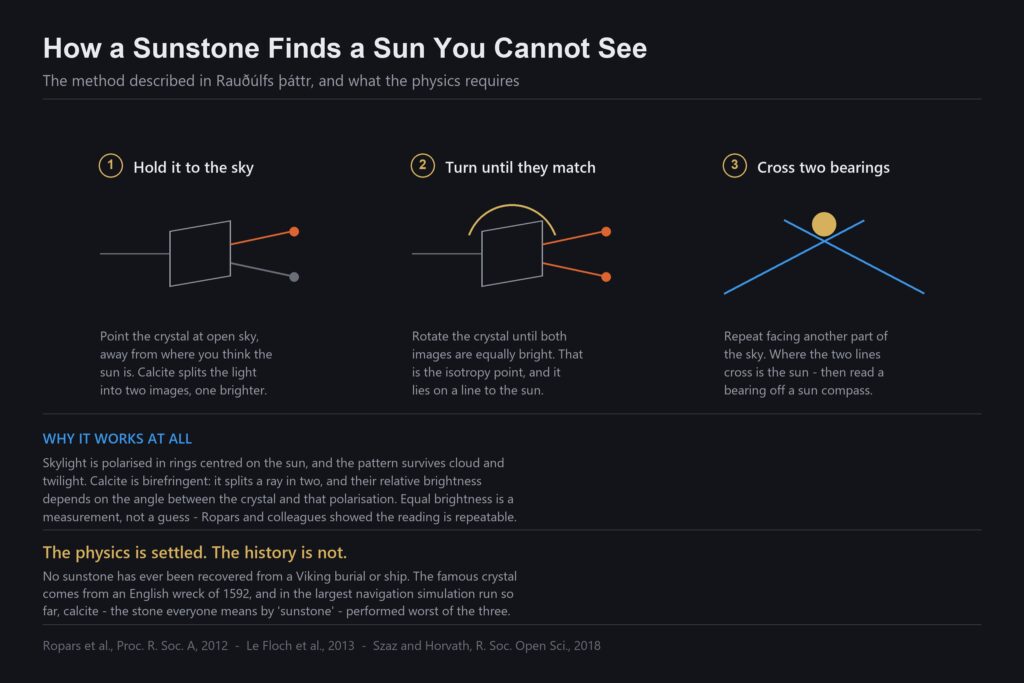
Sunlight scattering through the atmosphere comes out polarised — its waves vibrate preferentially in one plane — and the pattern is not random. It forms rings centred on the sun. Stand anywhere, look anywhere, and the polarisation angle at that patch of sky encodes where the sun is. Bees navigate by it. The pattern survives cloud and persists after sunset, which is exactly when a navigator has no other reference.
To read it you need something that responds to polarisation. Calcite does. A clear piece of calcite — Iceland spar — is birefringent: it splits an incoming ray into two, and the two emerge separated, so you see everything through it doubled.
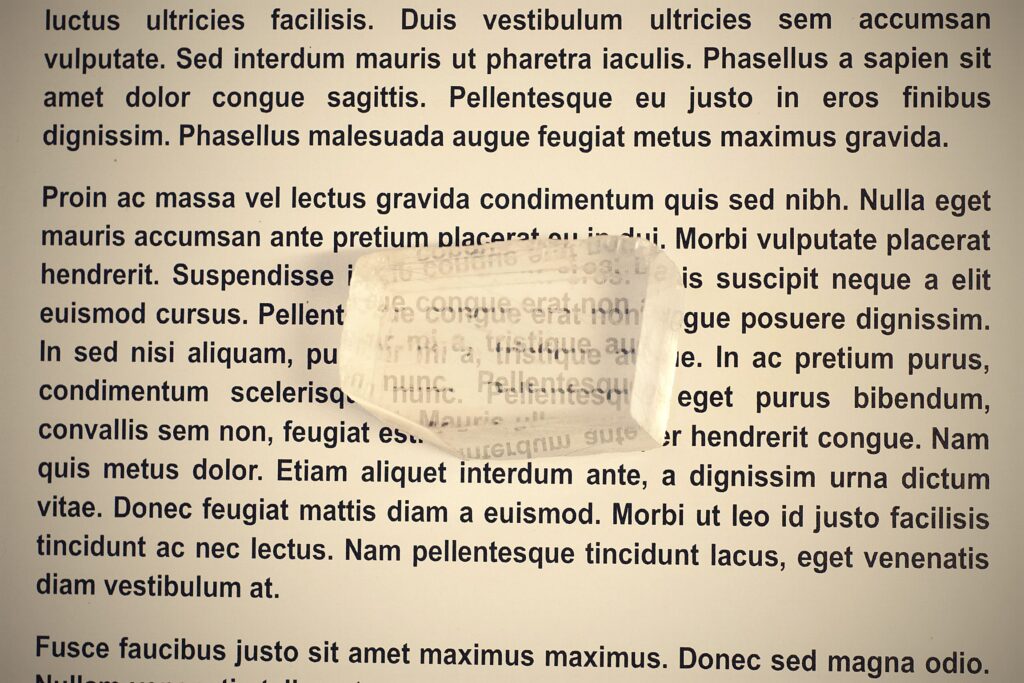
That doubling is the instrument. The relative brightness of the two images depends on the angle between the crystal’s axis and the polarisation of the light entering it. Rotate the crystal and one image dims while the other brightens. At one particular orientation they are equally bright, and that point — the isotropy point — is sharp enough to be a measurement rather than an impression.
Gábor Ropars and colleagues published the working version of this in the Proceedings of the Royal Society A in 2012. Their finding was about precision: the eye is poor at judging absolute brightness but very good at judging when two adjacent patches match, so the equal-brightness method gives a repeatable reading. They reported the sun’s direction recoverable to within a few degrees under overcast skies.
So the sequence is: hold it up, rotate to equal brightness, note the bearing. Do it again facing a different part of the sky, and the two bearings cross where the sun is. Then you still need a way to turn “the sun is over there” into a heading, which is a second instrument and a second argument.
The Two Texts
The word is sólarsteinn, sun-stone, and it appears in medieval Icelandic writing in two narrative sources, both thirteenth century.
The one everybody quotes is Rauðúlfs þáttr. It is set around 1030, at a farm visited by King Olaf Haraldsson of Norway. The weather has closed in. The king asks a man named Sigurður to say where the sun is; Sigurður answers. Then, in the passage that launched a thousand articles:
the king made them fetch the solar stone and held it up and saw where light radiated from the stone, and thus directly verified Sigurður’s prediction.
The second is Hrafns saga Sveinbjarnarsonar, which mentions a sunstone without explaining it.
That is the entire literary corpus. Two thirteenth-century mentions, one of which describes a use, for an object supposedly central to crossing the North Atlantic for three hundred years.
What the Sagas Do Not Say
Two things, and popular accounts tend to mention neither.
The passage is not about navigation. Nobody is at sea. The king is on land, indoors, testing a man’s claim about the position of the sun. It is a demonstration of a marvel, not a page from a sailing manual. Whether the same object was used to steer a ship is an inference, and it is our inference, not the text’s.
**And Rauðúlfs þáttr is an allegory.** This is the part that rarely survives the retelling. The þáttr is a thoroughly symbolic work, and there is a serious reading in which the sunstone is an image of the Virgin — part of a widespread medieval figure in which the virgin birth is compared to a ray of sun passing through glass without breaking it. On that reading the stone in the story is doing theological work, and its optical properties are the vehicle, not the point.
That does not make it fiction about a fictional object. A symbol usually borrows something real. But it does mean the one text describing how a sunstone was used is the one text least safe to read as a technical description.
The Sunstones That Were Definitely Real, and Were Not for Sailing
Here the record becomes more solid and, awkwardly, less helpful.
Sólarsteinn turns up in Icelandic church and monastery inventories of the fourteenth and fifteenth centuries, listed among valuables with no explanation of what it was for. Peter Foote catalogued these in 1956. So the word had ordinary material currency in late medieval Iceland: sunstones were objects somebody owned, counted and wrote down.
But look at where they are. Not on ships — in churches, three to five centuries after the Viking age. And Árni Einarsson argued in 2010 that these inventory sunstones were most likely timekeeping aids for the hours of prayer, which is a perfectly good use for a stone that tells you where the sun is, and has nothing to do with the Atlantic.
So the securely attested sunstone is a piece of monastic equipment. The seafaring one is the one we cannot find.

What Has Actually Been Dug Up
No sunstone has ever been recovered from a Viking burial, a Viking ship or a Viking settlement. That is the plain state of the archaeology, and it is the sentence most articles on this subject skip.
The nearest thing is genuinely interesting and genuinely not Viking. In 2013 a team led by Albert Le Floch published, again in the Proceedings of the Royal Society A, on a calcite crystal recovered from a wreck off Alderney in the Channel Islands. They showed it would work as an optical compass. The ship sank in 1592 — Elizabethan, roughly five and a half centuries after the Viking age. It tells you that a sailor might carry such a crystal. It does not tell you that a Norse one did.
There is also the Uunartoq disc: a wooden semicircle about 7 cm (2.8 in) across, notched around the curved edge, dug up in 1948 at an eleventh-century convent site in Greenland. It has been read as the remains of a sun compass — the second instrument the method needs — and some have argued the irregularities in its lines mean it was doing something more sophisticated, like finding latitude. Others think it is not a navigational object at all. It is one broken thing, and the argument over it has run for seventy years.
In fairness to the case: absence is weaker evidence here than it looks. The Norse cremated a great many of their dead, a small clear crystal is not an obvious grave good, and undecorated calcite in a disturbed context is easy to miss or discard. A thing can be real and leave nothing.
This is the same shape of problem as the Baghdad Battery, where the chemistry works and the question was never the chemistry. Physics that functions is not by itself a historical claim.
Could It Actually Get You to Greenland?
In 2018 Dénes Száz and Gábor Horváth put the question to a computer. Writing in Royal Society Open Science, they ran about 36,000 simulated voyages along the latitude sailing route from Bergen in Norway to Hvarf in Greenland, under modelled cloud, with a navigator using a sunstone and a sun compass. A voyage counted as successful if it reached sight of the Greenland mountains within three weeks.
The result turned on one variable almost nobody mentions: how often you check.
| Sunstone consulted every… | Voyages that arrived |
|---|---|
| 1–3 hours | 92–100% |
| 4 hours | 32–59% |
Three hours is the difference between a technique that works and one that loses you in the North Atlantic. Which is a rather human finding: the instrument is not the hard part, the discipline is.
The Result Nobody Quotes
The same study compared crystals, and this is the part that ought to be better known.
Three minerals can do the job: calcite, cordierite and tourmaline. In the simulations cordierite performed best. Calcite performed worst.
Calcite is Iceland spar. Iceland spar is what everyone means when they say “Viking sunstone” — it is the stone in every photograph, including the one further up this page, and it is the stone named after the island. And on the best modelling anyone has done of the actual voyage, it is the weakest of the three candidates.
That does not sink the idea. Calcite still worked in the simulations, it is abundant in Iceland, and the equal-brightness method that Ropars tested is a calcite method. But the popular version — Vikings crossed the Atlantic using Iceland spar — has quietly inherited a specific mineral that the research ranks last.
Where That Leaves It
Set the two columns side by side and neither is empty.
For: the polarisation pattern is real and readable. The method has been demonstrated in the laboratory and gives repeatable bearings under cloud. Simulated voyages using it succeed at high rates. The word sólarsteinn exists in medieval Icelandic and named a real, ownable object. The Norse demonstrably reached Iceland, Greenland and Newfoundland, and the magnetic compass did not arrive in the north until long after they did.
Against: the only description of a sunstone in use is set on land, in a symbolic text, and may be a figure for the Virgin. The securely documented sunstones are church property from centuries later and were probably clocks. Nothing has been excavated from a Viking context. The one crystal recovered from a wreck is Elizabethan. And the mineral everyone names performs worst in the only large-scale test.
The honest summary is that the Vikings clearly had some way of holding a course out of sight of land, and the sunstone is a physically sound candidate for part of it that has never been confirmed. That is a narrower and more interesting claim than the one usually made, and it is the one the evidence will carry.
It is the same position as Roman concrete or the Antikythera mechanism, with one difference that matters. Those two are objects we possess and are trying to explain. This one is an explanation we possess and are trying to find an object for.
Frequently Asked Questions
How does a Viking sunstone work?
Skylight is polarised in rings centred on the sun, and the pattern persists through cloud and after sunset. A clear calcite crystal is birefringent — it splits light into two images — and their relative brightness changes as the crystal is turned against that polarisation. Rotate until both images are equally bright and the crystal is aligned with a line to the sun. Cross two such bearings and you have the sun’s position.
How do you use a Viking sunstone?
Hold the crystal up to open sky, away from where you think the sun is. Rotate it slowly and watch the two images it produces. Stop when they are equally bright — that is the isotropy point — and note the direction. Repeat facing a different part of the sky. The two lines cross at the sun. Turning that into a compass heading needs a second instrument, such as a sun compass.
Are Viking sunstones real?
The physics is real and demonstrated. The history is unproven. No sunstone has ever been recovered from a Viking burial, ship or settlement. The word sólarsteinn appears in two thirteenth-century Icelandic texts and in later church inventories, so the object existed — but nothing ties the excavated or documented examples to navigation.
Did the Vikings actually use sunstones to navigate?
Nobody can say for certain. The only text describing a sunstone in use, Rauðúlfs þáttr, is set on land and is a symbolic work in which the stone may stand for the Virgin. Simulations published in 2018 show the method would have worked well enough to reach Greenland if consulted every one to three hours, but a technique that could have been used is not evidence that it was.
What were Viking sunstones made of?
Calcite, or Iceland spar, is the usual candidate and the one most often pictured. Cordierite and tourmaline also respond to polarised light and have been proposed. In the 2018 navigation simulations cordierite performed best and calcite worst — an awkward result, since calcite is the stone the popular story names.
How do you make a Viking sunstone?
You do not make one, you find one. Iceland spar is a naturally occurring clear variety of calcite, and the quality needed is simply a piece transparent enough to show the doubling clearly. The Helgustaðir deposit in eastern Iceland was the historic source of the finest material, and specimens from it supplied European optical science for centuries.
Has a Viking sunstone ever been found?
No. A calcite crystal was recovered from a shipwreck off Alderney and published in 2013, and it does work as an optical compass — but that ship sank in 1592, five and a half centuries after the Viking age. The Uunartoq disc, found in Greenland in 1948, may be part of a sun compass rather than a sunstone, and its purpose is still argued over.
Why has nothing been found if they were used?
The usual answer is that the Norse cremated many of their dead, that a small undecorated crystal is not an obvious grave offering, and that clear calcite in a disturbed archaeological layer is easy to overlook. That is a reasonable explanation for an absence. It is not evidence of a presence, and it is worth keeping the two apart.
Continue Reading
- The Baghdad Battery: The Chemistry Works. That Was Never the Question. — Copper, iron, bitumen and vinegar will produce a current whether anyone intended it or not. What the Baghdad jars…
- Derinkuyu: The Doors Only Close From Inside — Eighty-five metres down, eight levels open of an estimated eighteen, and a half-tonne stone wheel with a spear-hole…
- The Sumerian King List: 241,200 Years Before the Flood — Eight kings, 241,200 years, then a flood. Almost every retelling adds the numbers up — and what that shape means is the…