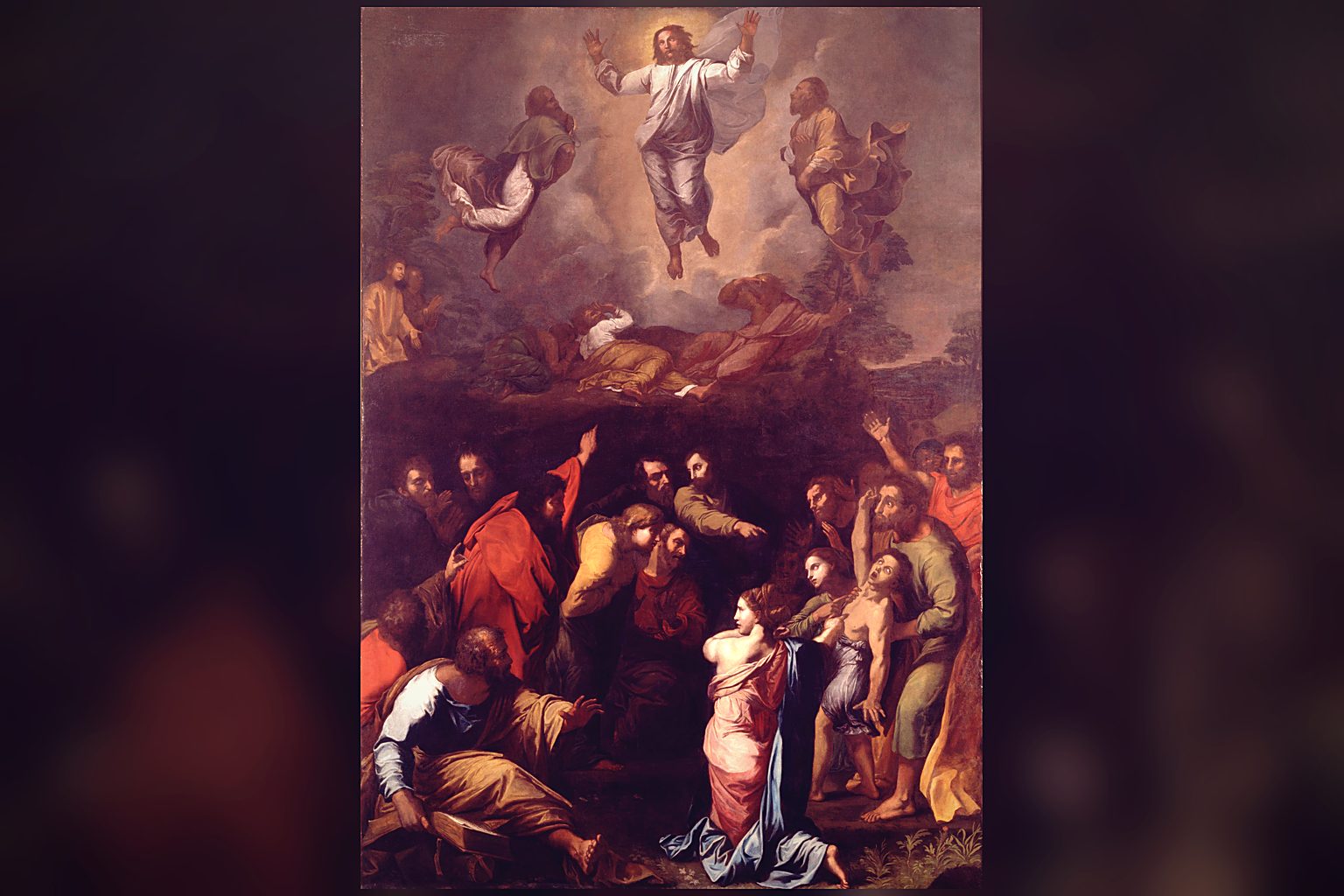
In a synagogue in Capernaum, according to Mark, a man interrupted the teaching by shouting. Jesus said two things to whatever was shouting — be quiet, and come out — and the man convulsed and went silent.
What the crowd said next is the part worth stopping on. They did not say he was powerful. Exorcists were ordinary; every town had access to one. What they said was: what is this? A new teaching — with authority he commands even the unclean spirits, and they obey him.
They were not astonished that a demon left. They were astonished that nothing was used.
How Did Jesus Cast Out Demons?
By speaking, and by nothing else. No ring, no root, no incantation, no invocation of a higher name, no water, no smoke, no repeated formula. In the accounts he gives an instruction — usually one sentence, sometimes two words — and the narrative moves on.
That sounds unremarkable until you see what his contemporaries were doing, which is documented in detail and is not remotely like it.
What Every Other Exorcist Needed
Josephus, writing in the first century, says he personally watched a Jewish exorcist named Eleazar work in front of the emperor Vespasian and his officers. The procedure is described step by step: a ring containing a root that Solomon had prescribed, held under the possessed man’s nose; incantations, also attributed to Solomon, recited over him; the demon drawn out through the nostrils. Eleazar then had the departing spirit knock over a basin of water, to prove to the audience that it had left.
Every element of that is machinery. The authority is Solomon’s, invoked; the root does work; the basin supplies proof.
The Greek Magical Papyri, a body of spell texts from Roman Egypt, show the same architecture across a much wider field: long written formulae, strings of divine names from several religions at once, objects, and instructions for exactly what to say. Practitioners copied and sold them. The longer and more comprehensive the list of names, the better the spell was thought to work.
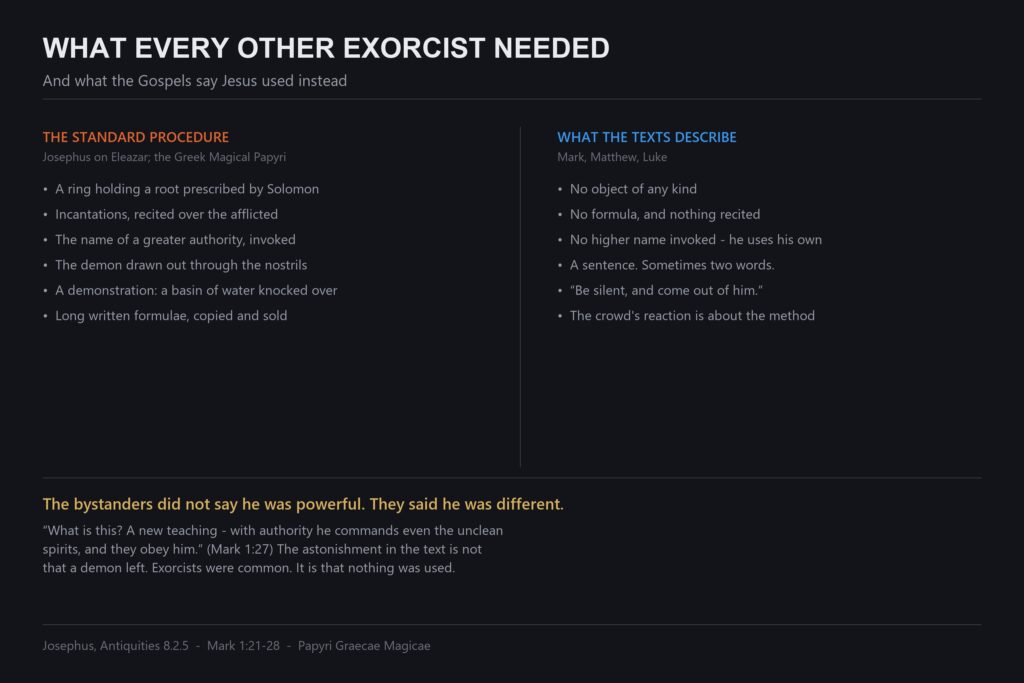
Against that background the Gospel accounts are strange in a specific, checkable way. They describe a man doing the same category of act with none of the equipment, and they record bystanders reacting to that absence rather than to the result.
The Cases, One by One
Capernaum (Mark 1:21–28). The synagogue. “Be silent, and come out of him.”
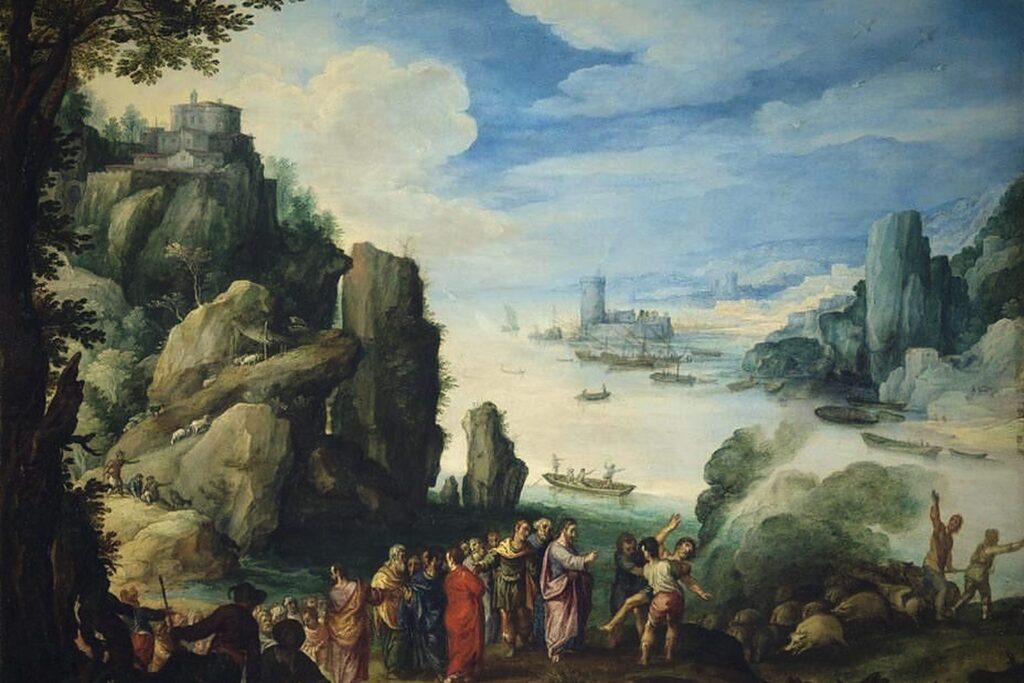
The Gerasene (Mark 5:1–20). The longest account. A man living among tombs, uncontrollable, breaking chains, cutting himself with stones. This one is unusual because there is a conversation — a name is asked for and given, Legion, for we are many — and because it ends with a herd of pigs going into the lake. It is also the only case where the locals ask Jesus to leave afterwards.
The boy (Mark 9:14–29). A father brings a son the disciples could not help. The description is clinical: the attacks throw him down, he foams at the mouth, grinds his teeth, becomes rigid, and has fallen into both fire and water. This is the case medicine has the most to say about, and we will come back to it.
The bent woman (Luke 13:10–17). Eighteen years bent over and unable to straighten. Luke, who is careful with medical language, calls it a spirit of infirmity, and the release is described as a loosing rather than an expulsion.
Mary Magdalene (Luke 8:2). Named in passing, seven demons, no scene and no description. The text says nothing more, and neither should anyone else.
The Accusation That Concedes the Point
The most interesting evidence in the Gospels about whether Jesus performed exorcisms comes from his opponents.
In Matthew 12 they do not say the exorcisms are fake. They say he casts out demons by Beelzebul, the prince of demons — that the power is real and its source is wrong. His reply is the line about a house divided against itself.
Historians treat that kind of hostile concession as unusually strong evidence, because the people with the most reason to deny an event are conceding it and disputing only the interpretation. Whatever was happening in those encounters, the people standing closest to it and liking it least did not claim nothing happened.
Signs of Demonic Possession
This is the question everybody actually wants answered: how would you tell?
The most developed formal answer is the Catholic one. The Rituale Romanum, authorised in 1614, lists indicators: speaking in languages the person never learned, strength beyond their natural capacity, knowledge of hidden or distant things they could not have acquired, and violent aversion to sacred objects.
What is less well known is how cautious the same document is. It warns the priest repeatedly against proceeding where there is no true possession. The 1999 revision, De Exorcismis et Supplicationibus Quibusdam, tightens it further: medical and psychological evaluation is expected first, and the signs are to be treated as insufficient unless they cannot be explained naturally.
In other words, the institution with the longest continuous practice of exorcism has spent four centuries making its own criteria harder to satisfy.
What Medicine Sees
Read the description of the boy in Mark 9 without the framing and any neurologist will recognise it. Sudden loss of postural control, foaming at the mouth, teeth grinding, rigidity, recurrent episodes, injuries sustained during attacks including burns and near-drownings. That is a tonic-clonic seizure disorder, described accurately by someone who had watched one.
The Gerasene account reads to modern clinicians like severe psychosis or a dissociative disorder. The bent woman’s eighteen years of spinal flexion has been read as spondylitis.
This matters for a reason beyond interpretation. Conditions that are now treated have historically been read as possession, and people have been harmed by that reading. Deaths have occurred during exorcism rituals — from restraint, from dehydration, from beatings, from withheld medication. Any honest treatment of this subject has to say plainly that where there is a medical explanation, medical treatment is what helps, and that failing to seek it has a body count.
That is not an argument against the texts. It is an argument about what to do on a Tuesday, which is a different question.
Possession Across Cultures
Here is the finding that makes the subject harder rather than easier.
Erika Bourguignon led a cross-cultural survey of 488 societies in the 1960s. 437 of them — about 90 per cent — had some institutionalised form of altered state. Around 360, roughly three quarters, held beliefs about spirit possession specifically. The rates were highest in the Pacific, at 88 per cent, and around the Mediterranean, at 77 per cent.
That is close to universal, and it is not explained by cultural contact. Societies with no connection to each other independently developed the same category: a person, sometimes, is spoken through by something that is not them.
Brain imaging has since been pointed at the phenomenon. Julio Peres and colleagues published a study in PLOS ONE in 2012 scanning ten experienced mediums during trance writing and during ordinary writing, and found measurable differences in activity between the two states. The trance is not performance in the sense of pretence — something in the brain is doing something different.
What that something is remains the question.
The Case That It Is a Real External Agent
Stated properly: the texts describe an entity that talks, that recognises Jesus before anyone else in the narrative does, that negotiates, that can be asked its name, and that relocates. The Gerasene account has the afflicted man behaving in ways that are a poor fit for a single condition — the dialogue is coherent, which psychosis rarely is, and the change is immediate, which neither psychosis nor epilepsy is.
The method argument sits here too. A man treating a medical condition would be expected to use the available remedies, and the striking thing about these accounts is the systematic absence of them, remarked on by hostile witnesses.
And the near-universality of the possession category across unconnected societies is at least as consistent with there being something to encounter as with there being a shared human tendency to misattribute.
The Case That It Is Something Else
Stated equally properly: every named case in the Gospels has at least one plausible medical reading, and the boy in Mark 9 has an obvious one. Ancient medicine had no category for epilepsy that distinguished it from spirit affliction, so a first-century description would look exactly like this whether or not a spirit was involved.
The cross-cultural universality cuts the other way as easily. Human minds dissociate; dissociation feels like being occupied; every culture that has minds will produce an idiom for it. That predicts near-universality without requiring anything external.
And the diagnostic criteria have never been made to work. Xenoglossy, superhuman strength and hidden knowledge are exactly the claims that evaporate under controlled observation. No case has been documented under conditions that would satisfy a sceptic, and the institution most invested in the phenomenon now requires doctors to be consulted first.
What Is Genuinely Unresolved
The criteria problem. Nobody has a test. Not the Church, which now defers to medicine; not medicine, which has categories for the presentation but not for the question being asked. Without a test, cases cannot be sorted.
Why the accounts describe no method. Whatever one concludes about the events, the absence of apparatus in the Gospel descriptions is a real feature of the texts, written in a period whose other exorcism literature is nothing but apparatus.
What the trance states are. The imaging shows a distinct state. It does not show what produces it.
Frequently Asked Questions
How did Jesus cast out demons?
By command alone. The accounts describe no ring, root, incantation, formula or invocation of a higher name — a sentence, and sometimes two words. The reaction recorded in Mark 1:27 is specifically about that absence of method rather than about the result.
How did other exorcists do it in the first century?
With equipment and formulae. Josephus watched an exorcist named Eleazar use a ring containing a root prescribed by Solomon, held under the man’s nose, together with recited incantations, and then have the departing spirit knock over a basin of water as proof. The Greek Magical Papyri preserve long written spells using strings of divine names.
What are the signs of demonic possession?
The Rituale Romanum of 1614 lists speaking unlearned languages, strength beyond natural capacity, knowledge of hidden things, and violent aversion to sacred objects. The same text warns strongly against proceeding without genuine possession, and the 1999 revision expects medical and psychological evaluation first, with the signs counting only where natural explanations have been excluded.
Is demonic possession real?
The experience is real and documented almost everywhere: a survey of 488 societies found about 90 per cent with institutionalised altered states and roughly three quarters holding possession beliefs. Whether an external agent is involved is not something any existing test can settle, which is why the institution with the longest practice now requires doctors to be consulted before a rite proceeds.
What happened with the demons and the pigs?
In Mark 5 a man living among tombs near Gerasa gives his name as Legion, “for we are many”, and the spirits ask to enter a nearby herd of pigs, which then run into the lake. It is the longest exorcism account in the Gospels, the only one with an extended dialogue, and the only one after which the local people ask Jesus to leave.
Did Jesus cast seven demons out of Mary Magdalene?
Luke 8:2 says she was one of several women “out of whom went seven devils”. That is the entire content of the reference: no scene, no description, and no connection in any Gospel to the identification with a prostitute, which appears centuries later.
Could the possessed boy in Mark 9 have had epilepsy?
The description matches a tonic-clonic seizure closely — sudden collapse, foaming, teeth grinding, rigidity, recurring attacks, injuries from falling into fire and water. Ancient medicine had no category separating epilepsy from spirit affliction, so a first-century account would read this way in either case, which is precisely why the passage cannot settle the question on its own.
Is exorcism dangerous?
It can be. Deaths have occurred during exorcism rituals through restraint, dehydration, beating and withheld medication. Where a medical condition is present, medical treatment is what helps, and the formal Catholic rite itself now expects that evaluation to happen before anything else.
Where That Leaves You
Three things are solid, and they do not point the same way.
The texts describe a method that is not a method, in a period whose entire surviving exorcism literature consists of methods — and hostile witnesses who disputed the source of the power rather than its existence.
The clinical descriptions in those same texts are good enough that modern doctors can read diagnoses out of them, and the history of treating illness as possession has cost lives, which is not an abstraction and not a debating point.
And the category itself is nearly universal across societies that never met, which is exactly what you would expect if there were something out there, and also exactly what you would expect if there were something in here.
Like the figure that sits on the chest in every culture’s sleep paralysis, the phenomenon is real, consistent and reported everywhere. What it is has never had a test proposed that both sides would accept.
Which leaves the oldest question in the subject exactly where the Capernaum crowd left it. They asked what this was. Nobody in the passage answers them.
Continue Reading
- Demonic Possession vs Mental Illness: The Argument That Never Ended — For thousands of years, madness meant possession. Then psychiatry relabelled the symptoms and offered drugs that work…
- Demonic Possession in the Bible: Every Case, and the One That Comes Back — The evil spirit on Saul. Legion in the tombs. The boy the disciples could not help. Every case of demonic possession in…
- The Mandela Effect: Seven Images That Made Strangers Agree — A room full of strangers remembered a death that never happened. Then somebody tested it properly: forty famous images…