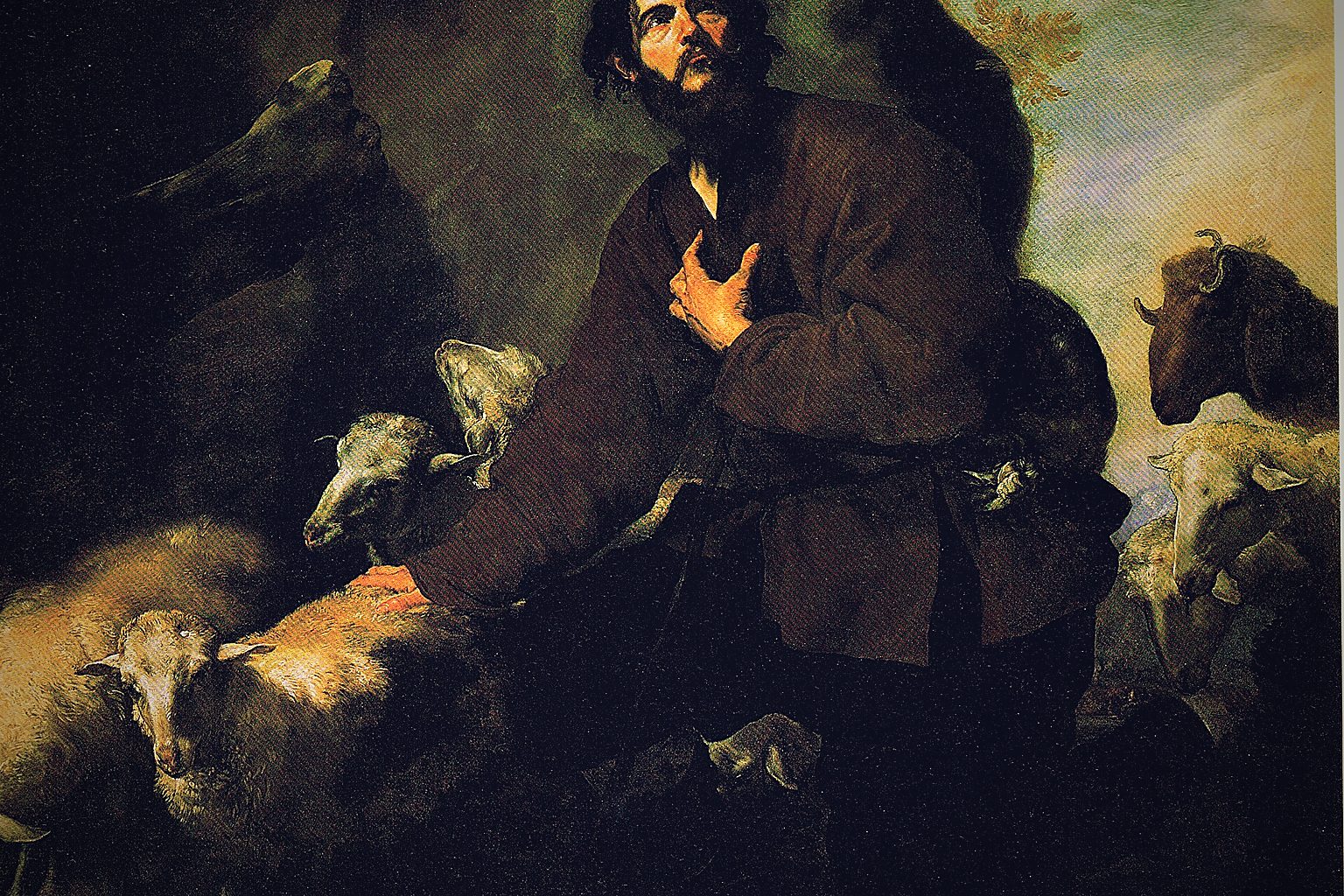
Laban thought he had designed the perfect swindle. He had actually designed a genetics experiment, and he was on the losing side of it.
The deal in Genesis 30 looks, on its face, like daylight robbery. Jacob offers to keep working for his father-in-law, and asks for wages: every spotted, speckled and dark animal in the flock. Laban agrees instantly — because in a Near Eastern flock those are the minority, the off-colour stock, the culls.
Then Laban cheats anyway. He removes every marked animal from the herd and puts a three-day journey between them and Jacob, leaving him a flock of solid-coloured sheep.
Laban’s reasoning was straightforward. Remove the spotted parents and you cannot get spotted offspring.
He was wrong, and the reason he was wrong would not be published for another three and a half thousand years.
What Happened in Genesis 30?
Jacob agreed to work for Laban in exchange for the speckled and spotted animals born to the flock. Laban removed all existing marked animals to prevent this. Jacob then bred the remaining flock selectively — placing peeled rods at the watering troughs and, critically, mating only the stronger animals in front of them — and the marked animals multiplied enormously until, as Genesis 30:43 records, “the man increased exceedingly.”
The Thing Laban Could Not See
Coat colour in sheep is controlled by genes that come in variant forms called alleles, inherited one from each parent. For the relevant trait, simplified:
- A dominant allele (call it A) produces solid white wool. One copy is enough to show it.
- A recessive allele (a) produces spotted or dark wool. It shows only when both copies are present.
That gives three genotypes and only two appearances:
| Genotype | Appearance | Carries the recessive allele? |
|---|---|---|
| AA | White | No |
| Aa | White | Yes — invisibly |
| aa | Spotted | Yes |
There is the trap Laban walked into. He removed every aa animal — every sheep that looked spotted. But he left behind an unknown number of Aa animals, which look exactly like AA animals and are indistinguishable by eye.
Laban culled the phenotype, the visible appearance. The genotype — the underlying code — stayed in his flock, hidden inside animals he was certain were clean.
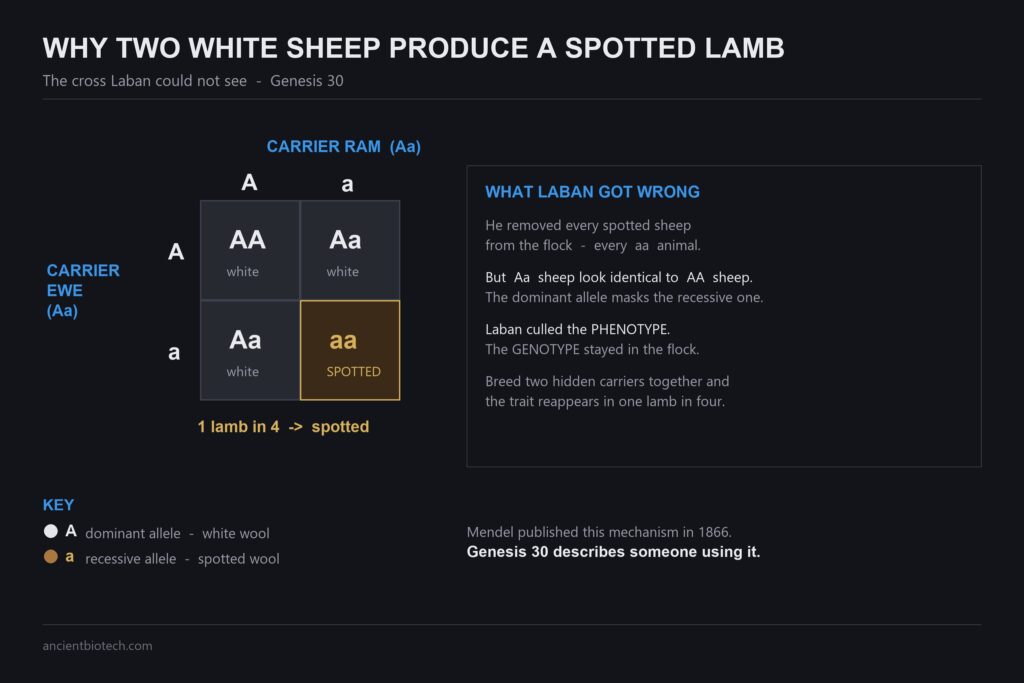
Breed two hidden carriers together and the arithmetic is fixed: one quarter AA, one half Aa, one quarter aa. Twenty-five percent of the lambs come out visibly spotted — from two white parents.
Gregor Mendel worked this out in a monastery garden in Brno and published it in 1866. Genesis 30 describes someone arriving at the result without the theory.
Where Did Jacob Get the Information?
This is the part of the account that is easy to skip and hardest to explain.
Jacob could not see a genotype. Nobody could until the twentieth century. To run the cross deliberately, he needed to know which of the visually identical white rams were carriers — and the text tells us where the information came from. Not in Genesis 30, but in Jacob’s own retelling a chapter later:
“And it came to pass at the time that the cattle conceived, that I lifted up mine eyes, and saw in a dream, and, behold, the rams which leaped upon the cattle were ringstraked, speckled, and grisled.” (Genesis 31:10)
In the dream, the rams are marked. In the field, they were not — Laban had removed every marked animal.
So the dream is not showing Jacob what the rams looked like. It is showing him something about them that was not visible. In modern terms, he was handed a carrier screen: an identification of which phenotypically white rams held the recessive allele.
The angel then states the reason plainly:
“…for I have seen all that Laban doeth unto thee.” (Genesis 31:12)
The information was provided because Laban was cheating. This was not a magic trick; it was, in the text’s own framing, a correction applied to a rigged contract.
So What Were the Peeled Rods For?
The famous detail is the one sceptics seize on, and fairly:
“And Jacob took him rods of green poplar, and of the hazel and chesnut tree; and pilled white strakes in them… And he set the rods which he had pilled before the flocks in the gutters in the watering troughs.” (Genesis 30:37-38)
Striped sticks in the water. Animals conceive in front of them. Striped lambs result.
Taken as a causal claim, that is maternal impression — the ancient belief that what a mother looks at during conception shapes her offspring. It is false. Visual stimuli do not alter gametes.
But look at what Genesis 30 actually says Jacob did, in the two verses that are almost always ignored:
“And it came to pass, whensoever the stronger cattle did conceive, that Jacob laid the rods before the eyes of the cattle in the gutters, that they might conceive among the rods. But when the cattle were feeble, he put them not in: so the feebler were Laban’s, and the stronger Jacob’s.” (Genesis 30:41-42)
That is not a superstition. That is a breeding protocol.
Jacob is sorting the flock into two groups and controlling which animals breed under which conditions. The rods mark the location where the selected matings happen. The animals he wants bred go to the marked troughs; the rest do not.
Read this way, the rods are not causing anything. They are signposts — a physical marker delimiting the breeding zone, in an era with no fencing wire, no ear tags and no written stud book. A shepherd managing thousands of animals needs a system, and a visually distinctive marker at a specific watering point is a workable one.
And the outcome the text reports is exactly what selective breeding produces: Jacob’s animals were not only more numerous but stronger. Colour was the contract term. Vigour was what he actually selected for.
Why This Detail Survived
There is a reason to think this account was recorded rather than invented.
An invented story would have Jacob’s rods work directly — stripes on sticks, stripes on lambs, a clean magical causality. Instead the text preserves a set of details that pull in different directions: a dream about the rams’ hidden condition, rods at the troughs, and a strength-based selection criterion applied to a colour-based contract.
That is what a remembered procedure looks like after generations of retelling: the operative step survives alongside the ritual, and nobody can tell which was doing the work. The narrator reports both because he does not know which mattered.
The same pattern shows up across the biblical record — a workable specification preserved inside a frame the recorder did not fully understand. The Ark of the Covenant is given as a materials stack with handling rules and no explanation of why. Manna comes with storage limits and a weekly exception nobody accounts for. Ezekiel describes a mechanism he has no vocabulary for and says so repeatedly.
The Recessive Principle Elsewhere
Once you have seen the mechanism, it appears in another place in this record.
A recessive trait can travel invisibly through carriers for many generations and then resurface when two carriers meet. It does not need to be reintroduced. It only needs to have never been fully removed.
That is precisely the difficulty raised by Genesis 6:4, which says the Nephilim were on the earth “in those days; and also after that” — before and after a Flood that was supposed to end the line. One of the more coherent explanations offered for the giants reappearing after the Flood is the same mechanism Laban fell to: a trait carried through an unmarked carrier and re-expressed generations later.
Laban’s mistake is the general case. What you cannot see, you cannot cull.
Frequently Asked Questions
What did Jacob do with the striped rods?
Genesis 30:37-42 describes Jacob placing peeled rods at the watering troughs where the flocks mated. Crucially, verses 41-42 add that he used them only when the stronger animals were breeding and withheld them for the feebler ones — which makes the rods a marker for a controlled breeding programme rather than a cause of the markings.
How did Jacob get spotted sheep from white sheep?
White sheep can carry a hidden recessive allele for spotting. Two such carriers bred together produce visibly spotted offspring about 25% of the time. Laban removed all visibly spotted animals but could not identify the carriers, which looked identical to non-carriers.
What is the difference between genotype and phenotype?
Phenotype is the visible appearance; genotype is the underlying genetic makeup. A sheep with genotype Aa looks the same as one with genotype AA, but carries a recessive allele the other lacks. Laban selected on phenotype, which left the genotype untouched.
Did Jacob know about genetics?
Not in the way a geneticist would put it, and no ancient people is known to have understood inheritance mechanically. What is on the page is stranger than either a yes or a no: Genesis 31:10-12 describes a dream in which Jacob was shown which rams were “ringstraked, speckled, and grisled” — information about animals that were outwardly white, effectively identifying the carriers.
Does looking at striped sticks affect offspring?
No. That belief is called maternal impression and it is false; visual stimuli do not alter gametes. The text’s own account of Jacob’s method, which sorts animals by strength and controls which ones breed at the marked troughs, describes selective breeding.
Why did Jacob’s flocks become stronger than Laban’s?
Genesis 30:41-42 states that Jacob applied his procedure only to the stronger animals and withheld it from the feeble. Over successive generations that is straightforward artificial selection for vigour, in addition to the colour trait his wages depended on.
How long did Jacob work for Laban?
Genesis 31:41 records twenty years in total: fourteen for Rachel and Leah, and six for the flocks, during which Jacob says Laban changed his wages ten times.
Conclusion: The Victory of Information
Laban held every advantage. He owned the flock, he set the terms, he changed the wages ten times, and he physically removed the breeding stock that could have produced Jacob’s wages.
He lost anyway, and he lost for one reason: he was operating on what he could see.
The trait he thought he had eliminated was still in his flock, carried invisibly by animals he had personally inspected and approved. He had removed the evidence and left the cause, which is a mistake with a very long history and a very modern name.
Genesis 30 is usually read as a folk tale about magic sticks. Read the two verses everyone skips — the ones about the stronger and the feebler cattle — and it becomes something else: a record of a man running a controlled breeding programme against an opponent who did not know the code existed.
Three and a half thousand years before anyone drew a Punnett square, someone won an argument with one.
Continue Reading
- Human Chromosome 2: The Fusion, and the 1,280 Who Carried It — You have 46 chromosomes. Every other great ape has 48. What sits at 2q13, the case against reading it as a fusion, and…
- Junk DNA: An Archive Nobody Curated — An onion has five times more DNA than you do. That single fact is the hardest question in genomics, and it is the one…
- The Shroud of Turin: A Negative Nobody Ordered — Dust vacuumed from the cloth in 1978 has now been sequenced, and the result was reported as evidence the Shroud came…