Everyone who reads about the Book of Enoch giants arrives at the same two facts: they were enormous, and they ate people. Both are in the text. Neither is the interesting part.
The interesting part is that there was a second book — an entire lost work about these creatures, written from their point of view, in which the giants have names, hold meetings, have nightmares and send a messenger to find Enoch and ask him what the nightmares mean. It vanished. For sixteen hundred years the only trace of it was a handful of scraps dug out of a ruined oasis on the Silk Road, in languages that have nothing to do with the Bible.
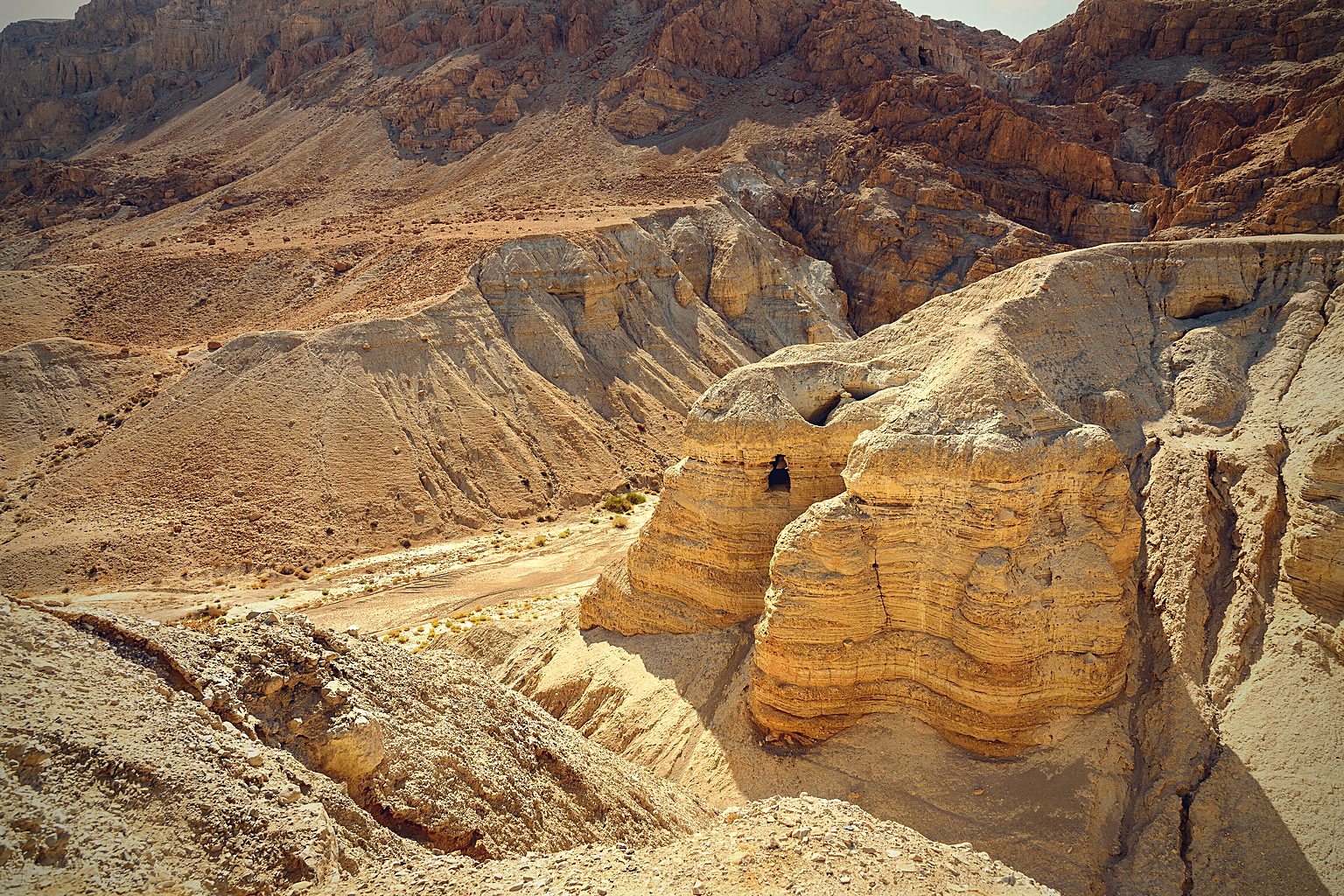
Then, in the caves above the Dead Sea, ten Aramaic copies turned up.
And one of them names Gilgamesh.
What the Book of Enoch Says About the Giants
The story sits in 1 Enoch 6–7, the section scholars call the Book of the Watchers. Two hundred angels, seeing the daughters of men, swear an oath on Mount Hermon to go down together so that no one can blame a single ringleader. They take wives. They also teach — metalwork and weapons, cosmetics, root-cutting, astrology, the arts of writing signs.
The children of those marriages are the giants, and 1 Enoch is blunt about what happened next:
And when men could no longer sustain them, the giants turned against them and devoured mankind. And they began to sin against birds, and beasts, and reptiles, and fish, and to devour one another’s flesh, and drink the blood. Then the earth laid accusation against the lawless ones. (1 Enoch 7:4–6)
Note the sequence, because it is the part usually skipped. They eat the food first. Then, when the food runs out, they eat the people. Then the animals — every category in the creation account, run backwards. Then each other. The earth itself finally lodges the complaint that brings the Flood.
This is not a monster story. It is an escalation, and the escalation is the argument: the Watchers’ gift is consumption that cannot stop. The Watchers’ whole curriculum has the same shape — every item on it is a real technology handed over before anyone was ready for it.
How Tall Were They? The Number Is Not What You Think
This is the most-searched question about the giants, and it has a genuinely strange answer: the figure depends entirely on which manuscript you are reading, and in the oldest ones the line may not exist at all.
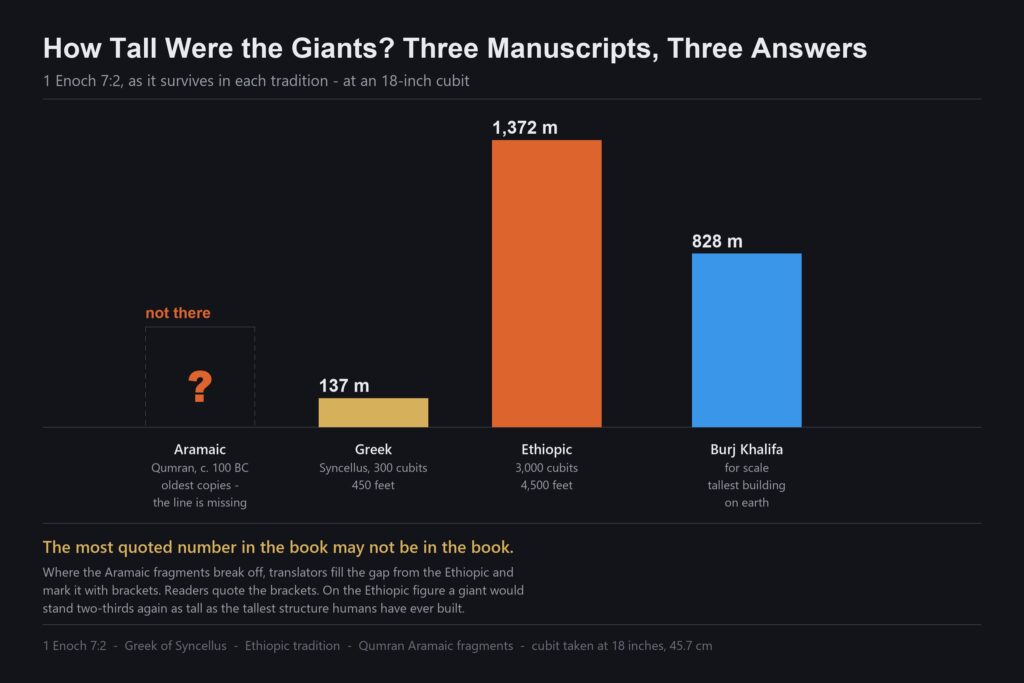
The Greek text preserved by the Byzantine chronicler George Syncellus says 300 cubits — about 137 metres (450 feet). The Ethiopic tradition, which is the one almost every English translation is made from, says 3,000 cubits: 1,372 metres (4,500 feet). That is not a giant. That is a creature two-thirds taller than the Burj Khalifa, who could not stand up in most weather systems.
And the Aramaic fragments from Qumran — the oldest copies of 1 Enoch that exist, roughly 100 BC — break off around this passage. Translations print the number anyway, in square brackets, supplied from the Ethiopic. Readers quote the brackets.
So the honest statement is this: 1 Enoch describes the giants as enormous beyond any human scale, and the specific number that circulates online is a late reading from the most recent branch of the tradition, not a datum from the oldest one. Whether the original had a figure at all is unknown.
Numbers in ancient texts grow in transmission more often than people expect, and the clearest demonstration is not here but with Goliath, whose height is different in the Dead Sea Scrolls than in the Hebrew Bible — four cubits and a span in the older witness, six in the later one. Same direction of travel. Same lesson about which manuscript you happen to be holding.
The Sequel: A Whole Book About Them
Now the part almost nobody knows.
1 Enoch has a companion text devoted entirely to the giants. It is called the Book of Giants, and it was not preserved by any church. It survives in two utterly unconnected ways.
The first is Qumran. Fragments of it were found in caves 1, 2, 4 and 6 — the manuscripts catalogued as 1Q23, 2Q26, 4Q203, 4Q206a, 4Q530, 4Q531, 4Q532, 4Q533 and 6Q8. That is around ten separate copies of one book in a single library, which by the standards of the Dead Sea Scrolls is a lot. Somebody at Qumran took this text seriously. The oldest copies date to roughly 100 BC, which puts the Book of Giants in circulation alongside the rest of the Dead Sea Scrolls and centuries before the New Testament.
The second route is stranger, and it comes later.
The Giants Have Names
The Book of Giants gives them a cast. Among the names recoverable from the Aramaic are Ohyah and Hahyah, sons of the chief Watcher Shemihazah; Mahaway, son of the Watcher Baraq’el, who acts as the giants’ courier; and Ahiram.
And then there is the name that stops people.
Gilgamesh. The hero of the oldest surviving epic in the world — king of Uruk, builder of walls, the man who went looking for immortality and came back without it — appears in a Jewish text from the Dead Sea Scrolls as one of the giants. He is there at 4Q530. The Manichaean versions, which come later, keep him and add Hobabish, a name that appears to answer to Humbaba, the monster Gilgamesh kills in the cedar forest.
It is worth sitting with what that means. A Jewish scribe, writing in Aramaic in Judea in the last century BC, reached into Babylonian epic and cast its hero as one of the monstrous offspring of Genesis 6. The Mesopotamian flood story and the Hebrew one were not sealed off from each other. Someone was reading both, and decided the two casts overlapped. The same collision shows up around Lilith, whose name is Mesopotamian long before it is Jewish.
The Two Dreams
The heart of the surviving Book of Giants is a scene that reads less like scripture than like something out of a much later kind of literature. The giants have been dreaming, and the dreams have frightened them.
Hahyah stands up in the assembly and describes his: gardeners watering a garden, and the garden putting out great shoots — and then water and fire arriving, and the whole thing destroyed.
Ohyah describes his: a great stone tablet thrown into water. When it is drawn out again, every inscription on it has been washed away except three.
Nobody present can read them. So the giants send Mahaway to find Enoch — the man who walked with God, who by this point in the story is no longer entirely available — and ask him to interpret. Mahaway travels, finds him, and brings back the answer.
The garden is the earth. The watering is the life in it. The water and fire are the judgement coming. The tablet is the record of everything alive, and the washing away is what a flood does to a record. And the three inscriptions that survive the water are three names: Noah and his sons.
That is the interpretation of a dream, inside a lost book, about the Flood, delivered by Enoch to the doomed creatures who are about to be erased by it. They have been told the ending. They cannot do anything about it.
How a Jewish Book About Giants Ended Up in China
Here is the second survival route, and it is the most improbable journey in this whole subject.
In the third century AD, a Persian prophet named Mani founded a religion that spread from Mesopotamia to the Roman west and along the Silk Road as far as the Chinese frontier. Mani wrote his own scriptures, and one of them was a Book of Giants — taken from the Enochic material, reworked, and made canonical for a faith that had nothing to do with Judaism.
Manichaeism was then persecuted almost everywhere until it disappeared. Its scriptures went with it.
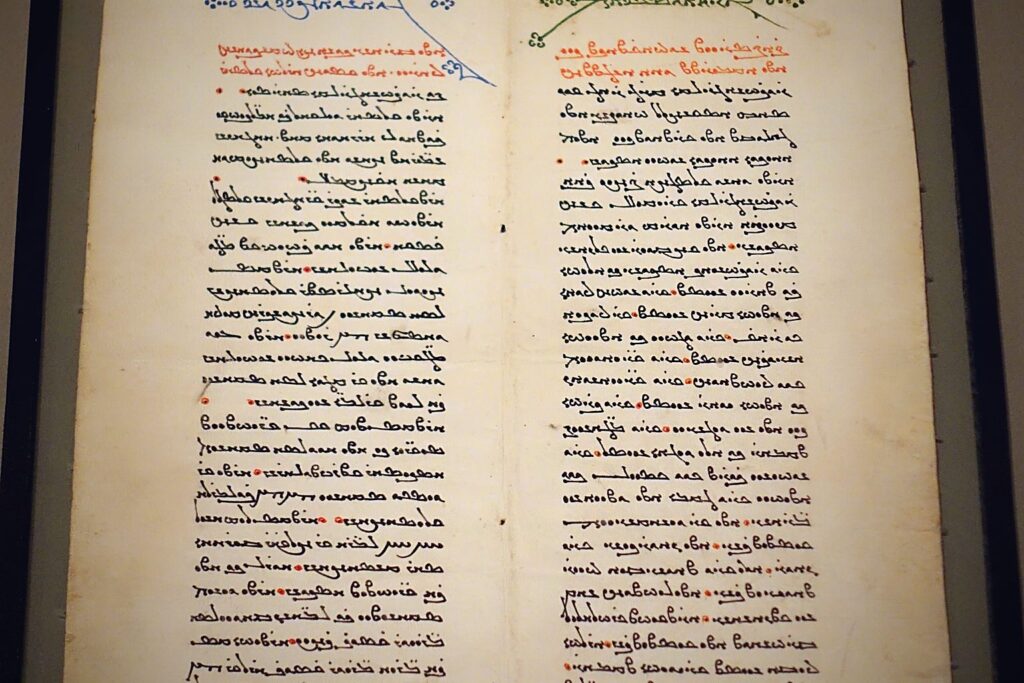
Except in one place. In the ruined oasis towns of Turfan, in what is now Xinjiang, German expeditions in the early twentieth century dug out a library of Manichaean manuscripts, buried and forgotten. Among them were fragments of Mani’s Book of Giants — in Middle Persian, in Parthian, in Sogdian, and in Old Uyghur. The scholar W. B. Henning published them in 1943, and that edition was, for the next few years, the only Book of Giants anyone had.
Then the Dead Sea Scrolls were found, and the Aramaic original that everything else descended from came back into the light — after which it became possible to see the chain: Aramaic in Judea, into Syriac, into Greek and Middle Persian, into Sogdian, into Old Uyghur. One book, six languages, five thousand kilometres (three thousand miles), and about a thousand years.
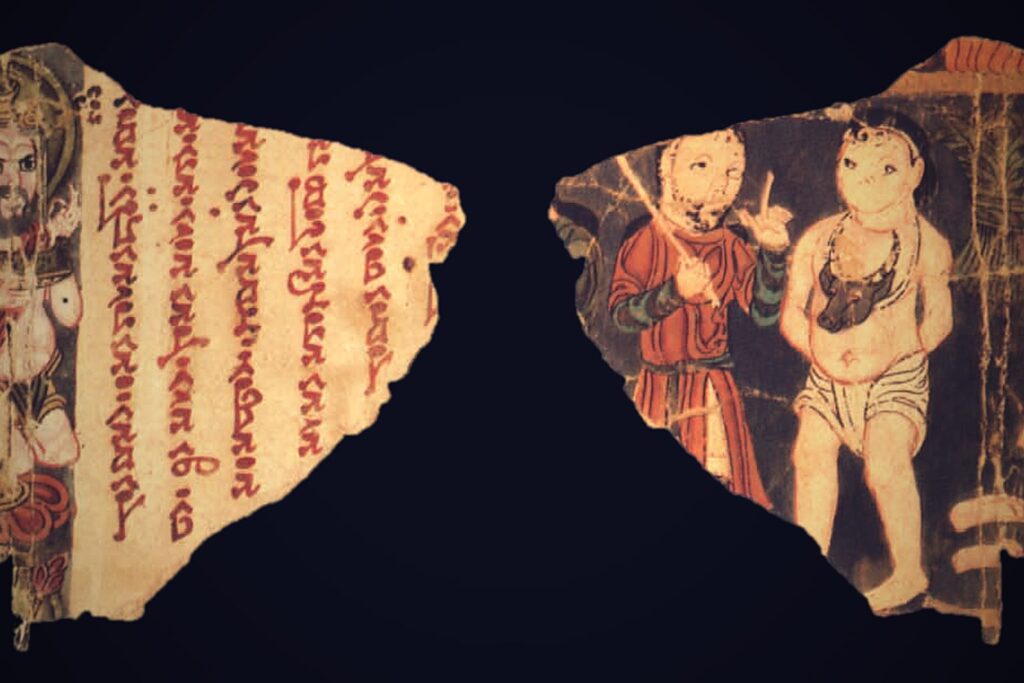
There is a detail in the Persian version that is almost too good. When the text was rendered for a Persian-speaking audience, the giants’ names were localised — and Ohyah and Hahyah were given the names Sām and Narīmān, heroes of Iranian epic, the ancestors of Rostam in the Shahnameh. The monstrous children of Genesis 6 were quietly recast as the founding heroes of Persian legend, because those were the names that meant enormous ancient warrior to the audience in hand.
Translation is never only translation. Somebody made that decision, and you can still see the fingerprints.
Is It in the Bible? That Depends Whose Bible
The obvious question, and the answer turns on a distinction that usually gets flattened.
The Book of Giants is in nobody’s canon. It was never a candidate. It is not a book that was voted out at a council, and there is no record of anyone proposing it in the first place. It belongs to a large body of Second Temple literature that was read, copied and valued without being scripture, in a period when the boundary between the two categories was not yet drawn where we draw it now. The fuller argument about what was left out and by whom applies here.
1 Enoch is a different case entirely, because it did make it — just not into the Bible most readers own. Jude quotes it directly. Several early Christian writers treat it as authoritative. And the Ethiopian Orthodox Tewahedo Church never let go of it: its canon runs to eighty-one books, and 1 Enoch is scripture inside it. So is the Book of Jubilees, called Mets’hafe Kufale in Ge’ez, and so are the three books of Meqabyan. The Eritrean Orthodox Tewahedo Church holds the same canon.
So “not in the Bible” is not a single fact. For a Protestant, a Catholic or a Greek Orthodox reader, 1 Enoch is outside. For an Ethiopian Orthodox reader it has been inside for as long as there has been an Ethiopian church — and that is not a footnote, it is the reason the book exists. Every other tradition let 1 Enoch go, and the Greek and Aramaic come down to us only in fragments. The complete text survives in Ge’ez because one church kept reading it.
Which loops back to the number this article started with. The Ethiopic branch that preserves the whole book is also the branch that gives the 3,000-cubit figure. The reason you can read all of 1 Enoch and the reason you read that particular height are the same reason.
The Book of Giants had no such patron anywhere. It survived instead by being useful to a Persian religion that was itself wiped out, and then by being buried in a desert at each end of the journey — one above the Dead Sea, one on the edge of the Taklamakan.
What the Text Actually Gives You
Strip out the shock value and something more unusual is left.
The Book of Giants is one of the only ancient texts that takes the perspective of the condemned. The giants in it are not simply monsters being punished offstage. They are characters who know something is coming, who cannot interpret the warning themselves, who send for the one man who can, and who receive an answer that offers them nothing. Ohyah’s tablet keeps three names, and none of them is his.
Whatever else the book is, it is not the gore that the search results promise. It is a story about being told the ending in advance and not being able to change it — which, for a text found in ten copies in the library of a community that was itself waiting for a judgement it believed was near, is not a surprising thing to have been reading.
Frequently Asked Questions
What does the Book of Enoch say about the giants?
1 Enoch 6–7 describes them as the children of the Watchers — angels who descended on Mount Hermon — and human women. The text says they first consumed everything men could produce, then turned on people and devoured them, then attacked birds, beasts, reptiles and fish, then began eating one another and drinking blood, until the earth itself brought an accusation against them and the Flood followed.
How tall were the giants in the Book of Enoch?
It depends on the manuscript. The Greek text of Syncellus gives 300 cubits, about 137 metres (450 feet). The Ethiopic tradition, which most English translations follow, gives 3,000 cubits — about 1,372 metres (4,500 feet), taller than any building on earth. The oldest witnesses, the Aramaic fragments from Qumran, break off around this passage, so translations supply the number in brackets from the Ethiopic. Whether the earliest text gave a figure at all is not known.
What are the names of the giants in the Book of Enoch?
1 Enoch does not name them individually. The names come from the related Book of Giants, found at Qumran: Ohyah and Hahyah, sons of the Watcher Shemihazah; Mahaway, son of Baraq’el, who carries messages; Ahiram; and — remarkably — Gilgamesh, the hero of the Babylonian epic, who appears as one of the giants at 4Q530.
Is Gilgamesh really in the Dead Sea Scrolls?
Yes. The name appears in the Aramaic Book of Giants at 4Q530, where Gilgamesh is one of the giants rather than a Mesopotamian king. The later Manichaean versions keep him and add Hobabish, apparently corresponding to Humbaba from the same epic. It is direct evidence that Jewish writers of the Second Temple period knew Babylonian epic literature and were willing to fold its characters into their own.
What is the Book of Giants?
A Second Temple Jewish work about the giants of Genesis 6, related to 1 Enoch but separate from it. Around ten Aramaic copies were found among the Dead Sea Scrolls, the oldest from roughly 100 BC. It was later adapted by the Persian prophet Mani into Manichaean scripture, and fragments of that version were recovered at Turfan in Central Asia in Middle Persian, Parthian, Sogdian and Old Uyghur.
Did the giants in the Book of Enoch eat humans?
That is what the text says. 1 Enoch 7 has them devouring mankind once ordinary food ran out, then moving on to animals, then to one another. The Book of Giants adds that the violence extended to the created order generally, which is why the earth itself is described as bringing the complaint that triggers the Flood.
What was the dream about the trees in the Book of Giants?
Hahyah dreams of gardeners watering a garden that produces great shoots, which is then destroyed by water and fire. Ohyah dreams of a stone tablet thrown into water, from which every inscription is washed away except three. Enoch interprets: the garden is the earth, the destruction is the Flood, the tablet is the record of all living things, and the three surviving inscriptions are Noah and his sons.
Why is the Book of Giants not in the Bible?
It was never proposed for any canon, and it is not scripture in any church today. It belongs to a wide body of Second Temple writing that was read and copied without being treated as scripture. 1 Enoch is the opposite case: it is fully canonical in the Ethiopian Orthodox Tewahedo Church, whose Bible runs to eighty-one books and also includes Jubilees and the three books of Meqabyan. That is the reason the complete text of 1 Enoch survives in Ge’ez at all.
Continue Reading
- Who Was Enoch? The Man Who Never Died — Genesis 5 lists the patriarchs and every entry ends the same way: and he died. On the seventh entry the ledger simply…
- Books Mentioned in the Bible but Not Included: The Dead Links — Around twenty books are named in scripture as its own sources, cited more than forty times, and not one has ever been…
- How Tall Was Goliath? The Number That Grew — The oldest manuscripts say six foot nine, not nine foot nine. Why the difference matters, what the Rephaim actually…