Modern reinforced concrete has a design life of about 50 to 100 years. Marine structures do worse — seawater attacks the steel inside, the steel rusts, rust expands, and the concrete spalls away from the inside out. Harbour works built in the 1950s are already being demolished.
The Roman harbour at Caesarea has been sitting in the Mediterranean since roughly 22 BC.
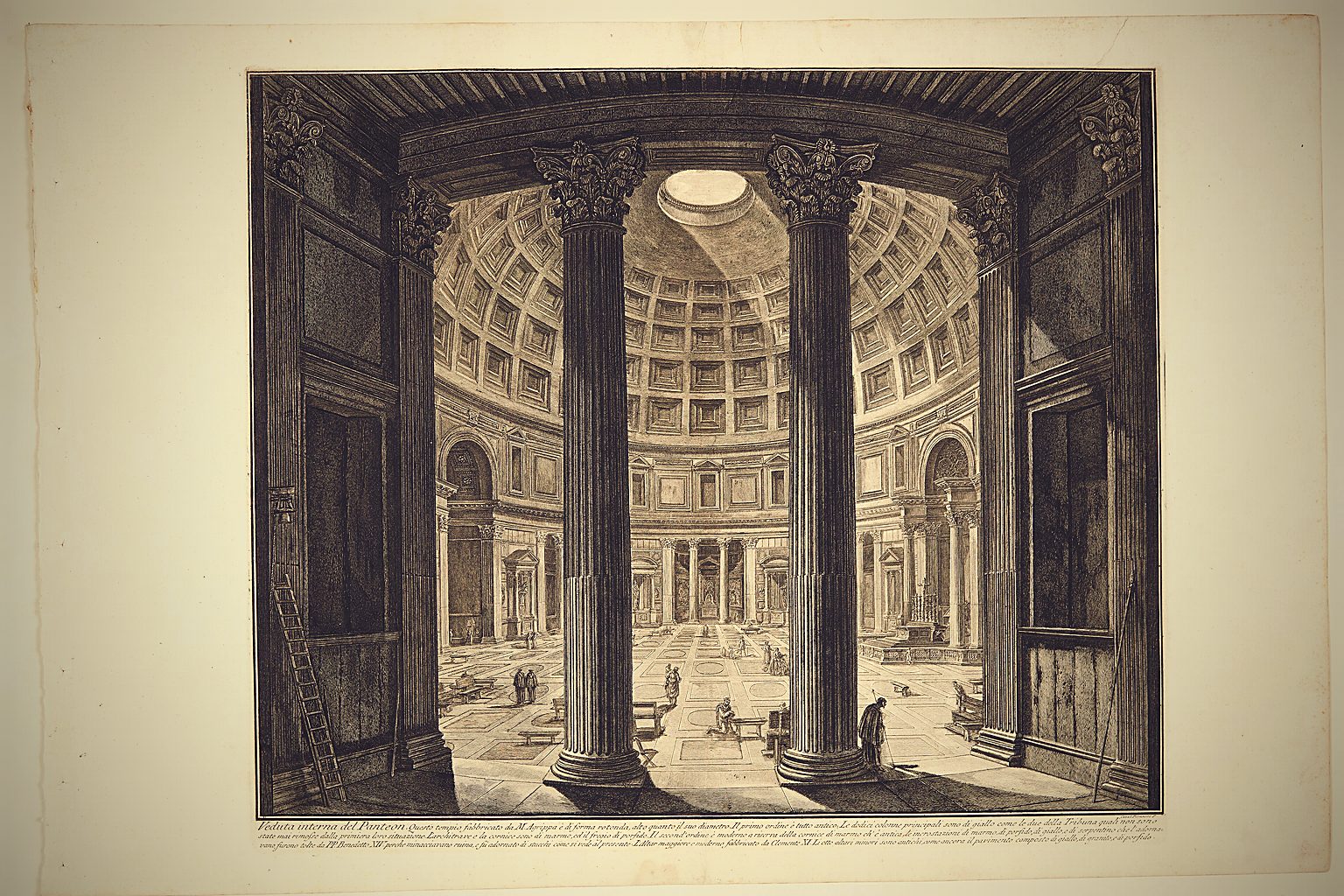
It is still there. So is the Pantheon dome, unreinforced, 43.3 metres (142 ft) across, holding itself up after nineteen centuries with a nine-metre hole in the top.
For a long time this was explained away as survivorship — we only see the ones that lasted. That explanation is no longer adequate, because since 2017 we have actually looked at the material, and it turns out Roman concrete does something modern concrete cannot.
It gets stronger.
What Was Roman Concrete Made Of?
Roman concrete — opus caementicium — combined three things:
- Lime (calcium oxide or slaked lime)
- Pozzolana: volcanic ash, the best from the Bay of Naples around Pozzuoli, which gave the material its name
- Aggregate: rubble, broken brick, tuff, pumice — whatever suited the load
For marine work, the Romans mixed it with seawater and packed it into wooden forms sunk in place. Vitruvius describes the recipe in De architectura in the first century BC, and Pliny the Elder notes that the material becomes “a single stone mass, impregnable to the waves and every day stronger.”
Pliny was right, and nobody took him literally for two thousand years.
Discovery One: The Seawater Is a Feature
In 2017, a team led by geologist Marie Jackson drilled cores from Roman marine structures and analysed them.
What they found was not a material that had merely resisted the sea. It was a material that had been reacting with it, continuously, for two millennia.
Seawater percolating through the concrete dissolves components of the volcanic ash and allows rare minerals to crystallise in the voids — aluminous tobermorite and phillipsite. These grow as interlocking plate-like crystals that reinforce the matrix from within.
In modern Portland-cement concrete, water intrusion is the beginning of failure. In Roman marine concrete, it is the mechanism of improvement. The structure is not enduring the ocean; it is using it.
Discovery Two: It Repairs Itself
The second finding came in 2023, from a team at MIT led by Admir Masic, and it resolved a detail that had been dismissed as sloppiness for a century.
Roman concrete contains small white lumps called lime clasts. The standard reading was that these were evidence of poor mixing — unreacted lime that the workers had failed to distribute properly. Analysts had been mentally subtracting them from the material for decades.
The MIT team proposed instead that they were deliberate, produced by hot mixing: using quicklime (calcium oxide) rather than slaked lime, so that the mix reacts exothermically during preparation. The heat drives the chemistry faster and leaves brittle, lime-rich clasts distributed through the matrix.
Then the clasts do something useful. When a crack forms, it propagates preferentially through the brittle clast rather than the surrounding material. Water entering the crack dissolves the exposed lime, and calcium carbonate recrystallises in the gap — sealing it.
The team tested it. They made concrete with and without lime clasts, cracked both, and ran water through. The clast-bearing samples sealed completely within two weeks. The control samples never sealed at all.
So the lumps that looked like a manufacturing defect are a distributed self-healing system, and the Romans either understood this or arrived at it empirically and kept doing it because it worked.
What This Says About “Lost” Knowledge
The recipe was not really lost in the sense of being hidden. Vitruvius was copied, read, and printed. The information survived.
What was lost was the practice — and with it, the accumulated judgement that makes a recipe work: which ash from which deposit, how hot to run the mix, how to proportion aggregate for a given load. After the Western Empire’s administrative collapse, the supply chains that moved volcanic ash across the Mediterranean stopped, the large-scale projects that justified the expertise ended, and the people who knew how to do it were not replaced.
Concrete essentially disappears from European construction for roughly a thousand years. It returns in the 18th century, when John Smeaton begins testing hydraulic limes for the Eddystone Lighthouse, and modern Portland cement is patented in 1824 — a different material, arrived at independently.
The same pattern runs through the Antikythera mechanism, where gearing of extraordinary sophistication appears once and then nothing comparable survives for 1,400 years. Capability held by a small number of practitioners, dependent on institutions and supply chains, is fragile in a way that written knowledge is not — and written knowledge without the practice is a recipe nobody can execute.
Why We Did Not Simply Copy It
The obvious question is why modern engineering did not just use the Roman formula.
Several honest reasons:
It sets slowly. Roman concrete gains strength over years and decades. Modern construction economics require a structure to bear load in weeks.
It is weaker in compression initially. Portland-cement concrete reaches far higher early strength, which is what allows tall buildings and long spans.
It is not compatible with steel reinforcement. Modern concrete’s defining trick is embedding steel to carry tension. Roman concrete has no reinforcement — which is precisely why it does not suffer the corrosion failure mode, and also why it cannot do what reinforced concrete does.
The ingredients are local. Pozzolana of the right composition is not available everywhere.
So Roman concrete is not simply better. It is optimised for a different problem — permanence over speed, durability over strength, mass over span. The Pantheon works by being extremely heavy and carefully graded, with dense travertine aggregate at the base and light pumice near the oculus, so the dome lightens as it rises.
That said, the recent findings are being actively pursued. Self-healing formulations using hot mixing are under development, and the motivation is not antiquarian: cement production accounts for roughly 8% of global CO₂ emissions, and a concrete that lasts three times longer is a large emissions reduction by itself.
The Pattern Worth Noticing
There is a specific failure mode on display here, and it is not the Romans’.
For a hundred years, analysts looked at lime clasts and saw a mistake. The material was outperforming everything modern, in the most hostile environment available, and the lumps in it were classified as evidence that the builders had been careless.
The assumption ran one way: we understand concrete, they did not, so anything in their material we cannot explain is a defect. It took until 2023 for someone to invert the question and ask what the clasts were for.
This is the same error that left Göbekli Tepe catalogued as a medieval cemetery for thirty years, and the same one that read the man pouring water in front of a sledge at Djehutihotep’s tomb as a ritual gesture rather than friction reduction.
It also cuts the other way, and the discipline matters. The Romans did not have chemistry. They had two centuries of failed harbours, surviving harbours, and craftsmen who noticed which was which. That is enough to produce a superb material and not enough to produce an explanation — which is exactly the profile of procedures preserved without the theory behind them that keeps turning up in ancient sources.
Frequently Asked Questions
What made Roman concrete so durable?
Two mechanisms. Volcanic ash reacting with seawater grows reinforcing aluminous tobermorite and phillipsite crystals inside the material over time, and lime clasts distributed through the matrix dissolve and recrystallise to seal cracks.
Is Roman concrete self-healing?
Yes. A 2023 MIT study led by Admir Masic showed that lime clasts, long dismissed as poor mixing, let cracks reseal with calcium carbonate. Test samples containing clasts sealed completely within two weeks; samples without them never sealed.
What is hot mixing?
Preparing concrete with quicklime (calcium oxide) rather than slaked lime, so the mixture reacts exothermically during preparation. The heat speeds the chemistry and leaves lime-rich clasts through the matrix that give the material its self-healing property.
Was the Roman concrete recipe lost?
The written recipe survived in Vitruvius. What was lost was the practice — the supply chains for volcanic ash, the large projects that justified the expertise, and the craftsmen’s judgement. Concrete largely vanishes from European construction for about a thousand years.
Is Roman concrete better than modern concrete?
For durability and marine exposure, yes. For strength and speed, no. Modern concrete reaches far higher early compressive strength and works with steel reinforcement; Roman concrete gains strength slowly over decades and has no reinforcement.
Why does seawater strengthen Roman concrete?
Seawater percolating through the material dissolves components of the volcanic ash, allowing aluminous tobermorite and phillipsite to crystallise in voids as interlocking plates that reinforce the matrix. In modern concrete, water intrusion instead corrodes the steel and causes spalling.
How old is the Pantheon dome?
The current Pantheon was completed around AD 126 under Hadrian, making the dome roughly 1,900 years old. At 43.3 metres (142 ft) it remains the largest unreinforced concrete dome in the world.
Pliny, Reread
“A single stone mass, impregnable to the waves and every day stronger.”
Pliny the Elder wrote that in the first century AD, and for nineteen hundred years it was filed as Roman self-congratulation — the kind of thing an imperial naturalist says about imperial engineering.
In 2017 a drill core showed that the mineral content of Roman marine concrete really does continue to develop, in seawater, indefinitely. In 2023 a cracked test specimen sealed itself in a fortnight.
Pliny was not boasting. He was describing the material accurately, using the only vocabulary available to someone with no chemistry — and the description sat in the literature, correct and unread, until somebody thought to check whether the odd lumps were there on purpose.
Continue Reading
- The Viking Sunstone: How It Works, and What Has Been Found — The physics is settled: a calcite crystal really can locate the sun through cloud. Everything else is argued — the one…
- The Baghdad Battery: The Chemistry Works. That Was Never the Question. — Copper, iron, bitumen and vinegar will produce a current whether anyone intended it or not. What the Baghdad jars…
- The Antikythera Mechanism: A Computer From 100 BC — Thirty surviving bronze gears that predicted eclipses, tracked four calendar cycles and modelled the moon’s variable…