
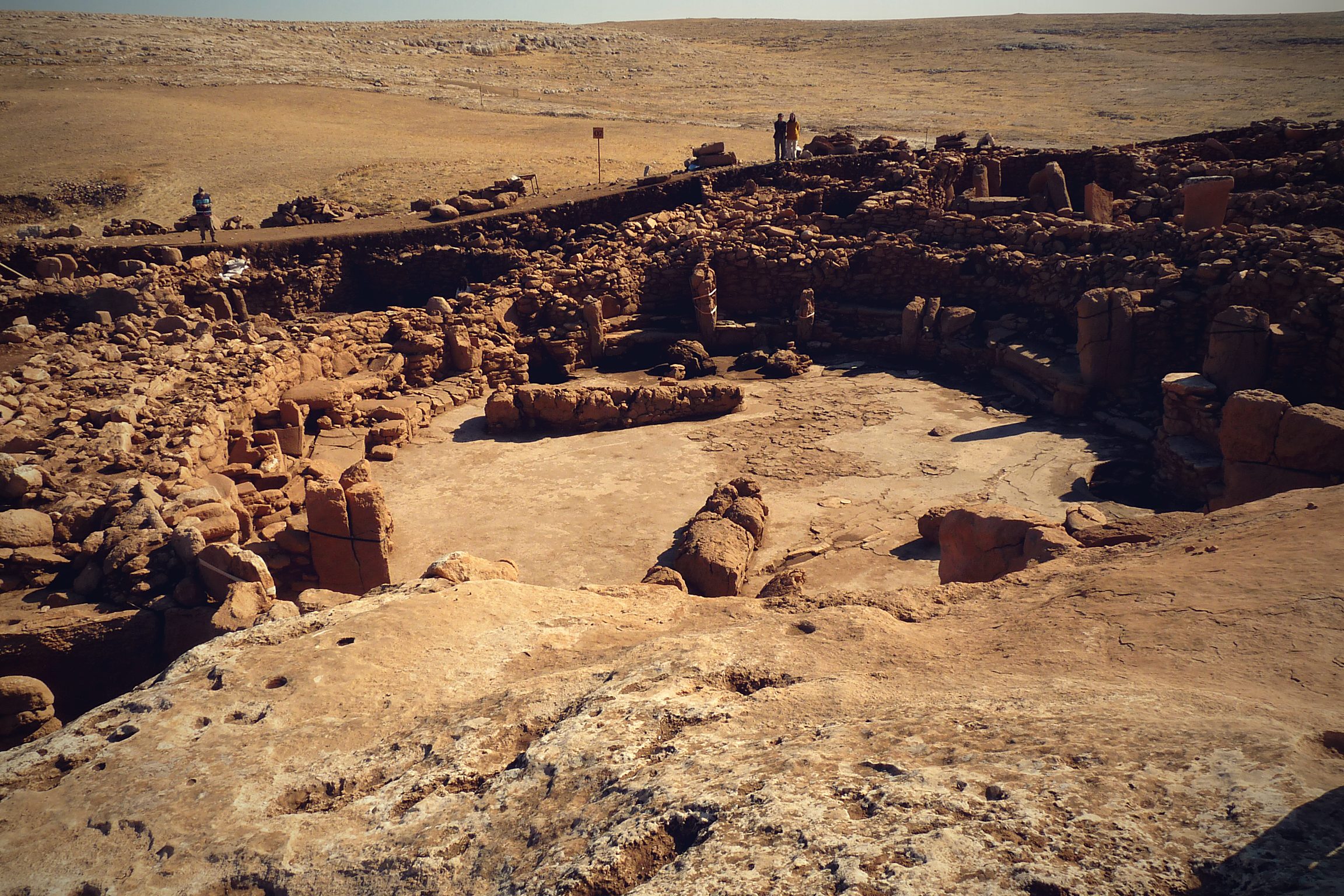
Cut down into the living rock of a ridge in southeastern Turkey, at a site called Karahan Tepe, is a small chamber about seven metres (23 ft) across that someone hollowed out of solid bedrock roughly eleven thousand years ago. They did not raise its pillars and stand them up. They carved the room around them — chiselling the stone away until ten shafts were left rising from the floor, each one shaped like an erect phallus. An eleventh, made separately, was slotted into a socket to complete the group. [1]
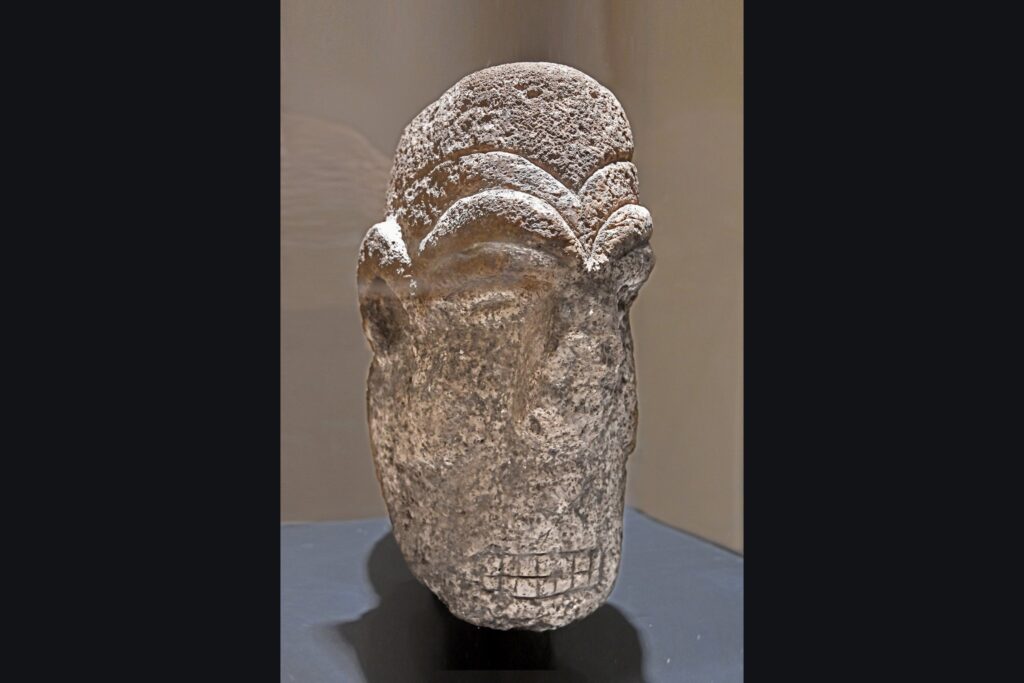
On the long wall opposite, watching the stones, a human head leans out of the rock: bearded, its neck running back into the wall like the body of a snake.
This is the best-known room at the site, and the people who made it had no pottery, no metal, no writing, no wheel and no farms. They worked with flint, stone and labour, in the same centuries that built Göbekli Tepe over the hills to the west. For most of the twentieth century, the accepted story said monuments like this came after agriculture, near the end of a long climb. Karahan Tepe sits before it.
What Was Karahan Tepe Used For?
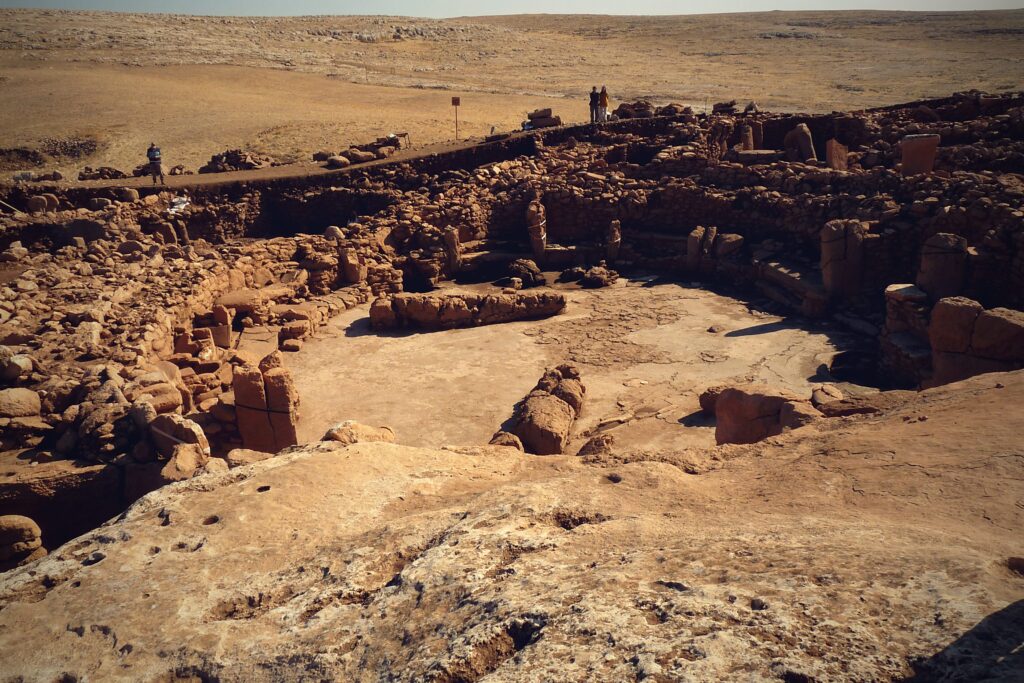
Nobody knows for certain, and the excavators are careful to say so. The leading reading, from the team now digging the site, is that Karahan Tepe was a place where dispersed groups gathered — to build together, to hold rites, and to share feasts — rather than an ordinary village where people simply lived. [2]
That reading rests on what the ground has produced: monumental rock-cut chambers, rows of carved pillars, sculpted human and animal figures, and a striking shortage of the everyday domestic clutter you would expect from a settled population of farmers. Later excavation has complicated the picture — there are signs of habitation too — but the core of the site is built for assembly and display, not for daily subsistence. What the gatherings meant to the people who held them is the part that is genuinely open, and every answer to it so far is interpretation.
Where Is Karahan Tepe?
Karahan Tepe stands in the Tek Tek Mountains of Şanlıurfa province, in southeastern Turkey, roughly 35 km (22 miles) east of Göbekli Tepe. [7] The two sites face each other across the same arc of upland north of the Harran plain, close enough that a person could walk between them in a long day.
That proximity matters. Karahan Tepe is not an isolated curiosity but one node in a dense cluster of contemporary sites across this corner of Anatolia — the group now studied together as Taş Tepeler, “stone hills” — of which Göbekli Tepe is only the most famous. [5]
When Was Karahan Tepe Discovered?
The site was first recorded in 1997, when the archaeologist Bahattin Çelik, surveying the Şanlıurfa region, noticed the tops of T-shaped pillars breaking the surface of the hill. [1][7] Follow-up surveys counted the visible stones: by 2000 more than 260 pillars had been logged across the mound, most of them still buried. [7]
For two decades the hill sat largely untouched, recorded and waiting. Systematic excavation began only in 2019, under the direction of Necmi Karul of Istanbul University. [2][7] In 2021 the work was folded into Taş Tepeler, a research programme run by Turkey’s Ministry of Culture and Tourism that is excavating around a dozen Neolithic sites across the region at once. [5] Almost everything the public now knows about Karahan Tepe — the pillar chamber, the sculpted head, the statues — has come out of the ground since 2019.
How Old Is Karahan Tepe?
Karahan Tepe dates to the Pre-Pottery Neolithic, with its monumental construction placed broadly in the centuries around 9500 BC — roughly 11,000 years ago, and broadly contemporary with the earliest enclosures at Göbekli Tepe. [2][7] That puts it some seven thousand years before the Great Pyramid and about six thousand before Stonehenge.
The people who cut the pillar chamber had, by every measure the excavation has recovered:
- No pottery
- No metal tools
- No writing
- No wheel or draft animals
- No confirmed domesticated crops or herds
What they had was flint, stone, rope, timber and the ability to organise a great deal of labour. With that they quarried nothing and carried nothing heavy for the chamber itself — they did something arguably harder, removing tonnes of rock to leave the pillars standing exactly where the stone already was. The toolkit is Neolithic. The result is monumental.
The Pillar Chamber: Eleven Standing Stones and a Watching Head
The find that made Karahan Tepe famous is the room described at the top of this article, catalogued by the excavators as Structure AB and sometimes called the Pillar Shrine. It is a semi-subterranean chamber, about 7 by 6 metres (23 by 20 ft), cut down into the bedrock and reached by a stair. [1]
Ten of its pillars were carved directly out of the living rock — four in a front row, six behind — their phallic shaping unambiguous. An eleventh, fashioned separately, was fitted into a socket. “All pillars are erected and shaped like a phallus,” Karul told reporters when the chamber was announced in 2021. [3] Facing them from the middle of the long wall is the sculpted human head, emerging from the stone with a neck that trails back into the wall like a serpent.
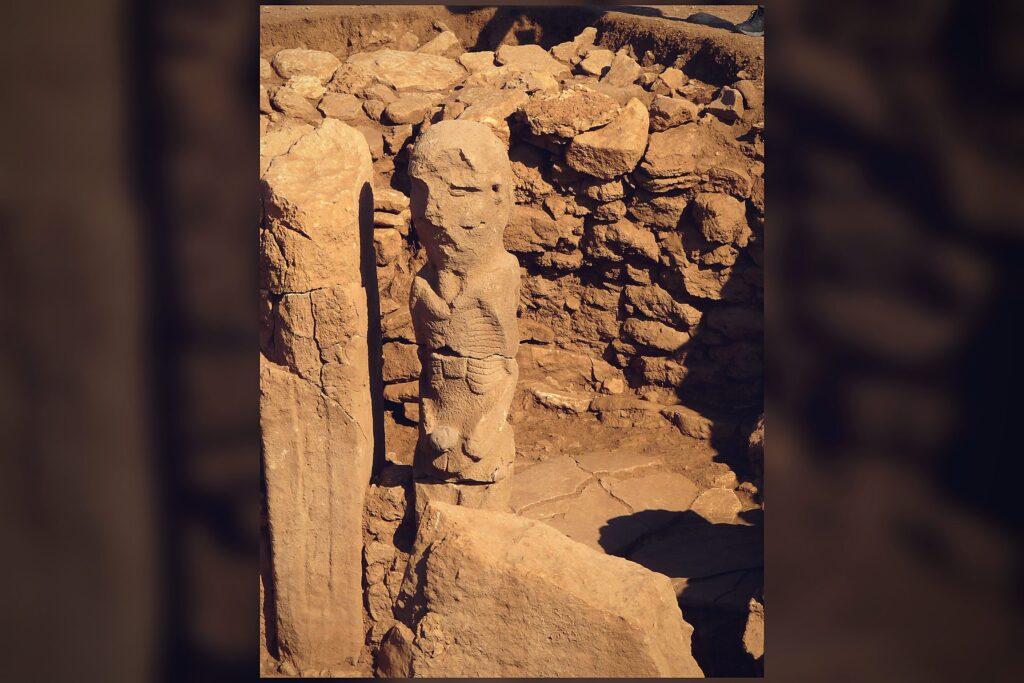
The chamber is not the only sculpture here. In September 2023 the team recovered a 2.3-metre (7 ft 7 in) statue of a man, fixed in a seated position on a stone bench, both hands gripping his phallus, with a carved vulture found nearby. [4][7] It is among the largest naturalistic human statues known from this period — a sibling to the famous “Urfa Man” from the same region, long held to be the oldest life-size human statue in the world.
Was Karahan Tepe Deliberately Buried?
Many of the structures at Karahan Tepe were found filled with rubble and sediment, their chambers packed to the brim — which is the same condition in which Göbekli Tepe’s enclosures were discovered, and it raises the same unsettled question. Karul’s own account of the site describes buried buildings. [2]
Whether that burial was deliberate — a ritual “decommissioning” of a chamber at the end of its use — or simply the slow work of erosion, slope wash and collapse is not yet settled, and it is the identical debate that has run over Göbekli Tepe for years. At Göbekli the original claim of intentional backfilling has been substantially softened by later work. At Karahan Tepe, with excavation only a few years old, the honest answer is that the fill is real and its cause is still being argued.
Why Karahan Tepe Matters
Strip away every contested reading and one hard fact remains: monumental building, organised across a whole region, is here before farming rather than after it. Göbekli Tepe established that on its own. Karahan Tepe, 35 km (22 miles) away and built in the same style in the same centuries, shows it was not a one-off.
That is the real weight of the Taş Tepeler discovery. A single astonishing site can be treated as an anomaly. A landscape of them — a dozen contemporaries sharing T-shaped pillars, rock-cut chambers and a common sculptural language, with no known shallow-end tradition leading up to them anywhere — is a pattern, and patterns demand an explanation. The order everyone was taught, in which surplus food comes first and only much later pays for priests and monuments, does not obviously survive it.
Two broad readings compete for what that pattern means. Both have serious people behind them, and both are stated here at their strongest.
The Case That Something Older Lies Behind It
The reading that Karahan Tepe preserves knowledge older or larger than the Neolithic toolkit around it is usually dismissed before it is stated. Put properly, it rests on four points.
There is no learning curve. As at Göbekli Tepe, the most ambitious construction is not the latest. A tradition that developed on site should show early fumbling and later mastery; what the region shows instead looks to its advocates like competence arriving already formed.
A whole region starts at once. Karahan Tepe, Göbekli Tepe and their neighbours appear across southeastern Anatolia in the same window with no identified precursor — no clumsy first attempts in the archaeological record leading up to them. A tradition usually has a shallow end; this one seems to begin at the deep end.
The date sits on a threshold. Construction clusters near the close of the Younger Dryas, the abrupt cold snap that ended around 9600 BC. Those who read a lost chapter into prehistory argue that a world-changing climate event and the sudden appearance of monumental culture in the same centuries deserve more than a shrug.
Most of it is still in the ground. With more than 260 pillars logged and only a handful of structures opened, any confident statement about what Karahan Tepe does not contain is a statement about a small, dug fraction of it.
On top of this evidential core sit the more expansive interpretations. The writer Andrew Collins, in a popular 2024 book on the site, reads Karahan Tepe as a shamanic “oracle” centre whose chamber was aligned to the bulge of the Milky Way and the constellation Scorpius, and identifies its builders with the Watchers and Nephilim of Hebrew tradition and the Anunnaki of Mesopotamian myth, tying the site’s serpent imagery to the serpent of Eden. [6] These are his claims, offered as interpretation; the serpent-necked head and the astronomical ambitions elsewhere in the region are what he builds them on.
The Reply From the Excavators
The excavation team and the wider Neolithic field answer the case point by point, and the answers are specific rather than dismissive.
The toolkit is Neolithic, and it is enough. Everything found at Karahan Tepe — flint blades, grinding stones, stone tools, no metal — belongs to its period. Removing tonnes of rock to leave pillars standing is extraordinary for the date, but it needs organisation and time, not lost technology. What the site demonstrates, on this reading, is that Pre-Pottery Neolithic people were capable of far more than the old model allowed — not that someone else did the work.
The symbolism reads as ritual, not astronomy. The ranked phallic pillars, the watching head and the sculpted animals point most naturally to rites bound up with ancestry, fertility or male social potency, and to gatherings that knit scattered groups together. The chamber’s job, on this account, was to hold those gatherings — the same “cult before the crops” logic the Göbekli Tepe excavators proposed, now reinforced by a whole region of such places. [2]
The learning is actually visible. The field reads the same inversion the advocates cite in the opposite direction: traditions peak and then decline, which is what human traditions do. Treating a decline as proof of a vanished golden age, they argue, mistakes a normal pattern for a mystery.
The mythological identifications have nothing under them. There is no material link between the builders of Karahan Tepe and the Anunnaki, the Watchers or the Garden of Eden. Critics of the popular literature note that its astronomical and scriptural readings are assembled by selecting the handful of details that fit and setting the rest aside. [6] The serpent-necked head is genuinely strange; naming it is not the same as explaining it.
Sources
- Çelik, B. (2011). “Karahan Tepe: a new cultural centre in the Urfa area in Turkey.” Documenta Praehistorica 38 — doi.org/10.4312/dp.38.19
- Karul, N. (2021). “Buried Buildings at Pre-Pottery Neolithic Karahantepe.” Türk Arkeoloji ve Etnografya Dergisi 86 — tastepeler.org/en/pdf/karulN2021.pdf
- “Prehistoric Phallus-Shaped Pillars Found in Turkey.” Archaeology (Archaeological Institute of America), 2021 — archaeology.org/news/2021/10/21/211022-turkey-karahan-tepe-pillars
- “Statues found in Göbekli Tepe and Karahan Tepe.” Archaeology Magazine (archaeologymag.com), 2023 — archaeologymag.com/2023/10/statues-found-in-gobekli-tepe-and-karahan-tepe
- Taş Tepeler Project (Şanlıurfa Neolithic Research Project), Türkiye Ministry of Culture and Tourism — tastepeler.org/en
- “Review of Andrew Collins’ Karahan Tepe: Decoding a Neolithic Mystery.” A Hot Cup of Joe, 2024 — ahotcupofjoe.net/2024/12/review-of-andrew-collins-karahan-tepe-decoding-a-neolithic-mystery
- “Karahan Tepe.” Wikipedia — en.wikipedia.org/wiki/Karahan_Tepe
Frequently Asked Questions
What was Karahan Tepe used for?
Most likely as a gathering place rather than an ordinary village — somewhere dispersed groups came together to build, to hold rites and to feast. That is the excavators’ leading reading, based on the monumental rock-cut chambers and sculpture and the scarcity of everyday domestic remains. What the gatherings meant to the people who held them is still open.
How old is Karahan Tepe?
Roughly 11,000 years, with its monumental construction placed in the centuries around 9500 BC, in the Pre-Pottery Neolithic. That makes it broadly contemporary with the oldest enclosures at Göbekli Tepe, about 35 km (22 miles) away, and older than pottery, metal, writing and farming.
Where is Karahan Tepe?
In the Tek Tek Mountains of Şanlıurfa province in southeastern Turkey, around 35 km (22 miles) east of Göbekli Tepe. It is one of roughly a dozen contemporary sites in the region studied together under the name Taş Tepeler.
When was Karahan Tepe discovered?
The site was first recorded in 1997 by the archaeologist Bahattin Çelik, who spotted T-shaped pillar tops on the surface during a regional survey. Systematic excavation did not begin until 2019, under Necmi Karul of Istanbul University.
What is the pillar chamber at Karahan Tepe?
A semi-subterranean room, Structure AB, cut into the bedrock and holding eleven pillars — ten carved directly from the rock and one set into a socket — most shaped like a phallus. A human head, with a snake-like neck, is sculpted from the wall facing them.
Was Karahan Tepe deliberately buried?
Its structures were found filled with rubble and sediment, exactly as Göbekli Tepe’s were. Whether that burial was intentional, as part of closing a chamber down, or the natural result of erosion and collapse is still debated, and the excavation is only a few years old.
Is Karahan Tepe older than Göbekli Tepe?
No — the two are broadly contemporary, both built in the Pre-Pottery Neolithic around the same centuries. Karahan Tepe is often called Göbekli Tepe’s sister site because of their matching age, T-shaped pillars and close distance.
Is Karahan Tepe connected to the Anunnaki or the Nephilim?
Only in popular interpretation. Writers such as Andrew Collins tie the builders to the Anunnaki, the Watchers and the Nephilim, but there is no material evidence linking the site to any of them; the excavators read the remains as the work of Pre-Pottery Neolithic communities. Both readings are set out in this article.
Conclusion: The Room Carved Out of the Hill
The most telling thing about Karahan Tepe is how it was made. Most monuments are an addition to a landscape: stone is quarried somewhere, carried, and stacked into a shape that was not there before. The pillar chamber is a subtraction. The people who made it chose a slab of hillside, decided where the stones would stand, and then cut everything else away — committing to the final arrangement before the first strike, with no way to undo a mistake.
That demands a plan held firmly in the mind, and the labour and coordination to execute it, among people the old sequence said should not yet have had either. Whether that points to a lost chapter of prehistory or to how badly the capacities of the first Neolithic communities were underestimated is exactly what the two readings above divide on.
The serpent-necked head is still watching its eleven stones, as it has for eleven thousand years, and most of the hill has never been dug.
Continue Reading
- Göbekli Tepe: The Temple That Came Before Farming — 11,600 years old – older than pottery, metal, writing and the wheel. Why Göbekli Tepe inverted the accepted order of…
- Derinkuyu: The Doors Only Close From Inside — Eighty-five metres down, eight levels open of an estimated eighteen, and a half-tonne stone wheel with a spear-hole…
- The Sumerian King List: 241,200 Years Before the Flood — Eight kings, 241,200 years, then a flood. Almost every retelling adds the numbers up — and what that shape means is the…