You go to sleep normally. Then, without an alarm, without a sound, you are awake — and the clock reads 3:12. The next night, 2:58. The night after that, 3:04. You are not alone in this. It is one of the most searched sleep questions in the world, and the spiritual meaning people pin on waking up at 3 AM splits cleanly into two camps that barely speak to each other.
One camp says the hour is spiritual. It calls 3 AM the “devil’s hour”, or points to the deep traditions — Hindu, Islamic, Christian, Buddhist — that single out the last stretch of the night as the most charged time to pray. The other camp says it is architecture: a dip in your body clock, a shift in your sleep stages, a rise in a stress hormone, and a worried mind that learns to wake itself.
This is an article about which parts of each account are solid, which are folklore sold as fact, and which are genuinely open. The surprising thing is how much of both survives scrutiny.
The Spiritual Meaning of Waking Up at 3 AM, and the Other Kind
There is no single established meaning of waking up at 3 AM, and the honest answer is that it depends on which kind of explanation you are asking for. Physiologically, the early hours are when your sleep is lightest and most easily broken, so a brief 3 AM wake-up is common and usually harmless. Spiritually, many of the world’s largest religious traditions treat the pre-dawn hours as the time most set apart for prayer — though, as we will see, almost none of them actually name “3 AM” as such.
The confusion comes from stacking the two meanings on top of each other and reading one as proof of the other. The claim that “I keep waking at 3 AM, therefore something spiritual is calling me” quietly assumes the body would otherwise sleep straight through — and it would not. The claim that “it is just biology, so the traditions are meaningless” quietly assumes the traditions were ever making a medical claim — and they were not. Both readings are worth taking seriously on their own terms before they are set against each other.
The Witching Hour, and Why 3 AM
The older phrase is the “witching hour”, and in its original sense it was not 3 AM at all. It was midnight. The idea that the powers of night peaked at the turn of the day is old folk belief, and the phrase itself is usually traced to Shakespeare — “’tis now the very witching time of night” — in Hamlet [6]. For centuries, the dangerous hour was twelve o’clock.
The 3 AM version is a later, specifically Christian overlay. The reasoning runs like this: the Gospels place the death of Jesus at “the ninth hour”, which on the Roman reckoning from sunrise is 3 PM. A tradition then grew that the demonic preferred to mock that moment by inverting it — holding its own “hour” at 3 AM, twelve hours opposite the hour of the Crucifixion [6]. On this account the “devil’s hour” is not an independent fact about the night so much as a deliberate parody of a sacred afternoon.
It is worth being plain about the status of this. The inversion is a folk-theological interpretation, not a statement found anywhere in the Bible. Horror cinema did the rest: films built around a character waking at 3 AM made the number a shorthand for dread, and the shorthand fed back into what people expect to feel when they see that time on the clock. Expectation is not nothing — it shapes experience — but it is also exactly the kind of thing that can manufacture a pattern out of ordinary nights.
Is 3 AM Actually in the Bible?
The Bible does not single out 3 AM. What it does, repeatedly and with weight, is treat the night as divided into watches and treat the darkest, latest of those watches as a time for prayer.
The Hebrew night ran in three watches; by the first century, under Roman custom, it ran in four, each about three hours long. The Gospel of Mark lists all four by name:
“Watch ye therefore: for ye know not when the master of the house cometh, at even, or at midnight, or at the cockcrowing, or in the morning.” (Mark 13:35)
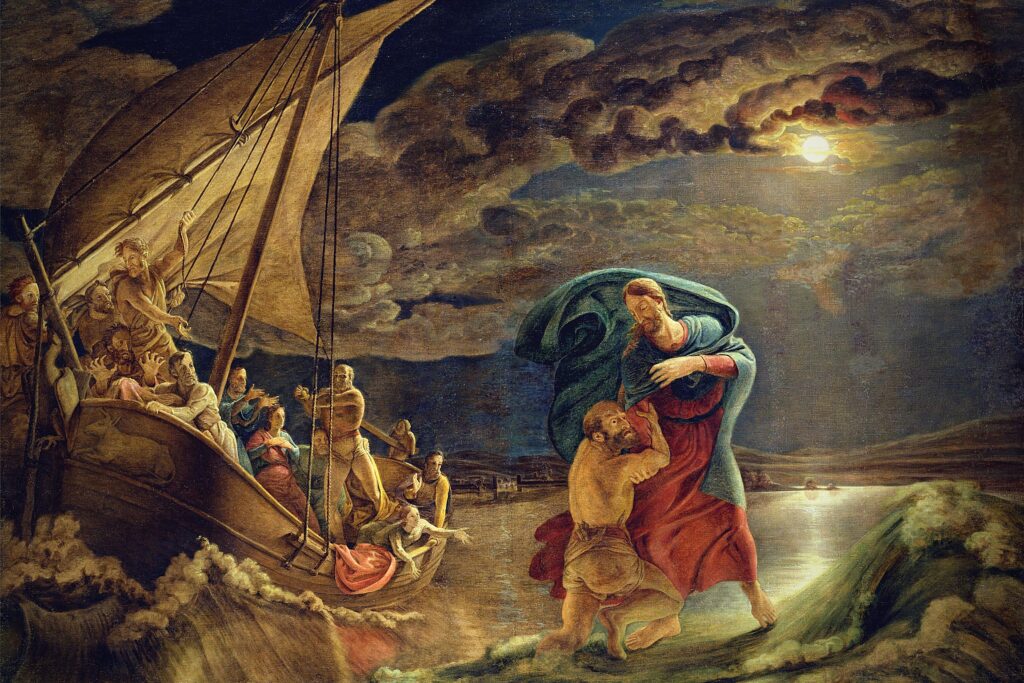
The “fourth watch” in that scheme runs roughly from 3 to 6 AM — and it is precisely when the most famous night scene in the Gospels is set:
“And in the fourth watch of the night Jesus went unto them, walking on the sea.” (Matthew 14:25)
The pattern of pre-dawn prayer is everywhere once you look. Jesus himself is described rising before daylight to pray alone:
“And in the morning, rising up a great while before day, he went out, and departed into a solitary place, and there prayed.” (Mark 1:35)
The Psalms make night prayer a settled habit, not an emergency: “At midnight I will rise to give thanks unto thee” (Psalm 119:62), and
“When I remember thee upon my bed, and meditate on thee in the night watches.” (Psalm 63:6)
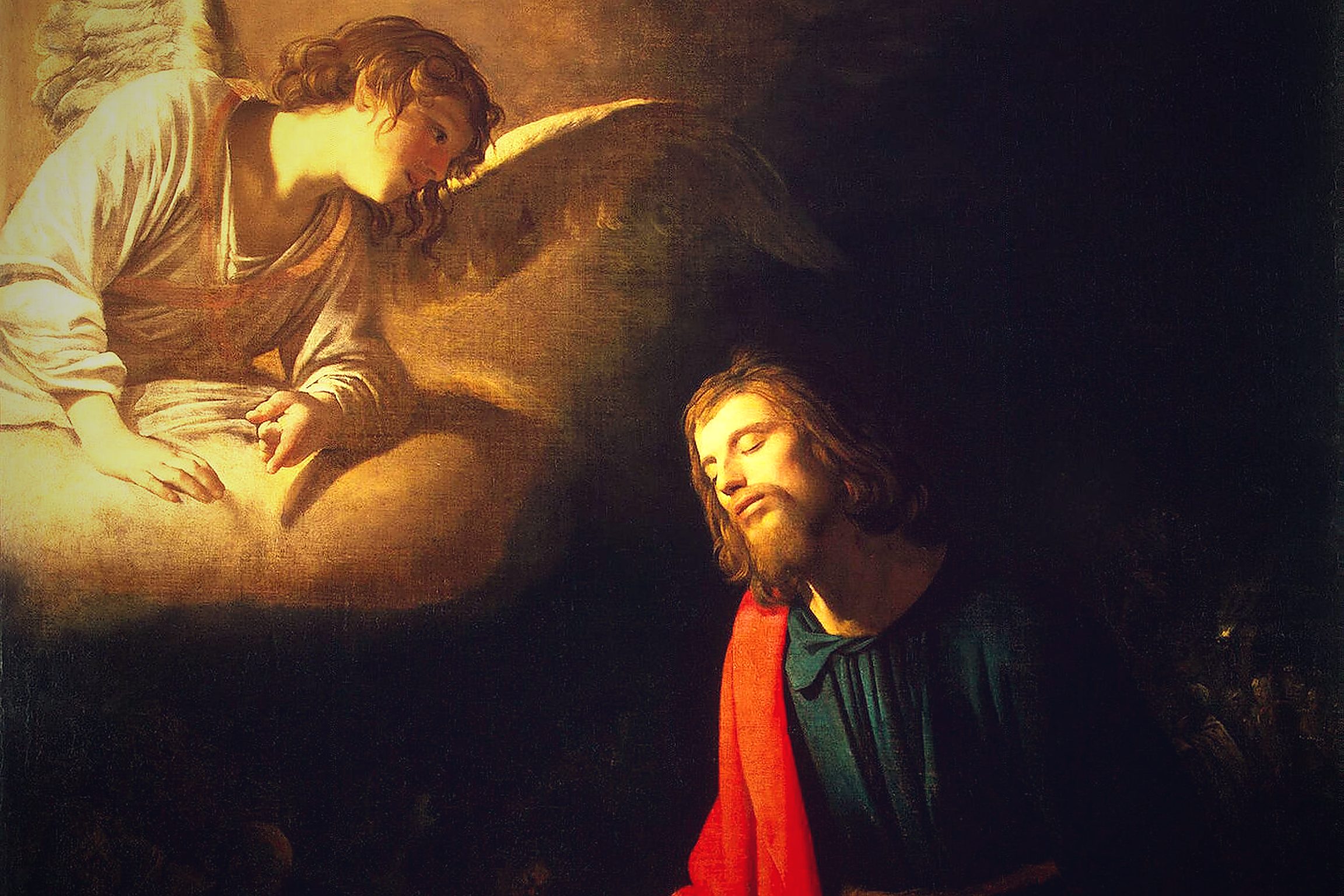
Paul and Silas sing in prison at midnight (Acts 16:25). In Gethsemane, Jesus asks the sleeping disciples the question that every later night-prayer tradition would take as its charter — “could ye not watch with me one hour?” (Matthew 26:40). And the Crucifixion itself is framed by the clock: darkness “over the whole land” from the sixth hour to the ninth — noon until 3 PM (Mark 15:33) [13].
So the biblical case is real but narrower than the popular version. Scripture honours the night watches and pre-dawn prayer in general; it nowhere marks 3 AM as a portal, a danger, or a scheduled appointment. The hour people fixate on sits inside a window the Bible treats as holy, which is not the same as the Bible naming the hour.
The Same Hour in Other Religions
What is striking is that the instinct to pray in the last part of the night is not Christian property. Several unrelated traditions converge on roughly the same window, each with its own reasoning.
In Hinduism, the auspicious pre-dawn period is Brahma Muhurta, “the hour of Brahma”. It is reckoned as two muhurtas — about 96 minutes, or roughly an hour and a half — before sunrise, which in practice places it somewhere around 3:30 to 5:30 AM depending on the season and latitude [8]. It is held to be the time when the mind is naturally calm and least cluttered, and so the ideal window for meditation, study and sadhana.
In Islam, the voluntary night prayer is Tahajjud, offered during Qiyam al-Layl, the standing of the night. Its merit is tied to a widely cited saying attributed to the Prophet, recorded in both of the most authoritative hadith collections:
“Our Lord descends every night to the lowest heaven when the last third of the night remains, and He says: Who will call upon Me, that I may answer him? Who will ask of Me, that I may give him? Who will seek My forgiveness, that I may forgive him?” (Sahih al-Bukhari 1145)
Scholars have long debated how to read the word “descends”, but the point for our purposes is the timing: the “last third of the night” is, in most seasons, close to the same early-morning stretch [7].
Monastic Christianity built the same instinct into a daily timetable. The night office — called Vigils, later Matins, with Lauds at daybreak — took its very name from the Roman army’s night watches, and Benedictine communities historically rose in the small hours to sing it [10]. Buddhist monasteries likewise rise well before dawn for seated meditation. The windows do not line up to the minute, but they cluster.
| Tradition | Practice | Rough window | Stated reason |
|---|---|---|---|
| Hindu | Brahma Muhurta | ~3:30–5:30 AM | Calmest, most sattvic hour for meditation |
| Islam | Tahajjud / Qiyam al-Layl | Last third of the night | The hour of nearness and answered prayer |
| Christian monastic | Vigils / Matins / Lauds | ~2–5 AM | Keeping watch; praying while the world sleeps |
| Buddhist monastic | Pre-dawn meditation | Before sunrise | Clear mind before the day’s activity |
One clarification belongs here, because it is the single most common mix-up. The Catholic Divine Mercy devotion also fixes on “three o’clock” — but that is 3 PM, the hour of the Crucifixion, honoured as the Hour of Great Mercy [9]. It has nothing to do with 3 AM. People who read a devotional note about “the three o’clock hour” and assume it endorses waking at 3 AM have crossed two entirely different clocks.
Churches That Pray From 3 to 5 AM
This is not only history. In living practice, millions of Christians today gather specifically in the 3-to-5 AM range.
In South Korea, dawn prayer — saebyeok gido — is a daily institution across Protestant and Catholic churches, with services commonly starting between about 4:00 and 5:00 AM before people leave for work. Large congregations run early-morning prayer festivals that draw tens of thousands; one Seoul megachurch holds services beginning at 4:50 AM [11]. The practice predates Korean Protestantism and has become one of the most recognisable features of Korean Christianity.
In Nigeria and across much of Pentecostal Africa, the parallel form is the all-night vigil. Churches such as the Redeemed Christian Church of God hold Friday-night meetings that run into the early hours, on grounds built to hold crowds in the hundreds of thousands [12]. The window from roughly midnight to dawn is treated as prime time for intercession and spiritual breakthrough. In the Orthodox tradition, the Midnight Office and nocturnal Matins keep the same vigil in a more liturgical key.
Ask practitioners why that window, and the answers rhyme across traditions: it is quiet, the world’s demands are switched off, the mind is undistracted, and — in the explicitly supernatural framing — it is when the veil between the seen and unseen is felt to be thinnest. That last claim is exactly the one the other camp sets out to explain in ordinary terms.
What the Body Is Doing in the Early Hours
Set the traditions aside and look at what sleep science has measured, and the early morning turns out to be a genuinely eventful stretch — just not a mystical one.
Your sleep is lightest then. A night runs in cycles of roughly 90 minutes. The first half is loaded with deep, slow-wave sleep; the second half shifts toward lighter stage-two sleep and longer REM periods [1]. By around 3 to 4 AM most people are well into that lighter territory, where a full bladder, a noise, a dropping room temperature or a vivid dream can tip them over into waking. A brief awakening at that hour is not an anomaly; it is the part of the night most built for it. This is also why the “someone is in the room” sensation clusters here — the mechanism behind sleep paralysis and the night-hag experience lives in exactly this REM-rich late window.
Your core temperature bottoms out, and your clock turns. The circadian low point for body temperature falls in the pre-dawn hours, and the rhythm begins turning toward morning around then. This is the same window in which melatonin starts to ebb and the body prepares, hours in advance, to wake.
Cortisol is rising — but the popular version overstates it. It is often said that you wake at 3 AM because of a “cortisol spike”. The real picture is more careful: cortisol is lowest in the evening, climbs through the second half of the night, and peaks shortly after normal waking time [2]. So cortisol is indeed on its way up at 3 AM — but recent work indicates the rise is driven by the internal clock rather than caused by the act of waking, which makes “a cortisol spike woke me” a weaker claim than it sounds.
Blood sugar and the rebound question. In the early morning the body releases hormones that raise blood glucose to prepare for the day — the “dawn phenomenon”, roughly 4 to 8 AM [3]. A related idea, the Somogyi effect, held that an overnight low triggers a hormonal rebound that jolts you awake; continuous-glucose studies have largely disputed it as a cause of high morning readings [3]. What is better established is that the body’s defences against a genuine overnight low — including the ability to wake up at all — are weaker in the later part of the night than earlier [4]. For most people without diabetes this is not the explanation, but it shows the early hours are metabolically active, not inert.
Anxiety and the learned wake-up. Sleep-maintenance insomnia — waking and struggling to fall back — tends to cluster in the early hours, and worry makes it self-sustaining: the more alarming the 3 AM wake-up feels, the more the mind rouses to meet it, and the more reliably it recurs. A harmless brief awakening becomes a nightly 3 AM vigil of a very different kind. Alcohol, which fragments the second half of the night as it is metabolised, is one of the most common triggers.
The Liver Clock
One more claim deserves a straight hearing, because it is everywhere online. In Traditional Chinese Medicine, the 24-hour day is divided into twelve two-hour windows, each tied to an organ, and the liver is assigned 1 to 3 AM. Waking in that window is read as a sign of imbalance in the liver’s energy [5]. It is an internally coherent system and a very old one.
It is also not clinically established. There is no controlled evidence that a specific organ “regenerates” or detoxifies on a fixed two-hour clock, and liver function in fact varies across the whole sleep period rather than switching on at 1 AM [5]. Real circadian biology exists and is well documented; it simply does not map onto the TCM organ hours. The honest position is that the liver-clock is a traditional framework, not a measured one — worth knowing about, not worth treating as physiology.
The Case That the Hour Is Spiritual
Put at its strongest, the spiritual reading does not rest on the horror-film “devil’s hour” at all. It rests on convergence. Here are traditions with no shared origin — Vedic, Abrahamic, monastic, Pentecostal — independently arriving at the conviction that the last part of the night is the time most open to the divine. When unrelated cultures keep drawing the same line in the same place, the advocate argues, that is evidence the line is real and not invented.
The reading leans, too, on the testimony. People across these traditions report that prayer in the small hours feels qualitatively different — clearer, heavier, more answered — and the sheer consistency of that report is the kind of data the dismissive account has to explain away rather than engage. It connects to the wider question of whether the sleeping and waking mind touches something beyond itself, the same territory as dreams that seem to arrive before their events and the strangely uniform content of near-death experiences. And it takes the biblical framing at face value: the night watches are commended for prayer, the fourth watch is where Christ comes walking, and a believer who wakes in that window may reasonably treat it as an invitation rather than an accident.
The Case That It Is Sleep and Suggestion
Put at its strongest, the naturalistic reading does not need to call anyone a liar. It accepts the testimony and explains it. The early hours are, measurably, when sleep is lightest and most interruptible, when cortisol is climbing, when temperature and glucose are shifting — so of course people wake then, and of course the body is in an aroused, dream-saturated state that lends any experience unusual vividness.
The convergence of traditions, on this reading, is convergence on the obvious: every pre-industrial culture noticed that the hour before dawn is quiet, undistracted and strangely lucid, and built a practice around the one slot in the day when nothing else is demanding attention. That is a sound observation about attention, not evidence of a thinner veil. The “devil’s hour” at 3 AM is demonstrably a late, derivative folk gloss on the 3 PM Crucifixion, amplified by cinema. And the feeling that a specific hour is “calling” you is precisely what the mind does when it reads meaning into ambiguous states — including, on the materialist account, when the brain’s own chemistry floods the field, the question raised by the molecule the pineal region can make. Confirmation does the rest: you remember the nights you woke at 3:00 and forget the nights you slept through or woke at 5:40.
Where That Leaves You
Both accounts are stronger than their opponents allow, and they are not arguing about the same thing. The physiological case explains, convincingly, why a human body tends to surface in the early hours. It does not touch the separate claim that the hour so surfaced-into is spiritually significant — a claim about meaning, which no glucose curve can confirm or refute. The spiritual case, at its best, is not a rival theory of sleep architecture; it is a claim about what the quiet hour is for.
What would move the question? On the natural side, the pattern should dissolve under measurement — and for the plain “why do I wake up” part, it largely does. On the spiritual side, the interesting evidence was never going to be a clock reading; it is whether sustained prayer in that window produces anything the person, and those around them, can recognise as real. That is not a test a sleep lab can run.
The one detail that resists both tidy conclusions is the convergence itself. The body-clock account tells you why the hour is available. It does not quite tell you why so many unrelated peoples, long before any of them could measure a circadian rhythm, decided that the hour the body hands them awake was the hour to spend on their knees.
Sources
- “Physiology, Sleep Stages” — StatPearls, NCBI Bookshelf — ncbi.nlm.nih.gov
- “Rhythms in cortisol mediate sleep and circadian impacts on health” — review, NCBI PMC — pmc.ncbi.nlm.nih.gov
- “Dawn Phenomenon and Somogyi Effect” — StatPearls, NCBI Bookshelf — ncbi.nlm.nih.gov
- Jauch-Chara K et al., “Awakening and counterregulatory response to hypoglycemia during early and late sleep” — PLOS Medicine, 2007 — journals.plos.org
- Meridian (Chinese medicine) — the organ-clock claim and its evidential status — en.wikipedia.org)
- “Witching hour” — origin of the phrase and the 3 AM “devil’s hour” inversion — World Wide Words — worldwidewords.org
- Hadith on Allah descending in the last third of the night — Sahih al-Bukhari 1145 — sunnah.com
- Muhurta / Brahma Muhurta — timing before sunrise — en.wikipedia.org
- “The Hour of Great Mercy” — the 3 PM Divine Mercy devotion — EWTN — ewtn.com
- “Matins” — the monastic night office (Vigils) — Catholic Encyclopedia, New Advent — newadvent.org
- South Korea’s early-morning dawn prayer — CBN News — cbn.com
- Pentecostalism in sub-Saharan Africa and all-night vigils — An Introduction to Pentecostalism, Cambridge University Press — cambridge.org
- Bible text (KJV) — Bible Gateway — biblegateway.com
Frequently Asked Questions
What does waking up at 3 AM mean spiritually?
There is no single agreed spiritual meaning. Many traditions — Hindu Brahma Muhurta, Islamic Tahajjud, Christian monastic Vigils — treat the pre-dawn hours as the time most set apart for prayer and nearness to God, and some believers read a 3 AM wake-up as an invitation to pray. A separate folk idea calls 3 AM the “devil’s hour”. Neither is stated in the Bible, which commends the night watches for prayer without naming a specific hour.
Why do I keep waking up at 3 AM every night?
The early hours are when sleep is naturally lightest — the second half of the night is richer in REM and light stage-two sleep — so brief awakenings are common and usually harmless. Rising cortisol, a dropping core temperature, alcohol, a full bladder and anxiety can all contribute. If the wake-up feels alarming, worry itself tends to make it recur, turning a normal awakening into a nightly pattern.
Is 3 AM the “devil’s hour”, and is that in the Bible?
The “devil’s hour” at 3 AM is a folk-theological idea, not a biblical teaching. It arose by inverting the hour of Jesus’ death, which the Gospels place at the ninth hour — 3 PM — so that 3 AM became its supposed mockery twelve hours opposite. The Bible never names 3 AM as dangerous. Horror films popularised the association in recent decades.
What is the “last third of the night”?
It is the final third of the hours between sunset and dawn, prized in Islam as the best time for voluntary night prayer (Tahajjud). A famous hadith describes God drawing near in that window to answer those who call upon Him. In most seasons it overlaps with the same early-morning stretch other traditions single out, roughly 3 to 5 AM.
Is the Divine Mercy “three o’clock hour” the same as 3 AM?
No, and this is the most common mix-up. The Catholic Divine Mercy devotion honours 3 PM — the Hour of Great Mercy, the time of the Crucifixion — not 3 AM. A devotional reference to “the three o’clock hour” is about the afternoon, and has nothing to do with waking in the middle of the night.
Does waking at 3 AM mean high cortisol?
Cortisol does rise through the second half of the night and is on its way up by 3 AM, reaching its peak shortly after normal waking. But recent research indicates the rise is driven by the body’s internal clock rather than caused by waking, so “a cortisol spike woke me” overstates the link. Cortisol is one factor among several, not a switch.
What organ is linked to 3 AM in Chinese medicine?
Traditional Chinese Medicine assigns the liver to the 1-to-3 AM window on its organ-clock, and reads waking then as a sign of liver imbalance. It is a coherent traditional system but is not clinically established: there is no controlled evidence that an organ repairs on a fixed two-hour schedule, and liver function varies across the whole night rather than switching on at 1 AM.
Why do some churches pray from 3 to 5 AM?
Monastic communities have kept a night office (Vigils and Matins) since the early centuries, taking the name from the Roman night watches. Korean churches hold daily dawn prayer from around 4 to 5 AM, and many Pentecostal churches in Africa hold all-night vigils running into the early hours. Practitioners describe the window as quiet, undistracted and, in the supernatural framing, uniquely open to prayer.
Continue Reading
- The Pineal Gland: The Eye That Went Inside — Some lizards have a real third eye with a lens and a retina, and it is an extension of the pineal. What the human…
- The Mandela Effect: Seven Images That Made Strangers Agree — A room full of strangers remembered a death that never happened. Then somebody tested it properly: forty famous images…
- Demonic Possession vs Mental Illness: The Argument That Never Ended — For thousands of years, madness meant possession. Then psychiatry relabelled the symptoms and offered drugs that work…