
At Dragon Con in 2009, a paranormal researcher named Fiona Broome mentioned to someone in the convention’s security team that she remembered Nelson Mandela dying in prison in the 1980s. She remembered it in detail: the news coverage, the rioting in South African cities, a televised speech by his widow.
The man she was talking to remembered it too. So did other people in the room. Within the hour she was standing in a group of strangers comparing a memory none of them should have had, because Nelson Mandela was alive. He had been released in 1990, served as president of South Africa, and would not die until December 2013.
Broome called it the Mandela effect and put up a website. What has happened since is more interesting than the website: the thing turned out to be measurable, somebody measured it, and the result held up.

What Is the Mandela Effect?
The Mandela effect is a shared false memory: a specific, confident recollection of a detail that large numbers of unconnected people hold, and that turns out not to match the record. The defining feature is not that people are wrong. It is that they are wrong in the same direction, about the same detail.
An ordinary memory failure scatters. Ask a hundred people to recall a logo they have not examined closely and you should get a hundred slightly different wrong answers. What makes this category strange is that you do not.
The Examples Everyone Cites
| What a great many people remember | What is actually there |
|---|---|
| “Luke, I am your father” | “No, I am your father” |
| “Mirror, mirror, on the wall” | “Magic mirror on the wall” |
| The Berenstein Bears | The Berenstain Bears |
| The Monopoly Man’s monocle | He has never worn one |
| A cornucopia in the Fruit of the Loom logo | There has never been a cornucopia |
| C-3PO, gold all over | One leg is silver |
| Curious George’s tail | He does not have a tail |
| “Life is like a box of chocolates” | “Life was like a box of chocolates” |
Read that list and something uncomfortable happens. Most people find at least one line where the right-hand column feels wrong — not unfamiliar, but actively incorrect, as though the world has been edited.
That feeling is the phenomenon. Everything after this is an argument about where it comes from.
The Study That Made It Testable
For a decade this lived in forums, which is to say it lived nowhere: a pile of anecdotes with no denominator. Then in 2022, Deepasri Prasad and Wilma Bainbridge at the University of Chicago published a paper in Psychological Science that turned it into an experiment.
Their method was blunt and good. Take forty well-known images — logos, characters, brand marks. Show each participant three versions of one image: the real one, and two altered versions with a feature added, removed or changed. Ask which is correct.
If shared false memory is not a real category, the wrong answers should spread out. They did not. Seven of the forty images produced a consistent, specific error across participants — the same wrong version chosen, by strangers, at rates far above chance.
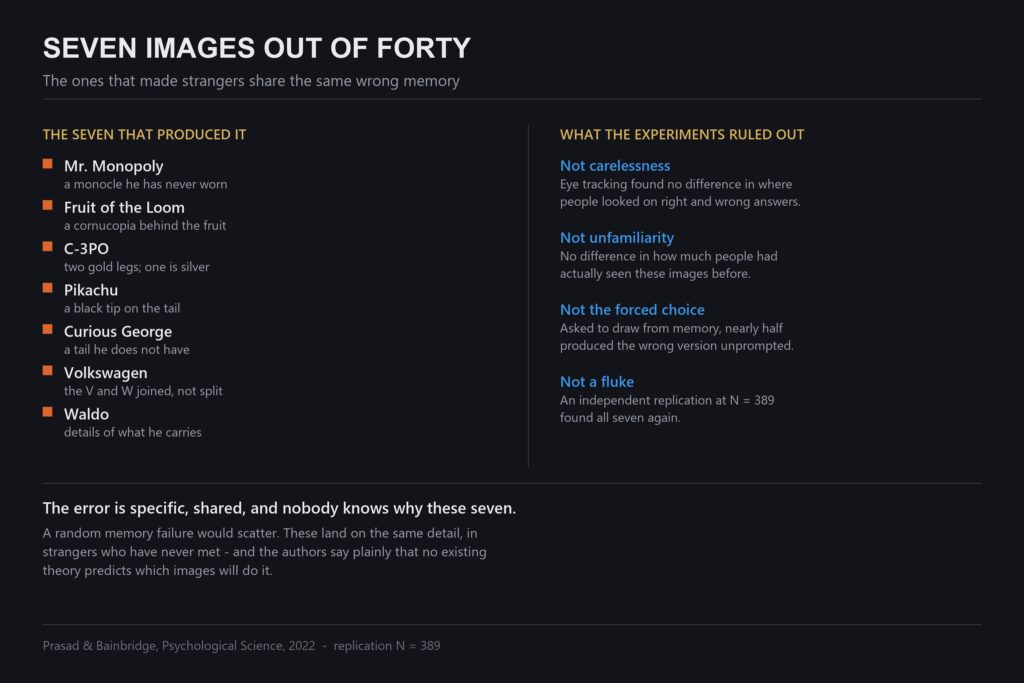
The seven were Mr. Monopoly, the Fruit of the Loom logo, C-3PO, Pikachu, Curious George, the Volkswagen logo, and Waldo. Prasad and Bainbridge called it the Visual Mandela Effect.
What the Experiments Ruled Out
The paper ran four experiments, and the later three exist to kill the obvious explanations.
It is not carelessness. In a second experiment they tracked where people were looking. If the error came from never really examining the relevant part of the image, gaze patterns should differ between correct and incorrect answers. They did not. People looked at the monocle’s absence and reported a monocle.
It is not unfamiliarity. A third experiment checked whether these particular images are ones people have simply seen less often or less clearly. No meaningful difference.
It is not an artefact of being offered choices. In a fourth experiment people were asked to draw the images from memory, with nothing to pick from. Nearly half the drawings contained the false feature anyway. The monocle gets drawn.
And it is not a fluke. An independent replication with 389 participants — far more than the original’s hundred — found all seven again.
That last point deserves weight. A great deal of psychology has failed to replicate over the past fifteen years, and this site has written about one of the most famous failures. This one replicated at nearly four times the sample size.
The Case That It Is Ordinary Memory
This is the mainstream reading and it is strong.
Memory stores gist, not detail. The brain is not a recording device. It keeps the meaning of a thing and reconstructs the specifics when asked, which is efficient and almost always good enough. The reconstruction draws on what is typical, and what is typical is where the errors come from.
Schemas fill the gaps in predictable directions. A wealthy cartoon tycoon in a top hat and spats belongs to a visual family that includes the monocle — Mr. Peanut wears one. A cartoon monkey should have a tail, because monkeys have tails. A brand called Fruit of the Loom is about abundance, and a cornucopia is the standard symbol for abundance. The false feature is not random; it is the more typical version of the image.
Elizabeth Loftus showed how easily this is pushed. Decades of her work demonstrate that memory can be edited by nothing more than the wording of a question, and that whole events can be implanted. If a leading question can do it, a thousand forum posts and a million memes can do it.
And every recall rewrites. Remembering is not reading a file. It is reassembling, and the reassembled version is what gets stored back. A memory recalled often is not better preserved; it has been through more edits.
That account explains a lot. It explains why the errors run toward the typical. It explains why they spread. It explains why confidence is no guide.
The Case That It Is Not Quite Solved
Here is what the schema account does not do, and the authors of the study say so themselves.
It does not predict which images. Thirty-three of the forty images tested produced no such effect. All forty are famous. Many have features just as atypical as a silver droid leg. No existing theory says in advance which ones will generate a shared false memory, and until a theory does, “schemas fill in the typical” is a description of the outcome rather than an explanation of it.
Typicality does not always fit. The Volkswagen logo error is about whether a gap separates the V and the W — a matter of spacing, not of meaning. There is no schema for “a car company’s initials should touch.”
And the errors are specific rather than vague. Not a general fuzziness about Pikachu’s tail, but the same black tip, reported by people with no contact with each other, and drawn from memory when nothing prompted it.
Then there is the reading the internet reached first: that these are traces of another version of reality — parallel branches, a simulation edited underneath us, CERN. Stated at its strongest, the claim is that the specificity is the evidence, because contamination should be noisy and this is not.
Stated honestly, it also has a problem the other side does not: as usually put, it predicts nothing. Any outcome can be accommodated by a sufficiently flexible multiverse. A version that named in advance which images would flip, and what else should differ, would be a scientific claim. Nobody has offered one.
What This Does to Testimony
This site spends most of its time on old texts and what people remembered long enough to write down, so the question has to be asked: if a hundred strangers can misremember a logo in unison, what is any tradition worth?
The honest answer has a distinction in it.
What the Visual Mandela Effect demonstrates is failure on incidental detail that nobody had a reason to encode carefully. Nobody ever looked at the Monopoly box and thought: I must fix the eyewear, this will matter. The errors cluster on exactly the sort of feature that memory is built to throw away.
That is a different category from an event with consequences attached, rehearsed deliberately, and told in a community that corrects each other. It does not make such memory reliable — it makes it a different problem, with different failure modes.
And for written transmission there is a check that memory does not have: the copies can be compared. When the Great Isaiah Scroll came out of a cave at Qumran, it was a thousand years older than the oldest Hebrew manuscript then known, and the comparison could simply be run. That is what the Dead Sea Scrolls settled and what they did not. You cannot do that with a memory. You can do it with a manuscript.
There is something else worth noticing, given how old this worry is. The Hebrew scriptures are unusually insistent about not trusting a single account: a matter is established at the mouth of two or three witnesses, never one. Written law was to be read aloud publicly, on a schedule, to a whole assembly. Stones were piled up as markers so that children would ask what they meant. Every one of those is a procedure for not relying on what one person recalls.
Whoever designed that system did not think memory was trustworthy on its own either.
Why You Remember Things Wrong
Because you are not playing back a recording, and you never were.
Recall assembles a plausible version from fragments, general knowledge and expectation, and it does this so smoothly that the result arrives feeling like retrieval. There is no internal signal that distinguishes a reconstructed detail from a stored one. Confidence tracks how fluently the memory came, not how accurate it is — which is why the Mandela effect feels so much like being gaslit rather than like being wrong.
The same architecture produces the phenomenon that shows up across every culture with the same figure sitting on the sleeper’s chest: a shared experience so consistent across strangers that it looks like evidence of something external, and turns out to be evidence about the machinery.
Whether the Mandela effect is the same kind of thing is the question, and it is not closed.
What Is Genuinely Unresolved
Why those seven. The central question, unanswered, stated as unanswered by the researchers who found it.
Whether the mechanism is one thing. “Berenstein” is a spelling, “Luke, I am your father” is a line of dialogue, the Volkswagen gap is a piece of geometry. They may have nothing in common but the name we have given them.
How much of it is contagion now. The effect was measured after fifteen years of internet discussion. What a clean 1995 baseline would have shown, nobody can now find out.
Frequently Asked Questions
What is the Mandela effect?
A shared false memory: a specific detail that many unconnected people confidently recall the same wrong way. It is named for Nelson Mandela, whom a large number of people remember dying in prison in the 1980s, although he was released in 1990 and died in 2013.
Is the Mandela effect real?
The phenomenon is real and measured. A 2022 study in Psychological Science tested forty famous images and found seven that produced consistent, specific false memories across participants, and an independent replication with 389 people found the same seven. What causes it is not settled — the researchers state that no existing theory predicts which images will do it.
What are the most common examples of the Mandela effect?
The Monopoly Man’s monocle, which he has never worn; a cornucopia in the Fruit of the Loom logo, which has never been there; the Berenstain Bears remembered as Berenstein; “Luke, I am your father”, which is actually “No, I am your father”; and C-3PO, who has one silver leg.
Did Nelson Mandela die in prison?
No. He was released on 11 February 1990 after 27 years, became president of South Africa in 1994, and died on 5 December 2013. He also did not spend those years entirely in a cell — the last fourteen months were in a warder’s house at Victor Verster prison, which is itself a detail most people remember wrongly.
Who came up with the term Mandela effect?
Fiona Broome, a paranormal researcher, after discovering at Dragon Con in 2009 that a room full of strangers shared her memory of Mandela’s death in prison. She launched a website documenting similar cases in 2010.
Why do we remember things wrong?
Because remembering is reconstruction rather than playback. Memory keeps the gist and rebuilds the details from what is typical, and the rebuilt version is stored back as though it were the original. There is no internal marker separating a detail you actually saw from one your brain supplied, which is why a false memory feels exactly like a true one.
Is the Mandela effect evidence of parallel universes?
That reading exists and its strongest point is the specificity — random error should scatter, and this does not. Its weakness is that, as usually stated, it predicts nothing and cannot fail a test. The competing explanation, that schemas fill gaps with the typical version, accounts for most cases but cannot say in advance which images will produce the effect.
Was it Berenstein or Berenstain Bears?
Berenstain, after the authors Stan and Jan Berenstain. It has always been spelled that way on the books, which is one reason this example is cited so often: the physical evidence is on millions of shelves, and people find it hard to believe when they check.
Where That Leaves You
Two things are true at once, and the discomfort comes from holding both.
The first is that this has been studied properly and it survived. Seven images out of forty make strangers wrong in the same specific way; it is not attention, it is not unfamiliarity, it is not the format of the question, and it replicated at four times the sample size. Anyone who tells you it is simply people being sloppy has not read the paper.
The second is that nobody can say why those seven. The schema explanation is the best available and it works backwards — it explains each case after you point at it, and it cannot tell you which image will be next. That is not a refutation. It is an unfinished job.
What the effect does prove, past argument, is smaller and stranger than a parallel universe and harder to live with. The confidence you feel when you remember something is not a measurement of whether it happened. It is a measurement of how easily the memory assembled itself.
And it assembles itself the same way whether it is true or not.
Continue Reading
- Demonic Possession vs Mental Illness: The Argument That Never Ended — For thousands of years, madness meant possession. Then psychiatry relabelled the symptoms and offered drugs that work…
- How Jesus Cast Out Demons: The Method, and the Signs — The Capernaum crowd was not astonished that a demon left. Exorcists were common. They were astonished that nothing was…
- Dreams That Predict the Future: The Records Kept in Advance — A psychiatrist went to Aberfan in 1966 and came back asking how many people had seen it coming. What his Premonitions…