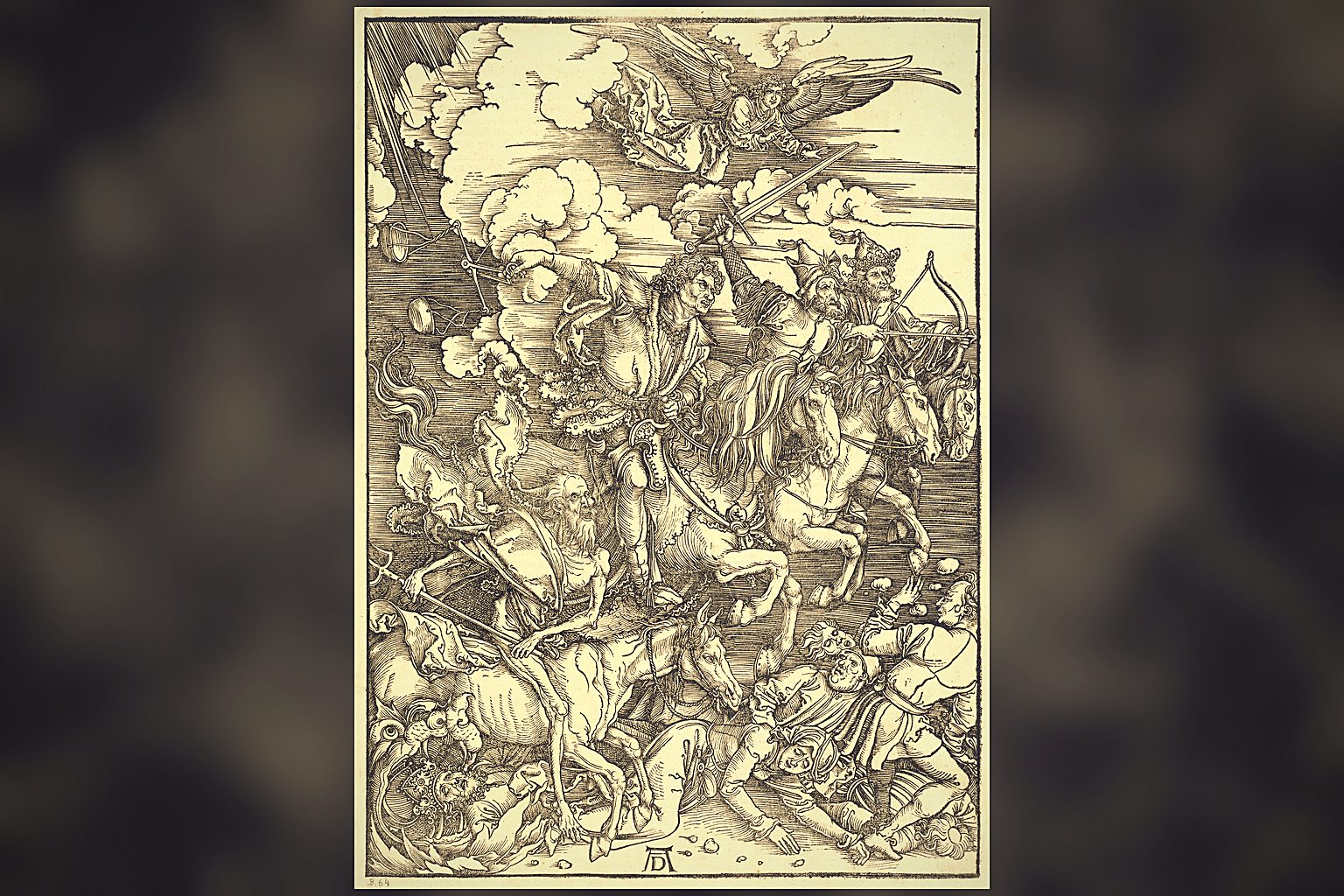
Revelation is the most-read and least-understood book in the Bible, and most of the confusion about how the world ends comes from one mistake: reading it as a timetable.
It is not structured like one. It is structured in three sequences of seven — seals, trumpets, bowls — and each sequence escalates, overlaps and recapitulates rather than simply continuing. The book returns to the same events repeatedly, from different altitudes.
Read as a calendar it is incoherent. Read as a series of concentric passes over the same ground, it has a shape.
The Structure: Three Sevens
| Sequence | Reference | Scope of damage | Character |
|---|---|---|---|
| Seven seals | Revelation 6-8 | A quarter of the earth | Conditions unleashed on history |
| Seven trumpets | Revelation 8-11 | A third of the earth | Warnings, partial and escalating |
| Seven bowls | Revelation 15-16 | Total | Final, complete, no fractions |
The fractions are the tell. Seals take a quarter. Trumpets take a third. Bowls take everything. The sequences are not simply consecutive — they are the same judgement intensifying across three passes, each with a wider reach.
The Four Horsemen
The first four seals release four riders (Revelation 6:1-8), and they form a causal chain rather than a list.
The white horse — conquest. A rider with a bow and a crown, going out “conquering, and to conquer.” This is commonly mistaken for Christ, who does ride a white horse in Revelation 19. But the two are different: the later rider has a sword, many crowns, and a name. This one has a bow with no arrows mentioned and a single crown given to him — the imagery of force projected rather than used. Conquest by threat and treaty.
The red horse — war. Power “to take peace from the earth.” Conquest without consent becomes open conflict.
The black horse — famine. A pair of scales, and a voice pricing a day’s wheat at a day’s wage. War destroys supply chains; rationing follows. The detail that the oil and wine are spared is pointed — luxury goods remain available while staples are priced out of reach. This is not scarcity. It is inequality under scarcity.
The pale horse — death. The consequence of the first three, with authority over a fourth of the earth “to kill with sword, and with hunger, and with death, and with the beasts of the earth.”
Conquest, war, famine, death. That is not a supernatural sequence. It is the documented progression of every large-scale collapse in recorded history, in the order it actually happens.
The Trumpets and the Bowls
The trumpet judgements strike the natural systems on which life depends: vegetation, sea, fresh water, and the light of sun, moon and stars (Revelation 8:7-12) — each affecting a third.
The fifth and sixth trumpets shift from environment to entities: the locusts from the abyss with a king named Abaddon in Hebrew and Apollyon in Greek — both meaning Destroyer — and an army released from the Euphrates.
The bowls (Revelation 16) repeat the same targets with the fractions removed. Sores, sea, rivers, sun, the throne of the beast, the Euphrates, and finally the air, with a voice declaring “It is done.”
The Two Witnesses, the Beast, and Babylon
Between the sequences, the book pauses for three extended portraits.
The two witnesses (Revelation 11) prophesy for 1,260 days, are killed, lie unburied for three and a half days, and rise. They are never named. The most common guess pairs Enoch and Elijah — the only two figures who left the world without dying — but the text does not identify them.
The beast (Revelation 13) rises from the sea with seven heads and ten horns, followed by a second beast from the earth that enforces worship and administers the mark.
Babylon (Revelation 17-18) is a city and a system — wealthy, seductive, drunk on the blood of the saints, and destroyed in a single hour. Revelation 18 reads as a trade lament: the merchants of the earth weep not for the people but for the loss of their market, and the cargo list ends with “slaves, and souls of men.”
That final item is the point of the whole chapter. The system’s last commodity is people.
The Four Ways to Read Revelation
Any honest treatment has to acknowledge that serious readers disagree fundamentally about what the book refers to.
| Approach | Claim | Strength |
|---|---|---|
| Preterist | Fulfilled in the 1st century, principally in Rome and the fall of Jerusalem in AD 70 | Explains the Nero gematria and the urgency of “shortly come to pass” |
| Historicist | A continuous map of church history from John to the end | Dominant among the Reformers |
| Futurist | Chapters 4 onward describe a still-future period | Most common in modern popular treatments |
| Idealist | A symbolic depiction of the ongoing conflict between good and evil in every age | Explains why the book has spoken to every generation |
The book itself frames its contents as “things which must shortly come to pass” (Revelation 1:1) and tells John not to seal it, “for the time is at hand” (22:10) — in deliberate contrast to Daniel, who was told to seal his words until the end (Daniel 12:4).
That contrast is not decorative. It is an argument for immediacy that the futurist reading has to account for, and it is the strongest textual point the preterists have.
What the Book Is Actually About
Strip the imagery and Revelation has a single structural claim, repeated at every level: the current arrangement is temporary and it is being dismantled on a schedule.
Note what it does not do. It does not end with destruction. The Apocalypse — Greek apokalypsis, meaning unveiling, not catastrophe — ends with construction:
“And I John saw the holy city, new Jerusalem, coming down from God out of heaven, prepared as a bride adorned for her husband.” (Revelation 21:2)
The last two chapters are not about fire. They are about a city with published dimensions, a river, a tree bearing twelve kinds of fruit, and the removal of death itself. The judgements clear a site. The New Jerusalem is what gets built on it.
And one detail closes a loop opened in the third chapter of Genesis. In Eden, access to the tree of life is cut off and cherubim are posted with a flaming sword to block the way. In Revelation 22:14, the final state is people “that they may have right to the tree of life.”
The same tree. The access restored. Everything between Genesis 3 and Revelation 22 is the story of how the barrier came down.
Frequently Asked Questions
What are the seven seals in Revelation?
Seven judgements opened by the Lamb in Revelation 6-8. The first four release the horsemen — conquest, war, famine and death — affecting a quarter of the earth. The fifth reveals martyrs, the sixth brings cosmic disturbance, and the seventh introduces the trumpets.
Who are the Four Horsemen of the Apocalypse?
The riders of the first four seals: white (conquest), red (war), black (famine) and pale (death). They form a causal chain, since conquest leads to war, war to famine, and famine to mass death.
Is the white horse rider Jesus?
No. The rider in Revelation 19 who is identified as Christ carries a sword, wears many crowns and is named. The rider of the first seal has a bow, one crown given to him, and no name — the imagery of conquest by threat.
What is the difference between the seals, trumpets and bowls?
Escalating scope. The seals affect a quarter of the earth, the trumpets a third, and the bowls are total with no fraction given. They are generally read as three intensifying passes over the same conflict rather than three consecutive stages.
Who are the two witnesses in Revelation 11?
They are not named. They prophesy for 1,260 days, are killed, and rise after three and a half days. A popular but unconfirmed identification is Enoch and Elijah, the two figures in Scripture who did not die.
What is Babylon in Revelation?
A city and an economic-religious system described in Revelation 17-18, destroyed in a single hour. The trade lament in chapter 18 lists its cargo, ending with “slaves, and souls of men.”
How will the world end according to Revelation?
Revelation does not end with destruction. After the judgements, chapters 21-22 describe a new heaven and a new earth, the New Jerusalem descending with stated dimensions, the removal of death, and restored access to the tree of life.
What does the word apocalypse mean?
The Greek apokalypsis means unveiling or revelation — a disclosure of something previously hidden. The sense of “catastrophe” is a later development in English, not the meaning of the title.
Conclusion: An Unveiling, Not an Ending
The popular picture of Revelation is a book about the end of the world. Its own title says otherwise: it is an unveiling, and what gets unveiled is that the present order is provisional.
Read that way, the sequence makes sense. Three passes of escalating judgement dismantle a system described as a market that finally trades in people. And then, in the last two chapters, something is built — with measurements, materials, a water supply and a food source, in the language of specification the biblical writers use whenever they mean something to be taken as real.
The book does not end with the world burning. It ends with a gate that is never shut, and a tree that has been off-limits since Genesis 3 standing in the middle of a city, available.
The destruction is the demolition phase. It was never the point.
Continue Reading
- The Third Temple: What Is Actually Ready, and What Is Not — The vessels are finished, the garments are woven and the plans exist. What does not exist is a valid set of ashes, an…
- The Mark of the Beast: What Revelation 13 Actually Specifies — There are two marks in Revelation, in the same place, doing the same job. Why 666 may be 616, what gematria points to…
- The New Jerusalem: Is the City of God a Divine Mothership? — Revelation gives the New Jerusalem a size, a shape and a materials list. Twelve thousand furlongs a side, walls of only…