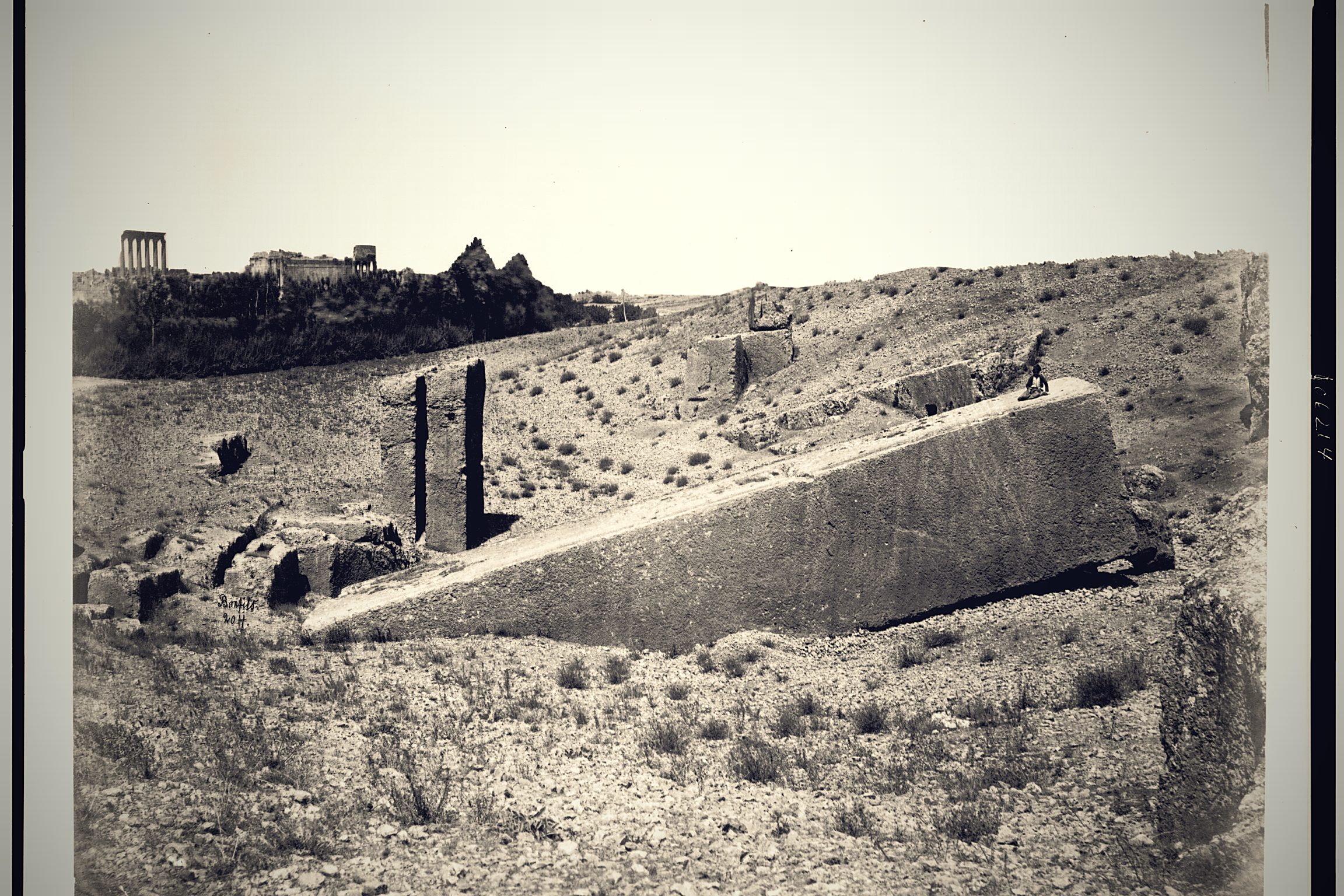
The Baalbek stones are the largest ever moved and placed in any structure in the ancient world. In the western wall of a Roman temple in Lebanon, three of them sit in a single course. Each one is roughly 19 metres (62 ft) long, 4.3 metres (14 ft) high, and 3.6 metres (12 ft) thick. Each weighs approximately 800 tonnes (880 short tons). They are called the Trilithon — and nine hundred metres away, in the quarry they came from, three even larger stones sit unfinished, still connected to the bedrock, as though whoever was cutting them simply stopped.
The largest of the three quarry stones weighs an estimated 1,650 tonnes (1,820 short tons). It was discovered in 2014, lying underneath a block that has been visible for centuries. Nobody can explain why anyone would cut a stone that large when the 800-tonne (880-short-ton) blocks were already at the limit of what could be moved.
What Are the Baalbek Stones?
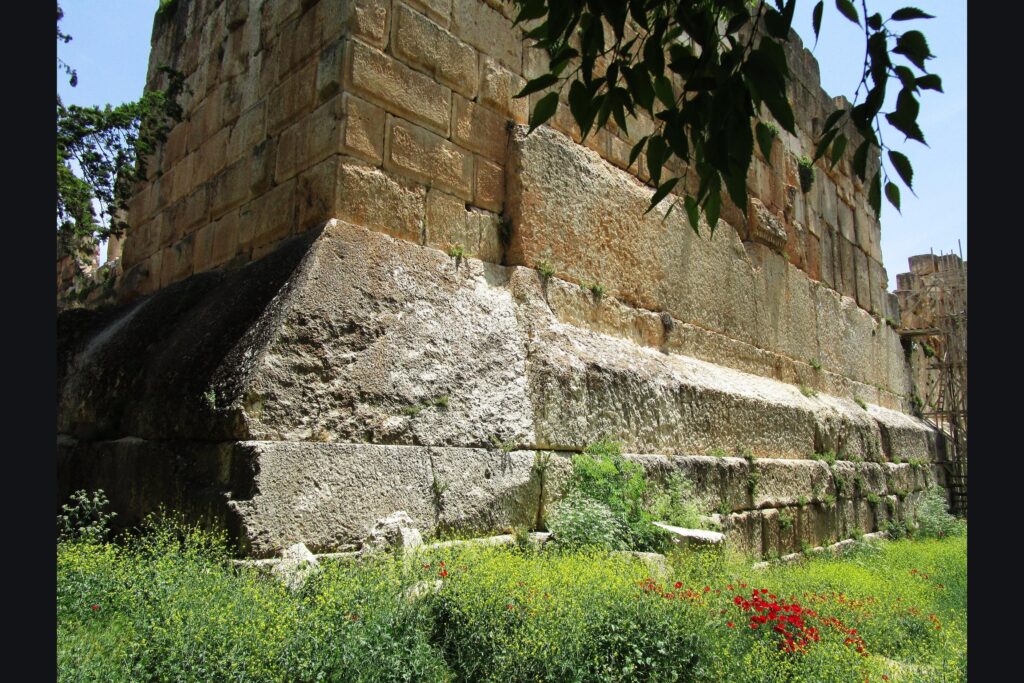
The Trilithon is a row of three megalithic blocks set into the western retaining wall of the Temple of Jupiter at Baalbek (ancient Heliopolis) in Lebanon’s Beqaa Valley. Each block measures roughly 19 × 4.3 × 3.6 metres (62 × 14 × 12 ft) and weighs an estimated 750–800 tonnes (830–880 short tons). They sit in the uppermost course of the western wall of the temple’s podium, raised about 7 metres (23 ft) above the foundation.
The temple itself was Roman — begun around 16 BC when Baalbek was established as a Roman colony, and largely completed by AD 60, based on a graffito found on one of the topmost column drums. It originally had fifty-four unfluted Corinthian columns, each 19.9 metres (65 ft) high. Six still stand.
But the site was sacred long before Rome arrived. The name “Baalbek” derives from Baal, the Canaanite storm deity. A Phoenician temple to Baal-Hadad and his consort Atargatis stood here first. The Romans built over it, syncretising Baal-Hadad with Jupiter Heliopolitanus. Cultic activity had taken place at the site for centuries before the first Roman stone was laid.
The question that makes the Trilithon interesting is not who ordered the temple. It is who moved the stones.
The Quarry and Its Three Unfinished Blocks
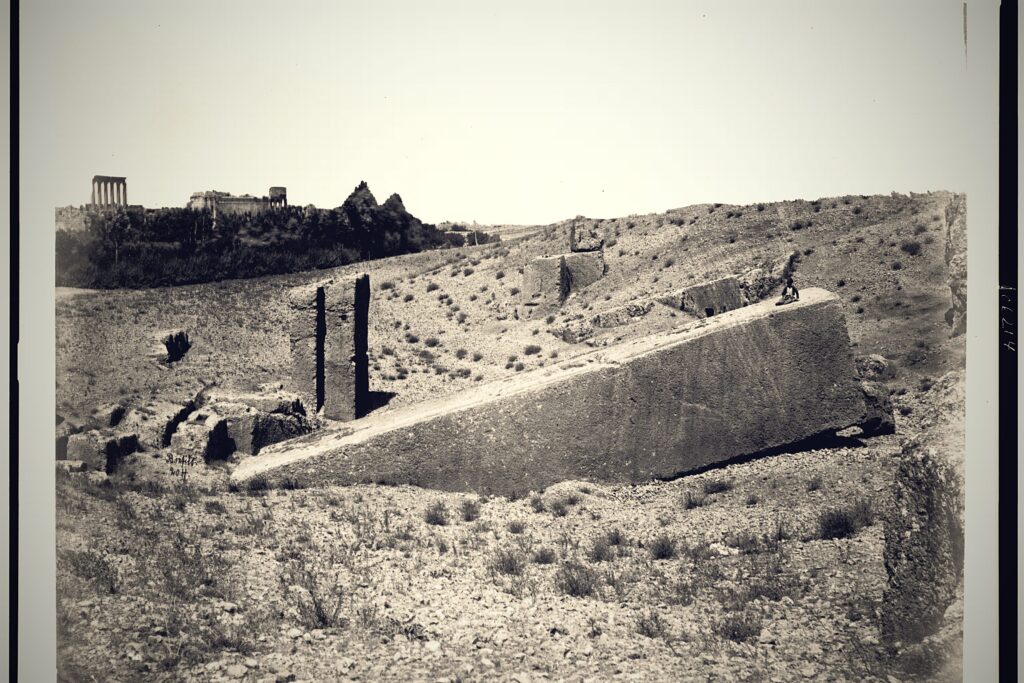
Nine hundred metres (3,000 ft) from the temple complex, in a limestone quarry at roughly the same elevation, three enormous blocks sit in various stages of extraction.
The Stone of the Pregnant Woman (Hajar el-Hibla) has been visible for centuries. It measures approximately 20.5 × 4.3 × 4.3 metres (67 × 14 × 14 ft) and weighs an estimated 1,000 tonnes (1,100 short tons). A crack in one corner is thought to be the reason it was abandoned. The name comes from a local tradition in which a pregnant woman claimed she knew the secret to moving the stone, if the townspeople would feed her until she gave birth.
The Stone of the South (Hajar el-Gouble) sits across the road from the first, at a raised angle, its base still attached to bedrock. It weighs approximately 1,242 tonnes (1,370 short tons).
The Forgotten Stone was discovered in the summer of 2014 by a team from the German Archaeological Institute (DAI) [1], working with Lebanese University and the Lebanese Council of Antiquities. It measures 19.6 × 6 × 5.5 metres (64 × 20 × 18 ft) and weighs an estimated 1,650 tonnes — making it the largest known hewn stone in the ancient world. It was found directly underneath the Stone of the Pregnant Woman. The DAI noted that the level of smoothness indicates the block was meant to be transported and used without further cutting. It too may have been abandoned due to a flaw that would have caused cracking during transport.
| Block | Weight | Status |
|---|---|---|
| Trilithon blocks (×3) | ~800 tonnes (880 short tons) each | Placed in the temple wall |
| Stone of the Pregnant Woman | ~1,000 tonnes (1,100 short tons) | Abandoned in quarry — cracked |
| Stone of the South | ~1,242 tonnes (1,370 short tons) | Abandoned in quarry — still attached |
| Forgotten Stone (2014) | ~1,650 tonnes (1,820 short tons) | Abandoned in quarry — discovered 2014 |
One abandoned block is an accident. Three suggests either a pattern of escalating ambition that kept hitting the same limit, or a workforce that was pulled away before the job was done.
How the Stones Were Moved: The Engineering Case
The conventional explanation is that the Romans moved the stones using methods well within their documented engineering capabilities, at a scale beyond anything they attempted elsewhere.
Jean-Pierre Adam, a French architect and archaeologist, published a detailed analysis in 1977 and later in Roman Building: Materials and Techniques [2]. His key finding was that the route from quarry to temple follows the 1,150-metre elevation contour almost perfectly — the transport was essentially level, requiring no uphill haul. Using compound pulleys and capstan systems, Adam calculated that as few as 512 workers operating 40 capstans could haul an 800-tonne block along a prepared trackway. A later refinement suggested that 144 workers with sufficient mechanical advantage could do it.
Daniel Lohmann of the German Archaeological Institute proposed sledges on prepared trackways combined with multiple capstan systems. His excavations beneath the Roman floor level revealed pre-Roman monumental construction, including a floor 5 metres (16 ft) lower with a freestanding podium monument — evidence that the sacred precinct was built in phases, each more ambitious than the last.
The case is strengthened by comparison. The precision of the stones at Puma Punku in Bolivia presents a similar puzzle — extraordinary construction using methods that appear to be within the reach of the civilisation that built it, pushed to a scale that makes the method difficult to believe.
| Stone moved in antiquity | Weight | Distance |
|---|---|---|
| Baalbek Trilithon (×3) | ~800 tonnes (880 short tons) each | 900 m (3,000 ft) |
| Colossi of Memnon (×2) | ~720 tonnes (790 short tons) each | 680 km (420 mi) overland |
| Lateran Obelisk | ~413 tonnes (455 short tons) | Egypt to Rome |
| Great Pyramid largest blocks | ~80 tonnes (88 short tons) | Aswan to Giza, 800 km (500 mi) |
| Unfinished Obelisk, Aswan | ~1,200 tonnes (1,320 short tons) | Never moved — cracked |
The Trilithon blocks are the heaviest stones successfully transported and set in place in the ancient world. The Colossi of Memnon come closest at roughly 720 tonnes (790 short tons) each, but they were quartzite statues moved 680 km (420 mi), not construction blocks placed in a wall at height. The Lateran Obelisk — the largest stone the Romans are known to have moved outside Baalbek — weighed 413 tonnes (455 short tons). The jump from 413 to 800 is the gap the engineering argument has to bridge.
Adam’s calculations show it is bridgeable. The question is whether the calculations explain why anyone would attempt it, or only how they could.
The Case for Something Older
The alternative argument holds that the Trilithon platform predates the Roman temple above it — that the Romans built on top of a much older structure, possibly thousands of years older, whose builders and methods are unknown.
The evidence cited in support:
The weathering differential. The Trilithon stones show more surface degradation than the Roman courses above and around them. If both were placed at the same time, they should weather at the same rate. The standard reply is that different stone sources within the same quarry weather differently depending on their mineral composition and exposure.
The construction pattern. The drafted-margin masonry of the podium — large blocks with raised, rough-cut centres and carefully dressed edges — differs visually from the finer Roman work above it. To its advocates, this difference reads as a time gap. To its critics, it reads as a function: the podium is a foundation, and foundations are finished differently from facades.
The scale is anomalous. The Romans built enormous structures throughout the empire, but nowhere else did they cut, transport and place blocks of this weight. If the technology existed, the argument goes, it should appear elsewhere. Its absence suggests the Trilithon belongs to someone else.
Graham Hancock has argued the platform is roughly 12,000 years old, built by survivors of a civilisation lost in the Younger Dryas. The Younger Dryas impact hypothesis and its implications for lost civilisations are examined separately.
The Case Against
The archaeological evidence for Roman construction is substantial.
Andreas Kropp and Daniel Lohmann [3] published findings showing that the podium’s first phase was built by Herodian architects around 15 BC. The masonry technique — drafted margins, alternating headers and stretchers — matches the Temple Mount in Jerusalem, which Herod the Great was building during the same period. Their analysis places the Trilithon’s installation after Herod’s death (5/4 BC) but within the Julio-Claudian construction programme, roughly in the decades between Augustus and Nero.
In-situ Latin inscriptions naming Roman builders appear on capitals whose tooling and bonding match the surrounding courses. Imperial-era epigraphy sits on stone demonstrably part of the same construction sequence as the Trilithon wall.
The 2014 DAI excavation confirmed the construction sequence: the bedrock was carved to shape, the podium wall was raised in courses, and the Trilithon blocks were set into the uppermost course — all as part of a phased programme. No artefacts or architectural features predating the Hellenistic/Roman period were found beneath the platform.
The “Herodian connection” is the strongest piece of the conventional case. If the drafted-margin technique matches Jerusalem, and Jerusalem’s dating is firm, then the same technique at Baalbek does not need a lost civilisation to explain it. It needs Herod’s architects, who are documented.
What Nobody Has Explained
Even the conventional reading leaves questions.
Why 800 tonnes (880 short tons)? The Temple of Jupiter is enormous, but no structural analysis has demonstrated that the Trilithon needed blocks of this size. A wall of smaller blocks, bonded and reinforced, would have borne the same load. The decision to quarry, transport and place three 800-tonne (880-short-ton) monoliths — and then start cutting even larger ones — looks like something other than engineering efficiency.
Why were three quarry stones abandoned and none finished? One crack is bad luck. Three unfinished blocks, each larger than the last — 1,000, 1,242 and 1,650 tonnes (1,100, 1,370 and 1,820 short tons) — looks like an ambition that repeatedly exceeded what the material or the method could deliver. Were they intended to replace the Trilithon? To extend the wall? To build something else entirely? The quarry preserves the question but not the answer.
Why only here? The Romans had the administrative reach, the labour force and the engineering tradition to attempt this kind of operation at any major construction site in the empire. They did not. Baalbek is an outlier in Roman engineering by a factor of two — and outliers that large deserve an explanation beyond “they could, so they did.”
The site is not inexplicable. It is unexpectedly ambitious, at a scale that sits outside the pattern, at a location where the sacred history predates the builders by centuries. Whether that makes it evidence of unknown predecessors or evidence that the Romans were more capable than their other buildings suggest depends on which absence the reader finds harder to explain — the absence of earlier builders elsewhere, or the absence of anything this large anywhere else the Romans built.
Sources
- German Archaeological Institute (DAI) — heritagedaily.com/2014/12/research-team-discover-the-worl…
- Roman Building: Materials and Techniques — routledge.com/Roman-Building-Materials-and-Techniques/Ada…
- Andreas Kropp and Daniel Lohmann — academia.edu/1850855
Frequently Asked Questions
How heavy are the Baalbek stones?
The three Trilithon blocks in the temple wall weigh roughly 800 tonnes each (880 short tons). In the quarry, the Stone of the Pregnant Woman weighs approximately 1,000 tonnes (1,100 short tons), the Stone of the South roughly 1,242 tonnes (1,370 short tons), and the Forgotten Stone discovered in 2014 approximately 1,650 tonnes (1,820 short tons). The quarry stones were never moved.
How were the Baalbek stones moved?
The conventional explanation uses compound pulleys, capstans and timber trackways. Jean-Pierre Adam calculated that 144 to 512 workers with sufficient mechanical advantage could haul an 800-tonne block along the essentially level 900-metre route from the quarry. The topography follows the same elevation contour, so no uphill transport was required.
Who built the Baalbek platform?
Most archaeologists attribute the entire platform, including the Trilithon, to the Roman construction programme that began around 16 BC and continued through the first century AD. Kropp and Lohmann have shown that the podium’s first phase used masonry techniques matching the Herodian Temple Mount in Jerusalem, dating the initial work to roughly 15 BC. Some researchers argue the platform or parts of it are far older, but no pre-Hellenistic artefacts have been found beneath it.
Why were the quarry stones never moved?
All three appear to have been abandoned due to defects discovered during quarrying. The Stone of the Pregnant Woman has a visible crack in one corner. The Forgotten Stone may have had a flaw that would have caused cracking during transport. The pattern — three stones started and abandoned — suggests the builders repeatedly pushed past the limit of what the local limestone could deliver at that scale.
Are the Baalbek stones the largest ever moved?
The three Trilithon blocks, at roughly 800 tonnes (880 short tons) each, are the heaviest stones known to have been successfully transported and placed in a structure in the ancient world. The Colossi of Memnon in Egypt, at roughly 720 tonnes (790 short tons) each, are close. The quarry stones at Baalbek (up to 1,650 tonnes / 1,820 short tons) and the Unfinished Obelisk at Aswan (~1,200 tonnes / 1,320 short tons) were never moved.
What was the Baalbek temple originally?
Before the Romans, the site was a Phoenician sanctuary dedicated to the storm god Baal-Hadad and his consort Atargatis. The name Baalbek derives from Baal. The Romans syncretised the local deity with Jupiter Heliopolitanus and built their temple over the earlier sacred precinct, beginning around 16 BC. Cultic activity at the site predates the Roman construction by centuries.
Continue Reading
- The Viking Sunstone: How It Works, and What Has Been Found — The physics is settled: a calcite crystal really can locate the sun through cloud. Everything else is argued — the one…
- The Baghdad Battery: The Chemistry Works. That Was Never the Question. — Copper, iron, bitumen and vinegar will produce a current whether anyone intended it or not. What the Baghdad jars…
- Roman Concrete: The Material That Heals Itself — Modern marine concrete fails in 50 years. Caesarea harbour has been in the Mediterranean since 22 BC and is getting…