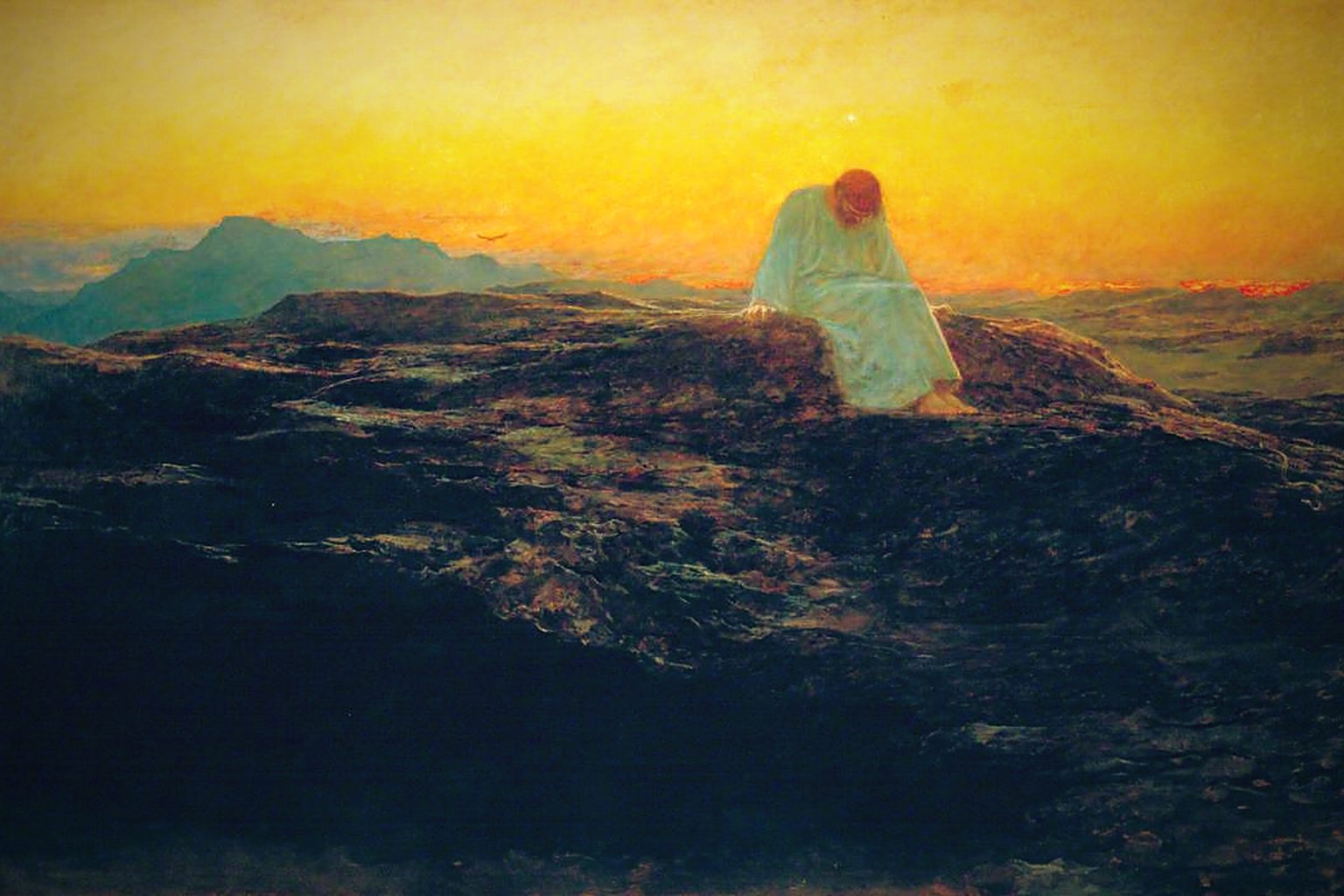
Nobody else was there.
That is the first thing to sit with. The temptation in the wilderness has no witnesses — no disciples, no crowd, no bystander who later told someone. Jesus went into the desert alone and came out alone, and the account of what happened in between exists because he is the only person who could have told it.
So whatever else this is, it is a man describing his own forty days. And what he described, three times over, was an argument he won by quoting a single book.
What Did Jesus Say to Satan?
Three sentences, and all three are quotations from Deuteronomy.
To the offer of bread: man shall not live by bread alone, but by every word that proceeds from the mouth of God (Deuteronomy 8:3). To the invitation to jump: you shall not tempt the Lord your God (6:16). To the offer of the kingdoms: you shall worship the Lord your God, and him only shall you serve (6:13).
He does not argue. He does not explain. He answers three different propositions with three lines from the same few chapters of one book — and those chapters are about something specific, which is the part most retellings leave out.
The Three Offers, in Order
| The offer | What was said | |
|---|---|---|
| 1 | Turn these stones into bread | “If you are the Son of God, command that these stones be made bread” |
| 2 | Throw yourself from the temple | Satan quotes Psalm 91: the angels will bear you up |
| 3 | Take every kingdom on earth | “All this I will give you, if you will fall down and worship me” |
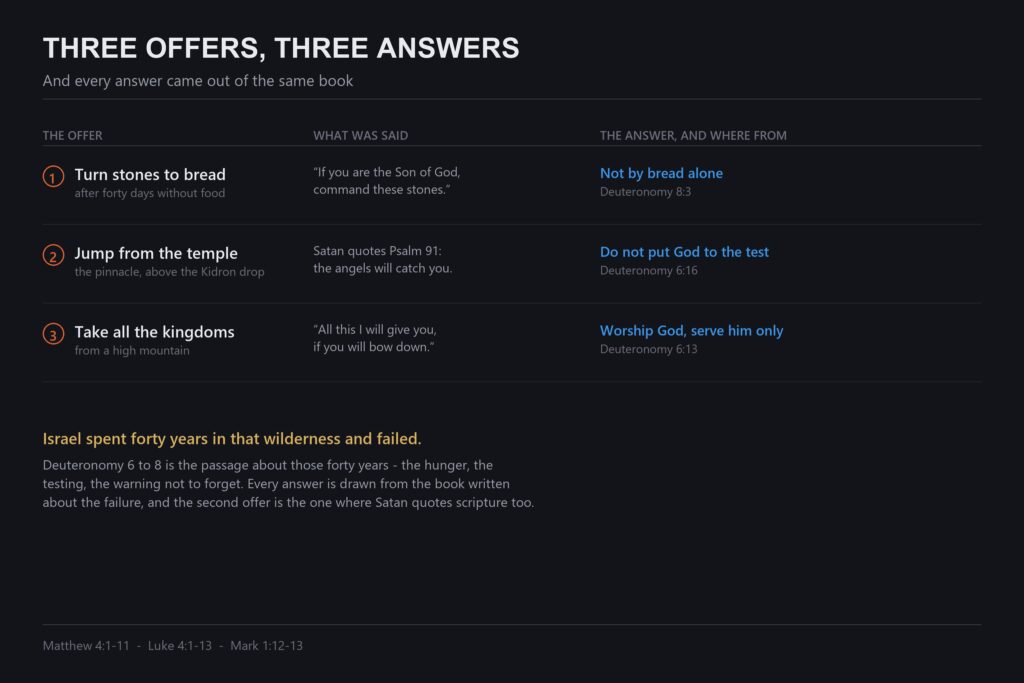
Notice the second one. Satan quotes scripture, accurately, and the reply is not that the quotation is false. It is another quotation, which frames the first correctly. That exchange is the single most-cited detail in the passage among people who read it carefully, because it establishes something the rest of the chapter assumes: that a verse can be quoted exactly and used wrongly.
Forty Days Without Food
The number is not decoration, and the physiology is worth knowing because it is checkable.
A human body without food moves through stages. Blood glucose falls and liver glycogen goes within about twenty-four hours. The body switches to fat, producing ketone bodies that the brain learns to burn in place of glucose — this is ketosis, and it begins within a day or two. Once it is established, muscle wasting slows, because the brain is no longer demanding that protein be converted into sugar.
How long this can go on depends almost entirely on how much fat there is to start. The conventional figure for a person of ordinary build is thirty to forty days. Bobby Sands died on the sixty-sixth day of a hunger strike in 1981. Angus Barbieri, who was severely obese and under hospital supervision in Dundee, went 382 days on tea, coffee, water and vitamins, losing 125 kilograms (276 pounds) — and he had originally planned to stop at forty days, which his doctors described as the longest duration then considered medically reasonable.
So forty days without food is survivable, at the edge.
Forty days without water is not, and this is where the text is more careful than its readers usually are. Three to four days is the outside limit without fluid. Luke says he ate nothing in those days — the Greek is about eating. Neither Gospel says he did not drink. In a Judaean wilderness with seasonal springs and winter rain, a man who drank and did not eat for forty days would be at the far end of human endurance and still alive, which is precisely the condition the text then describes: afterward he was hungry.
The account is not claiming something physiologically impossible. It is claiming something physiologically extreme, which is a different kind of claim and a more interesting one.
This is the same tradition that produced the ten-day trial in Daniel 1, where the text records a controlled comparison and its result. Fasting in these books is described with a precision that invites checking.
The Pinnacle
The second offer has an address. The pterygion of the temple — the “little wing”, usually taken as the southeastern corner of the temple platform, where the ground falls away into the Kidron valley.
Josephus, describing that corner, says the drop was so great that anyone looking down from it became dizzy. The height of the wall plus the fall of the valley floor put the total at well over a hundred metres (several hundred feet) at the worst point. It was not a dramatic flourish. It was the highest place in Jerusalem a person could stand and the most public, and the offer is specifically that an audience would see angels intervene.
The Mountain That Cannot Exist
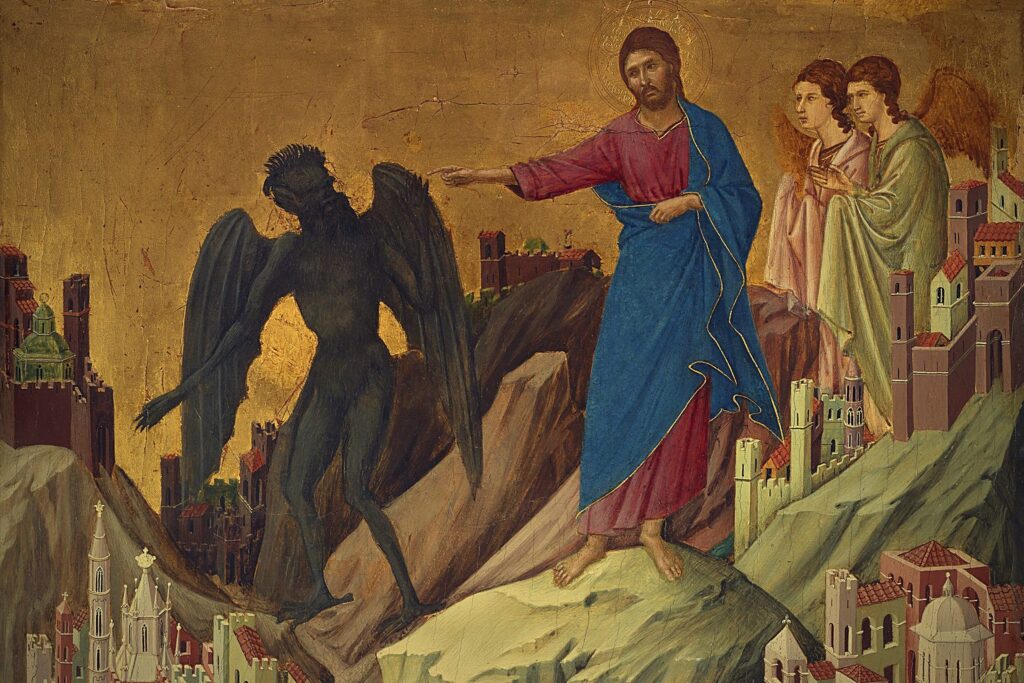
The third offer has a problem the first two do not: all the kingdoms of the world shown in a moment of time from a high mountain. No mountain does that. The Earth curves; Rome is not visible from the Judaean hills.
This is the point where readings separate, and both are old.
The visionary reading says the third offer was shown rather than travelled to — that the mountain is where he stood and the kingdoms were displayed, in the same way the visions in Ezekiel and Revelation are displayed. Luke’s phrase, in a moment of time, fits that: no geography works that way, but a vision does.
The literal reading says the text means a real mountain and a real view, and that a being capable of the offer is capable of the display. It notes that the other two temptations are physical — real stones, a real parapet — and that switching genres midway through a single narrative is an odd thing to assume.
The text does not settle it. What both readings agree on is that the offer is presented as genuine: the passage has Satan claiming the kingdoms are his to give, and it does not have anyone contradicting him.
Matthew and Luke Do Not Agree on the Order
Matthew has bread, temple, mountain. Luke has bread, mountain, temple. The three offers are the same and the sequence is not.
This is not a hidden problem; it has been discussed since the early centuries, and it matters because it tells you what kind of document you are reading. One of the two arranged the material thematically rather than chronologically — Matthew’s order builds to the mountain and a kingdom, Luke’s builds to Jerusalem and the temple, and each ending suits that Gospel’s larger shape.
An honest reader takes two things from that. First, at least one account is ordered for meaning rather than sequence, which is normal for ancient biography and was not considered deceptive. Second, the disagreement is evidence of independence — two writers working from a shared account rather than one copying the other’s arrangement.
Mark, characteristically, gives the whole thing two sentences and no offers at all.
The Reading That Says It Happened Inside His Head
This deserves a full statement.
Extreme fasting, isolation, heat and sleep deprivation are a known recipe for altered perception. Hallucination is documented in starvation, in solitary confinement and in desert conditions, and a man forty days into a fast alone in the Judaean wilderness has every physiological risk factor at once. On this reading the encounter was real as experience and internal as event — a mind under extreme load, externalising its own arguments.
The reading has real force, and it is not new. It also has a specific weakness.
The content of the episode does not look like delirium. Starvation hallucination is characteristically fragmentary, sensory and disorganised — figures at the edge of vision, voices without structure. What the text reports is a tightly ordered exchange of scriptural citations, in which the adversary quotes a psalm correctly and is answered by a passage that reframes it. That is the shape of a rabbinic dispute, not the shape of a hallucination.
The counter to the counter is that Jesus could have composed the account afterwards, in order, from an experience that was not ordered. And there the argument stops, because nobody can go back and check.
What Was Actually Being Offered
Set aside the mechanism and look at the content, because this is the part that repays attention.
Each offer is a shortcut to something the texts say he gets anyway.
He is offered bread, and the Gospels later have him feeding thousands. He is offered a public demonstration that God will catch him, and the narrative ends with a death and a resurrection witnessed and reported. He is offered the kingdoms of the world, and the last chapter of Matthew has him saying that all authority in heaven and on earth has been given to him.
Not one of the three offers is a temptation to something wrong in itself. Bread, vindication and rule are all things the story hands him in the end. What is on offer is the same destination by a different road — immediately, without the cross, and on someone else’s terms.
That is a more sophisticated account of temptation than the one most people carry around, and it is sitting in the text in plain sight. The offers are not for evil things. They are for good things, early.
What Is Genuinely Unresolved
Who told it, and when. The account must originate with Jesus, but neither Gospel says when he told it or to whom.
Whether the third offer was seen or travelled to. The text does not say, and the two readings have coexisted for nineteen centuries.
Which order is the original. Matthew and Luke cannot both be chronological, and there is no way to recover which is.
Frequently Asked Questions
What did Jesus say to Satan in the desert?
Three sentences, all quoted from Deuteronomy: that man does not live by bread alone but by every word from God’s mouth (8:3); that you shall not put the Lord your God to the test (6:16); and that you shall worship the Lord your God and serve him only (6:13). He offered no argument of his own beyond the citations.
How long was Jesus in the desert?
Forty days, according to Matthew, Mark and Luke. Luke specifies that he ate nothing during that period. Neither Gospel says he did not drink, which matters physiologically: a person can survive roughly thirty to forty days without food, but only three to four without water.
What were the three temptations of Jesus?
To turn stones into bread after forty days of fasting; to throw himself from the pinnacle of the temple, with Satan quoting Psalm 91’s promise that angels would catch him; and to receive all the kingdoms of the world in exchange for worship.
Was the temptation of Jesus physical or spiritual?
The text describes physical elements — actual stones, an actual parapet — and one element that has no physical reading, since no mountain shows all the kingdoms of the world at once. Some readers take the whole episode as a vision, others as physical events with a visionary third scene, and the passage does not decide between them.
Why did Satan quote scripture to Jesus?
In the second temptation he cites Psalm 91:11–12, that God will command his angels to bear you up. The reply does not deny the verse; it answers with Deuteronomy 6:16. The exchange is usually read as making a deliberate point: that an accurate quotation can still be put to a wrong use.
Is the temptation of Jesus in all four gospels?
No. Matthew and Luke give the full account with all three offers, in different orders. Mark records the forty days and the testing in two brief verses without listing the temptations. John does not include the episode.
Why forty days?
Forty is the length of Israel’s wandering in the wilderness, of Moses on Sinai, and of the rain in the Flood account. The connection to Israel’s forty years is made explicit by the answers themselves, all of which come from Deuteronomy 6 to 8 — the chapters describing that period, its hunger and its testing.
Could a person actually survive forty days without eating?
Yes, with water. Ordinary survival estimates run to thirty or forty days for a person of average build, longer with greater fat reserves; Bobby Sands died on day sixty-six of a hunger strike, and a medically supervised patient in Dundee fasted for 382 days. Without water, three to four days is the limit.
Where That Leaves You
The episode is short, and almost everything about its mechanism is beyond recovery. Nobody watched it. Two accounts of it disagree about the order. The third scene describes a view that no mountain provides.
What is recoverable is the structure, and the structure is tight. A man goes into a wilderness for forty days, in a tradition where forty days in a wilderness means one particular thing. He is offered food, proof and power. He answers each one out of the book about the last time this nation was hungry in a desert and failed the test — and the adversary, in the middle offer, quotes scripture too, correctly, and is answered not with a denial but with a better reading.
Whether you take the adversary as a person, a vision or a mind arguing with itself, that arrangement did not assemble itself by accident.
And the offers were never for bad things. That is the part worth carrying away.
Continue Reading
- Demonic Possession in the Bible: Every Case, and the One That Comes Back — The evil spirit on Saul. Legion in the tombs. The boy the disciples could not help. Every case of demonic possession in…
- The Daniel Fast: What Daniel 1 Actually Describes — A captive proposed a ten-day controlled trial with a comparison group and an agreed endpoint. What the Daniel Fast…
- The Shroud of Turin: A Negative Nobody Ordered — Dust vacuumed from the cloth in 1978 has now been sequenced, and the result was reported as evidence the Shroud came…