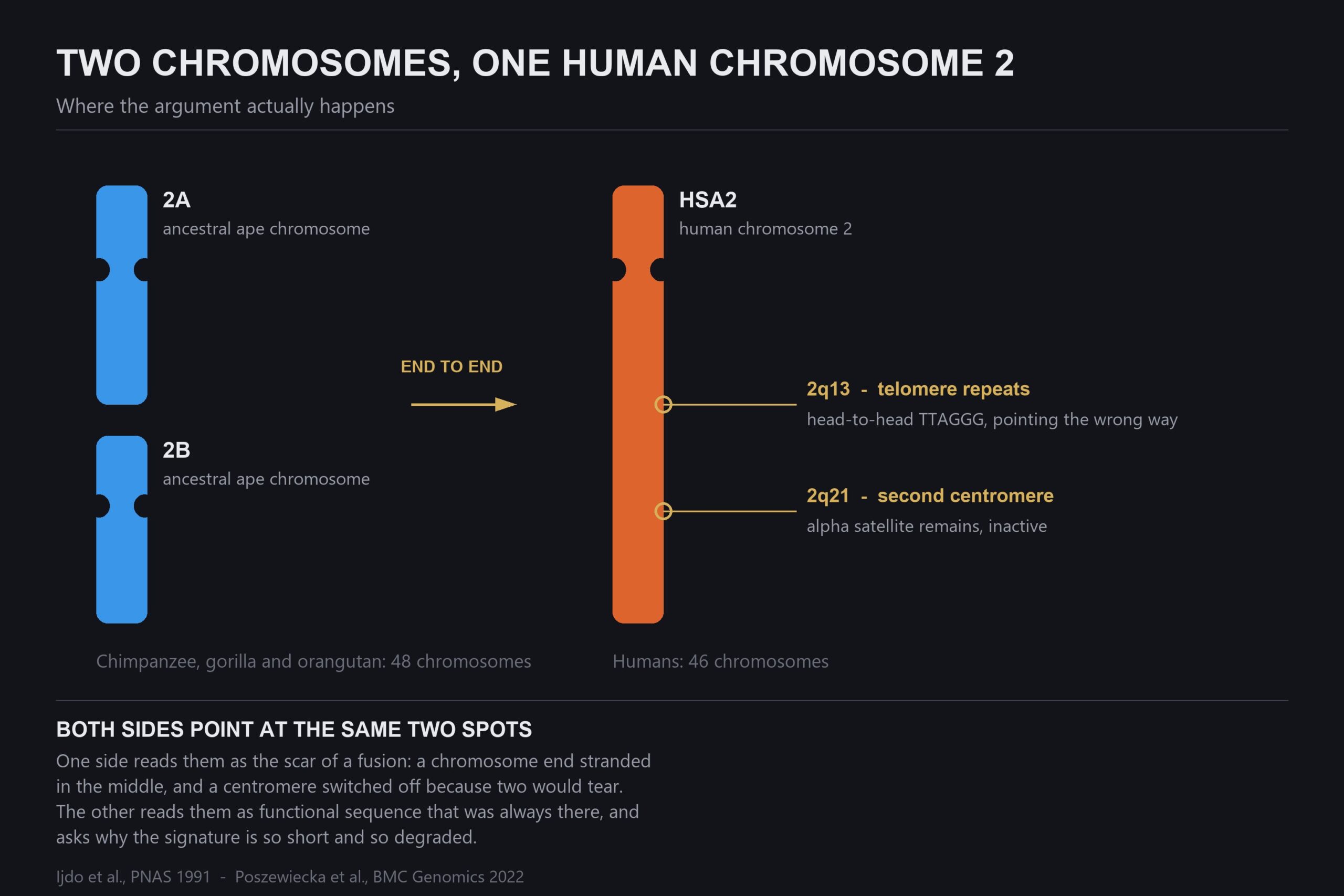
You have 46 chromosomes. Every chimpanzee, gorilla and orangutan alive has 48.
That is not a small difference. Chromosome number is one of the most conserved things about a species, because getting it wrong usually means not having children. And yet somewhere in the line that produced us, two chromosomes became one, and the count dropped by a pair — the event known as the human chromosome 2 fusion.
The place it is supposed to have happened is not hidden. It sits at a known address on the second-largest chromosome you own, and both sides of one of the longest-running arguments in biology point at exactly the same spot. They disagree entirely about what it is.
What makes this worth returning to now is a number. In 2022 the fusion was re-dated, and the answer came back far more recent than the textbook version implies. In 2023 a separate team, working on a completely different problem, found that the human population had collapsed to roughly a thousand breeding adults at almost precisely the same moment.
What Is the Human Chromosome 2 Fusion?
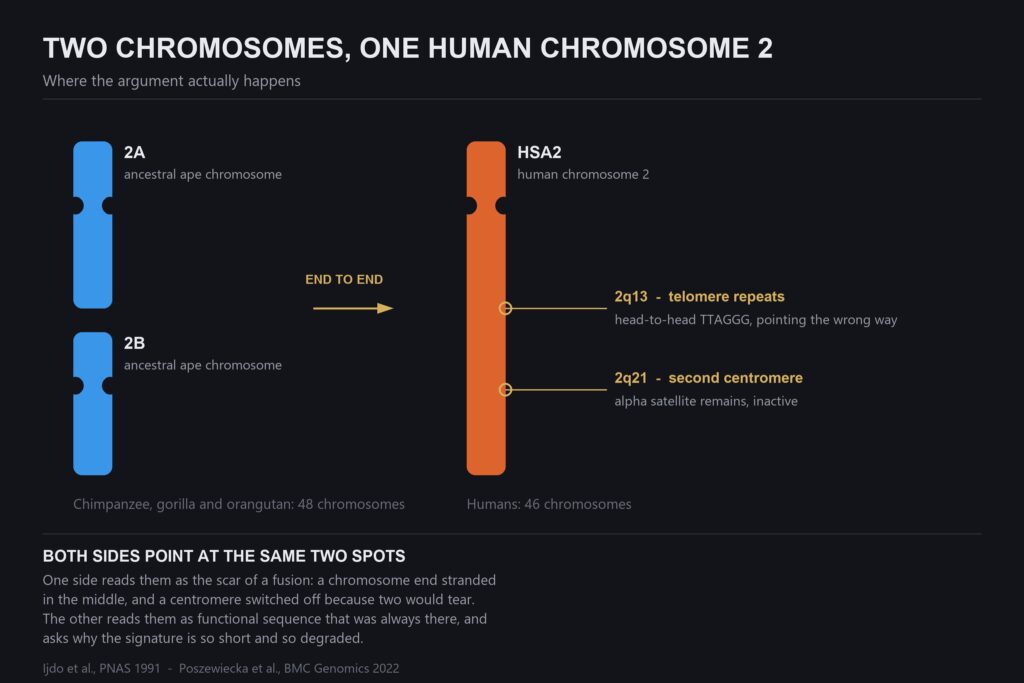
It is the proposal that human chromosome 2 was formed when two smaller ancestral chromosomes joined end to end, reducing the human count from 48 to 46. The two chromosomes still exist separately in chimpanzees, where they are called 2A and 2B.
The proposal was published by J. W. Ijdo and colleagues in PNAS in 1991, under a title that says exactly what they thought they had found: Origin of human chromosome 2: an ancestral telomere-telomere fusion.
The Count Nobody Disputes
Start with what is not in question, because it is more than people expect.
| Chromosome pairs | Total | |
|---|---|---|
| Human | 23 | 46 |
| Chimpanzee | 24 | 48 |
| Bonobo | 24 | 48 |
| Gorilla | 24 | 48 |
| Orangutan | 24 | 48 |
Human chromosome 2 is also, by any measurement anyone has made, about the same length as chimpanzee 2A and 2B laid end to end. Its banding pattern — the striped signature a chromosome shows under a microscope after staining — matches the two of them placed nose to nose. The gene order along it matches too.
Nobody argues about that part. The argument is about what produced the match.
The Case That It Is a Fusion
Two features of chromosome 2 are the whole of the case, and both are specific enough to check.
Telomeres in the middle. Telomeres are the caps on the ends of a chromosome, built from the sequence TTAGGG repeated over and over. They belong at the ends. At band 2q13, roughly in the middle of the chromosome, there is a stretch of telomeric repeat — and it is arranged head to head, one run pointing one way and a second run pointing back at it. That is the pattern you would get by taking two chromosome ends and welding them together, and it is not the pattern you would get any other way that anyone has proposed.
A second centromere, switched off. The centromere is the pinch point a chromosome is dragged by when a cell divides. A chromosome needs exactly one. Two is a serious problem: the cell’s machinery pulls from both, and the chromosome can tear. At 2q21.3–q22.1 there is a block of alpha satellite DNA — the repeat that centromeres are built from — sitting in the right place to be the remains of 2B’s centromere, and it is inactive.
Put together, the reading is a scar: an old chromosome end stranded in the middle, and a spare centromere shut down because keeping two would have been lethal.
There is also a quieter piece of evidence that is harder to argue with because nobody was looking for it. Near real telomeres, a process called biased gene conversion leaves a statistical fingerprint — a local excess of substitutions favouring G and C bases. That same fingerprint appears around 2q13, which is what you would expect if that stretch used to sit at a chromosome end and behaved like one for a long time.
The Case That It Is Not a Fusion
The most sustained technical objection comes from Jeffrey Tomkins, a geneticist writing from a creationist position, and it is worth stating properly rather than in the form it takes when someone is about to dismiss it.
The signature is far too short. A fusion of two chromosome ends should bury something on the order of ten thousand bases of telomeric repeat at the join. What is actually at 2q13 is roughly 800 bases. Tomkins’ argument is that the mainstream account requires most of the evidence to have been deleted, and that an explanation which needs the evidence to be missing is weaker than it sounds.
The repeats are badly degraded. Of the repeat units at the site, Tomkins counts fewer than half as perfect TTAGGG or TTGGGG. A sequence that decayed that far in five or six million years, he argues, would be indistinguishable from chance, and a pattern you can only see once you have decided what you are looking for is not a pattern.
The site is inside a working gene. The 2q13 region falls within the first intron of a gene called DDX11L2, and Tomkins showed the region functions as a transcription factor binding site, binding eleven different factors including RNA polymerase II. His conclusion: chromosome ends colliding do not produce functional regulatory DNA, so the simplest reading is that the sequence was always meant to be there.
The spare centromere does not match. The alpha satellite at 2q21 is much shorter than a working centromere, sits inside another expressed gene, and — Tomkins notes — does not closely match chimpanzee centromeric sequence, which is what you would want if it were inherited from a shared ancestor.
The Reply From the Subtelomeres
The DDX11L point is the strongest of those four, and it has a specific answer that is worth knowing because it turns the argument around.
DDX11L is not a normal gene. It is a family, and in 2009 a team publishing in BMC Genomics mapped where its members live: eighteen different subtelomeric sites across the human genome. These are sequences that sit just inside chromosome ends, on almost every chromosome, and the paper’s argument is that the extraordinary instability of those regions is what generates the family in the first place.
So the presence of a DDX11L gene tells you that a stretch of DNA has the character of a chromosome end. On every other chromosome, the DDX11L genes are at the ends, which is where chromosome ends are. On chromosome 2, one of them is in the middle.
That does not make the objection disappear — a defender of the design reading can hold that the family is distributed that way because those regions need that kind of sequence. But it does mean the gene’s presence at 2q13 is precisely what the fusion account predicts, rather than a problem for it.
The Reply From the Other Side
That answer has an answer, and the exchange is worth following to the end rather than stopping where one side happens to be speaking.
The design reading does not concede that a DDX11L gene marks a former chromosome end. Its case is the reverse: these are regions that need a particular kind of sequence, and the family is distributed across them for the same reason similar tools turn up wherever a similar job has to be done. On that reading the gene at 2q13 is doing work, not marking a scar, and pointing out that its relatives sit near chromosome ends describes the pattern without explaining it.
There is also a question the fusion account has not answered cleanly. If 2q13 is a former telomere, it has had, on the most recent dating, about nine hundred thousand years to decay — not the five or six million the older estimates assumed. Tomkins’ complaint was that the site is far too degraded for its supposed age. Moving the date closer makes the decay harder to explain, not easier, because there has been less time for it to happen.
That is not a small point, and nobody has published a quantitative answer to it.
The Date That Moved
Here is where the subject stopped being a settled textbook item.
The fusion was long assumed to have happened somewhere near the split from the chimpanzee line, six or seven million years ago. In 2022, Poszewiecka, Gogolewski, Stankiewicz and Gambin published a re-dating in BMC Genomics, using the rate at which that biased-gene-conversion fingerprint accumulates as a clock.
Their answer: about 900,000 years ago, with a 95% confidence interval of 400,000 to 1.5 million. Earlier estimates had run as high as 4.5 million.
Take that seriously for a moment and the picture changes. Six million years ago is before Homo existed. Nine hundred thousand years ago is the middle of it. On this dating, Homo erectus — a species that made tools, used fire and walked out of Africa — would have had 48 chromosomes.
The confidence interval is wide, and this is one method on one signal. But it is the most careful attempt yet made, and it puts the event inside our own genus rather than at the root of the family tree.
Why a Fusion Needs a Very Small Population
This is the part that rarely gets explained, and it is the part that matters most.
A fusion happens in one individual. That individual now has 47 chromosomes and has to breed with the 48-chromosome population around it. Their children inherit an odd set, and when those children make eggs or sperm the chromosomes have to pair up — with one partner missing.
The result is well documented in humans today, because the same thing happens in carriers of what is called a Robertsonian translocation, where two chromosomes fuse. Carriers are healthy. What they have is reduced fertility, and a raised rate of miscarriage and of embryos with the wrong chromosome count.
So a new fusion is normally selected against. In a large, well-mixed population it disappears. For it to spread to every member of a species, that species has to be small enough for chance to beat selection — a population so reduced that a mildly harmful variant can drift to fixation simply because there are not enough individuals for selection to work properly.
In other words: the fusion carried in every human cell is itself an argument that the human population once passed through something very narrow.
The Number That Arrived From Somewhere Else
In 2023, a team led by Wangjie Hu published in Science a reconstruction of ancient human population size, built from the genomes of 3,154 living people using a method they called FitCoal. They were not working on chromosome 2. They were asking how many people there had ever been.
What they found was a collapse.
| When | roughly 930,000 to 813,000 years ago |
|---|---|
| Breeding population | about 1,280 individuals |
| Duration | around 117,000 years |
| Share of ancestral population | 1.3% |
| Genetic diversity lost | 65.85% |
For roughly a hundred thousand years, on their reconstruction, the entire ancestral human population was about the size of a village — and it stayed that way for longer than our own species has existed.
Now put the two findings side by side. A chromosomal fusion that requires a tiny population to spread, dated to about 900,000 years ago. A population reduced to about 1,280 breeding adults between 930,000 and 813,000 years ago, found by a different team using a different method on a different question.
They may be the same event seen from two directions. They may not be: the fusion date carries a wide interval, the bottleneck reconstruction has been challenged by other groups, and two numbers landing near each other is exactly the kind of coincidence that gets overread. But the convergence is real, and it is not something either team was trying to produce.
What This Has to Do With Genesis
The reason this argument has never been only about biology is that it lands directly on a claim in a text.
Genesis 2 describes humanity beginning with a man and a woman made directly, not with a population that gradually became human. Every genealogy after it is built on that, and it is the reading this site works from.
The objection raised against it from genetics has always been the same one: that our genome carries too much variation to have come from two people, and that you cannot fit the diversity of living humans through a gate that narrow.
The bottleneck finding does not dissolve that objection, and it should not be sold as though it did. 1,280 is not two. What it does is move the ground the objection stands on, in two ways worth stating precisely.
It establishes that the genome does record a near-extinction — that the idea of humanity passing through a radically narrow gate is not a religious import into the data but something the data produced on its own. And it shows that the number can be recovered at all, which means the question “how narrow” is a measurable one rather than a matter of taste.
Readers who take Genesis at its word treat that as movement in their direction, and note that every revision of the number has gone the same way — downward. Readers who do not reply that a floor of roughly a thousand is still three orders of magnitude from two, and that no further narrowing has been demonstrated. Both are fair statements about the same result, and the result is recent enough that neither side should be speaking as if the matter were closed.
The same shape appears elsewhere in this record. The Genesis lifespans form a curve rather than a scatter, which is a real pattern that does not by itself say what produced it. The Y chromosome in the virgin birth account raises a genuine mechanical problem that genetics can state precisely and cannot resolve. Jacob’s breeding programme in Genesis 30 describes recessive inheritance working correctly, centuries before anyone had a word for it. In each case there is something real in the data and an argument about what it means, and the two are worth keeping apart.
What Is Genuinely Unresolved
Being honest about this subject means naming what neither side has.
Nobody has watched it happen in a primate. Chromosome fusions are observed in other mammals, and Robertsonian translocations occur in humans now. A fusion fixing across an entire ape population has never been observed, only inferred.
The date is one method. The 900,000-year figure rests on a single clock applied to a single signal, with an interval running from 400,000 to 1.5 million years. It is the best available number, not a measured one.
The bottleneck is contested. Hu and colleagues’ reconstruction has been questioned by other population geneticists, who argue the method can produce an apparent bottleneck from population structure rather than from a true collapse. That exchange is still running.
The 2025 assemblies made the site more complicated, not less. Complete telomere-to-telomere genomes for chimpanzee, bonobo, gorilla and both orangutan species were published, and a team working in Cell Genomics used them to look at the fusion region directly. What they found was not a clean seam but a mosaic of duplicated segments whose closest relatives are in different ape lineages — a pattern called incomplete lineage sorting. The region is older and messier than a simple join.
Frequently Asked Questions
What is the human chromosome 2 fusion?
The proposal that human chromosome 2 formed when two smaller ancestral chromosomes joined end to end, which would explain why humans have 46 chromosomes and every other great ape has 48. It was published by Ijdo and colleagues in PNAS in 1991.
Why do humans have 46 chromosomes and chimpanzees 48?
Because human chromosome 2 corresponds to two separate chimpanzee chromosomes, 2A and 2B. That correspondence is not disputed by anyone — the length, the banding pattern and the gene order all match when the two are laid end to end. What is disputed is whether a fusion produced the match.
What is the evidence for the chromosome 2 fusion?
Two things, both at known addresses. Telomeric TTAGGG repeats arranged head to head at band 2q13, in the middle of a chromosome where chromosome ends should not be; and a block of inactive alpha satellite DNA at 2q21, positioned as the remains of a second centromere.
What is the argument against the fusion?
Chiefly that the signature is short and degraded — roughly 800 bases where a fresh fusion should leave around ten thousand, with fewer than half the repeats intact — and that the site sits inside a functioning gene, DDX11L2, that binds eleven transcription factors. Jeffrey Tomkins argues that functional regulatory DNA is not what colliding chromosome ends produce.
When did the chromosome 2 fusion happen?
The most careful estimate, by Poszewiecka and colleagues in BMC Genomics in 2022, is about 900,000 years ago with a 95% confidence interval of 400,000 to 1.5 million years. That is much more recent than the six-to-seven-million-year figure the textbook account implies, and it would place the event inside the genus Homo.
Does the chromosome 2 fusion prove human evolution?
No — not on its own, and the two claims get run together so constantly that it is worth separating them. Whether a fusion happened is a question about two stretches of DNA inside the human line. Where that line came from is a different question, and a fusion within a line says nothing about its origin either way.
What is actually being argued over is the resemblance: human chromosome 2 looks like chimpanzee 2A and 2B laid end to end. On the design reading that is what you would expect from one designer working to one pattern, in the same way the rest of the genome resembles theirs without that resemblance having to mean inheritance. Those who read it as common descent take the same resemblance as inheritance. Neither side gets there from the fusion alone.
How small was the human population 900,000 years ago?
A 2023 study in Science led by Wangjie Hu estimated about 1,280 breeding individuals for roughly 117,000 years, between around 930,000 and 813,000 years ago — about 1.3% of the preceding population, with nearly two-thirds of genetic diversity lost. Other population geneticists have challenged the finding.
Could the fusion have happened in one person?
It had to. A fusion occurs in a single individual, whose descendants then carry an odd chromosome number and, on the evidence from Robertsonian translocations in humans today, reduced fertility. That is why a fusion spreading through a whole species requires the population to have been very small at the time.
What Would Settle It
Two things would move this, and neither is out of reach.
Find a fusion fixing in a wild population. Chromosomal races exist in living mammals — house mice in particular carry different fusion sets in different valleys. Following one to fixation, with the population sizes measured rather than inferred, would turn the central mechanism from a model into an observation.
Settle the bottleneck. The 1,280 figure is a reconstruction, and the objection to it is specific: population structure can imitate a collapse. That is a methodological question with a methodological answer, and the groups on both sides are still publishing.
Until then, what is on the table is this. Every cell in your body carries a chromosome that looks, at two separate addresses, like two chromosomes joined together. Whatever produced it spread to every human alive, which means it passed through a gate narrow enough for chance to beat selection. And a separate line of work, asking a different question, says the gate was about a thousand people wide.
Genesis says it was two. The distance between those numbers is the argument, and it has been getting shorter — which is not the same as saying it has closed.
Continue Reading
- The Shroud of Turin: A Negative Nobody Ordered — Dust vacuumed from the cloth in 1978 has now been sequenced, and the result was reported as evidence the Shroud came…
- The Divine Engineer: The Biology of Adam and Eve — Formed, then breathed – two separate operations. What dust of the ground gets chemically right, why tsela probably does…
- Junk DNA: An Archive Nobody Curated — An onion has five times more DNA than you do. That single fact is the hardest question in genomics, and it is the one…