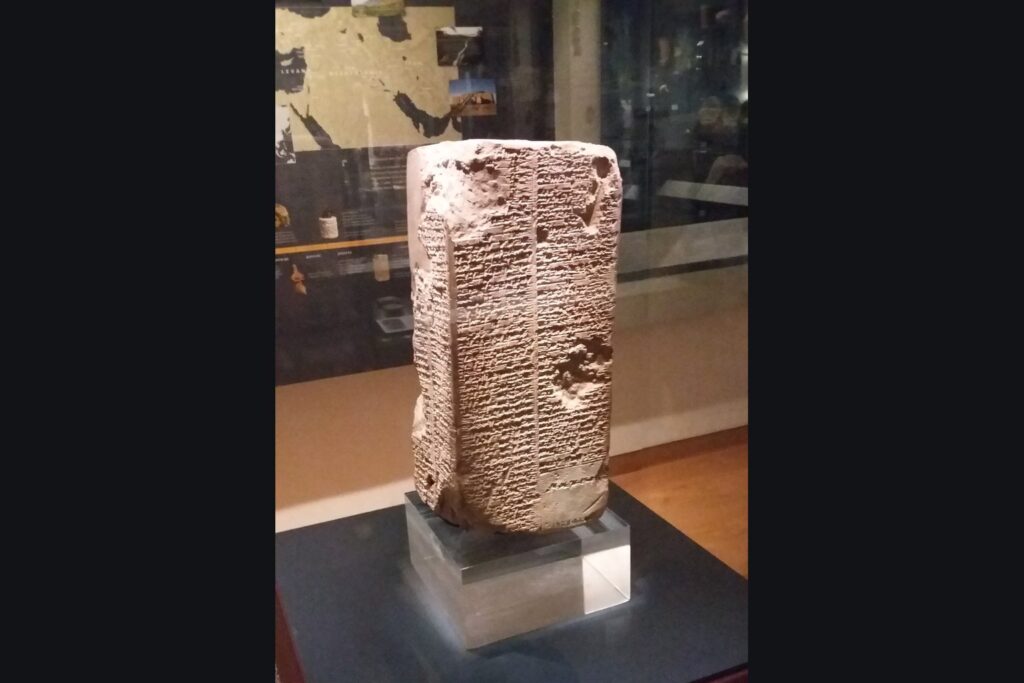
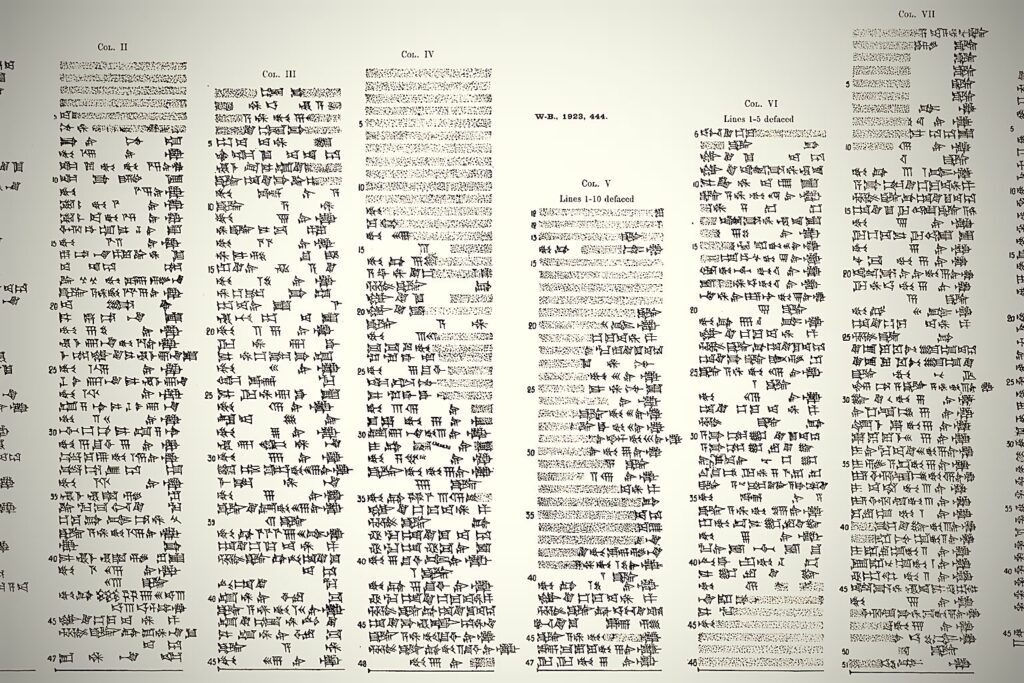
A clay prism the size of a wine bottle sits in the Ashmolean Museum in Oxford. Four sides, four columns a side, cuneiform from top to bottom, a hole bored through the middle so it could be turned on a spindle and read. It was inscribed in the eleventh year of Sin-Magir, king of Isin, which puts it around 1800 BC.
This is the Weld-Blundell Prism, and it carries the fullest surviving copy of the Sumerian King List. It opens by stating that kingship came down from heaven to the city of Eridu, and that a man named Alulim then ruled for 28,800 years.
Seven more kings follow. Between them they rule 241,200 years. Then a flood sweeps over, kingship comes down from heaven a second time, and the numbers begin to shrink until they reach the ordinary human lengths of rulers we can dig up and verify.
The Sumerian King List is the single most quoted document in the whole ancient-mysteries genre, and almost every version of the story you have read does the one thing the text does not support: it adds the numbers up.
What Is the Sumerian King List?
It is a Mesopotamian literary text that presents the kingship of Sumer as a single office passing from city to city, with the name and reign length of every holder. At least sixteen tablets and fragments of it survive. Most date to the Old Babylonian period, the early second millennium BC.
The best-preserved copy is the Weld-Blundell Prism in Oxford, and it is the one nearly every translation is based on.
What it is not is a chronicle, an archive or a chronology. It is a claim about how power works, written by people with an interest in the answer. Getting that distinction right disposes of most of what is written about it.
The Numbers Everyone Quotes
The antediluvian section gives eight kings across five cities.
| City | Kings | Notes |
|---|---|---|
| Eridu | Alulim, Alalngar | Alulim 28,800 years |
| Bad-tibira | 3 kings | includes the longest reigns |
| Larak | 1 king | |
| Sippar | 1 king | |
| Shuruppak | 1 king | the flood hero’s city in other texts |
Individual reigns run from 28,800 to 43,200 years. The total is 241,200 years before the flood.
After the flood the figures fall away — hundreds of years, then decades, then reigns of a handful of years that match what inscriptions and excavation actually show. The curve is the interesting part, and it is the part that gets skipped.
The Mistake Almost Everyone Makes
Here is the error, and it is not a small one. The dynasties in the list did not follow one another. Many of them ruled at the same time.
The list presents kingship as a single office held by one city at a time: Kish falls, Uruk rises, Uruk falls, Ur rises. Archaeology and contemporary inscriptions show something else entirely — competing city-states, several of them powerful simultaneously, each claiming supremacy over the others.
Unlike the Egyptian king lists, the Sumerian list is not in chronological order and could not be, because it names kings who were contemporaries. Add the reigns together and you are not summing a timeline. You are summing a set of overlapping claims, several times over.
This single fact undoes two opposite arguments at once:
- The argument that the list proves an enormously ancient civilisation, because the total is so large.
- The argument that the post-flood totals can be matched against a biblical chronology, because they add up neatly.
Neither works. The list was never an addition problem.
Why the Reigns Are So Long
Two serious explanations compete, and they are not exclusive.
The numbers are structured, not measured. Michael Rowton noticed that the figures behave like a number system rather than like records. Mesopotamian arithmetic was sexagesimal, based on sixty. A great many reigns turn out to be multiples of sixty — Jushur at 600 years, Puannum at 840 — and several are perfect squares: Ilku at 900, Meshkiangasher at 324. Alulim’s 28,800 is 8 sars, a sar being 3,600, which is sixty squared. These are not the shapes that real regnal years make.
Antiquity exaggerated the deep past. Thorkild Jacobsen, who edited the list and defended its historical value more strenuously than anyone, still accepted that the lengths reflect a tendency found in many ancient cultures to imagine enormous lifespans for the earliest generations. The same instinct that produces the nine-hundred-year lifespans in Genesis 5 is at work here, in a culture next door and several centuries earlier.
Note what neither explanation requires: no lost technology, no visitors, no different physics. A base-60 number system and a habit of inflating the remote past account for the figures completely.
Does It Mention the Flood?
Yes — and the detail that matters is almost never reported.
The antediluvian section is not present in every copy. The sole version that predates the Old Babylonian period, the Ur III text, does not carry the pre-flood material in the form the famous prism does. Scholars reading the manuscript tradition conclude the earliest contents were significantly altered after the Ur III period.
In plain terms: the flood and the eight enormous kings look like a later addition to an existing document, not the original core of it.
That does not make the Mesopotamian flood tradition late — it is old and it is independently attested in the Atra-Hasis and Gilgamesh material. It means the King List is a witness to that tradition being grafted onto a political text, not an independent record of the event. If you want the flood question itself, the reason so many cultures remember one is a better place to start.
Which Kings Actually Existed
This is where the list earns real respect, and it is the half that sensationalist and sceptical accounts both flatten.
Seven rulers named in the list also appear in Early Dynastic inscriptions found in the ground, independent of the literary tradition:
- Enmebaragesi of Kish — the first king in the list whose name is attested in contemporaneous Early Dynastic I inscriptions
- Gilgamesh of Uruk
- Mesannepada of Ur
- Meskiagnun
- Elulu
- Enshakushanna
- Lugal-zage-si
Enmebaragesi is the hinge. Before him the list is literature. From him on it is describing people who left objects behind with their names on them.
And yes — Gilgamesh is on that list, in a document that treats him as an ordinary entry between other kings. The epic hero has a line in an administrative-looking text. That is a genuinely remarkable thing, and it does not require the epic to be true.
What the List Was Actually For
Documents have purposes. This one has an obvious one.
By presenting kingship as a single office that passes from city to city, the list makes every ruler who holds it the sole legitimate heir of everyone who held it before. Piotr Steinkeller argued the redaction positions Akkad as the direct heir to the hegemony of Kish. The broader scholarly reading is that the various versions were produced and reworked to legitimise particular claims to power over Babylonia.
That is why the dynasties are sequential when reality was not. A list of simultaneous rival kings would prove that power was contested. A list of successive sole kings proves that the current holder is the latest in an unbroken line reaching back to heaven.
The 241,200 years are not a measurement. They are a pedigree.
It is worth seeing how ordinary this is. A ruler in 1800 BC with a claim to defend commissions a document showing his office descending unbroken from the gods, and quietly flattens the rivals into a queue. The technique outlived Sumer: the same instinct produces royal genealogies that run back to a god, and it is visible in how the archaeology of a famous kingdom rarely matches the account written about it later. The document is evidence of what its author wanted believed. That is a real kind of evidence. It is just not the kind it gets quoted as.
The list’s shape also travelled. Its style and contents influenced later Mesopotamian compositions, including the Babyloniaca of Berossus, a Babylonian priest writing in Greek in the third century BC. Berossus gives ten kings before the flood rather than eight, and a total of 120 saroi — 432,000 years, since a saros is 3,600. Same number system, more kings, a bigger total. The tradition kept growing after the prism was buried, which is the behaviour of a literary form rather than an archive.
What This Does Not Say
The honest limits, stated plainly.
It does not say the pre-flood kings are fictional characters. Jacobsen’s position — that the kings should in principle be considered historical, with the lengths exaggerated — is a serious one held by a serious scholar. “The numbers are wrong” is not the same claim as “the men never existed”, and the evidence for the earliest names is simply absent either way.
It does not settle when the flood section was added. The manuscript evidence shows the text changed and that the antediluvian material is not universal across copies. The precise date and circumstances of the insertion are reconstructed, not documented.
It does not make the list useless for chronology. It makes it useless for arithmetic. Used carefully, with the overlaps disentangled against inscriptions and archaeology, the later sections remain one of the main sources for third-millennium Mesopotamia. Scholars have leaned on it heavily for exactly that reason, while knowing the early material is largely literary.
Frequently Asked Questions
How old is the Sumerian King List?
The best-preserved copy, the Weld-Blundell Prism, was inscribed in the eleventh year of Sin-Magir of Isin, around 1800 BC. At least sixteen tablets and fragments survive, most from the Old Babylonian period, with one earlier version from the Ur III period.
Is the Sumerian King List accurate?
In parts. Seven kings it names are independently attested in Early Dynastic inscriptions, starting with Enmebaragesi of Kish. The pre-flood section, with reigns of tens of thousands of years, is not a record of anything measurable, and the list’s sequential structure misrepresents dynasties that actually overlapped.
Does the Sumerian King List mention the flood?
Yes. It divides history into before and after a flood that “swept over”, after which kingship descended from heaven a second time. But the antediluvian section is not present in every copy, and the manuscript evidence points to it being added to an existing text rather than being original to it.
Where is the Sumerian King List kept?
The most complete copy, the Weld-Blundell Prism, is in the Ashmolean Museum in Oxford. Other tablets and fragments are held across several collections.
How long did the kings before the flood reign?
Eight kings across five cities, with individual reigns from 28,800 to 43,200 years, totalling 241,200 years. Alulim of Eridu, the first, is given 8 sars — 28,800 years, since a sar is 3,600.
Why are the reigns so long?
Because they are built out of a base-60 number system rather than counted. Many are multiples of sixty or perfect squares. Michael Rowton documented the pattern; Thorkild Jacobsen added that ancient cultures generally imagined vast lifespans for the earliest generations.
Is Gilgamesh on the Sumerian King List?
Yes, as a king of Uruk, listed like any other ruler. He is also one of the seven names with independent attestation in early inscriptions, which makes the epic hero a considerably more interesting figure than a pure invention — without making the epic itself historical.
Does the Sumerian King List prove the Anunnaki were real?
No. The list is about human kingship and the phrase “kingship descended from heaven” is a statement about the office being divinely granted, not about who was sitting in the chair. What the Sumerian tablets actually say about the Anunnaki is a separate question, and a much less exciting one than it is usually made out to be.
What the Shape Suggests
Lay the reign lengths out in order and the document shows you its shape. Tens of thousands of years, then thousands, then hundreds, then decades, then the short, awkward, unrounded numbers of men whose inscriptions are in museums.
That shape is the hinge of the whole argument, and both readings start from it: vast and round where nobody could check, ordinary and specific where somebody could.
Most Assyriologists read the prism in Oxford as a political document rather than a chronology — one that tells you, quite openly, where its author thought legitimate power came from, with the 241,200 years load-bearing precisely because nobody was ever meant to count them.
The reading that keeps the numbers takes the same shape and draws the opposite conclusion. On that view the descending curve is a conversion artefact, not a fading memory: Mesopotamian arithmetic was sexagesimal, the early figures are conspicuously divisible by 3,600, and a unit that meant something else to the scribe would produce exactly this pattern when read as years. Nobody has produced the unit. What they have produced is a reason the shape might mean something other than distance from the truth.
The same two readings run through what the Sumerian tablets say about the Anunnaki, and they turn on the same thing: whether a number in a Sumerian document is a measurement or a claim. The prism is in Oxford, on a shelf, and it has been read both ways by people who can read it in the original.
Continue Reading
- The Anunnaki: What the Sumerian Tablets Actually Say — The Anunnaki are real and the tablets are real. Whether they are the gold-mining aliens from Nibiru is the argument…
- The Baghdad Battery: The Chemistry Works. That Was Never the Question. — Copper, iron, bitumen and vinegar will produce a current whether anyone intended it or not. What the Baghdad jars…
- The Viking Sunstone: How It Works, and What Has Been Found — The physics is settled: a calcite crystal really can locate the sun through cloud. Everything else is argued — the one…