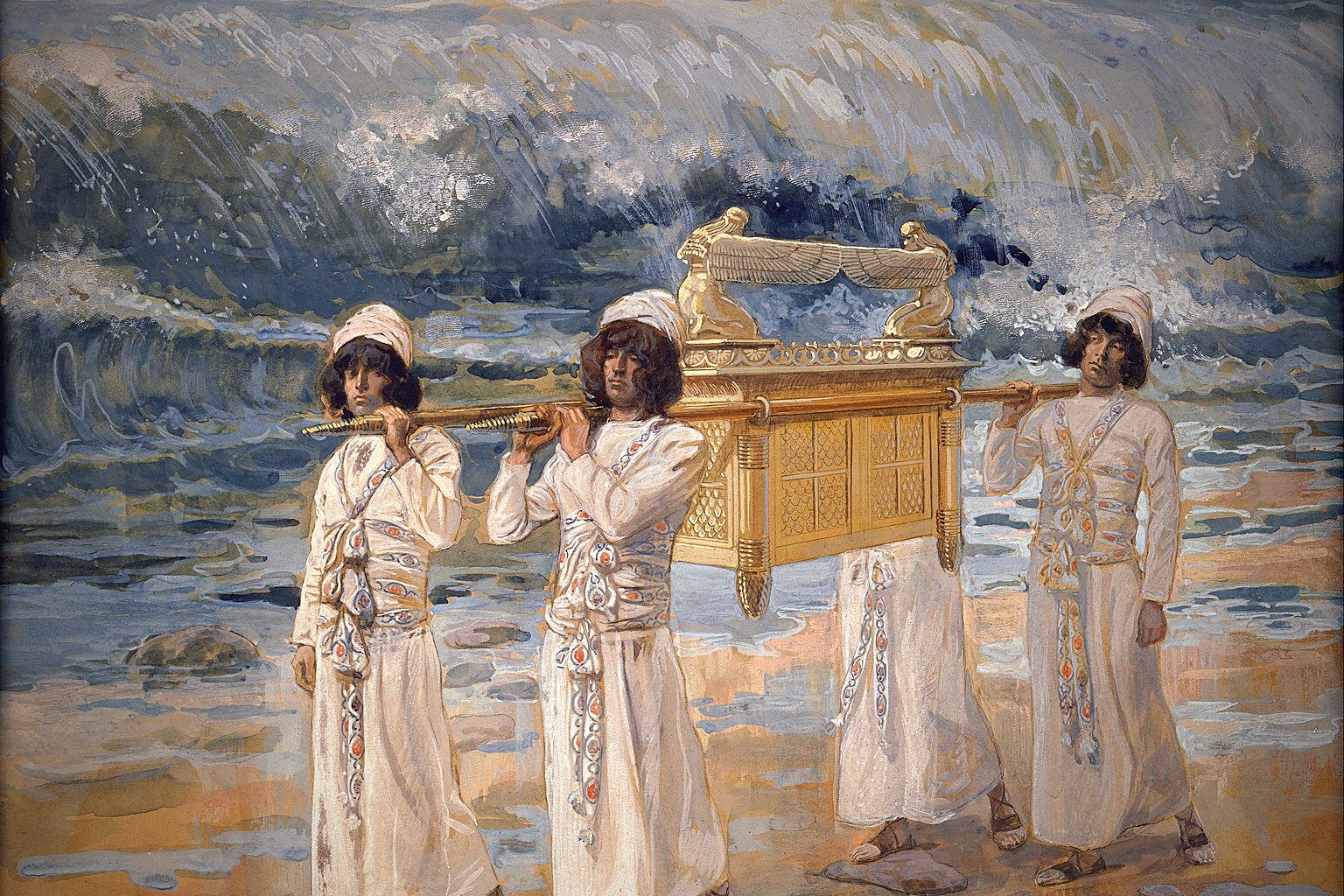
Most people picture the Ark of the Covenant as a gilded box that held two stone tablets — a reliquary, a symbol, a piece of sacred furniture. That picture comes from art, not from the text.
Read Exodus as an engineer reads a specification, and something else appears. The instructions are obsessively dimensional. They name exact materials. They mandate a layer order. And then, crucially, they are followed by handling protocols with a body count.
Objects that require safety procedures are not symbols. They are equipment.
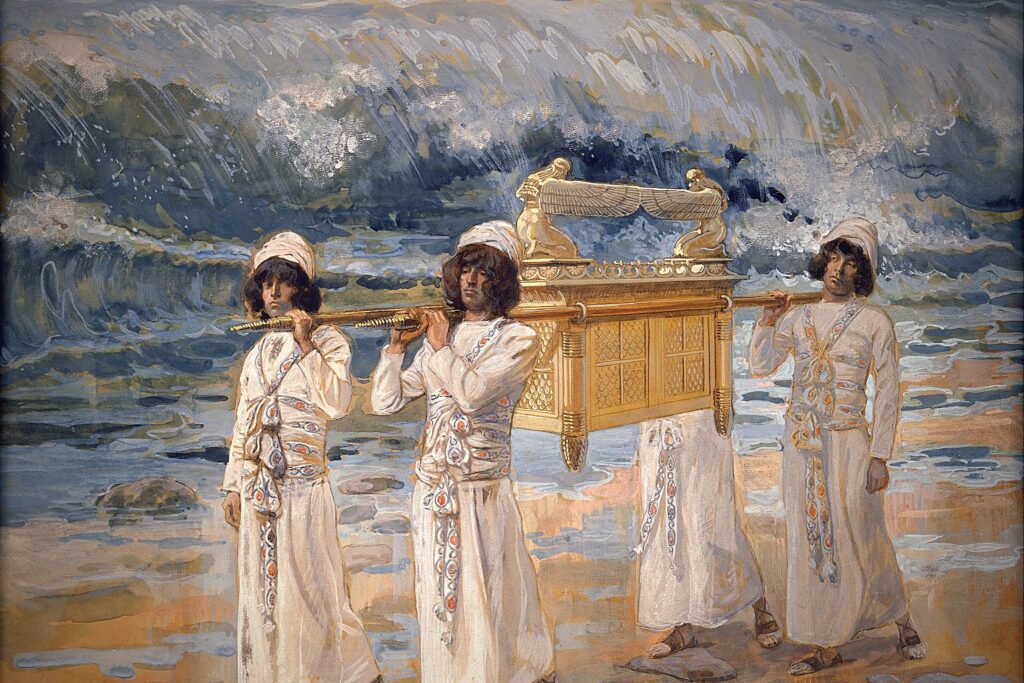
Was the Ark of the Covenant a Weapon?
The Bible never calls the Ark a weapon. But it describes an object that stored something, discharged lethally on unauthorised contact, required insulated handling by trained operators, caused a disease outbreak when captured, and was present at the collapse of a fortified city. Read through a modern hazard lens, the Exodus specification describes a layered gold-and-wood structure that is, in electrical terms, a capacitor — and the narrative that follows behaves accordingly.
That is not proof of ancient technology. It is a genuinely strange correspondence between a 3,000-year-old building instruction and a piece of physics that was not described until the 18th century. This article takes that correspondence seriously — and then tests where it breaks.
The Specification: Exodus 25 as a Schematic
“And they shall make an ark of shittim wood: two cubits and a half shall be the length thereof, and a cubit and a half the breadth thereof, and a cubit and a half the height thereof. And thou shalt overlay it with pure gold, within and without shalt thou overlay it.” (Exodus 25:10-11)
Read the layer order carefully. Gold without. Wood. Gold within.
That is three layers: conductor, insulator, conductor.
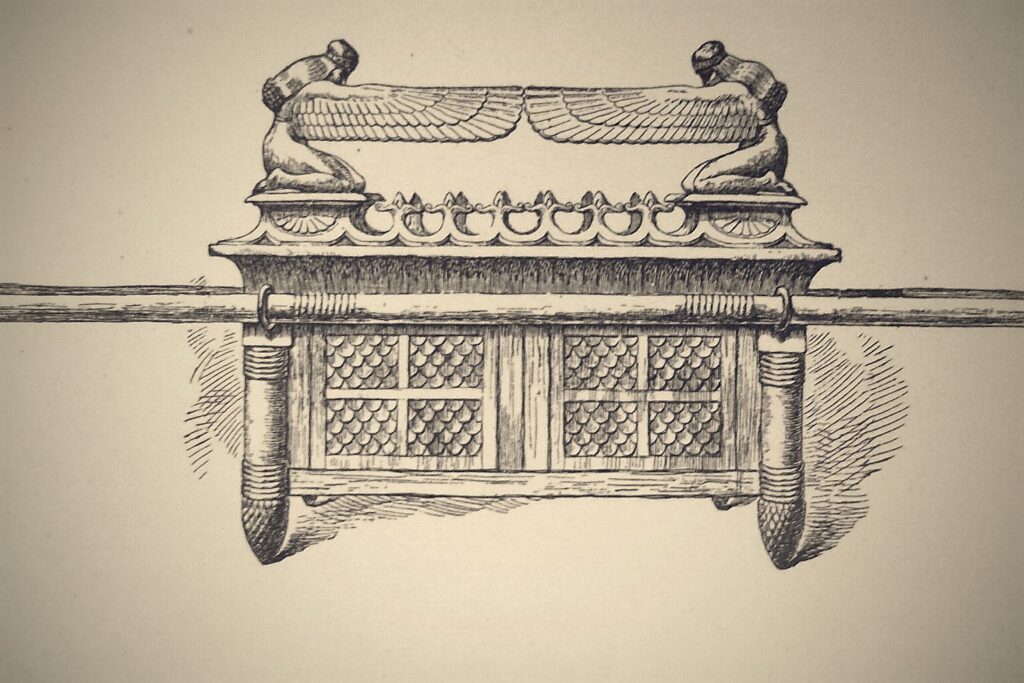
It is the defining structure of a capacitor — a device that stores electrical charge in the field between two conductive plates separated by a dielectric. A Leyden jar, invented in 1745, is the same idea in a different shape: metal foil, glass, metal foil.
The specification does not say “make it beautiful.” It says gold inside and outside, over a wooden core. A purely decorative object needs gold on the outside only. Gilding the interior of a box that will be closed, covered and hidden is expensive, invisible and — from a decorative standpoint — pointless.
Unless the inner layer is doing a job.
Running the Numbers
This is where most treatments of the subject stop, because the next step requires actually calculating something. So let us calculate it.
Using the Royal Egyptian cubit (52.36 cm (21 in)), which Moses would plausibly have used after an Egyptian court education:
- Dimensions: 2.5 × 1.5 × 1.5 cubits = 1.31 × 0.79 × 0.79 m (4.3 × 2.6 × 2.6 ft)
- Total plate area (A): approximately 5.35 m²
- Dielectric: acacia wood, relative permittivity roughly 2.5 when dry
- Separation (d): the board thickness — unspecified, but a structural panel of roughly 25 mm (0.98 in) is reasonable
The parallel-plate formula gives:
C = ε₀ εr A / d ≈ 4.7 nanofarads
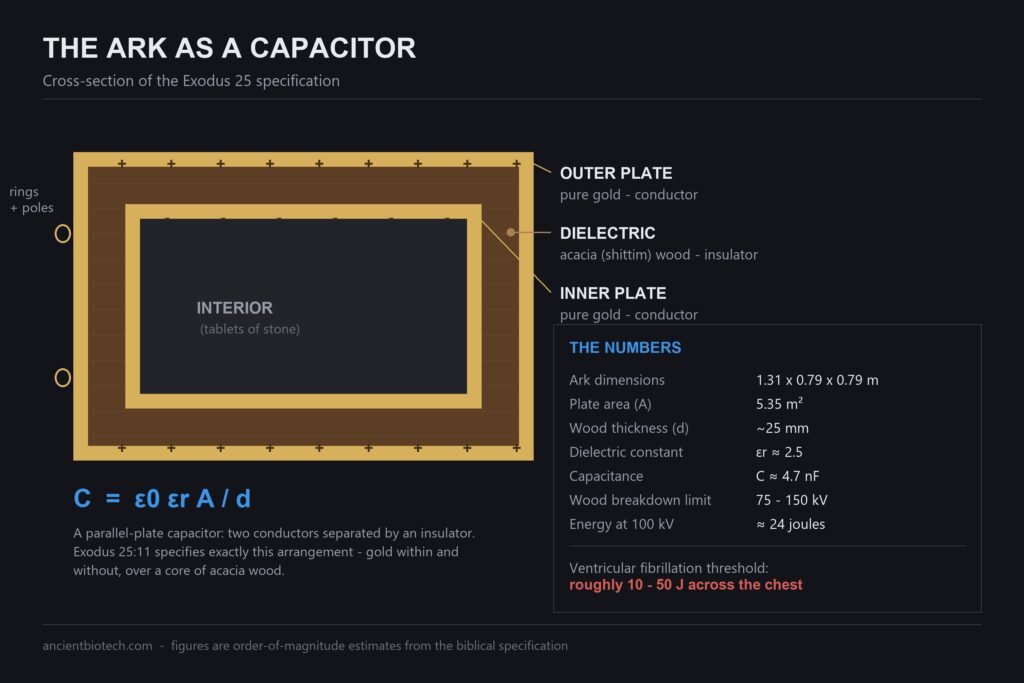
Four and a half nanofarads is a small capacitance. On its own that sounds unimpressive — until you ask what voltage it could hold.
Dry wood has a dielectric strength of roughly 3 to 6 kV per millimetre. Across 25 mm (0.98 in) of acacia, that is a breakdown limit somewhere between 75 and 150 kV.
At 100 kV, the stored energy is:
E = ½CV² ≈ 24 joules
Here is why that number matters. The threshold for inducing ventricular fibrillation with a capacitive discharge across the chest is on the order of 10 to 50 joules. A cardiac defibrillator delivers 200 to 360 J deliberately.
In other words: a structure built exactly to the Exodus specification, charged to the limit its own insulation could withstand, would store an amount of energy that sits squarely inside the lethal range for a discharge through the human body.
That is an uncomfortable coincidence.
Where the Charge Could Come From
A capacitor stores charge; it does not generate it. The obvious candidate is triboelectric charging — static generated by friction.
Numbers 4:5-6 specifies that in transit the Ark was covered with a badger-skin covering and a cloth of blue. Animal hide and woven fabric, moving continuously against a gold surface, in the extreme dryness of the Sinai, is a workable static generator. It is the same physics as a Van de Graaff belt, which routinely reaches hundreds of kilovolts.
And the transport rules are strangely specific:
“And the staves shall be in the rings of the ark: they shall not be taken from it.” (Exodus 25:15)
The poles are never removed. The Ark is never carried directly. The handlers are permanently separated from the gold by wooden staves — and wood is an insulator.
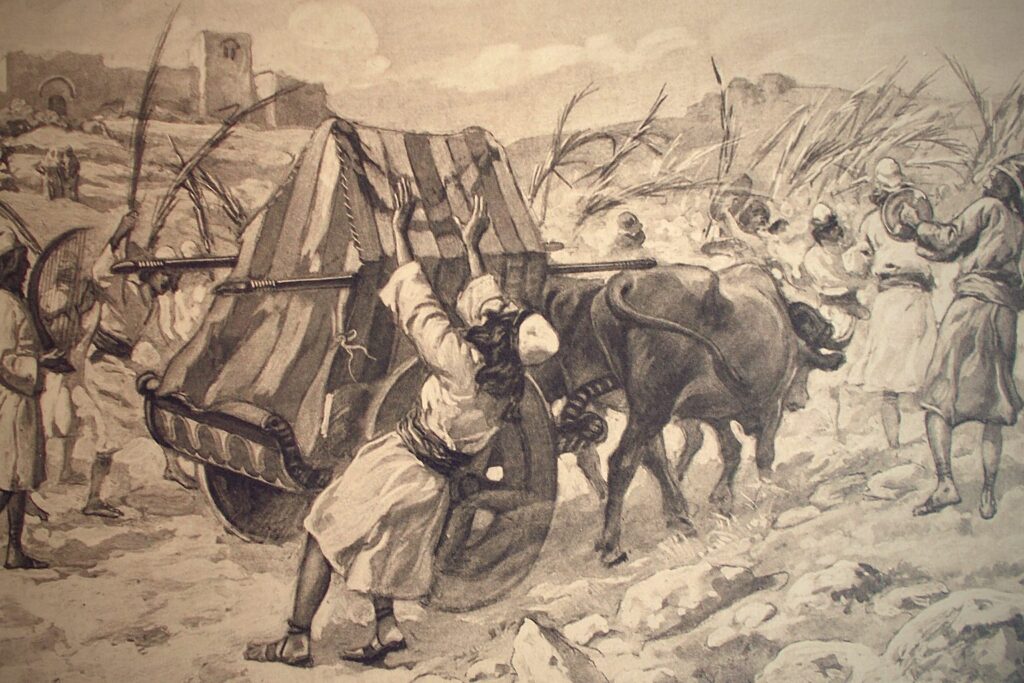
The Uzzah Incident: An Instantaneous Death
The most direct evidence is the incident that ended a celebration.
David was moving the Ark to Jerusalem — on a cart, which was already a procedural violation; the law required it to be carried on poles by Levites. The oxen stumbled.
“And Uzzah put forth his hand to the ark of God, and took hold of it… And the anger of the LORD was kindled against Uzzah; and God smote him there for his error; and there he died by the ark of God.” (2 Samuel 6:6-7)
Notice the details. Direct contact. Bare hand. Instantaneous death. No wound described.
Uzzah was not a hostile actor. He was trying to prevent the Ark from falling — the instinctive, decent reaction. The text does not present it as punishment for wickedness; it calls it an error. A mistake. A procedure not followed.
A man standing on the ground who grasps a charged conductor becomes the path to earth. If the Ark held a charge anywhere near the figures above, the discharge would have crossed his chest and stopped his heart in milliseconds. No burn necessarily visible, no blood, no warning.
The word translated “error” — shal — carries the sense of an inadvertent slip rather than a crime. That is precisely the language you would use for a safety violation.
The Philistine Outbreak: 1 Samuel 5
The Philistines captured the Ark at the battle of Aphek and took it to Ashdod as a trophy. They had no priesthood, no protocols, no shielding.
“But the hand of the LORD was heavy upon them of Ashdod, and he destroyed them, and smote them with emerods.” (1 Samuel 5:6)
The affliction spread from city to city as the Ark was moved — Ashdod, then Gath, then Ekron — with the outbreak tracking the object’s location. After seven months the Philistines sent it back, accompanied by a guilt offering of five golden tumours and five golden mice (1 Samuel 6:4).
Two observations:
- The disease followed the object, not the population. That is the signature of an environmental source rather than person-to-person contagion.
- The Philistines associated the outbreak with mice.
This second detail is what makes the passage genuinely interesting, because it points in a direction that has nothing to do with radiation. Tumour-like swellings in the groin, a rodent association, and rapid mortality is a recognisable description of bubonic plague — buboes are swollen lymph nodes, and the classic vector is the rat flea. Many scholars read 1 Samuel 5-6 as one of the earliest plague accounts in literature.
So the honest reading is that the Philistine outbreak is better explained by epidemiology than by an energy source — and a careful writer should say so rather than reaching for the more exciting answer.
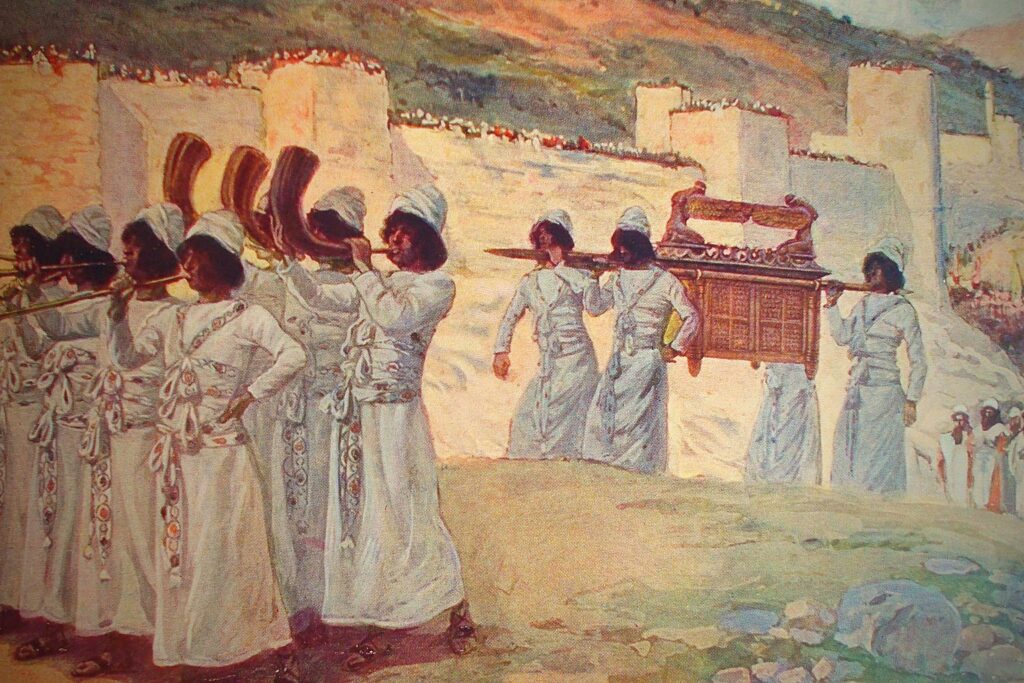
Jericho: Resonance, Not Magic
The siege of Jericho in Joshua 6 is the one episode where the Ark is present at large-scale structural failure.
The procedure is oddly precise: the Ark is carried around the city once a day for six days in silence, then seven times on the seventh day, followed by a sustained trumpet blast and a mass shout. The walls fall.
The sonic reading is not unreasonable. Structures have resonant frequencies, and sustained periodic loading at the right frequency can amplify displacement dramatically. Marching columns are still ordered to break step on bridges for exactly this reason.
But the honest assessment is that a crowd shouting cannot deliver the energy required to collapse a fortified rampart. What the account describes better is timing: six days of repetitive, disciplined, silent circuit, and then a coordinated release at a single moment. Whatever happened at Jericho, the text presents it as a scheduled event, executed to a procedure.
Archaeologically, Jericho’s walls did collapse — Kathleen Kenyon’s excavations confirmed a destruction layer with fallen mudbrick forming a ramp against the retaining wall. The dating of that layer to the biblical period remains disputed, which is an argument worth having honestly rather than ignoring.
The Mercy Seat: A Gap Between Two Conductors
The lid is described separately, and the description is peculiar:
“And there I will meet with thee, and I will commune with thee from above the mercy seat, from between the two cherubims.” (Exodus 25:22)
Two gold figures, wings extended toward each other, with a defined gap between them — and communication specified as originating in that gap.
Two conductors separated by an air gap is a spark gap. When potential across the gap exceeds the breakdown voltage of air (about 3 kV per millimetre), it arcs. Early radio transmitters were built on exactly this principle: Marconi’s first systems were spark-gap transmitters, generating broadband electromagnetic pulses.
Whether the Ark transmitted anything is unknowable. What is documented is that the text places the point of communication precisely at the one location in the whole structure where two conductors face each other across a gap.
The Case Against It
A theory is only worth holding if you know its weak points. This one has several, and they deserve stating plainly:
- Gold leaf is not a sealed plate. Overlay is not the same as a continuous foil electrode. Seams, joins and the rings would create discharge paths that bleed charge away long before it reached lethal potential.
- Wood is a poor dielectric when humid. Acacia is dense and resinous, but any absorbed moisture collapses its resistivity. The Sinai is dry; Israel’s rainy season is not.
- Self-discharge would be rapid. A real capacitor of this construction would not hold a high-voltage charge for days or weeks. The Jericho reading — six days of accumulation — is not physically plausible.
- The Philistine outbreak fits plague better. The mice, the buboes, the seven-month duration and the geographic spread all point to disease, not exposure to a source.
- No physical evidence exists. The Ark has never been recovered, examined or tested. Every claim here is inference from a text.
What survives all of that is narrower but still striking: the specified layer order is the layer order of a capacitor, and the handling rules are the handling rules for something that can kill on contact. That is the core observation. Everything beyond it is interpretation.
Where Did the Ark of the Covenant Go?
The Ark disappears from the biblical record before the Babylonian destruction of Jerusalem in 586 BC. It is absent from the inventory of items Nebuchadnezzar carried off, and absent from the Second Temple — the Holy of Holies there was famously empty. Three traditions attempt to fill the gap:
| Tradition | Claim | Standing |
|---|---|---|
| Temple Mount | Hidden in tunnels beneath the Temple before the Babylonian siege; later sought by the Knights Templar, who excavated the Mount for nine years from 1119 | No access, no excavation possible; entirely unverified |
| Ethiopia | Taken to Aksum by Menelik I, son of Solomon and the Queen of Sheba, per the Kebra Nagast; now held at the Church of Our Lady Mary of Zion | A guardian exists and the tradition is ancient, but no one has ever been permitted to see or test the object |
| European caches | Moved by the Templars to Chartres, or to Rosslyn Chapel in Scotland | Late, thin, and largely a product of modern speculation |
The Ethiopian tradition is the most substantial of the three, because it is genuinely old and institutionally maintained rather than invented recently. It is also completely untestable by design, which is either exactly what you would expect of a real containment protocol or exactly what you would expect of a claim that cannot survive inspection.
Frequently Asked Questions
Was the Ark of the Covenant electric?
The Bible does not say so. But the Exodus 25 specification — gold, over acacia wood, over gold — is the layer structure of a capacitor, and the surrounding handling rules match the precautions you would take around a charged conductor. Calculated from the biblical dimensions, such a structure would have a capacitance of roughly 4.7 nF and could in principle store energy in the lethal range.
Was the Ark of the Covenant radioactive?
Nothing in the text points that way, and the passage usually offered does not carry it: the Philistine outbreak in 1 Samuel 5 describes tumour-like swellings associated with mice, which matches bubonic plague considerably better than radiation exposure. The electrical reading this article sets out does not need radioactivity and does not claim it — a charged capacitor and a radiation source are different objects.
How did Uzzah die from touching the Ark?
2 Samuel 6:6-7 records that Uzzah reached out to steady the Ark and died instantly. The text calls it an error rather than a crime. A person standing on the ground who grasps a charged conductor provides a path to earth, and a discharge across the chest can stop the heart in milliseconds.
Why was the Ark overlaid with gold inside and out?
Exodus 25:11 requires gold on both the interior and exterior surfaces. Gilding the inside of a closed, covered chest serves no decorative purpose, since it would never be seen. It does, however, create the second conductive plate required for a capacitor.
How much energy could the Ark have stored?
Using the royal cubit, an area of about 5.35 m² and 25 mm (0.98 in) of acacia, the capacitance works out to roughly 4.7 nF. At 100 kV — near the breakdown limit of the wood — that stores about 24 joules. The ventricular fibrillation threshold is roughly 10 to 50 joules.
Where is the Ark of the Covenant now?
Unknown. It vanishes from the record before 586 BC. The strongest surviving tradition places it at the Church of Our Lady Mary of Zion in Aksum, Ethiopia, guarded by a single monk, though no independent examination has ever been permitted.
Did the Ark bring down the walls of Jericho?
The Ark was carried around Jericho for seven days before the walls fell (Joshua 6). Archaeology confirms Jericho’s walls collapsed outward, forming a ramp, though the dating is disputed. A shout cannot deliver enough energy to topple a rampart, so the text is better read as describing timing and procedure than a physical mechanism.
Where That Leaves It
Strip away the gilt-and-incense imagery and what remains in Exodus is a document with the tone of an operating manual: exact dimensions, a mandated material stack, mandatory insulated handling, restricted personnel, protective garments, and a one-metre exclusion zone enforced by lethal outcome.
The Bible does not explain why any of these rules exist. It simply issues them, and then records what happens to the people who break them.
Whether the Ark was an instrument or a presence is not something a calculation can settle. But the specification is real, the physics of that layer order is real, and the casualty list is in the text. Someone wrote down a build sheet and a set of safety procedures — and then history recorded exactly the kind of accidents those procedures were designed to prevent.
One thing would settle it, and it is the one thing nobody has: the object. The Ark has never been recovered, examined or measured, and every claim on this page — in either direction — is inference from a document.
The same argument gets made about other passages that carry unexpected numbers: the New Jerusalem with its published dimensions, Noah’s Ark with its hull ratios, manna with its storage behaviour and shelf life. Whether that is a pattern in the texts or a habit in the reading is the part you are left to judge.
Continue Reading
- Ezekiel’s Wheel: The Vision a Priest Had No Words For — A wheel in the middle of a wheel, rims full of eyes, moving in four directions without turning. What Ezekiel 1 actually…
- The Viking Sunstone: How It Works, and What Has Been Found — The physics is settled: a calcite crystal really can locate the sun through cloud. Everything else is argued — the one…
- Derinkuyu: The Doors Only Close From Inside — Eighty-five metres down, eight levels open of an estimated eighteen, and a half-tonne stone wheel with a spear-hole…