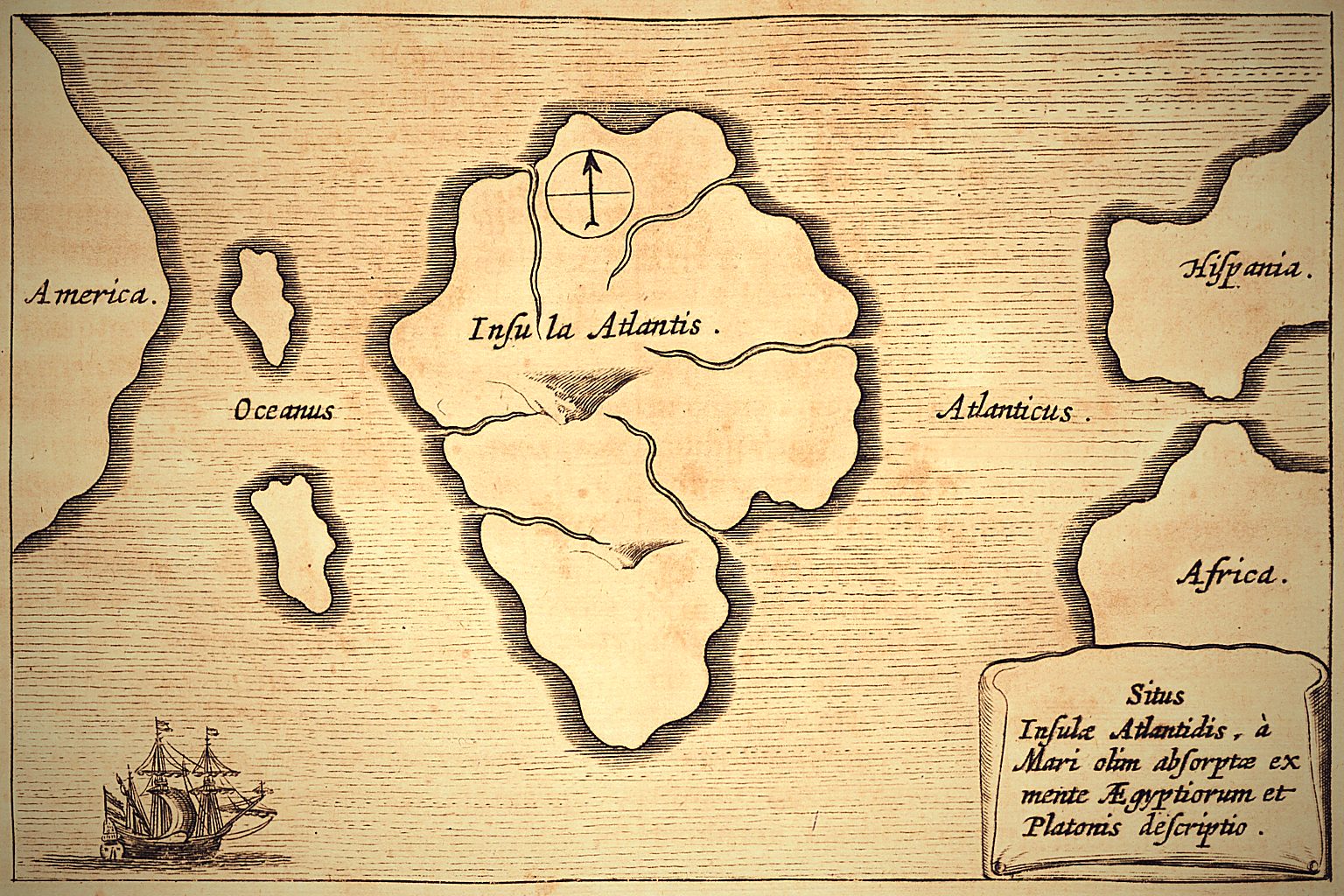
Was Atlantis real? Before anything else, there is exactly one source for it.
Not one primary source among several. One. Everything ever written about Atlantis — every expedition, every documentary, every map, every claimed location from Antarctica to the Bahamas — traces back to two unfinished dialogues written by a single Athenian philosopher around 360 BC.
No earlier text mentions it. No Egyptian record, no Mesopotamian tablet, no Phoenician account, no Greek writer before Plato. For a civilisation supposedly so magnificent that its destruction was remembered for nine thousand years, the documentary trail begins and ends with one man.
That fact does not by itself settle the question. But any honest treatment has to start there, because almost none of them do.
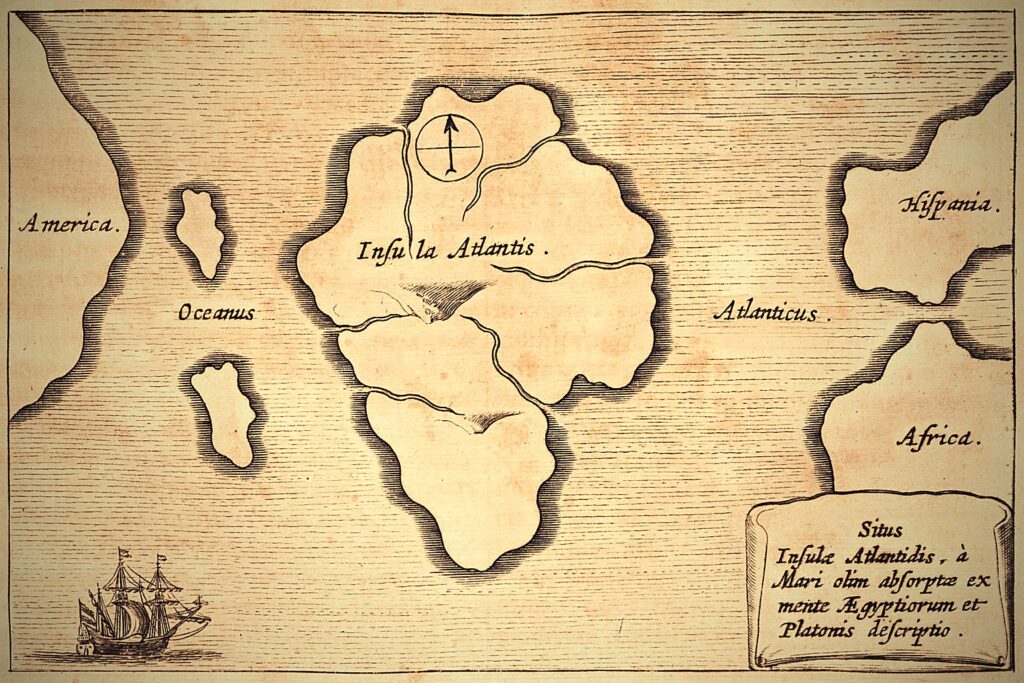
What Did Plato Actually Say?
Atlantis appears in two of Plato’s dialogues, the Timaeus and the Critias, written around 360 BC.
The frame is a chain of transmission: the story came from Egyptian priests at Saïs, who told it to the Athenian statesman Solon around 590 BC, who told it to his relative Dropides, who told it to his son Critias, who told it to his grandson — the Critias who narrates it. Four hand-offs before it reaches the page.
The content:
- Atlantis lay beyond the Pillars of Heracles (Gibraltar), an island larger than Libya and Asia combined
- It was founded by Poseidon, ruled by ten kings descended from his sons
- The capital was built in concentric rings of land and water, with harbours, canals, and a temple sheathed in silver and gold
- The walls were clad in a metal called orichalcum, which “flashed with a red light”
- It had elephants, hot and cold springs, and enormous fleets
- It grew corrupt and imperialist, attacked the Mediterranean, and was defeated by ancient Athens
- Then earthquakes and floods destroyed it in “a single day and night”, and it sank beneath the sea
- All of this 9,000 years before Solon
The Critias breaks off mid-sentence. Plato never finished it.
What Plato Was Doing
The context is the part that gets removed when the story is retold, and it is decisive.
The Timaeus and Critias were intended as sequels to the Republic — Plato’s work on the ideal state. In the Republic he describes the perfect city in theory. In the Timaeus, Socrates says he would like to see that city in motion, tested in war.
Atlantis is the answer to that request. Ancient Athens is the ideal state, and Atlantis is the opposite: wealthy, technologically superb, maritime, imperial, and morally decayed. The virtuous, modest, land-based city defeats the rich naval empire.
This is a lesson about hubris and civic virtue, delivered in exactly the form Socrates asked for, by an author who used invented narrative freely elsewhere — the Ring of Gyges, the Myth of Er, the Cave.
And there is a pointed detail. Plato’s Athens in the story is a land power that defeats a naval empire. Plato was writing after Athens’ own naval empire had overreached, lost the Peloponnesian War, and been humiliated. Atlantis is not a distant memory. It is a mirror.
Aristotle’s Verdict
Plato’s own student appears to have regarded it as invention. The remark attributed to Aristotle, via the geographer Strabo, is: “He who invented it also destroyed it.”
That is the earliest recorded opinion on Atlantis by someone who knew Plato personally, and it is a dismissal.
Why the Atlantic Location Is Ruled Out
This part is no longer arguable, and it is worth being precise about why.
There is no sunken continent in the Atlantic. The ocean floor has been mapped by sonar, satellite altimetry and seismic survey. The Mid-Atlantic Ridge is a spreading centre — new crust is being created there and moving outward, which is the opposite of a landmass sinking.
Plate tectonics forbids it. Continental crust is less dense than oceanic crust. It does not sink; it floats. A continent-sized landmass cannot subside into the Atlantic basin in a day, or at all.
Deep-sea cores show no such event. Sediment cores across the Atlantic record continuous deposition. There is no horizon marking a catastrophic submergence within the last twelve thousand years.
The Atlantic Atlantis is not an open question that mainstream science refuses to examine. It is a claim that was examined and closed by the mapping of the seafloor.
The Serious Candidate: Thera
If any real event lies behind the story, the strongest candidate is the eruption of Thera (Santorini) in the Aegean, around 1600 BC.
The parallels are genuine:
| Plato’s Atlantis | Thera / Minoan Crete |
|---|---|
| Circular rings of land and water | Thera is a caldera — a circular island with a flooded centre |
| Destroyed suddenly by natural catastrophe | One of the largest volcanic eruptions of the Holocene |
| Sank beneath the sea | The island’s centre collapsed into the sea |
| Great maritime power | Minoan Crete was the dominant Aegean naval civilisation |
| Bull imagery in ritual | Minoan bull-leaping and bull cult are well documented |
| Advanced plumbing, hot and cold water | Minoan palaces had sophisticated water systems |
| Sudden end of the civilisation | Minoan power declines after the eruption and associated tsunamis |
The problems are equally real: Thera is inside the Mediterranean, not beyond Gibraltar; it was destroyed around 1600 BC, not 9600 BC; and it was an island of modest size, not a continent.
The Zeros Problem
One proposed reconciliation is elegant enough to mention. If the Egyptian source recorded a figure in months and Solon or a later transmitter read it as years, 9,000 becomes roughly 750 years before Solon — which lands close to the Minoan collapse. A similar effect follows if a factor of ten entered the transmission somewhere.
It is speculative. It is also the kind of error that four hand-offs between languages and counting systems reliably produces.
Other Candidates, Briefly
Doñana, Spain. Marshland near Cádiz, beyond Gibraltar, with circular structures identified in satellite imagery and a history of tsunami inundation. Location fits; scale and date do not.
Sardinia. Proposed on the basis of the nuragic towers and a tsunami hypothesis. Weak on the sinking.
The Black Sea. The Ryan-Pitman hypothesis proposes a catastrophic Mediterranean inflow around 5600 BC that flooded a large inhabited area. The flooding may be real and may underlie flood traditions generally, but it does not match Plato’s specifics.
Antarctica. Requires the continent to have been ice-free and inhabited within human history, which the ice cores — containing continuous records hundreds of thousands of years deep — directly contradict.
What Atlantis Is Actually For
The reason the story has outlived every disproof is that it is structurally perfect.
It is a civilisation more advanced than the present, destroyed by its own moral failure, in a single night, leaving no trace — which conveniently explains the absence of evidence as part of the story. It cannot be falsified by not finding it, because not finding it is what the narrative predicts.
That is also the reason it has been so easy to attach to whatever the age required. Nineteenth-century writers used it for racial theories. Twentieth-century occultists made it the source of secret wisdom. Modern versions make it a lost technological civilisation.
Plato built a story about a rich, clever, over-reaching sea power that believed its own superiority and was destroyed. Every generation since has recognised itself in it, which is precisely what a well-constructed parable does.
The genuine lost civilisations are less convenient and more interesting. Göbekli Tepe really was unknown, really did overturn the accepted sequence, and really was raised by people with no metal or pottery. Tiwanaku really did move 90-tonne stone across 90 km (56 miles) at 3,800 metres (12,467 ft). Neither needed to sink to be remarkable.
Frequently Asked Questions
Was Atlantis real?
Everything anyone knows about Atlantis comes from two dialogues by Plato, written around 360 BC; no earlier text from any culture mentions it. The Atlantic location Plato gives is excluded by seafloor mapping and plate tectonics, which is why the serious candidates are elsewhere. Whether he was reporting something older or building an argument is the part still open, and the dialogue stops mid-sentence before telling us.
Who wrote about Atlantis first?
Plato, in two dialogues around 360 BC. He presents the story as reaching him through Egyptian priests, Solon, and three generations of his own family — four transmissions before it was written down.
Where was Atlantis supposed to be?
Plato places it beyond the Pillars of Heracles, the Strait of Gibraltar, in the Atlantic. No submerged continent exists there: the Mid-Atlantic Ridge is a spreading centre creating new crust, and continental crust is too buoyant to sink.
Could Atlantis be Santorini?
Thera is the strongest candidate. It is a circular caldera destroyed by one of the largest eruptions of the Holocene around 1600 BC, associated with the decline of Minoan Crete, a major naval power with bull cult and advanced plumbing. But it is inside the Mediterranean and far too recent and too small.
What did Aristotle say about Atlantis?
Plato’s own student appears to have regarded it as fiction. The remark attributed to him, preserved by Strabo, is “He who invented it also destroyed it.”
What was orichalcum?
A metal Plato describes as cladding the walls of Atlantis, flashing with a red light, and second in value only to gold. Ancient sources elsewhere use the name for a copper alloy, most likely a brass. Ingots of a copper-zinc alloy recovered from a shipwreck off Sicily in 2015 have been linked to the name.
Why does the Critias end mid-sentence?
Plato never finished it. The dialogue breaks off in the middle of Zeus addressing the assembled gods about Atlantis’s punishment.
Is there any real event behind the Atlantis story?
Possibly the Thera eruption and the Minoan decline, which match several details. Plato’s own framing, as the sequel to the Republic showing an ideal state tested in war, indicates the primary purpose was philosophical rather than historical.
Conclusion: An Unfinished Sentence
The Critias stops mid-sentence. Zeus has gathered the gods to pronounce judgement on Atlantis, he begins to speak, and the text simply ends.
Plato put the manuscript down and never came back to it.
That is a strange thing for a historical record to do, and a completely ordinary thing for a writer to do with an illustration that had already served its purpose. The point had been made: a brilliant, wealthy, over-confident sea power convinced of its own superiority meets the limit of what brilliance and wealth can protect.
Athens got the message. Twenty-four centuries of Atlantis hunters got the map.
Continue Reading
- Why Every Culture Remembers a Flood — Over 200 flood traditions worldwide. The word carrying the weight is ‘independently’ — and a 120-metre post-glacial sea…
- Göbekli Tepe: The Temple That Came Before Farming — 11,600 years old – older than pottery, metal, writing and the wheel. Why Göbekli Tepe inverted the accepted order of…
- King Solomon: What the Archaeology Actually Shows — No inscription names him. But radiocarbon put industrial copper smelting in the Arava in his century, and a 2021…