Around 12,900 years ago, the world was warming out of the last ice age. The glaciers were retreating. Then, in a span that ice cores suggest may have been as short as a single decade, the northern hemisphere slammed back into near-glacial cold and stayed there for roughly 1,200 years.
Then it ended, and did so even faster — Greenland ice cores record a warming of perhaps 10°C in around a decade.
This is the Younger Dryas, and it is not controversial. It is one of the best-documented climate events in the geological record, visible in ice cores, lake sediments, ocean cores and pollen sequences across the world.
What is controversial is what caused it — and that argument has become the single most contested question in earth science, largely because of what else happened at the same time.
What Was the Younger Dryas?
The Younger Dryas was an abrupt return to cold conditions beginning around 12,900 years ago and ending around 11,700 years ago. It is named after Dryas octopetala, an arctic flower whose pollen appears in European sediment layers from the period — the plant moved south as the cold returned.
Its defining feature is speed. Most climate transitions take millennia. This one took decades at both ends, which is why it is studied so intensively: it is the clearest evidence that Earth’s climate can flip states rapidly.
Three things coincide with it, and the coincidence is what drives the argument:
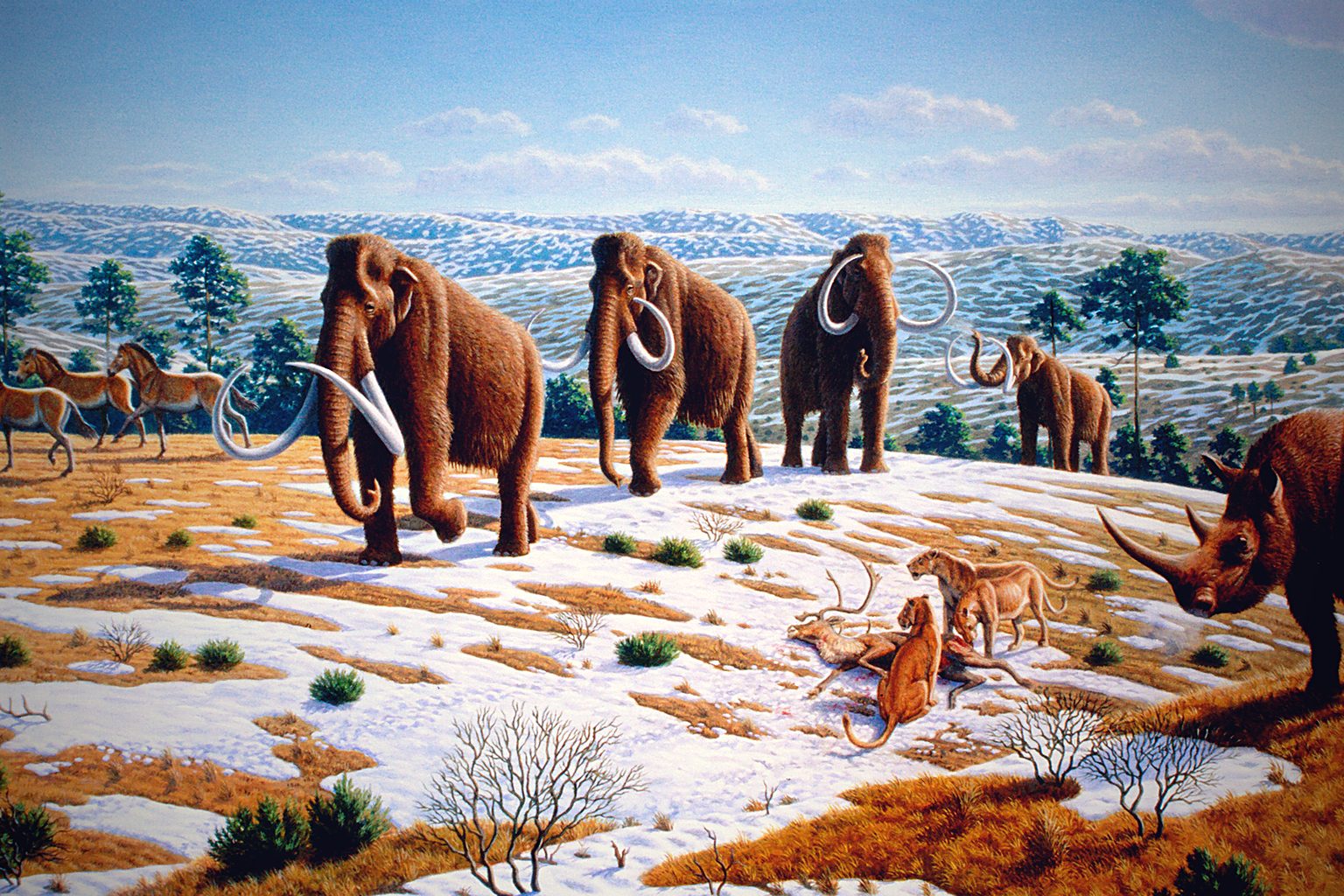
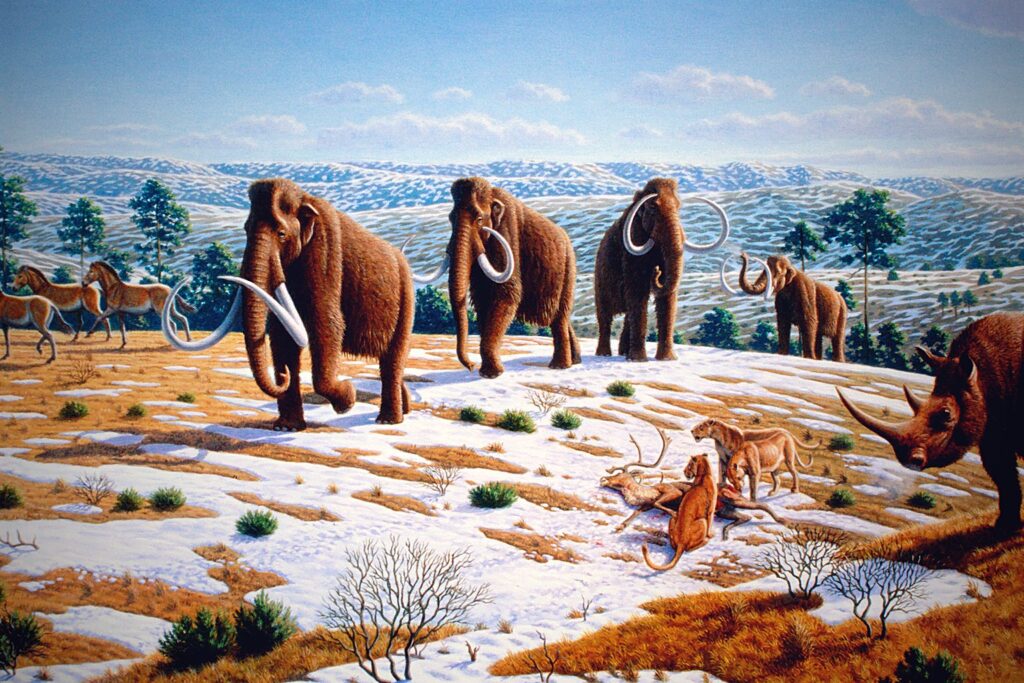
- The North American megafauna extinction. Mammoths, mastodons, giant ground sloths, sabre-toothed cats, dire wolves and American horses disappear around this boundary.
- The disruption of the Clovis culture, the widespread early North American archaeological tradition, whose distinctive fluted points stop appearing.
- A dark sediment layer, the “black mat,” found at many North American sites, directly above which no megafauna remains occur.
The Two Explanations
The Meltwater Hypothesis
The mainstream account. As the Laurentide Ice Sheet melted, enormous volumes of fresh water pooled in Lake Agassiz, a proglacial lake larger than all the modern Great Lakes combined. At some point an ice dam failed and that fresh water discharged into the North Atlantic.
Fresh water is less dense than salt water. Enough of it arriving at the surface disrupts the Atlantic Meridional Overturning Circulation — the system by which warm surface water travels north, cools, sinks, and returns south. Shut that down and northern Europe and North America lose an enormous heat delivery, fast.
This mechanism is physically well understood, is reproduced in climate models, and does not require anything unusual to have happened. Its difficulty has been identifying the exact outflow route, since evidence for the specific drainage channel has been debated.
The Impact Hypothesis
Proposed in 2007 by Richard Firestone and colleagues: a comet or asteroid fragmented in the atmosphere over the Laurentide Ice Sheet, and the resulting airbursts and impacts triggered continental wildfires, injected soot and dust into the stratosphere, destabilised the ice sheet, and drove the cooling.
The proposed evidence, reported across many papers and more than 50 sites on several continents:
- Nanodiamonds, including hexagonal forms, at the Younger Dryas boundary
- Magnetic and carbon spherules formed by high-temperature melting
- Platinum and iridium enrichment — elements rare in the Earth’s crust and common in meteoritic material
- Meltglass requiring temperatures above 2,000°C
- A 2025 geochemical study of Baffin Bay ocean sediments reporting metallic debris, microspherules and elevated platinum, iridium, nickel and cobalt at the Younger Dryas onset
Why the Impact Hypothesis Is Still Rejected by Most Specialists
The criticisms are specific, and they have not been answered.
There is no crater. After nearly two decades, no impact structure of the required age and scale has been identified. Proponents respond that an airburst over an ice sheet would leave none — which is a reasonable answer, but it also means the single most direct form of evidence is unavailable by construction.
The markers have not replicated reliably. Independent teams attempting to reproduce the nanodiamond and spherule findings at the same sites have frequently failed to find them, or have found them in layers of other ages. Magnetic spherules occur naturally from volcanic and industrial sources and from ordinary micrometeorite infall.
The dating does not line up. Critics including Vance Holliday and colleagues have documented an age spread of up to two centuries between sites claimed to record a single instantaneous event. A simultaneous event cannot be two hundred years wide.
The wildfire mechanism fails modelling. Climate models published in 2025 in Nature Geoscience indicate that even continent-scale wildfires would not generate enough soot to produce cooling of the observed magnitude and, critically, of the observed 1,200-year duration. An airburst is a brief event; the Younger Dryas is not.
The megafauna extinction does not fit cleanly. Many species were already in decline before the boundary, extinction timings differ by species and region, and South American and Eurasian patterns do not match the North American one. Human hunting pressure and habitat change remain strong competing explanations.
A 2025 review in Skeptical Inquirer characterised the hypothesis as having failed; its proponents have published rebuttals accusing critics of misrepresenting the evidence. The exchange has become unusually acrimonious for a scientific dispute.
Where That Leaves It
The Younger Dryas is real and abrupt. Not in dispute.
The cause is most likely a freshwater disruption of ocean circulation. This remains the mainstream position, is mechanistically well understood, and explains the duration.
The impact hypothesis has produced genuine anomalies that have not been fully explained — the platinum enrichment in particular has been reported by multiple groups, including in Greenland ice — but it lacks a crater, lacks reliable replication, and its proposed mechanism does not account for how long the cooling lasted.
The most defensible statement: something may have hit, and it probably is not what caused the Younger Dryas. Those are separate claims, and the debate has suffered badly from treating them as one.
Why This Matters for Lost Civilisations
The Younger Dryas is the load-bearing element in a much larger popular argument, most prominently associated with Graham Hancock, whose Netflix series brought it to a mass audience.
The argument runs: an advanced civilisation existed before 12,900 years ago; the cataclysm destroyed it; survivors carried knowledge to later peoples; Göbekli Tepe and worldwide flood traditions are its fingerprints.
The dates are genuinely suggestive. Göbekli Tepe begins around 9600 BC — close to the end of the Younger Dryas, not its beginning. Sea levels were rising catastrophically through this whole period, drowning coastlines worldwide.
But the inference does not hold, for reasons that have nothing to do with gatekeeping:
An advanced civilisation leaves debris. Metallurgy leaves slag. Agriculture leaves pollen signatures and modified seed morphology. Cities leave foundations, middens and disturbed soil chemistry. Mining leaves spoil. None of this appears in the pre-Younger Dryas record anywhere.
Göbekli Tepe argues against it, not for it. Its builders used flint. There is no metal at the site. And the enclosures show learning in reverse — the earliest are the largest and finest, the later ones smaller and rougher. That is a tradition that peaked and declined, not knowledge inherited from a superior source.
Flood traditions have a better explanation. A 120-metre post-glacial sea level rise, witnessed on every inhabited coastline over generations, accounts for the distribution without requiring a lost civilisation.
What the Younger Dryas does establish is more modest and still significant: human beings lived through an abrupt global climate catastrophe, lost a continent’s worth of large animals, and had their way of life disrupted — and the memory of a world that ended is not an invention.
Frequently Asked Questions
Is the Younger Dryas real?
Yes. It is one of the best-documented climate events in the geological record, appearing in Greenland ice cores, lake sediments, ocean cores and pollen sequences worldwide. What is disputed is its cause, not its existence.
What caused the Younger Dryas?
The mainstream explanation is a large influx of fresh meltwater into the North Atlantic, probably from glacial Lake Agassiz, disrupting the Atlantic Meridional Overturning Circulation. A competing impact hypothesis remains contested.
How long did the Younger Dryas last?
Roughly 1,200 years, from about 12,900 to 11,700 years ago. Both its onset and its end were extremely rapid — Greenland ice cores suggest warming of around 10°C within about a decade at the end.
Is the Younger Dryas impact hypothesis accepted?
No, not by most specialists. It lacks an identified crater, its markers have frequently failed independent replication, site dates spread across up to two centuries, and 2025 climate modelling indicates wildfire soot could not sustain 1,200 years of cooling.
Did the Younger Dryas cause a flood?
Not directly in the way flood myths describe. Sea level rose roughly 120 metres (394 ft) over the whole post-glacial period, drowning coastlines worldwide across generations. The Younger Dryas was a cold interval within that longer transition.
Did the Younger Dryas kill the mammoths?
It coincides with the North American megafauna extinction, but causation is disputed. Many species were declining beforehand, timings vary by species and region, and human hunting pressure remains a strong competing explanation.
Was there an advanced civilisation before the Younger Dryas?
No physical evidence supports one. Metallurgy leaves slag, agriculture leaves pollen and seed signatures, and cities leave foundations and altered soil chemistry. None appears in the pre-Younger Dryas record.
Will the Younger Dryas happen again?
The mechanism — freshwater disruption of Atlantic circulation — is actively studied because Greenland ice melt introduces fresh water today. Assessments of how close the circulation is to a tipping point vary considerably and remain an open research question.
Conclusion: The Decade Everything Changed
Strip away both the meltwater argument and the comet argument, and what remains is the reason anyone cares.
Somewhere around 12,900 years ago, human beings who were living through the end of an ice age — watching the glaciers retreat, the forests advance, the hunting improve — experienced the world reversing on them inside a single lifetime. The cold came back. It stayed for roughly forty generations. And then it left again just as abruptly.
They had no explanation, no records, and no way to know it would end. What they had was the experience of a world that was one thing and then became another, very fast.
Whatever hit the atmosphere or did not, that part is not in dispute. It is written in the ice, and it happened to people who were there.
Continue Reading
- What Is Under Antarctica’s Ice: The Claims and the Radar — Pyramids, a Nazi base, a fleet that went home early, an opening at the pole. Then what the radar actually found: a…
- Göbekli Tepe: The Temple That Came Before Farming — 11,600 years old – older than pottery, metal, writing and the wheel. Why Göbekli Tepe inverted the accepted order of…
- King Solomon: What the Archaeology Actually Shows — No inscription names him. But radiocarbon put industrial copper smelting in the Arava in his century, and a 2021…