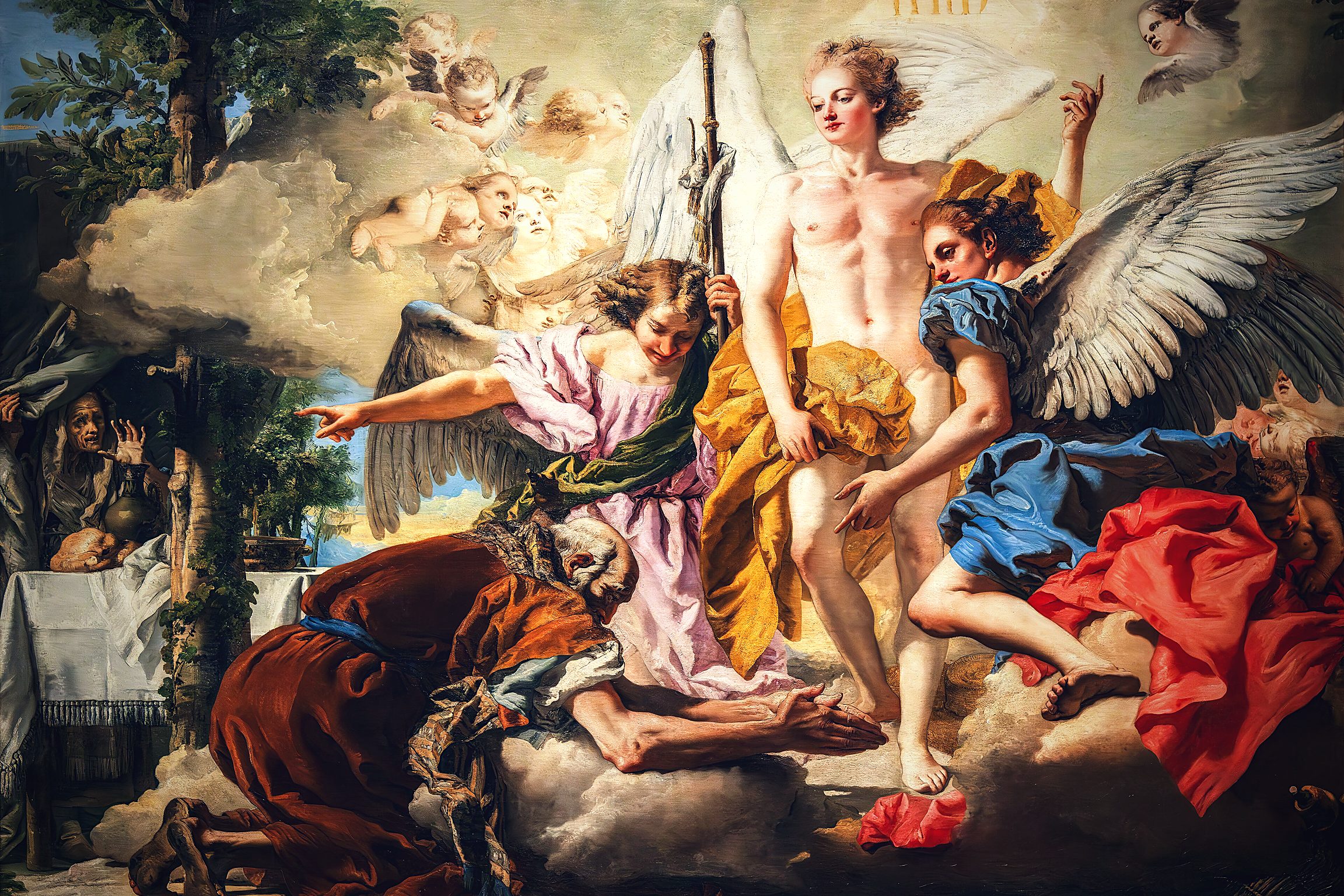
Abraham is sitting in his tent door in the heat of the day when he looks up and sees three travellers standing nearby. He runs to them, bows to the ground, washes their feet and has a calf killed and cooked. He waits on them while they eat under a tree. Only as the scene unfolds does the reader learn what Abraham is dealing with: two of the three are angels, and the third is the LORD himself. It is one of the oldest answers the Bible gives to a simple question — what do angels look like? — and it is not the one most people expect.
Nothing in the account mentions wings, haloes, light or fear. The angels look so completely like men that a ninety-nine-year-old host sprints across a camp to offer them lunch. A chapter later the same two walk into Sodom at evening and the men of the city take them for ordinary visitors — with intentions that make the mistake horrifying rather than quaint.
That is the first surprise waiting for anyone who asks what the Bible says angels look like. The picture most people carry — a winged figure in a white robe, or a plump baby with feathers — is mostly the work of later painters. The text itself describes something stranger and more divided: beings who usually pass for human, and occasionally blaze like something a prophet can barely find words for.
What Do Angels Look Like in the Bible?
In the Bible, angels most often look like ordinary men — so ordinary that the people who meet them do not realise what they are. A smaller set of appearances describe a very different thing: a radiant figure with a face like lightning and eyes like fire, so overwhelming that witnesses fall down as if dead. The winged, many-faced beings everyone pictures — the four-faced cherubim of Ezekiel and the six-winged seraphim of Isaiah — are a separate category the text treats as throne attendants, not the messengers who turn up in human stories.
So there is no single answer. The word translated “angel” — Hebrew mal’akh, Greek angelos — means “messenger”, a job description rather than a species, and the beings who do the job are described in at least two very different registers. The gap between them is the whole subject.
The Angels Who Looked Like Men
The default appearance of an angel on the ground, in a human story, is a man. Not a man with wings folded away — a man, full stop, with nothing to give the game away.
The three visitors to Abraham are introduced as exactly that:
“And he lift up his eyes and looked, and, lo, three men stood by him.” (Genesis 18:2)
When two of them reach Sodom, the text switches the label but not the look:
“And there came two angels to Sodom at even.” (Genesis 19:1)
Same beings, called “men” in one verse and “angels” in the next, and the people of Sodom treat them as men throughout. The pattern repeats across the Hebrew Bible. Joshua, scouting Jericho, meets a stranger:
“There stood a man over against him with his sword drawn in his hand.” (Joshua 5:13)
The figure turns out to be “captain of the host of the LORD”, and Joshua is told to take off his shoes — but what he saw first was a man with a sword. Jacob wrestles all night with what the text calls simply “a man” (Genesis 32:24) and only afterwards concludes he has seen God face to face. When the angel of the LORD appears to Samson’s parents, Manoah’s wife reports a visitor she took for a prophet, remarkable only in retrospect:
“His countenance was like the countenance of an angel of God, very terrible.” (Judges 13:6)
By the Gospels the convention is fixed. At the empty tomb, Mark describes “a young man … clothed in a long white garment” (Mark 16:5); Luke has “two men … in shining garments” (Luke 24:4). The letter to the Hebrews turns the whole pattern into a warning, and the warning only works if angels are unrecognisable:
“Be not forgetful to entertain strangers: for thereby some have entertained angels unawares.” (Hebrews 13:2)
You cannot entertain unawares a creature with a six-foot wingspan and a glowing ring over its head. The instruction assumes that the angel at your door looks like anyone else at your door. Every one of these messenger figures is described as male, and none of them is described with wings.
The Angels Who Looked Like Lightning
The other register is the opposite of understated. When Daniel, by the river Hiddekel, looks up and sees a heavenly being, the description is a catalogue of fire and metal:
“His body also was like the beryl, and his face as the appearance of lightning, and his eyes as lamps of fire, and his arms and his feet like in colour to polished brass, and the voice of his words like the voice of a multitude.” (Daniel 10:6)
Daniel’s companions do not even see it and flee in terror anyway; Daniel is left with no strength, his face to the ground. The same overwhelming quality attaches to the angel at the tomb in Matthew’s telling — a different writer describing the same morning Mark described with a plain “young man”:
“His countenance was like lightning, and his raiment white as snow.” (Matthew 28:3)
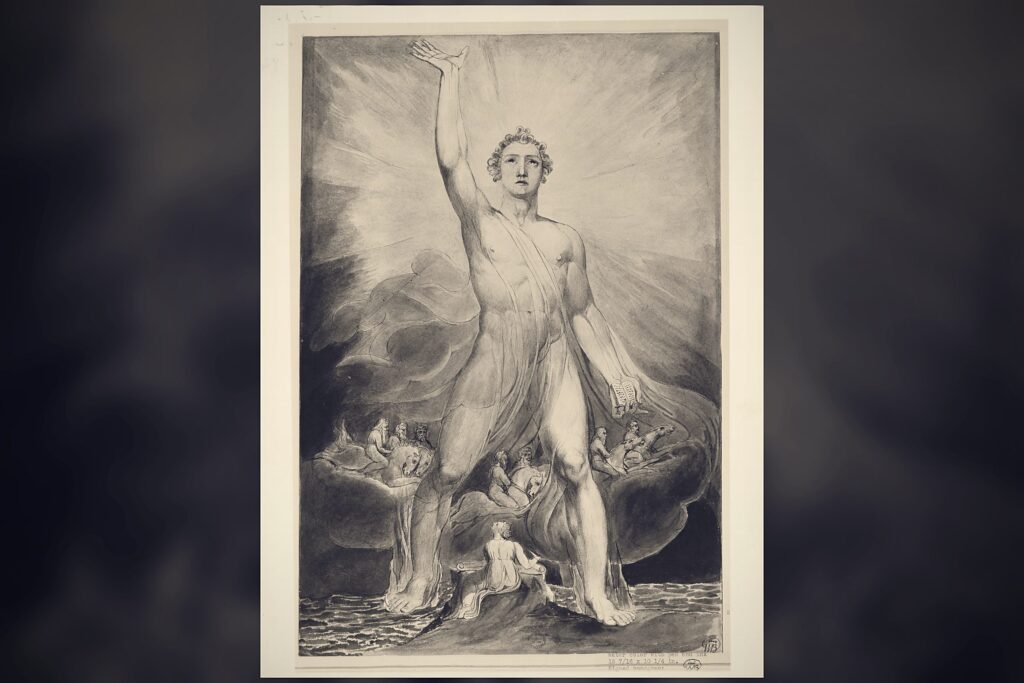
The guards, Matthew adds, shook and “became as dead men”. Luke’s shepherds are “sore afraid” when “the glory of the Lord shone round about them” (Luke 2:9). And John, on Patmos, describes a being on a scale that stops being a figure and becomes a landscape:
“Another mighty angel come down from heaven, clothed with a cloud: and a rainbow was upon his head, and his face was as it were the sun, and his feet as pillars of fire.” (Revelation 10:1)
One detail runs through almost every encounter of this kind, and it is easy to miss because it has become a cliché: the angel’s first words are fear not. Gabriel says it to Zacharias and to Mary; the angel says it to the shepherds and to the women at the tomb; the radiant man tells Daniel not to be afraid. The reassurance is a measure of the reaction. Nobody has to be told not to fear a being that looks like a kindly man in a robe. The repeated “fear not” belongs to the second register, where the sight is enough to put a prophet on the floor.
Do Angels Have Wings?
Here is the fact that surprises most readers: the ordinary messenger angels of the Bible — the ones who speak, travel, eat and are mistaken for men — are never described with wings. Not the visitors to Abraham, not Gabriel announcing births in Luke, not the figures at the tomb.
Wings in the Bible belong to two specific classes of heavenly being that are not called “angels” at all. The seraphim of Isaiah’s throne vision have six wings each — “with twain he covered his face, and with twain he covered his feet, and with twain he did fly” (Isaiah 6:2). The cherubim of Ezekiel have four, and the throne-bearing creatures of the same vision are stranger still. These are the winged beings, and the text keeps them in a different setting — the throne room, not the road, and near the top of the ranks of heavenly beings.
The nearest a named messenger angel comes to flight is Gabriel in Daniel, and even there the text is disputed. The King James has him “being caused to fly swiftly” (Daniel 9:21); several modern translations read the same Hebrew as “in swift flight”, while others render it simply as weariness or haste with no flight at all. It is a single ambiguous phrase, and an argument from it runs against the silence everywhere else.
| Being | Where | Wings | How it appears |
|---|---|---|---|
| Messenger angels | Genesis, Judges, the Gospels | none described | ordinary men |
| The radiant figure | Daniel 10, Matthew 28, Revelation 10 | none described | blazing light, fire, metal |
| Seraphim | Isaiah 6 | six | burning ones around the throne |
| Cherubim | Ezekiel 1, 10; Exodus 25 | four (two on the Ark) | four faces, covered in eyes |
| The two women | Zechariah 5 | stork-like | a symbolic vision, not called angels |
That last row is the exception that proves how careful the text is. The only winged female figures in the Hebrew Bible appear in one of Zechariah’s symbolic visions:
“There came out two women, and the wind was in their wings; for they had wings like the wings of a stork.” (Zechariah 5:9)
They carry a basket with a woman inside it representing wickedness, and the whole scene is openly a coded vision rather than a report of beings anyone met. They are the closest thing in Scripture to the winged figure of popular art — and they are not described as angels.
Where the Wings Came From
If the messenger angels of the text have no wings, the winged angel of churches and Christmas cards had to come from somewhere. The art historians have a fairly specific answer, and it is not the Bible.
The earliest Christian art shows angels as ordinary young men, wingless, identifiable only by context. The winged type appears in Christian art from around the fourth century, under Constantine, and seems to have been modelled on a figure the ancient world already knew well: the winged Victory, the Nike who stood on coins and monuments across the empire [1][2]. A triumphant, beautiful, winged messenger of the gods was a ready-made visual language, and Christian artists borrowed it to mark out the heavenly messenger at a glance. By the sixth century the winged angel is established — the large ivory panel of an archangel now in the British Museum shows the type fully formed [3]. Before about 400 it is hard to find; after it, the wings are everywhere.
The plump winged baby came later still, and from a different direction. The Renaissance cherub — the putto — fused the biblical cherub with the winged child-figures of Greco-Roman art, which had nothing to do with the divine. That story is told in full in the article on what cherubim actually look like; the short version is that the roundest, most harmless image of an angel in Western culture is the furthest from the terrifying, multi-faced guardian of the text.
None of this makes the winged image wrong as art. It makes it art — a convention, with a date and a source — rather than a description lifted from Scripture.
Two Ways to Read the Descriptions
So the text gives us men who are secretly angels and a figure of fire that flattens prophets, and almost never the wings everyone expects. What does that actually tell us about what angels look like? There are two serious readings, and the text supports a real version of each.
The literal reading: these are reports of what was seen. On this view the variety is not a problem but information. Angels on an errand among people take an ordinary human form — they can be touched, they eat Abraham’s meal, one of them can be wrestled until daybreak — because the job requires passing unnoticed. The radiant appearances are the same beings seen with the disguise off, or a different and higher order of being seen in its own setting. The consistency across more than a thousand years of writing — male, humanlike by default, overwhelming when revealed, winged only in the throne room — reads, to those who take it literally, like many witnesses describing the same real taxonomy rather than one evolving myth. The “fear not” is evidence too: it is the reaction you would expect to something genuinely present, not to a literary symbol.
The accommodated reading: these are words reaching for the unseeable. On this view the descriptions tell us how the experience was rendered, not what a camera would have caught. The prophets reach constantly for approximation — Ezekiel piles up “the likeness of”, “the appearance of”, “as it were” because he is describing something human language was not built for, and Daniel does the same. The man-like form may be the mind’s way of making an encounter bearable and communicable; the fire and lightning may be the same encounter when it refuses to be scaled down. On this reading the point of the descriptions is never the anatomy. It is the function — messenger, guardian, bearer of glory — and the forms are the vocabulary a particular writer had for a presence beyond form.
Both readings have to account for the same stubborn facts: the physical reality of the meals and the wrestling on one side, the open signalling of vision and symbol on the other. Neither disposes of the other cleanly, and the text does not arbitrate between them.
What the Descriptions Agree On
Strip away the wings, which the text barely gives, and two things survive every account.
The first is that angels are mistaken for men. Over and over the person in the story does not know, at first, what they are looking at — Abraham, the Sodomites, Joshua, Manoah’s wife, Mary Magdalene. Whatever an angel is, its ordinary working appearance is close enough to human to fool a careful observer, which is precisely why Hebrews can warn that the stranger at the door might be one.
The second is that, when the appearance is not ordinary, it is unbearable. The witnesses do not describe beauty; they describe collapse. Faces like lightning, eyes like fire, men lying on the ground with no strength left, soldiers frozen like corpses, a greeting that has to begin by talking the hearer down from terror.
What the Bible never settles is which of those two is the real face and which is the costume — whether the man is the angel putting on humanity, or the fire is the vision putting on scale. The painters chose wings and resolved the question for everyone. The text leaves it open, and leaves the most striking detail standing where it started: the most frightening thing a human being can meet, in these pages, keeps arriving as someone you would pass on the road.
Sources
- New Testament Angels in Early Christian Art: Origin and Sources — swiatowitwuw.pl/numery/49-tom-49-nr-a
- Early Christian Representations of Angels, Catholic Encyclopedia — newadvent.org/cathen/01476d.htm
- The Archangel Michael Ivory Panel — worldhistory.org/article/1526
Frequently Asked Questions
What do angels look like according to the Bible?
Most often, like ordinary men. The visitors to Abraham, the figures at Jesus’ tomb and the angel who met Joshua are all described simply as men, with no wings or haloes. A separate set of appearances — Daniel 10, Revelation 10 — describe a radiant being with a face like lightning and feet like fire. The Bible gives two very different pictures, not one.
Do angels have wings in the Bible?
The messenger angels who appear in human stories are never described with wings. Wings belong to two other classes of heavenly being: the six-winged seraphim of Isaiah 6 and the four-winged cherubim of Ezekiel. The winged human-shaped angel of popular art is not drawn from any text that describes an ordinary angel.
Are angels male or female in the Bible?
Every angel who appears in human form in the Bible is described as a man. The only winged female figures in Scripture are the two women in Zechariah 5:9, and they belong to a symbolic vision and are not called angels. The text never describes a female angel in a narrative encounter.
Why do angels say “fear not”?
Because the people who see them are terrified. The phrase appears whenever an angel’s presence is overwhelming — to Daniel, to Mary, to the shepherds, to the women at the tomb. The repeated reassurance is a clue that these encounters were frightening rather than gentle, especially in the appearances full of light and fire.
When did angels start being shown with wings?
Winged angels appear in Christian art from around the fourth century, under Constantine. Art historians connect the winged type to the classical figure of Victory, or Nike — a winged messenger the Roman world already pictured. Before that, early Christian art showed angels as ordinary young men without wings.
What is the difference between angels, cherubim and seraphim?
“Angel” means messenger and usually names a being that appears in human form. Cherubim and seraphim are throne attendants described with wings and, in the cherubim’s case, multiple faces and eyes. The Bible keeps them in different settings — messengers on the road, cherubim and seraphim around the throne — and never calls the winged throne-beings “angels”.
How many angels are named in the Bible?
Only two are named in the canonical Old and New Testaments: Gabriel, who announces births in Daniel and Luke, and Michael, called an archangel in Jude and Revelation. A third, Raphael, is named in the Book of Tobit, which Catholic and Orthodox Bibles include and Protestant Bibles do not. Extra-biblical texts go much further — the Book of Enoch names twenty fallen angels and their leaders.
Could an angel really be mistaken for a human?
In the Bible, repeatedly. Abraham offered the three visitors a meal, the men of Sodom took the two angels for travellers, and Hebrews 13:2 warns that a stranger shown hospitality may be an angel “unawares”. The text treats the ordinary human appearance as the normal working form of a messenger angel.
Continue Reading
- What Do Seraphim Look Like? The Bible’s Burning Ones — Isaiah saw them above the throne of God — six wings, a voice that shook stone, and a name borrowed from the serpents of…
- What Do Cherubim Look Like? Four Faces, Not Baby Wings — Four faces, eyes on every surface, and a body that gleams like burnished bronze. The Bible’s cherubim appear ninety-one…
- What Do Thrones Look Like? The Bible’s Wheel Within a Wheel — The Bible never describes a being called a throne. What it describes are ophanim — wheels of translucent stone, rims…