Demonic possession vs mental illness is not a new argument. It is one of the oldest arguments in human history, and the fact that it is still unresolved tells you something about both sides.
For most of recorded history, across every civilisation that left records, what we now call mental illness was understood as spiritual invasion. A person hearing voices, convulsing, speaking in a voice not their own, harming themselves, living among the dead — in Mesopotamia, in Egypt, in Greece, in Israel, the first diagnosis was always the same: something has entered this person from outside. The treatment was expulsion. The vocabulary was demons.
Then, over the course of about two centuries, that framework was replaced. What had been possession became schizophrenia. What had been a curse became epilepsy. What had been an evil spirit on a king became bipolar disorder. The new framework brought medications that work, brain imaging that shows physical differences, and an entire profession built on the premise that madness is in the brain, not in the spirit world.
Both frameworks have their evidence. Both have their failures. And neither has ever fully disposed of the other.
What Every Ancient Civilisation Believed
In ancient Mesopotamia, mental disturbance was understood as the work of demons. The diagnostic manuals — and there were manuals, cuneiform tablets cataloguing symptoms and their spiritual causes — assigned specific demons to specific conditions. The ashipu, priest-exorcists whose profession was highly organised, treated the afflicted with incantations, rituals and prayers intended to expel the invading entity. Skulls recovered from these cultures show evidence of trepanation — holes carefully drilled through bone — and the most widely accepted interpretation is that the holes were meant to let the spirit out.
Egypt was similar. The Ebers Papyrus, dating to roughly 1550 BC, describes conditions recognisable as depression and dementia alongside their treatments, which mix what we would call pharmacology — plant extracts, minerals — with incantation. The boundary between medicine and exorcism was not a boundary the Egyptians recognised.
Greece split the difference. Hippocrates, writing in the fifth century BC, rejected the idea that epilepsy was a “sacred disease” caused by the gods. He insisted the cause was in the brain: “It is the brain which is the messenger of understanding, and the brain which is the seat of madness and delirium.” His treatise On the Sacred Disease is the first surviving argument that mental disturbance is biological, not spiritual.
But the Greeks never fully accepted it. Plato, a generation after Hippocrates, described four forms of divine madness — theia mania — in the Phaedrus: prophetic madness from Apollo, ritual madness from Dionysus, poetic madness from the Muses, and erotic madness from Aphrodite. For Plato, some madness was a gift. The culture held both frameworks at once.
Israel had no such ambiguity. The Hebrew Bible describes spirits sent by God — the evil spirit that tormented Saul (1 Samuel 16:14), the lying spirit that entered the mouths of Ahab’s prophets (1 Kings 22:21-23), the evil spirit sent between Abimelech and Shechem (Judges 9:23). The vocabulary is spiritual, the agency is God’s, and the remedy is not medicine.
The point is not that all ancient people were naive. The point is that across civilisations that never met each other — Sumer and China, Israel and Peru — the first explanation for disturbed behaviour was the same: the person is not alone in their body.
The Biblical Cases, Read Two Ways
The tension between the medical and the spiritual reading runs through every major case of disturbed behaviour in the Bible. The same passages that theologians read as demonic possession, psychiatrists read as clinical descriptions.
King Saul
The account in 1 Samuel describes a man whose condition begins when the Spirit of the LORD departed from Saul, and an evil spirit from the LORD troubled him (1 Samuel 16:14, KJV). What follows is a pattern of violent mood swings, paranoid suspicion of David, impulsive violence — twice hurling a spear at David while he played the harp (1 Samuel 18:10-11; 19:9-10) — alternating with periods of calm, including episodes of weeping and remorse (1 Samuel 24:16-17). Music calms him, and the text says plainly that when David played, the evil spirit departed from him (1 Samuel 16:23).
A psychiatrist reading that description without the theological frame would recognise a mood disorder with psychotic features — possibly bipolar disorder with paranoid ideation. The violent outbursts, the cycling between aggression and remorse, the response to music as a calming stimulus, the progressive deterioration over years — the clinical picture is coherent.
The text does not present it as a clinical picture. It presents it as a spiritual event with a spiritual cause: God withdrew his Spirit, and something else moved in. The same account that medicine reads as a diagnosis, theology reads as a warning about what occupies the space God vacates.
Both readings account for the data. Neither conclusively rules out the other.
Nebuchadnezzar
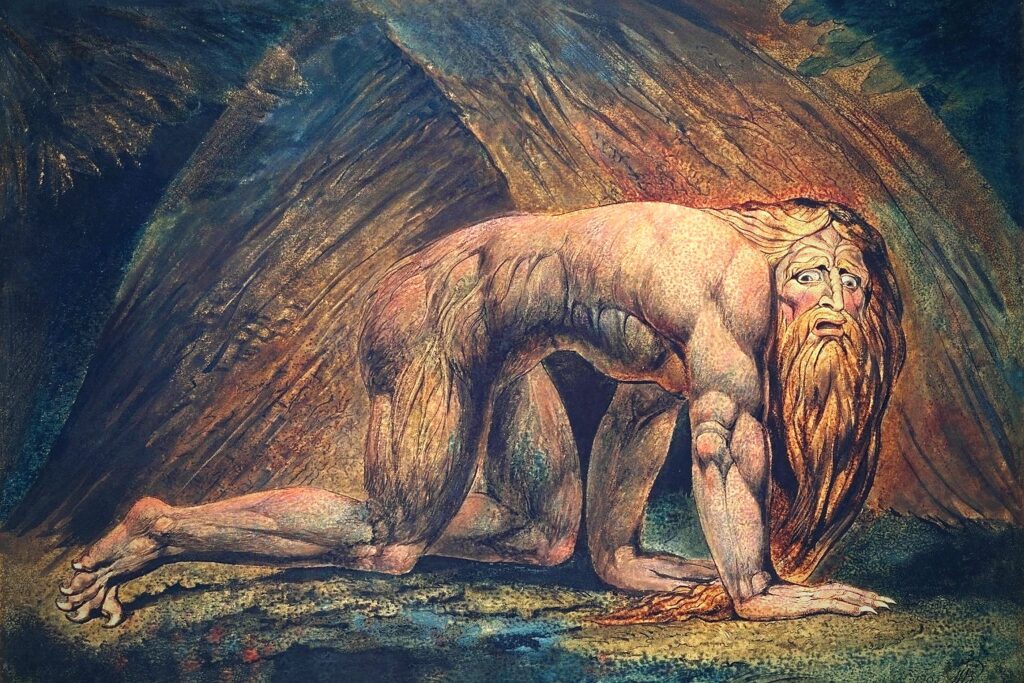
Daniel 4 describes the king of Babylon living outdoors, eating grass like an ox, his body drenched with dew, until his hair grew like eagles’ feathers, and his nails like birds’ claws (Daniel 4:33, ESV). The episode lasts for what the text calls “seven times” — usually read as seven years — and ends with the king’s reason returning when he raises his eyes to heaven.
The psychiatric term for this is boanthropy — the delusion that one is a bovine animal, a rare but documented condition that falls within the broader category of clinical lycanthropy, in which a person believes they have transformed into an animal. Cases have been reported in modern psychiatric literature, typically associated with severe psychotic episodes, sometimes with bipolar disorder or schizophrenia.
The text does not call it a delusion. It calls it a judgement — a direct act of God in response to the king’s pride, with a specific mechanism of restoration: the moment Nebuchadnezzar acknowledges the God of heaven, his sanity returns. The cure is not pharmacological. It is theological.
The Gerasene Demoniac
The longest account of disturbed behaviour in the Gospels. A man living among tombs, breaking chains, cutting himself with stones, crying out night and day (Mark 5:1-20). A modern clinician would note the self-harm, the isolation, the superhuman strength, the screaming — and would consider severe psychosis, possibly with dissociative features.
But the account includes details that do not fit any psychiatric model cleanly. There is a dialogue: Jesus asks a name and gets an answer — My name is Legion, for we are many (Mark 5:9, ESV). The entities negotiate a destination. They transfer to a herd of roughly two thousand pigs, which immediately run into the sea and drown. And the man is found afterwards sitting, clothed, and in his right mind (Mark 5:15) — an instantaneous transformation that no known psychiatric treatment produces.
The Boy with the Mute Spirit
A father brings his son to the disciples. The description is clinical enough that a neurologist can read it: seizures that throw him to the ground, foaming at the mouth, teeth grinding, rigidity, repeated falls into fire and water (Mark 9:17-18). That is a tonic-clonic seizure disorder described with remarkable accuracy by someone who had watched one.
Jesus addresses the condition as a spirit — you mute and deaf spirit, I command you, come out of him (Mark 9:25, ESV) — and when it leaves, the boy looks so lifeless the crowd says he is dead. He then rises, well.
The seizure profile matches epilepsy precisely. But ancient medicine had no category separating epilepsy from spirit affliction, so a first-century description would look exactly like this in either case. The passage cannot settle the question on its own.
David Feigning Madness
There is one case in the Old Testament that complicates both readings in a different way. When David is recognised in the court of King Achish of Gath, he saves his life by pretending to be insane — scratching on the doors of the gate and letting saliva run down his beard (1 Samuel 21:13). The performance is convincing. Achish dismisses him: Do I lack madmen, that you have brought this fellow to act like a madman in my presence? (1 Samuel 21:15, ESV).
The detail worth noticing is that David could imitate it. Madness was recognisable enough that a sane man could reproduce the behaviour convincingly, and that the king’s court had a category for it — they had seen it before, and they were not interested in seeing more. This is not a world in which every disturbed person was treated as spiritually afflicted. It is a world that recognised ordinary madness and found it tedious.
The Medical Revolution
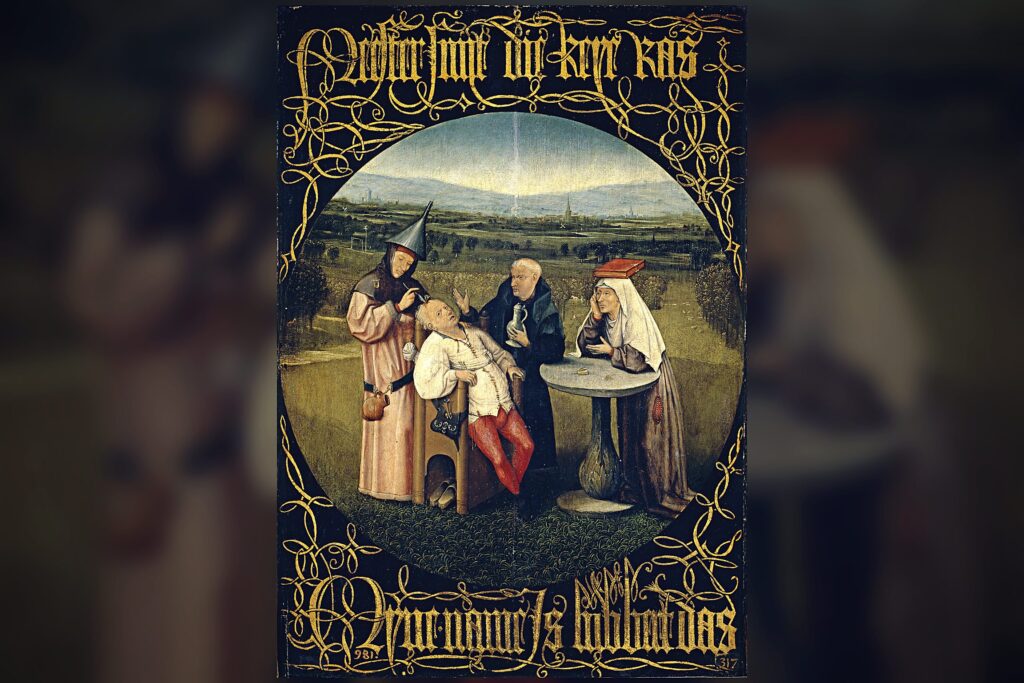
For roughly fifteen centuries after the New Testament, the dominant framework in the West remained spiritual. The medieval period treated mental disturbance as a mix of demonic affliction, divine punishment and humoral imbalance. Treatments ranged from prayer to confinement to trepanation — the same drilling of holes in the skull that Mesopotamian healers had practised millennia earlier, now dressed in European surgical vocabulary.
Then the framework began to shift.
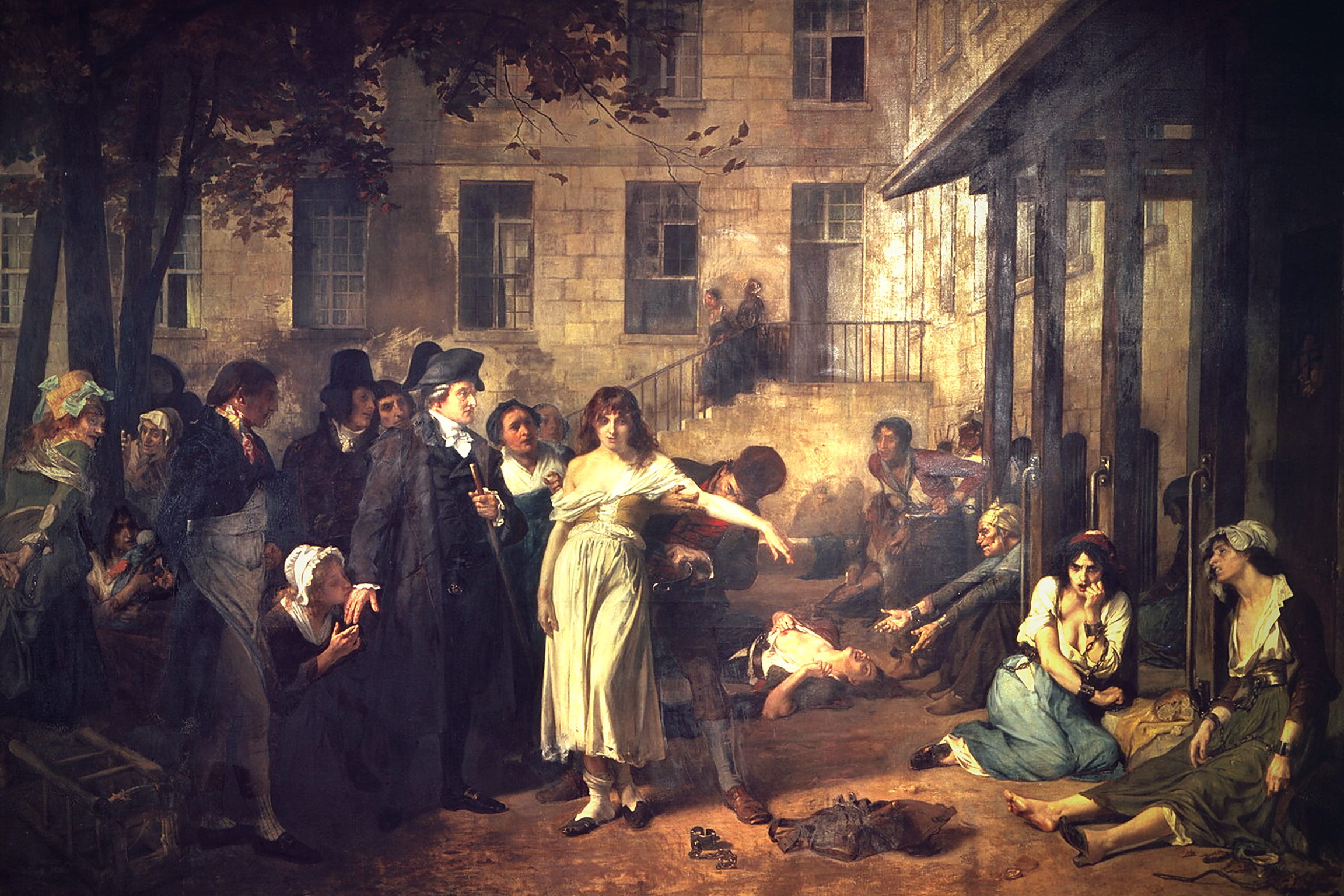
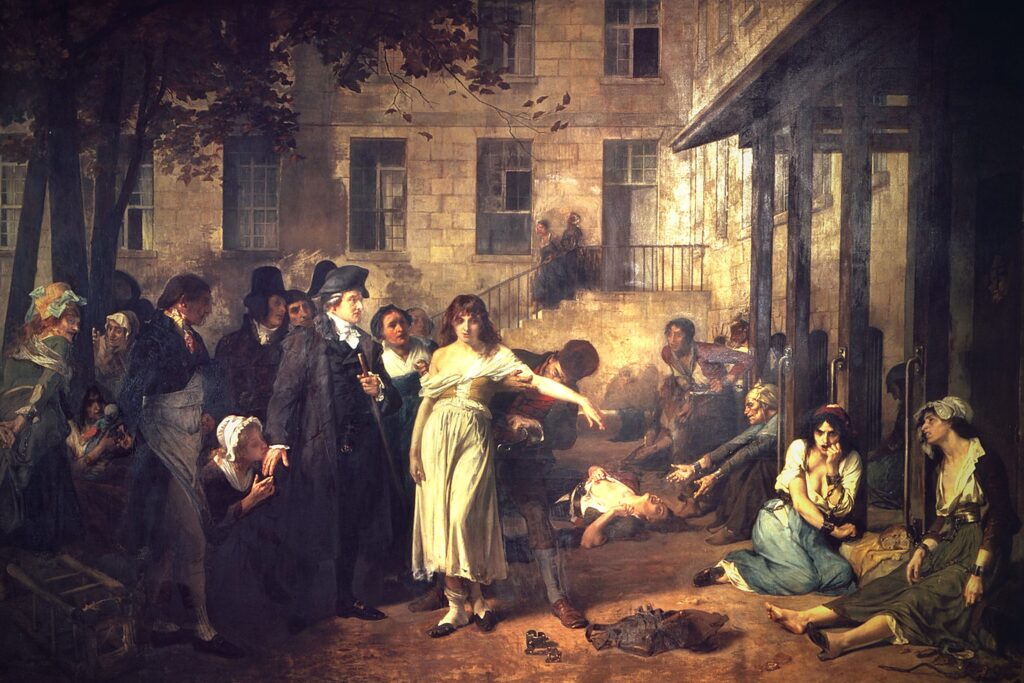
Jean-Baptiste Pussin and Philippe Pinel. The famous story is that Pinel unchained the mentally ill at the Bicêtre hospital in Paris in 1793. The actual history is more complicated: it was Pussin, a former patient turned hospital governor, who first removed the chains in 1797, and Pinel who formalised the approach after arriving at the Salpêtrière, where he lowered first-year patient mortality from over 50 per cent to roughly 12.5 per cent through improved hygiene and what he called traitement moral — treatment through kindness rather than restraint. Pinel always gave Pussin credit; history gave it to Pinel. What both men demonstrated was that people treated humanely improved, and people treated with chains did not.
Dorothea Dix. In 1841, an American teacher walked into a Massachusetts prison to teach a Sunday school class and found mentally ill people jailed alongside criminals, unclothed, in darkness, without heat. Over the next forty years, Dix persuaded fifteen US state legislatures to build or expand hospitals for the mentally ill. When she started, the United States had thirteen mental asylums. By 1880, it had 123. What she changed was not the understanding of mental illness. She changed the assumption that it did not deserve treatment.
The pharmacological revolution. In 1949, an Australian psychiatrist named John Cade injected lithium into guinea pigs and noticed they became calm. He gave it to ten manic patients, and five were discharged from hospitals where they had been confined for years. In 1952, two French psychiatrists, Jean Delay and Pierre Deniker, gave chlorpromazine — later marketed as Thorazine — to patients with schizophrenia, and for the first time in history, the hallucinations diminished. By the 1960s and 1970s, the discovery of antipsychotic and mood-stabilising drugs led to the deinstitutionalisation movement: patients who had spent decades in locked wards walked out.
The DSM. In 1952, the American Psychiatric Association published the first Diagnostic and Statistical Manual of Mental Disorders — a spiral-bound pamphlet of 32 pages defining 106 conditions. The current edition, DSM-5-TR, published in 2022, runs to 947 pages and defines roughly 300 conditions. What had been “possession” was now schizophrenia. What had been “divine madness” was now bipolar disorder. What had been the “sacred disease” was epilepsy. What had been “lunacy” was dissociative identity disorder, Tourette syndrome, temporal lobe epilepsy — each with its diagnostic criteria, its evidence base, and its recommended pharmacotherapy.
The relabelling was not cosmetic. It came with treatments that work.
The Case for the Medical Model
Stated at its strongest — and this site owes it that — the case for the medical model is formidable.
Medications work. Antipsychotic drugs reduce hallucinations and delusions in most patients with schizophrenia. Lithium stabilises mood in bipolar disorder so effectively that it remains the gold standard seventy-five years after Cade’s discovery. Anticonvulsants control seizures. SSRIs and SNRIs reduce the frequency and severity of depressive and anxiety episodes. These are not placebo effects; they are reproducible across populations, and withdrawing the medication reliably produces relapse.
Brain imaging shows physical differences. MRI studies consistently show reduced hippocampal and cortical grey matter volume in patients with schizophrenia. People with major depression show altered activity in the prefrontal cortex and the amygdala. Temporal lobe epilepsy shows up on an EEG as unmistakably as a broken bone shows up on an X-ray.
Genetics loads the gun. Twin studies — the largest, from the University of Copenhagen, involving over 30,000 pairs — estimate that roughly 79 per cent of the risk for schizophrenia is heritable. The concordance rate in identical twins is about 33 per cent: not inevitable, but vastly higher than chance. Hundreds of genes have been implicated, each contributing a small effect. Mental illness runs in families because DNA runs in families.
The symptoms are measurable and reproducible. A tonic-clonic seizure looks the same in Lagos and London. The diagnostic criteria for schizophrenia — hallucinations, delusions, disorganised speech, catatonia — are recognisable across cultures, not because clinicians imposed them, but because the brain produces the same categories of malfunction everywhere.
The humanitarian case is real. People who were chained, beaten, starved and drilled are now treated with medications, therapy and dignity. Human rights frameworks in mental health — informed consent, the right to refuse treatment, community-based care — exist because the medical model made them thinkable. The body count from treating illness as possession is not abstract. People have died during exorcism rituals from restraint, dehydration, beating and withheld medication.
Any account of this subject that fails to state these facts plainly is not being honest.
The Case That Something Is Missing
Stated with equal force — and this site owes it exactly the same — the case that the medical model does not explain everything is also substantial.
Treatment resistance is not an edge case. Between 20 and 60 per cent of patients with schizophrenia are classified as treatment-resistant. Of those who are tried on clozapine — the only drug specifically approved for treatment-resistant schizophrenia — only about 40 per cent respond. For depression, the STAR*D trial found that after four sequential medication trials, roughly a third of patients had still not achieved remission. These are not failures of compliance. They are failures of the model’s own tools, applied by its own standards, and the numbers are large.
The knowledge problem. The Rituale Romanum of 1614 — the Catholic Church’s manual for exorcism — lists indicators that include speaking in languages the person never learned, knowledge of hidden or distant things, and strength beyond natural capacity. These are exactly the claims that sceptics say evaporate under controlled observation, and they are right that no case has been documented under conditions that would satisfy a laboratory. But the claims persist, from exorcists across cultures, decades and continents, and the dismissal rests on the absence of evidence rather than evidence of absence.
The Vatican’s own position is carefully guarded. The 1999 revision of the rite, De Exorcismis et Supplicationibus Quibusdam, requires medical and psychiatric evaluation before an exorcism may proceed. The Church estimates that more than 99 per cent of cases presented to exorcists involve mental illness rather than possession. Father Gabriele Amorth, who served as the Vatican’s chief exorcist and claimed over 160,000 exorcisms, said that fewer than 100 involved what he regarded as genuine possession. The institution with the longest continuous practice of exorcism has spent four centuries making its own criteria harder to satisfy — and has not abolished the practice, because it holds that the residual cases are real.
The phenomenon is near-universal and not explained by cultural contact. Erika Bourguignon’s cross-cultural survey of 488 societies in the 1960s found that 437 — about 90 per cent — had some institutionalised form of altered state of consciousness, and roughly 74 per cent held beliefs about spirit possession specifically. The rates were highest in the Pacific at 88 per cent and around the Mediterranean at 77 per cent. Societies with no historical connection independently developed the same category: a person, sometimes, is spoken through by something that is not them.
The hard problem of consciousness is unresolved. The medical model treats the brain as the organ that generates consciousness. But no one has explained how it does this. David Chalmers named this the “hard problem” in 1995: why does information processing feel like something from the inside? Chalmers bet the neuroscientist Christof Koch, in 1998, that the neural basis of consciousness would not be identified by 2023. He won the bet. Psychiatry operates on the assumption that consciousness is a product of the brain, but that assumption has not been demonstrated — it has been adopted, because it is useful, and usefulness is not the same as truth.
Jesus did not treat these cases as metaphors. In the Gospel accounts, he spoke to the entities as persons. They answered. They had names. They negotiated. They recognised him before any human in the narrative did. They were commanded and they obeyed, or they were commanded and they resisted until the command was pressed. Whatever one concludes about these accounts, they are not descriptions of a man addressing a neurological condition. They are descriptions of a man addressing someone. The entities are, in the text, persons — intelligent, wilful, and afraid.
The Distinction Nobody Resolved
Here is the uncomfortable truth that both sides tend to suppress: the early church fathers actually made the distinction between mental illness and demonic possession, and they made it clearly.
John Chrysostom, writing in the fourth century, referred to contemporary physicians as models of compassion toward those with mental illness, noting that physicians, when kicked and abused by insane patients, pitied them and worked toward their cure, “knowing that the insult comes from the extremity of their disease.” That is a doctor treating illness, described approvingly by a bishop — in the fourth century.
The patristic writers generally distinguished between conditions that were medical and conditions that were spiritual. The confusion of the two — treating every disturbed person as possessed — is not a biblical position. It is a cultural one, and the church’s own tradition resists it.
Modern exorcism protocols formalise the same distinction. The Catholic rite requires psychiatric evaluation first. The International Association of Exorcists — about 250 members in 30 countries, recognised by the Vatican — has issued guidelines emphasising that the vast majority of cases involve mental illness, not possession, and that spiritual treatment should not replace medical care.
The question that remains is the sorting problem. If some cases are medical and some are spiritual, how do you tell them apart? The Church has a list of signs — unlearned languages, hidden knowledge, superhuman strength, aversion to sacred objects — but it has spent four centuries tightening those criteria because the false positive rate was too high. Psychiatry has the DSM, but it has no entry for “genuine possession” and no diagnostic procedure that could identify one. Neither side has a test that both sides accept.
Why This Matters Now
The World Health Organisation reported in 2025 that over a billion people worldwide live with a mental health condition, and that 91 per cent of people with depression globally cannot access care. In the United States, about 29.5 million adults with a mental health condition received no treatment in 2024. A median of only 3 per cent of national health budgets is allocated to mental health.
The medical model is not failing because its science is wrong. It is failing because its reach is too short, its drugs do not work for everyone, and its understanding of consciousness is incomplete. At the same time, interest in spiritual approaches to mental disturbance is growing — not only in religious communities, but among secular researchers studying meditation, psychedelics, and the neuroscience of religious experience.
The biblical texts describe a world in which both frameworks operate simultaneously. The same Jesus who cast out demons also told people to see the priest for leprosy verification (Mark 1:44). The same Paul who encountered spirits at Philippi (Acts 16:16-18) recommended wine for Timothy’s stomach (1 Timothy 5:23). The texts do not present a universe in which everything is spiritual. They present a universe in which everything is real — body and spirit, chemistry and entity — and the challenge is knowing which is which.
That challenge has not been met. Not by medicine, which has categories for every presentation but no way to address the question being asked. Not by theology, which has the question but not a test. And not by the culture, which would like the answer to be clean and is finding that it is not.
The honest position is that both models have saved lives and both models have cost them. Medications have lifted people out of psychosis who would otherwise have spent their lives in locked wards. And exorcism rituals have killed people who needed a doctor, not a prayer. The humanitarian weight sits on both sides, and anyone who ignores either half is not looking at the whole picture.
Frequently Asked Questions
Is mental illness mentioned in the Bible?
The Bible describes conditions that modern psychiatry would diagnose as mental illness, though it uses spiritual rather than clinical language. King Saul’s violent mood swings and paranoia (1 Samuel 16-19), Nebuchadnezzar’s seven years living as an animal (Daniel 4), and the boy with seizures in Mark 9 all match recognised psychiatric profiles. David feigning madness before Achish (1 Samuel 21:13) shows that the ancient world also recognised ordinary insanity as a category distinct from spiritual affliction.
What is the difference between demonic possession and mental illness?
The medical model holds that disturbed behaviour originates in the brain — measurable through imaging, treatable with medication, and often heritable. The spiritual model holds that some cases involve an external entity inhabiting or oppressing the person. The signs historically cited for genuine possession — unlearned languages, hidden knowledge, superhuman strength — have never been documented under controlled conditions, but the Catholic Church, which requires psychiatric evaluation before exorcism, maintains that some cases remain unexplained after medical assessment.
Did the early church distinguish between mental illness and possession?
Yes. John Chrysostom, in the fourth century, praised physicians who treated the violently insane with compassion, recognising their behaviour as the product of disease rather than demonic affliction. The patristic writers generally maintained a category of natural illness separate from spiritual oppression, and the modern Catholic rite requires medical and psychiatric evaluation before an exorcism is authorised.
What percentage of mental illness is treatment-resistant?
Between 20 and 60 per cent of patients with schizophrenia are classified as treatment-resistant. For depression, roughly a third of patients do not achieve remission even after four sequential medication trials, according to the STAR*D study. Of those with treatment-resistant schizophrenia who are tried on clozapine — the only drug specifically approved for the condition — only about 40 per cent respond.
Does the Vatican still perform exorcisms?
Yes. The Catholic Church revised its rite of exorcism in 1999 and requires medical and psychiatric evaluation before the rite may be administered. The International Association of Exorcists has roughly 250 members in 30 countries. The Church estimates that more than 99 per cent of cases presented to exorcists involve mental illness rather than genuine possession, but it maintains that the remaining cases are real and require spiritual intervention.
What is the hard problem of consciousness?
The term was coined by philosopher David Chalmers in 1995 to describe the question of why information processing in the brain is accompanied by subjective experience — why it feels like something to be conscious. Neuroscience can identify correlations between brain activity and conscious states, but it has not explained how physical matter produces awareness. In 1998, Chalmers bet neuroscientist Christof Koch that the neural basis of consciousness would not be identified by 2023. Chalmers won the bet.
What was Nebuchadnezzar’s illness?
Daniel 4 describes the king of Babylon eating grass like an ox, living outdoors, with his hair growing long and his nails like claws. The psychiatric term for the belief that one has become a bovine animal is boanthropy, a rare but documented condition within the broader category of clinical lycanthropy. The biblical text presents the episode as a divine judgement for pride, ending when Nebuchadnezzar acknowledges God — a theological cure rather than a pharmacological one.
Continue Reading
- How Jesus Cast Out Demons: The Method, and the Signs — The Capernaum crowd was not astonished that a demon left. Exorcists were common. They were astonished that nothing was…
- Demonic Possession in the Bible: Every Case, and the One That Comes Back — The evil spirit on Saul. Legion in the tombs. The boy the disciples could not help. Every case of demonic possession in…
- The Mandela Effect: Seven Images That Made Strangers Agree — A room full of strangers remembered a death that never happened. Then somebody tested it properly: forty famous images…