
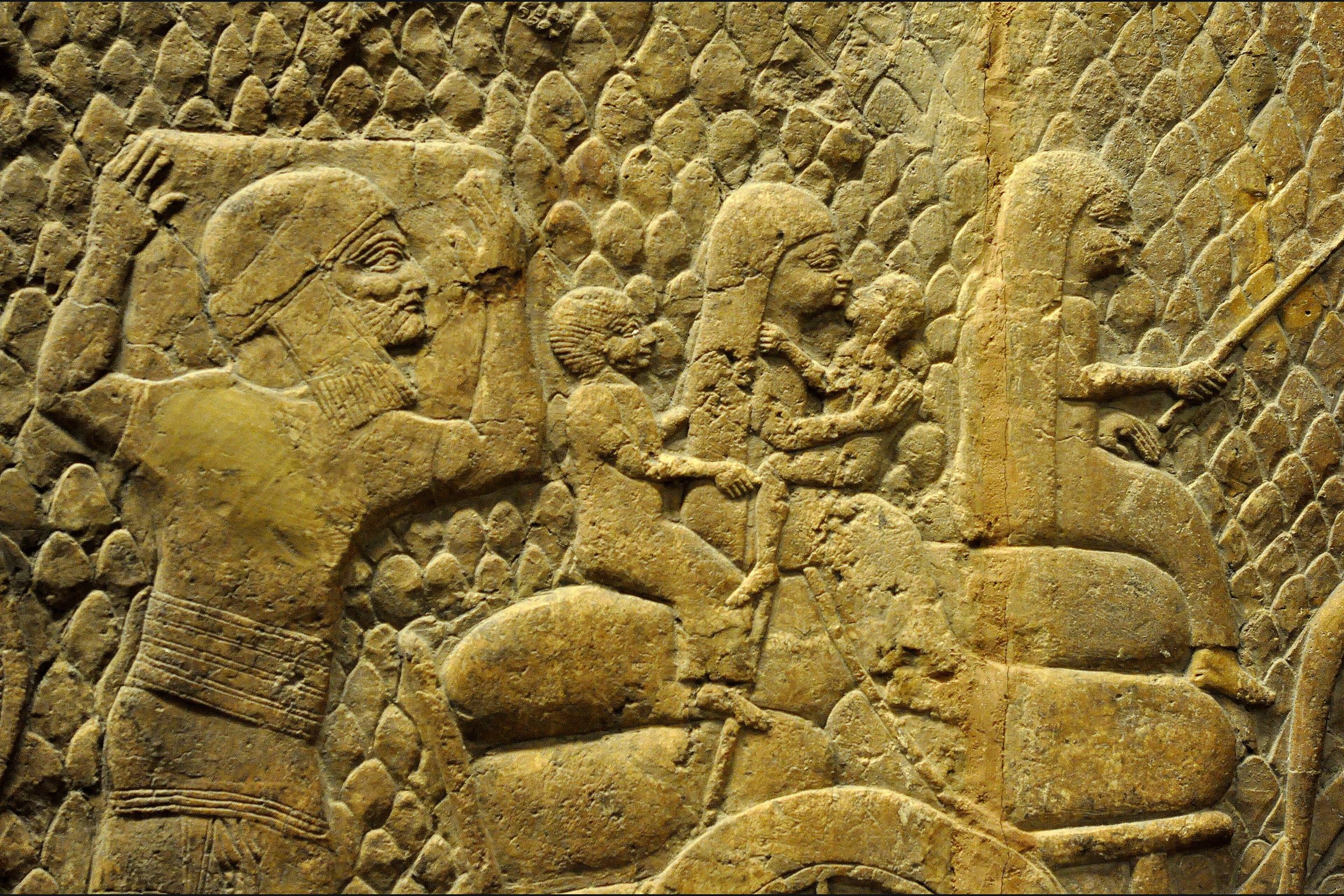
In the spring of 722 BC the capital of the northern kingdom fell after a siege that had ground on for roughly three years. An Assyrian king carried off the leading families, settled strangers in their emptied towns, and left a scribe to cut the triumph into stone. One of those inscriptions gives a number: 27,290 people led away [1].
That is the historical seed of the mystery of the lost tribes of Israel, one of the most durable puzzles in the Bible. Ten tribes went into the Assyrian machine and, as a political body, never came out. Since then, at least a dozen peoples — from the highlands of Ethiopia to the hills of Afghanistan to the coast of China — have said, in effect, we are them.
Some of those claims rest on centuries of oral tradition. A few now have DNA studies attached to them, pointing in more than one direction. And the oldest claim of all says the tribes did not scatter at all but crossed a river God held back for them and walked a year and a half into a land no one had lived in before.
This article does what the site exists to do: it sets the documented core against each popular claim, gives the evidence for and against, names who is making the case, and leaves the verdict to you.
What Happened to the Lost Tribes of Israel?
The short answer is that the lost tribes of Israel were deported by Assyria and absorbed into the peoples around them — not destroyed, and not spirited away to a hidden continent. “Lost” is a statement about records and identity, not about a vanished population. When a deported group stops keeping its own genealogies and marries into its neighbours, within a few generations it is untraceable as a distinct people. That is what the Assyrian deportation policy was designed to do, and by every indication it worked.
The ten tribes are the tribes of the northern kingdom of Israel, which split from the southern kingdom of Judah after the death of Solomon. Judah — with Benjamin and most of Levi — survived the Assyrian period and later gave its name to the Jews. The northern ten did not. Everything after that is the question of where their descendants ended up, and how far any living group can prove a line back to them.
What Scripture Records
The primary narrative is 2 Kings 17. It reports the siege, the fall, the deportation and the resettlement in plain terms, and it names the places.
“In the ninth year of Hoshea the king of Assyria took Samaria, and carried Israel away into Assyria, and placed them in Halah and in Habor by the river of Gozan, and in the cities of the Medes.” (2 Kings 17:6)
Halah and the Habor lay in what is now the Syria–Iraq borderland of the upper Khabur; the “cities of the Medes” sat far to the east, in north-western Iran. The deportees were not dumped in one place. They were dispersed across the empire, which is precisely how a nation becomes a diaspora and then a memory.
The same chapter records the other half of the policy — the part that is easy to forget and that changes everything:
“And the king of Assyria brought men from Babylon, and from Cuthah, and from Ava, and from Hamath, and from Sepharvaim, and placed them in the cities of Samaria instead of the children of Israel.” (2 Kings 17:24)
Foreign populations were moved in as Israelites were moved out. The newcomers intermarried with the Israelites who had not been deported, and the resulting mixed population of the region is the biblical origin of the Samaritans — a people who still exist, still keep their own Torah, and are not a lost tribe but the remnant-plus-settlers the text describes. The writer of 2 Kings read the whole catastrophe as the fulfilment of warnings the prophets had issued for generations, part of the long record of biblical predictions and their outcomes.
What the Assyrian Record Says
The Bible is not the only witness. The Assyrians were meticulous record-keepers, and their royal inscriptions describe the same events from the winner’s side.
Sargon II, who took the throne as Samaria fell, claimed the conquest in his annals and summary inscriptions: “I besieged and conquered Samaria and led away as booty 27,290 inhabitants of it,” one text runs; he adds that he drafted a contingent of their chariotry into his own army [1]. The figure appears as 27,290 in most copies and 27,280 in at least one — a scribe’s slip, not a different event.
There is a genuine historical tangle here, and it is worth stating plainly rather than smoothing over. The Babylonian Chronicle credits the capture of Samaria to Shalmaneser V, Sargon’s predecessor, who began the three-year siege and died around the time it ended. Sargon’s own inscriptions credit it to himself and describe a further suppression of the city in his second regnal year, around 720 BC. Scholars still argue over who should get the credit and whether there were one or two actions; Sung Jin Park’s 2012 reconstruction in Biblica lays out the competing timelines in detail [2]. What is not in dispute is the deportation itself, the two-way population exchange, and the scale.
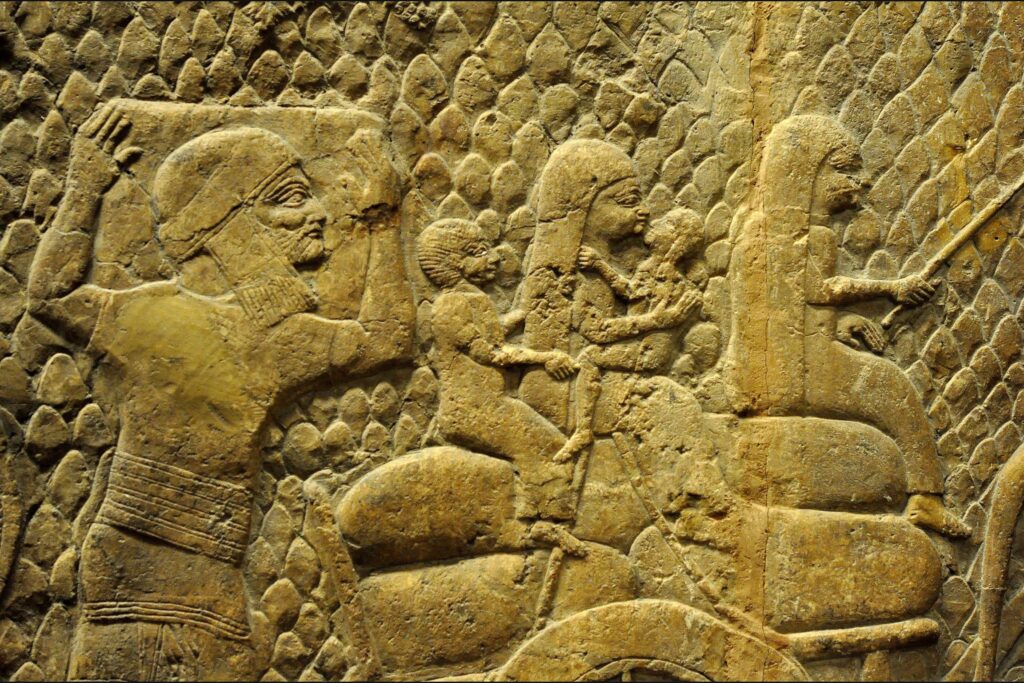
The Assyrian annals matter for the mystery because they confirm the mechanism. Mass deportation followed by resettlement with foreign peoples was standard Assyrian practice, applied across the empire. It was, in modern terms, a policy of deliberate assimilation — break a conquered nation’s attachment to its land and its leadership, and it stops being a nation.
Lost Means Assimilated, Not Teleported
This is the single most important correction to the popular picture, so it is worth making directly: the ten tribes were not annihilated and they were not teleported. Most were absorbed. Some were never deported at all — the Assyrians took the elite and a share of the population, not every farmer in Galilee — and those who remained merged into the mixed Samaritan population or drifted south into Judah.
There is a first-century witness to this reading. The Jewish historian Josephus, writing around AD 93, states as a matter of fact that “the ten tribes are beyond Euphrates till now, and are an immense multitude, and not to be estimated by numbers” [3]. In other words, six centuries after the deportation, a well-informed Jewish writer believed the descendants of the northern tribes were still living, identifiable, in the regions where Assyria had settled them — not vanished, just resident somewhere else and no longer organised as tribes.
That is the quiet, unspectacular answer, and it is the one most historians favour: the tribes became their neighbours. It is also the answer that leaves the door open, because “absorbed into the surrounding populations” is not the same as “gone without trace.” If some communities preserved a thread of descent or of practice, they might be found. That possibility is the engine behind every claim that follows.
The Groups Who Claim Descent
A remarkable number of communities carry a tradition of Israelite origin. Some are backed by rabbinic recognition, some by genetics, some by nothing firmer than a cherished story — and the three do not always line up. Here is the landscape before the detail.
| Group | Where | The claim | What the genetics shows |
|---|---|---|---|
| Beta Israel | Ethiopia | Tribe of Dan | Mostly local Ethiopian; a contested Middle Eastern thread |
| Bnei Menashe | NE India / Myanmar | Tribe of Manasseh | No clear paternal link; a faint, disputed maternal signal |
| Bene Israel | Konkan coast, India | Ancient Jewish settlers | Substantial Middle Eastern Jewish ancestry, male-biased |
| Pashtuns | Afghanistan / Pakistan | Bani Israel | Strong tradition, no conclusive genetic support |
| Lemba | Southern Africa | Judean priestly descent | A Near Eastern Y-chromosome marker, Jewish origin disputed |
| Kaifeng Jews | China | Jewish settlement | Persian-Jewish merchant origin, now assimilated |
| Anglo-Saxons | Britain / USA | The ten tribes themselves | Rejected by mainstream genetics and linguistics |
| Native peoples | The Americas | Book of Mormon lineage | Mainstream studies find East Asian, not Israelite, ancestry |
Beta Israel (Ethiopian Jews)
The Beta Israel have for centuries traced their descent to the tribe of Dan. The tradition gained weight in the 16th century when the chief rabbi of Egypt, David ibn Abi Zimra (the Radbaz), ruled that they were Jews of the tribe of Dan, and it was on that basis that the Sephardi chief rabbi Ovadia Yosef accepted them as Jews in 1973, opening the way to their airlift to Israel.
For: a continuous, self-contained Jewish practice preserved in isolation, and a rabbinic ruling of descent that predates any political motive. Some genome-wide work, including Behar and colleagues’ 2010 study in Nature, has been read as showing a paternal thread reaching back toward the Middle East [6].
Against: the largest recent population study, López and colleagues in Nature Communications (2021), finds the Beta Israel genetically closest to the Agaw and Qimant — their Ethiopian neighbours — rather than to Middle Eastern Jewish populations [5]. An earlier study by Lucotte and Smets concluded outright that they descend from ancient Ethiopians who adopted Judaism. The genetic case for literal tribal descent is, at best, unproven.
Bnei Menashe (North-East India)
The Bnei Menashe are Mizo and Kuki people from the India–Myanmar border who claim descent from the tribe of Manasseh, the lost memory revived in the late 20th century and promoted by the organisation Shavei Israel. In 2005 the Sephardi chief rabbi Shlomo Amar recognised them as descendants of a lost tribe — though recognition still required each individual to undergo formal conversion, which tells you how the rabbinate weighed the claim [11].
For: specific customs and an origin narrative that their advocates argue preserve a Manassite memory, plus a formal, if qualified, rabbinic acknowledgement.
Against: the genetics are weak. A Technion study of several hundred men in 2003 found no clear correlation with Middle Eastern DNA, and a Kolkata analysis around 2004–05 reported that the paternal lineages carried no trace of Jewish ancestry, with only a faint maternal signal that its own authors suspected was an artifact of long intermarriage [11]. The 2005 recognition rested on religious and historical review, not on DNA.
Bene Israel (Konkan Coast)
A separate Indian community, the Bene Israel of the Konkan coast south of Mumbai, has a quieter and in some ways stronger case. They long lived as village oil-pressers known as Shanivar Teli — “Saturday oil-pressers” — because they would not work on the Sabbath, and their tradition tells of a shipwreck that stranded a small group of Jewish ancestors on the Indian shore in antiquity.
For: here the genetics actually supports the oral history. Waldman and colleagues, writing in PLOS ONE (2016), found that the Bene Israel carry substantial Middle Eastern Jewish ancestry alongside their Indian ancestry, in a male-biased pattern — Jewish men, local women — with the admixture dated to the last millennium [7]. Behar’s 2010 study likewise placed a paternal Middle Eastern link in the group [6].
Against: the same studies date the Jewish admixture to roughly the last thousand years, not to the eighth century BC, and a medieval or late-antique Jewish merchant origin fits the data at least as well as any link to the deported northern tribes. Middle Eastern Jewish ancestry is not the same thing as descent from the lost ten.
Pashtuns (Bani Israel)
Among the Pashtuns of Afghanistan and Pakistan, a tradition of descent from the Bani Israel — the children of Israel — is old and widely held, written down as early as the 17th-century chronicle Makhzan-i-Afghani and reflected in tribal names that sound, to some ears, like the names of Israelite clans.
For: this is one of the strongest oral traditions of any claimant group, deeply embedded and long predating the modern state of Israel, with cultural parallels its advocates find persuasive [10].
Against: the genetic support is thin to absent. A study of Afridi Pashtun samples was undertaken to test the link, but no published analysis has demonstrated a conclusive Israelite signal, and the sounds-alike naming arguments do not survive careful linguistic scrutiny. The tradition is powerful; the physical evidence has not caught up with it.
Lemba (Southern Africa)
The Lemba of Zimbabwe and South Africa keep practices that look strikingly Jewish — male circumcision, food rules, endogamy, a day of rest — and tell of a priestly ancestor who led them south from a place called Sena.
For: this is the claim with the most-cited genetic finding. Thomas and colleagues, in the American Journal of Human Genetics (2000), reported that a Y-chromosome signature called the Cohen Modal Haplotype — common among Jewish priestly lineages — appears in about one in ten Lemba men overall, and in more than half the men of the senior Buba clan [8]. For a sub-Saharan population, a Near Eastern paternal marker at that frequency is genuinely striking.
Against: a 2013 re-examination of a larger Lemba and Remba sample concluded that it could not confirm a specifically Jewish origin for the non-African Y-chromosomes, noting that the haplotype is less exclusive to Jewish priests than the first study assumed [9]. A Near Eastern paternal input is well supported; that it is specifically Israelite is not.
Kaifeng Jews (China)
A Jewish community lived in Kaifeng, in central China, for the better part of a thousand years. Stone stelae at the site, the earliest dated 1489, record a synagogue and a community that most scholars trace to Persian Jewish merchants who came east along the Silk Road during the Song dynasty [15].
For: this is a documented, long-lived Jewish community in China — not a legend but an archaeological and textual fact.
Against: it is almost certainly not a lost tribe. The evidence points to medieval Persian-Jewish traders, not to eighth-century BC deportees, and the community gradually lost its language and practice and assimilated into the Chinese population — a diaspora story, not a survival of the northern kingdom.
British Israelism
British Israelism, which flourished in the 19th and early 20th centuries, holds that the peoples of Britain and north-western Europe — and by extension white Americans — are the literal biological descendants of the ten lost tribes.
For: its advocates assemble a chain of scriptural, etymological and migratory arguments and present it as a coherent case, and it is set out here as its own proponents would state it.
Against: mainstream scholarship rejects it across the board. Archaeologists, geneticists and linguists class it as pseudohistory; population genetics finds no close shared ancestry between Western Europeans and Jewish populations, and the linguistic bridges it depends on — such as deriving “Saxon” from “Isaac’s sons” — have no standing in historical linguistics [14]. It is named here as a claim, and the rebuttal is the mainstream one.
Native Americans and the Book of Mormon
The Church of Jesus Christ of Latter-day Saints has traditionally taught that some ancient inhabitants of the Americas descend from a family of Israelites led by the prophet Lehi out of Jerusalem around 600 BC — a people the Book of Mormon calls, in part, the Lamanites.
For: this is a core element of a living religious tradition, and the Book of Mormon presents it as sacred history.
Against: the mainstream scientific response is that genetic studies of Native American populations — Simon Southerton, a geneticist and former LDS bishop, cites testing of thousands of individuals — consistently find their closest matches in Siberia and East Asia, not in the ancient Near East [13]. The Church’s own 2016 Gospel Topics essay, “Book of Mormon and DNA Studies,” responds that DNA cannot be used to prove or disprove the account, that any Israelite settlers would have been a small group whose genetic signal could have been diluted beyond detection, and that the narrative may describe a limited geography rather than the whole hemisphere [12].
The Far Country: Arzareth and 2 Esdras 13
The oldest “answer” to the mystery is also the strangest, and it is not scripture in the canon most readers own. The book known as 2 Esdras — also called 4 Ezra, a Jewish apocalypse preserved in the Christian apocrypha and not part of the Jewish, Protestant or Catholic canon — tells in its thirteenth chapter that the ten tribes resolved to leave the heathen nations behind and journey to a country “where never mankind dwelt.”
By its account they came to the Euphrates, the Most High held back the river so they could cross, and they travelled a year and a half into a region called Arzareth, a name usually read as Hebrew for “another land.” There they would keep the law they had failed to keep at home.
It is a vivid tradition, and it is the ancestor of every “the tribes are hidden beyond a great river” legend that followed. But its status has to be stated plainly, the same way this site flags the Dead Sea Melchizedek scroll and 2 Enoch as texts outside the canon: 2 Esdras is not canonical scripture. It belongs to the same wide body of Second Temple and later writing as many of the books that were left out of the Bible, and the Arzareth story is one of the apocryphal legends that collected around the lost tribes rather than a historical record of where they went. It is telling that Josephus, writing in the same era, placed the tribes not in a mythical far country but simply beyond the Euphrates, where Assyria had put them.
What Would Settle It
Two readings sit side by side, and the evidence genuinely divides between them.
The first is the historian’s reading: the ten tribes were deported, dispersed and absorbed, and the various claimant communities are a mix of real but later Jewish diasporas (Bene Israel, Kaifeng), communities that adopted Judaism or Jewish-like practice (the strongest reading of Beta Israel and Lemba on current genetics), and traditions carried on memory alone (Pashtun, Bnei Menashe). On this reading the tribes are not lost so much as everywhere and nowhere, their blood long since folded into the nations around their places of exile — exactly what Josephus implied when he said they were an immense multitude beyond the Euphrates.
The second is the reading that takes the tribes as a people still recoverable — that behind one or more of these traditions is a genuine, traceable line, and that the right study or the right record will one day draw it out. The Lemba’s priestly marker and the Bene Israel’s male-biased Jewish ancestry are the places that reading points to, because they are where oral tradition and DNA have so far come closest to meeting.
What would settle it is specific: ancient DNA from securely identified northern-kingdom remains, matched against living claimant populations, would turn a web of traditions and modern-genome comparisons into something testable. Until that exists, every community’s claim rests on some combination of practice, memory, rabbinic judgement and probabilistic genetics — and each of those can carry a case only so far. The deportation is history. Where its descendants are sitting now is still, for most of the ten tribes, an open question. The one group the record is clearest about kept reading its own scripture the whole time: the Samaritans, the remnant that never left.
Frequently Asked Questions
Where are the lost tribes of Israel now?
There is no confirmed location. The historical consensus is that they were deported by Assyria into Mesopotamia and Media and gradually absorbed into the surrounding populations, which is why no living group can be shown with certainty to be their descendants. A number of communities from Ethiopia to India to southern Africa preserve traditions of Israelite descent, and a few have partial genetic support, but none has been proven to be a lost tribe.
What are the ten lost tribes of Israel?
They are the tribes of the northern kingdom of Israel — Reuben, Simeon, Issachar, Zebulun, Dan, Naphtali, Gad, Asher, Ephraim and Manasseh — which split from the southern kingdom of Judah after Solomon’s death. When Assyria conquered the north in 722 BC and deported its population, these tribes lost their separate identity. Judah and Benjamin, in the south, survived.
Are the lost tribes of Israel real?
The deportation is firmly historical: it is recorded both in 2 Kings 17 and in the royal inscriptions of Sargon II, who claimed to have led away 27,290 people from Samaria. What is uncertain is whether any identifiable group today descends from them in a traceable line, as opposed to having been absorbed into other peoples long ago.
Have the lost tribes of Israel been found?
No find has been confirmed by the standard of hard evidence. Several groups are recognised by rabbinic authorities or have suggestive genetics — the Bene Israel of India carry Middle Eastern Jewish ancestry, the Lemba of southern Africa carry a Near Eastern Y-chromosome marker — but Middle Eastern or Jewish ancestry is not the same as proven descent from the specific ten tribes, and the evidence for any single group remains contested.
Did the lost tribes become the Samaritans?
Partly. After the deportation, Assyria resettled the region with people from Babylon, Cuthah and elsewhere, who intermarried with the Israelites who had not been deported. 2 Kings 17 describes this mixed population, and the Samaritans — who still exist today and keep their own Torah — trace in part to that remnant plus the settlers. They are better described as what was left behind than as a lost tribe.
Are the Pashtuns descended from the lost tribes?
Many Pashtuns hold a strong oral tradition of descent from the Bani Israel, recorded in writing by the 17th century. It is one of the oldest and most tenacious of all such traditions, but no genetic study has demonstrated a conclusive Israelite link, and the linguistic arguments are disputed. It remains a powerful tradition without firm physical confirmation.
Are Native Americans one of the lost tribes?
This is taught within the Latter-day Saint tradition, which holds that some ancient Americans descend from an Israelite family led by Lehi. Mainstream genetic studies of Native American populations find their closest relatives in Siberia and East Asia rather than the Near East; the LDS Church’s own 2016 essay argues that DNA cannot settle the question and that any Israelite settlers would have been a small, now-undetectable group.
Is the story of Arzareth in the Bible?
It is in 2 Esdras 13, a text that is not part of the Jewish, Protestant or Catholic canon — it belongs to the apocrypha. It describes the ten tribes crossing the Euphrates and travelling a year and a half to a land called Arzareth. It is an ancient legend about the tribes rather than a historical or canonical account of where they went.
Sources
- Oracc / University of Pennsylvania, “Israel, the ‘House of Omri’” — Sargon II, the fall of Samaria and the deportation — oracc.museum.upenn.edu
- Sung Jin Park, “A New Historical Reconstruction of the Fall of Samaria,” Biblica 93 (2012) — bsw.org
- Josephus, Antiquities of the Jews 11.133 (Whiston translation) — penelope.uchicago.edu
- “Tribes, Lost Ten,” Jewish Encyclopedia — the Arzareth tradition and the later legends — jewishencyclopedia.com
- S. López et al., “Evidence of the interplay of genetics and culture in Ethiopia,” Nature Communications 12 (2021) — Beta Israel and their Ethiopian neighbours — ncbi.nlm.nih.gov
- D. M. Behar et al., “The genome-wide structure of the Jewish people,” Nature 466 (2010) — nature.com
- Y. Waldman et al., “The Genetic History of the Bene Israel of India,” PLOS ONE (2016) — ncbi.nlm.nih.gov
- M. G. Thomas et al., “Y Chromosomes Traveling South: The Cohen Modal Haplotype and the Origins of the Lemba,” American Journal of Human Genetics 66 (2000) — ncbi.nlm.nih.gov
- Re-examination of Lemba and Remba Y-chromosome ancestry (2013) — pubmed.ncbi.nlm.nih.gov
- “Theory of Pashtun descent from Israelites,” Wikipedia — en.wikipedia.org
- “Bnei Menashe,” Wikipedia — the Manasseh claim, 2005 recognition and the DNA studies — en.wikipedia.org
- “Book of Mormon and DNA Studies,” Gospel Topics Essays, Church of Jesus Christ of Latter-day Saints (2016) — churchofjesuschrist.org
- “Genetics and the Book of Mormon,” Wikipedia — the mainstream response — en.wikipedia.org
- “British Israelism,” Wikipedia — the claim and its rejection — en.wikipedia.org
- “Kaifeng Jews,” Wikipedia — the Silk Road community in China — en.wikipedia.org
Continue Reading
- What Do Angels Look Like? Men More Often Than Wings — Abraham fed three of them and took them for travellers. Daniel saw one and lost his strength. The Bible describes…
- Did Jesus Abolish the Sabbath? The Full Case on Both Sides — No recorded saying of Jesus abolishes the Sabbath — he kept it and called himself Lord of it. The full biblical record…
- What Did Jesus Say to Satan? Three Answers, One Book — Nobody else was there, so the account can only have come from him. The three offers in order, what forty days without…