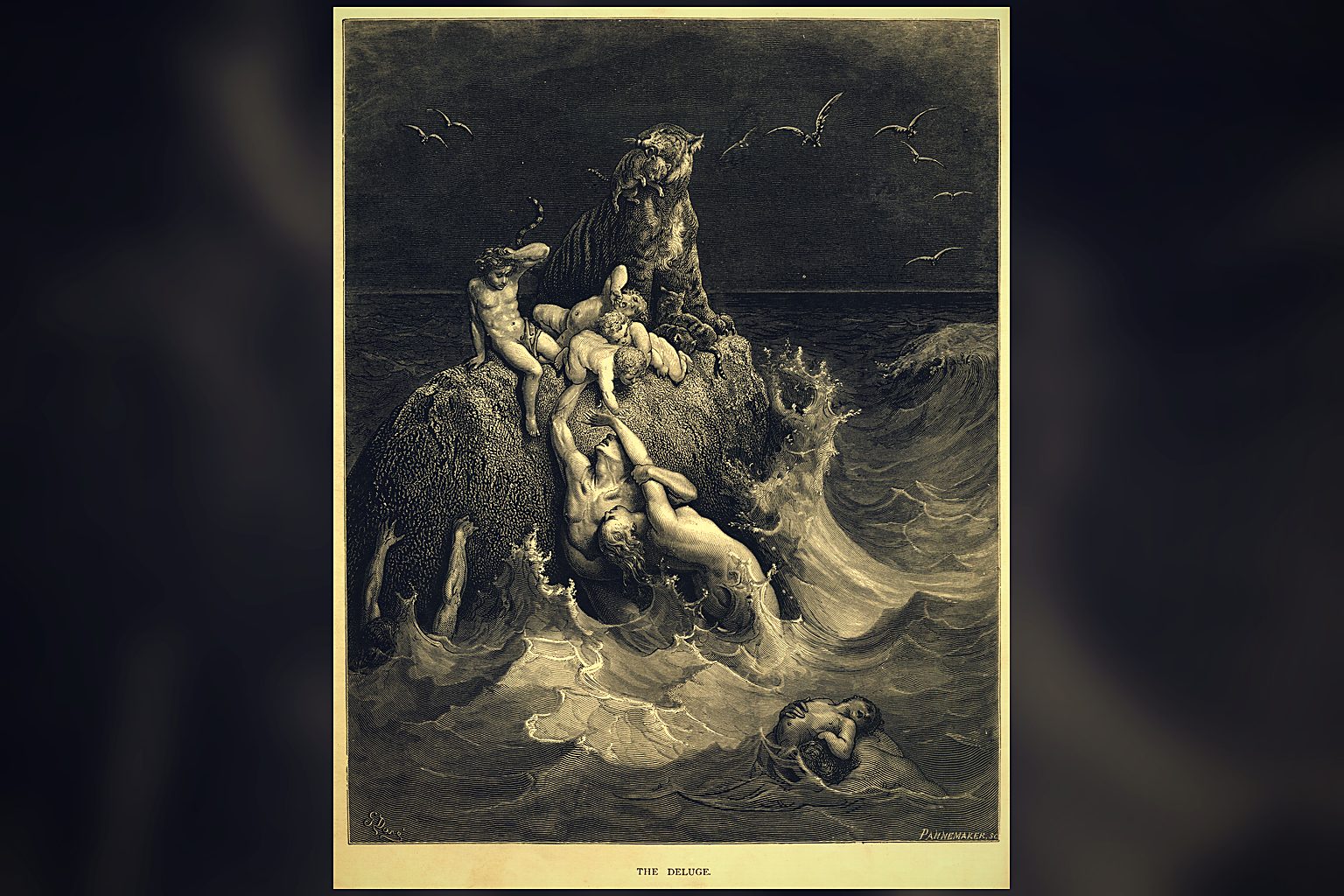
The claim you will see repeated is that more than 200 cultures independently preserve a story of a great flood that destroyed humanity, leaving a handful of survivors.
The number is roughly right. The word doing the damage is independently, and it is what separates a real question about flood myths from a bad answer to it.
Flood stories really are extraordinarily widespread — found in Mesopotamia, Greece, India, China, Mesoamerica, Australia, the Pacific and North America. That distribution is a genuine fact requiring explanation. But the explanations available are more interesting and more varied than the single answer usually given, and separating them is most of the work.
The Major Accounts
Mesopotamia — the oldest written versions
Atra-Hasis (c. 1700 BC) and Tablet XI of the Epic of Gilgamesh (c. 1200 BC, drawing on older material) contain the earliest surviving written flood narratives. A still earlier Sumerian version features Ziusudra.
The Gilgamesh account is remarkably close to Genesis:
- The gods resolve to destroy humanity
- One god warns a single man — Utnapishtim
- He builds a vessel to specified dimensions, sealed with bitumen
- He loads family, craftsmen and animals
- A storm lasts several days
- The boat grounds on a mountain (Nimush)
- He releases birds — a dove, a swallow, a raven — to test for dry land
- He offers a sacrifice, and the gods gather to it
- He receives a blessing
The Genesis account has the same sequence, including the bird test and the mountain landing.
The motives differ sharply, and that is where the accounts separate. In Atra-Hasis, the gods act because human noise prevents Enlil from sleeping. In Genesis, the reason is moral and biological — “all flesh had corrupted his way upon the earth.”
Greece — Deucalion
Zeus floods the world in response to human wickedness. Deucalion and his wife Pyrrha, warned by Prometheus, survive in a chest and land on Parnassus. They repopulate the earth by throwing stones over their shoulders.
India — Manu
In the Shatapatha Brahmana and later the Matsya Purana, Manu finds a small fish which asks for protection. It grows enormous, reveals itself as Vishnu, and warns of a coming flood. Manu builds a boat, and the fish tows it to a mountain peak.
China — Yu the Great
Notably different in structure, and the difference is instructive. The Chinese flood is not a single catastrophic event but a prolonged period of inundation. Yu the Great does not build a boat — he spends thirteen years dredging channels and controlling the water, and is rewarded with the founding of the Xia dynasty.
A civilisation built on managing the Yellow River produced a flood story about engineering, not escape.
The Americas and Elsewhere
Mesoamerican, Andean, North American and Australian traditions all include inundation narratives, though with far more variety in structure and survivors.
Four Explanations
The distribution is real. Here are the serious accounts of it, which are not mutually exclusive.
1. Literary transmission
The clearest case. The Mesopotamian and biblical accounts are too similar in specific sequence — the bird test alone is a very particular narrative device — for independence to be plausible. Scholars debate whether Genesis draws on Mesopotamian material directly, whether both draw on an older shared source, or whether a common regional memory underlies both. Almost nobody argues they arose separately.
Transmission also explains apparent independence in later cases. Missionary activity from the sixteenth century onward carried the Genesis narrative worldwide, and a number of “independent” flood stories recorded by later ethnographers show signs of contamination.
2. Real regional floods
Most early civilisations sat on floodplains, because floodplains are where the fertile soil is. Mesopotamia, the Indus, the Nile, the Yellow River — all subject to catastrophic inundation.
Archaeology confirms this directly. Leonard Woolley excavating at Ur in the 1920s found a sterile silt layer over two metres thick, deposited by a major flood. Similar layers exist at Shuruppak and Kish. These were regional events, not global — but to a society whose entire world was one river valley, a regional flood is the world ending.
3. Post-glacial sea level rise
The strongest candidate for a genuinely shared memory.
At the Last Glacial Maximum around 20,000 years ago, sea level was roughly 120 metres (394 ft) lower than today. As the ice sheets melted, the oceans rose — not smoothly, but with periods of rapid increase, including meltwater pulse 1A around 14,600 years ago, when sea level may have risen tens of metres in a few centuries.
Enormous areas of habitable coastal land were drowned: Doggerland between Britain and Denmark, Sundaland in Southeast Asia, the Persian Gulf basin, and continental shelves worldwide. These were among the most desirable places to live — coastal, resource-rich, temperate.
For populations living through it, the water came and did not go back. Over generations, land became sea. That is a real, worldwide, human-witnessed inundation, and it affected every populated coastline on earth.
The Black Sea hypothesis (Ryan and Pitman) proposes a specific dramatic instance — Mediterranean water breaching the Bosphorus around 5600 BC and flooding a large freshwater lake basin. The scale and suddenness are contested, with some research suggesting a gentler process.
4. Convergence
Some of the distribution needs no special explanation at all. Floods are the most common natural disaster on earth. Any society near water experiences them, and a catastrophic flood with a few survivors is an obvious story to tell — the same way most cultures have stories about fire, famine and drought.
A flood is also a natural narrative device: it wipes the slate clean, explains why the present order began, and separates a mythical past from the known present. Cultures needing an origin story reach for it.
What the Convergence Does Not Show
Two claims need separating carefully.
“Every culture has a flood myth, therefore there was a global flood.” This does not follow. Geology does not support a single worldwide inundation within human history: there is no global flood layer, the sedimentary record shows continuous non-marine deposition across many regions, and there is not enough water on the planet to cover the continents. The ice caps, if entirely melted, would raise sea level by roughly 65-70 metres (213-230 ft) — enormous, and nowhere near covering mountains.
“Every culture has a flood myth, therefore the myths are unrelated.” This does not follow either. Many are demonstrably related by transmission.
The honest position is that the flood tradition is overdetermined: transmission accounts for some, real regional catastrophes for others, post-glacial drowning for the deepest layer, and narrative convergence for the rest. You do not need a global flood to explain a global distribution of flood stories.
What Is Genuinely Striking
Two things survive all the deflation, and they are worth keeping.
The sea-level rise really happened, and people really watched it. Anatomically modern humans were present and populous throughout the post-glacial transgression. Coastlines that were inhabited are now under 100 metres (328 ft) of water. The submerged settlements are real — Doggerland artefacts come up in North Sea trawler nets, and drowned sites have been surveyed off Israel and India. There was an inundation of the human world, and it was witnessed.
The Mesopotamian and biblical accounts share a structure that is preserved with unusual precision. The Gilgamesh flood and the Genesis flood agree on the warning, the specified dimensions, the bitumen sealing, the animals, the mountain landing, the sequence of birds, and the sacrifice afterward. Something was transmitted with care across centuries and at least two languages.
And they preserve the same structure that appears elsewhere in the same literature — the Sumerian King List and Genesis 5 both showing lifespans collapsing after the flood, at very different scales but with the same shape.
Frequently Asked Questions
How many cultures have a flood myth?
Estimates commonly cited run to more than 200. The figure is broadly accurate, though many of these accounts are related by transmission rather than independent, and some recorded after the sixteenth century show missionary influence.
Which flood story is the oldest?
The oldest surviving written versions are Mesopotamian: Atra-Hasis from around 1700 BC, an earlier Sumerian account featuring Ziusudra, and Tablet XI of the Epic of Gilgamesh.
How similar are Gilgamesh and Noah?
Very. Both feature a warned survivor, a vessel built to specified dimensions and sealed with bitumen, animals aboard, a landing on a mountain, birds released to test for dry land, and a sacrifice afterwards.
Was there a global flood?
Geology does not support one within human history. There is no worldwide flood layer, sedimentary records show continuous non-marine deposition across many regions, and melting all ice caps would raise sea level by only about 65-70 metres (213-230 ft).
Could post-glacial sea level rise explain flood myths?
It is the strongest candidate for a genuinely shared memory. Sea level rose roughly 120 metres (394 ft) after the Last Glacial Maximum, drowning Doggerland, Sundaland, the Persian Gulf basin and coastlines worldwide while humans were living on them.
What is the Black Sea flood hypothesis?
The proposal by Ryan and Pitman that Mediterranean water breached the Bosphorus around 5600 BC and flooded a freshwater lake basin. The scale and suddenness remain contested.
Why is the Chinese flood story different?
It reflects a different relationship with water. Yu the Great does not escape by boat; he spends thirteen years dredging channels to control prolonged inundation, and is rewarded with founding the Xia dynasty. A civilisation built on managing the Yellow River produced a story about engineering rather than escape.
Is there archaeological evidence of ancient floods?
Yes, for regional floods. Leonard Woolley found a sterile silt layer over two metres thick at Ur in the 1920s, and comparable flood deposits exist at Shuruppak and Kish. These record major local events rather than a global one.
Conclusion: The Water Came and Did Not Go Back
The usual argument treats this as binary — either there was one global flood and every culture remembers it, or the stories are coincidence and mean nothing.
Neither is right, and the real answer is better than both.
There was no single worldwide deluge. There was a period, lasting thousands of years and witnessed by human beings on every inhabited coastline, during which the sea rose roughly 120 metres (394 ft) and never went down. Doggerland, where people hunted, became the North Sea. The Persian Gulf, a river valley, filled. Land that families had lived on for generations went under and stayed under.
No one alive at any moment would have called it a flood — it was too slow. But across the generations that told each other what had happened, the story compresses. The water came. The land we lived on is gone. Some of us got out.
That is not a myth explaining nothing. It is the longest disaster in human history, remembered at the only speed a story can hold it.
Continue Reading
- The Anunnaki: What the Sumerian Tablets Actually Say — The Anunnaki are real and the tablets are real. Whether they are the gold-mining aliens from Nibiru is the argument…
- Atlantis: One Source, and It Stops Mid-Sentence — Every Atlantis expedition in history traces back to two unfinished dialogues by one Athenian. What Plato actually…
- The Sumerian King List: 241,200 Years Before the Flood — Eight kings, 241,200 years, then a flood. Almost every retelling adds the numbers up — and what that shape means is the…