Some lizards have a third eye. Not metaphorically — an actual eye, on top of the skull, with a lens, a retina and a nerve connecting it to the brain.
It is called the parietal eye, and it is easiest to see in the tuatara of New Zealand, where hatchlings have a visible translucent scale over it. Many lizards, some frogs and some fish have one. It does not form images. It detects light, shadow and the length of the day, and it feeds that information into the animal’s internal clock.
The parietal eye is a forward extension of the pineal gland.
Humans have the pineal. We do not have the eye. But the structure in the middle of your head is the same organ that, in other vertebrates, is still connected to the sky — and that fact is the reason a great deal of nonsense has attached itself to it, as well as one genuinely strange piece of biology.
What Is the Pineal Gland?
The pineal gland is a small endocrine gland, roughly the size of a grain of rice — about 5-8 mm (0.2-0.3 in) — sitting near the centre of the brain in a groove between the two halves of the thalamus. It is named for its shape: pinea, Latin for pine cone.
Its established function is the production of melatonin, the hormone that regulates the sleep-wake cycle and signals biological night.
Two things about it are anatomically unusual:
It is unpaired. Almost everything in the brain comes in left and right versions. The pineal is single and sits on the midline — which is precisely what struck Descartes about it.
It sits outside the blood-brain barrier. The pineal is one of the few brain structures with a fenestrated, highly permeable blood supply, second only to the kidney in blood flow per gram of tissue. Substances that cannot normally reach brain tissue can reach it.
How It Actually Works
The light pathway is indirect but real, and it is worth following because it explains the “third eye” association without any mysticism.
Light hits specialised cells in your retina — intrinsically photosensitive retinal ganglion cells, containing the pigment melanopsin. These are not the rods and cones used for vision; they exist specifically to report ambient light level.
Their signal travels to the suprachiasmatic nucleus in the hypothalamus, the body’s master clock. From there the signal runs a long indirect route — down the spinal cord to the superior cervical ganglion, then back up along blood vessels — to the pineal gland.
When the signal says dark, the pineal releases melatonin. When it says light, production shuts down.
So the pineal is, functionally, a light-sensing organ operating at one remove. In a lizard it looks at the sky directly. In you, the retina looks for it.
Descartes and the Seat of the Soul
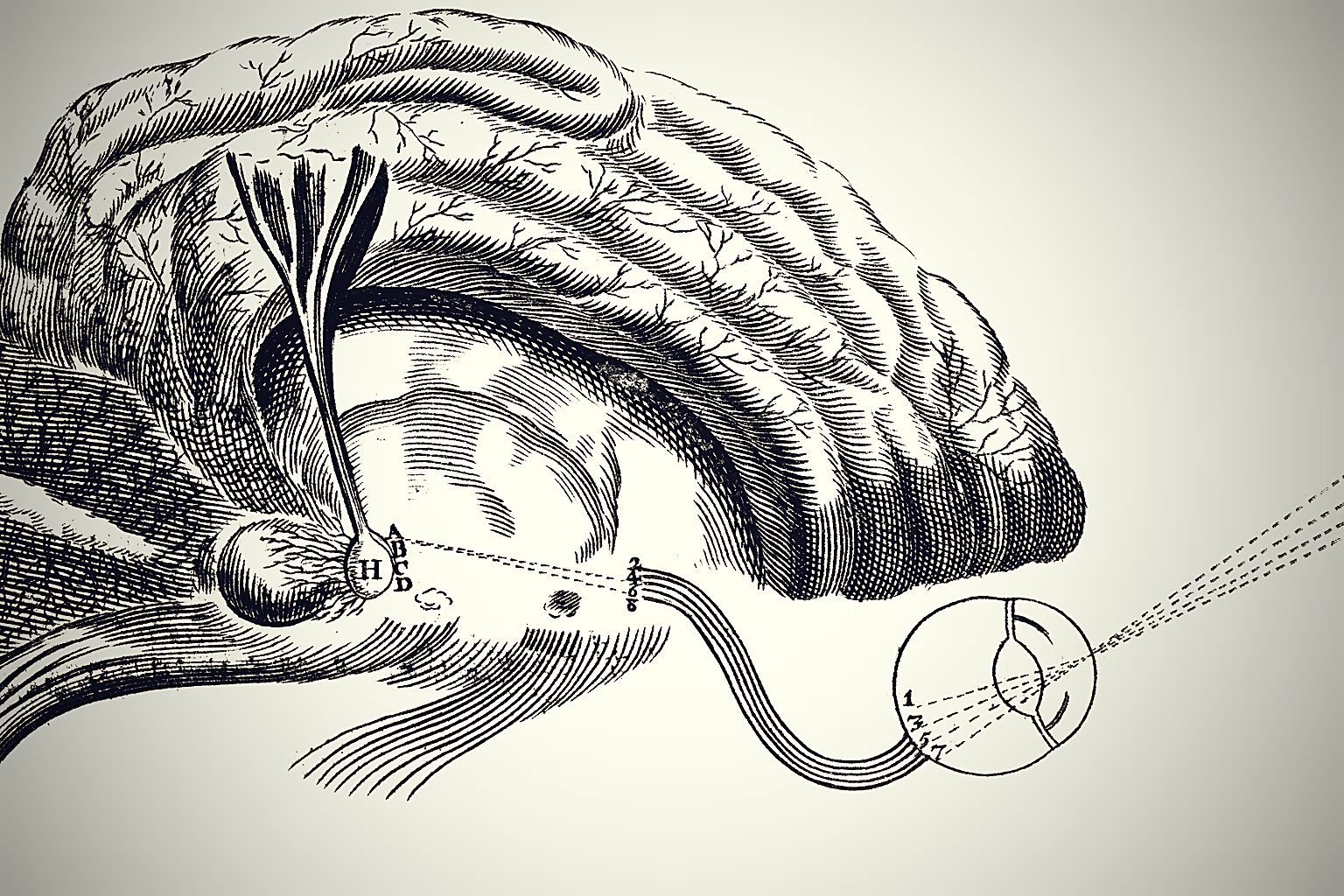
In the 1640s René Descartes identified the pineal gland as “the principal seat of the soul” — the point where the immaterial mind interacted with the physical body.
His reasoning was structural, not mystical. He observed that sensory organs come in pairs and produce paired signals, yet we experience a single unified perception. Something must combine them. The pineal was unpaired, central, and suspended in a position he believed allowed it to move and direct the flow of “animal spirits” through the ventricles.
He was wrong about the mechanism. But the question he was asking — how distributed neural activity becomes one unified experience — is the binding problem, and it remains genuinely unsolved in neuroscience today.
Descartes picked the wrong organ for the right question, and the association stuck.
The Third Eye Traditions
The pineal’s identification with the “third eye” of Eastern tradition is largely a modern overlay, and it is worth being clear about that.
The ajna chakra in Hindu and Buddhist tantric systems is located between the eyebrows and associated with insight and perception beyond the senses. These systems describe a subtle-body anatomy that does not map onto physical organs — the chakras are not claimed by the traditions themselves to be glands.
The pineal-ajna equation was made in the late nineteenth century, principally by Helena Blavatsky and the Theosophical Society, who were explicitly attempting to merge Eastern esotericism with the anatomy of their day. Madame Blavatsky wrote about the pineal as the atrophied organ of spiritual vision in The Secret Doctrine (1888).
So when a modern source tells you “the ancients knew the pineal was the third eye,” the accurate version is: a Victorian occultist proposed the identification in 1888, and it has been repeated since.
That does not make the traditions themselves less interesting. It means the specific anatomical claim is recent.
The frequently quoted biblical line — “if therefore thine eye be single, thy whole body shall be full of light” (Matthew 6:22) — is a saying about singleness of purpose and generosity in its context, not anatomy.
Calcification: The Part That Is Real
Here the biology gets genuinely odd.
The pineal gland calcifies with age. Deposits of calcium hydroxyapatite accumulate in it, forming concretions known as corpora arenacea — literally “brain sand.” These are visible on ordinary X-rays and CT scans, and radiologists use the calcified pineal as a midline landmark: if it has shifted, something is displacing it.
Calcification begins in childhood, is common by adolescence, and is near-universal in adults. Its cause is not fully understood.
The fluoride finding. In 1997, Jennifer Luke at the University of Surrey published research showing that the pineal gland accumulates fluoride at higher concentrations than any other soft tissue in the body — concentrating in the calcified deposits specifically. This is a real, replicated finding.
What follows from it is much less settled. Luke’s subsequent animal work suggested reduced melatonin output; human evidence linking pineal fluoride to altered melatonin or to any behavioural outcome is thin and contested. The honest statement is: the accumulation is established; the consequences are not.
Anyone selling you a protocol to “decalcify your pineal gland” is working well ahead of the evidence. There is no demonstrated method for reversing pineal calcification, and no demonstrated benefit from doing so.
What the Pineal Does Not Do
Worth stating plainly, because the claims are everywhere:
It is not a dormant organ. It is actively producing melatonin every night of your life. Melatonin also functions as a potent antioxidant and is involved in immune regulation and seasonal rhythms.
It is not proven to produce DMT in meaningful amounts. Endogenous DMT has been detected in mammalian brain tissue, including the pineal — the evidence is examined in detail here — but the quantities and whether they are sufficient to affect consciousness remain open questions, and later work found DMT production is not confined to the pineal.
It does not “open.” There is no mechanism by which the gland becomes a perceptual organ. In lizards it detects brightness, not images; even the fully formed parietal eye does not see.
The Interesting Thing That Remains
Strip out the overclaims and something genuinely notable is left.
The pineal is the organ that tells your body what time it is — not clock time, but planetary time: where you are in the daily rotation and the annual cycle. It is the interface between your physiology and the position of the sun.
In many animals alive now, the same organ looks directly upward, through a gap in the skull. In you it sits deep inside the head and takes its light information from the eyes instead — the same job, done from a different position.
That is a real, strange fact about your anatomy: there is a structure in the middle of your head whose entire function is to track the sky, descended from something that used to do it by looking.
The traditions that placed significance there were wrong about the anatomy. They were not wrong that something in the centre of the head is doing more than it appears to.
Frequently Asked Questions
What does the pineal gland do?
It produces melatonin, the hormone that regulates the sleep-wake cycle and signals biological night. Melatonin also acts as an antioxidant and is involved in seasonal and immune rhythms.
Is the pineal gland really a third eye?
It is the same organ as the parietal eye — a genuine light-sensing structure with a lens and a retina, sitting on top of the head in tuatara and many lizards. The human pineal has no lens and does not form images; it receives light information indirectly from the retina.
Did ancient traditions identify the pineal as the third eye?
The specific anatomical identification is modern. Hindu and Buddhist systems describe the ajna chakra between the eyebrows as part of a subtle-body anatomy, not as a gland. The pineal-ajna equation was popularised by Helena Blavatsky and the Theosophical Society in the late 1800s.
Why did Descartes call the pineal the seat of the soul?
Because it is unpaired and central, unlike most brain structures. He reasoned that since paired sense organs produce a unified experience, something must combine the signals. His mechanism was wrong, but the underlying question — the binding problem — is still unsolved.
Does the pineal gland calcify?
Yes. Calcium hydroxyapatite deposits called corpora arenacea, or “brain sand,” accumulate from childhood and are near-universal in adults. They are visible on X-ray and CT, and radiologists use the calcified pineal as a midline landmark.
Does fluoride affect the pineal gland?
The pineal accumulates fluoride at higher concentrations than any other soft tissue, a finding published by Jennifer Luke in 1997 and since replicated. Whether this meaningfully affects melatonin output or behaviour in humans is not established.
Can you decalcify your pineal gland?
There is no demonstrated method for reversing pineal calcification and no demonstrated benefit from attempting it. Protocols sold for this purpose are not supported by evidence.
Does the pineal gland produce DMT?
Endogenous DMT has been detected in mammalian brain tissue including the pineal, but later research found production is not limited to that gland, and whether the quantities are sufficient to influence consciousness remains contested.
Conclusion: The Eye That Went Inside
The best argument for taking the pineal seriously is not mystical. It is comparative anatomy.
Go far enough back down the vertebrate line and this organ sat on the surface of the skull, under a translucent scale, pointed at the sun. It had a lens. It had a retina. It had a nerve. It was, in every structural sense, an eye — and its job was to know where the animal stood in the cycle of day and year.
That eye is still on the head of a tuatara in New Zealand. In you it has moved inward, lost its optics, and delegated its light collection to the eyes in your face. But it kept the assignment.
Descartes was wrong about the soul. The Theosophists were wrong about the chakra. What is actually true is odd enough: there is a light organ buried in the middle of your brain, and it has been quietly tracking the sky your entire life.
Continue Reading
- DMT: The Molecule Your Neurons Make for No Known Reason — The brain does synthesise DMT. The measured amounts are orders of magnitude too low to do anything. Both facts are…
- Demonic Possession vs Mental Illness: The Argument That Never Ended — For thousands of years, madness meant possession. Then psychiatry relabelled the symptoms and offered drugs that work…
- The Mandela Effect: Seven Images That Made Strangers Agree — A room full of strangers remembered a death that never happened. Then somebody tested it properly: forty famous images…